
Prince Harry and the others who have sued Associated Newspapers have just lost their case. Nobody comes out of it exactly covered in glory. Here the balance between journalism, the legal profession and people with extremely high public profiles seems subject to a global warming effect of its own.
At the same time there is news from Australia that the pianist Jayson Gillham has lost his discrimination case against the Melbourne Symphony Orchestra, which cancelled his next concert a few days later after he spoke from the platform to introduce a work - Witness, by Connor D’Netto – which the composer dedicated to the hundred-plus Palestinian journalists killed by Israeli forces in Gaza. Gillham reminded the audience that the targeting of journalists in a conflict was a war crime under international law.
Many of us as observers felt at the time that the orchestra’s actions, which appeared to punish him for speaking out on a political matter of grave impact, were morally indefensible. When the MSO played at the Proms last year, there was a noisy protest. Ironically, since the orchestra had wanted to protect its “business and reputation”, its lousy publicity was the result of its own choices, not Gillham’s, and a head in the institution rolled as a result.
Many respondents on social media fear that this judgement means a chilling, repressive effect on artists’ right to free speech. It sets an unpleasant precedent.
There is, however, some useful information in the summary of the case, which is available to read here. Essentially the stumbling block is employment law and the issue of when and whether this applies to freelancers.
Here is an extract from the summary:
Issue 1: Did Mr Gillham have a “workplace right”?
The first issue is whether Mr Gillham had a “workplace right” within s 341(1) of the Fair Work Act. Mr Gillham says his workplace right is the right not to be treated unfavourably in the workplace because of his political belief, contained in the Equal Opportunity Act 2010 (Vic). Mr Gillham says the Equal Opportunity Act is a “workplace law” for these purposes.
The Court finds that the Equal Opportunity Act is not a “workplace law” as defined in the Fair Work Act, for two reasons. First, Mr Gillham was an independent contractor of the MSO. The Equal Opportunity Act in its application to him was therefore not a law “regulating the relationship between employer and employee”, as required by the definition of “workplace law”. Second, the scheme of the Fair Work Act is that State anti-discrimination laws, such as the Equal Opportunity Act, apply of their own force, supplemented by specific anti-discrimination rights in the Fair Work Act. It would be contrary to this legislative scheme to treat the Equal Opportunity Act as a “workplace law”, so as to re-apply as federal law the workplace discrimination provisions in the Equal Opportunity Act as “workplace rights” under s 340 of the Fair Work Act.
Just because something is morally and personally justified, and even central to our integrity as human beings, that doesn’t mean it is always protected by all the laws that surround the particular situation in which it takes place.
Perhaps law is only about law. It can seem a little like playing chess, with adversarial moves determined by a set of rules from which the participants can’t deviate. However right Gillham’s moral stance, however strong his perceived right to speak up - especially when the point was integral to the music he was playing - if the organiser (the orchestra) was determined to “address the effects…on its business and reputation”, then nothing could change the fact that they could checkmate him with the contractual details.
As in any field, and as the Prince Harry case makes clear, there are opportunists, people spotting a chance to explore an exciting idea for (usually) £££. In some instances I’ve observed over the years, clients have been encouraged and taken on, occasionally by famous law firms, yet the result has made it obvious that they never had a hen’s-tooth of a chance. Sometimes it’s no win, no fee. And sometimes it isn’t.
A journalist friend remarked, long ago, that people resort to legal action for all the wrong reasons. We imagine it will bring satisfaction to matters that are actually about emotions, justice and the difference between right and wrong. It usually doesn’t. But we’re human.
The court of public opinion is something different, and from the start it swung behind Gillham. I think it will continue to do so. And no doubt we’ll go on arguing about whether musicians have the right to use their platform to speak out, and some will say they do and others that they don’t, or that they do but should shut up anyway, and in most cases when someone tells a musician to shut up and play, it’s because they disagree with what that person says.
No amount of agreeing or disagreeing or muzzling others will change the basic facts of the situation they’re arguing about: Gaza has been reduced to rubble, over ten per cent of its population has been killed or injured as a result of the bombardment - and the targeting of journalists in a conflict remains a war crime under international law.
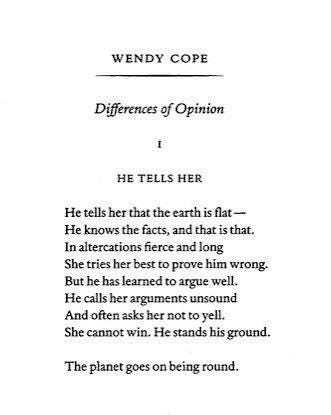
Wendy Cope puts it well.
• Next Sunday, 19th July, Fenella Humphreys (violin), Viv McLean (piano) and I will be at St Mary’s Perivale, revisiting the story of Jelly d’Arányi, her extraordinary life and musical impact, and the discovery of the Schumann Violin Concerto. This narrated concert, a good part of it based on my book Ghost Variations, includes music by Bartók, FS Kelly, Gluck, Brahms, Ravel, Elgar and Schumann. Achtung: please note starting time of 4pm (most Perivale concerts are earlier) for logistical reasons! Do join us to experience words&music on a Sunday afternoon in an exquisitely beautiful 12th-century church. There is also a livestream, which you can watch here.
• On Friday night, 17th July, the Proms begin! Don’t miss this stirring opening night: Yunchan Lim is soloist in the Ravel Piano Concerto in G major and the programme also includes Gershwin’s An American in Paris, a new commission world premiere from composer Josephine Stephenson and music by Copland and Finzi, with tenor Thomas Atkins. Dalia Stasevska conducts the BBC Symphony Orchestra and Chorus plus the BBC Singers. Info and booking here.
• Thursday 16th July, Queen Elizabeth Hall: the Orchestra of the Swan and its artistic director David Le Page are joined by the actors Anton Lesser and Charlie Hamblett for a different kind of words&music. Red Sky at Sunrise is the story of Laurie Lee through his autobiographical trilogy Cider with Rosie, As I Walked Out One Midsummer Morning and A Moment of War, a tale in which humour and darkness balance one another, from the English countryside to the Spanish Civil War. Music by Albéniz, Britten, Elgar, Falla, Holst and Turina. Booking here.
Comments
Nothing yet. Say the first thing.
Sign in to join the conversation.