
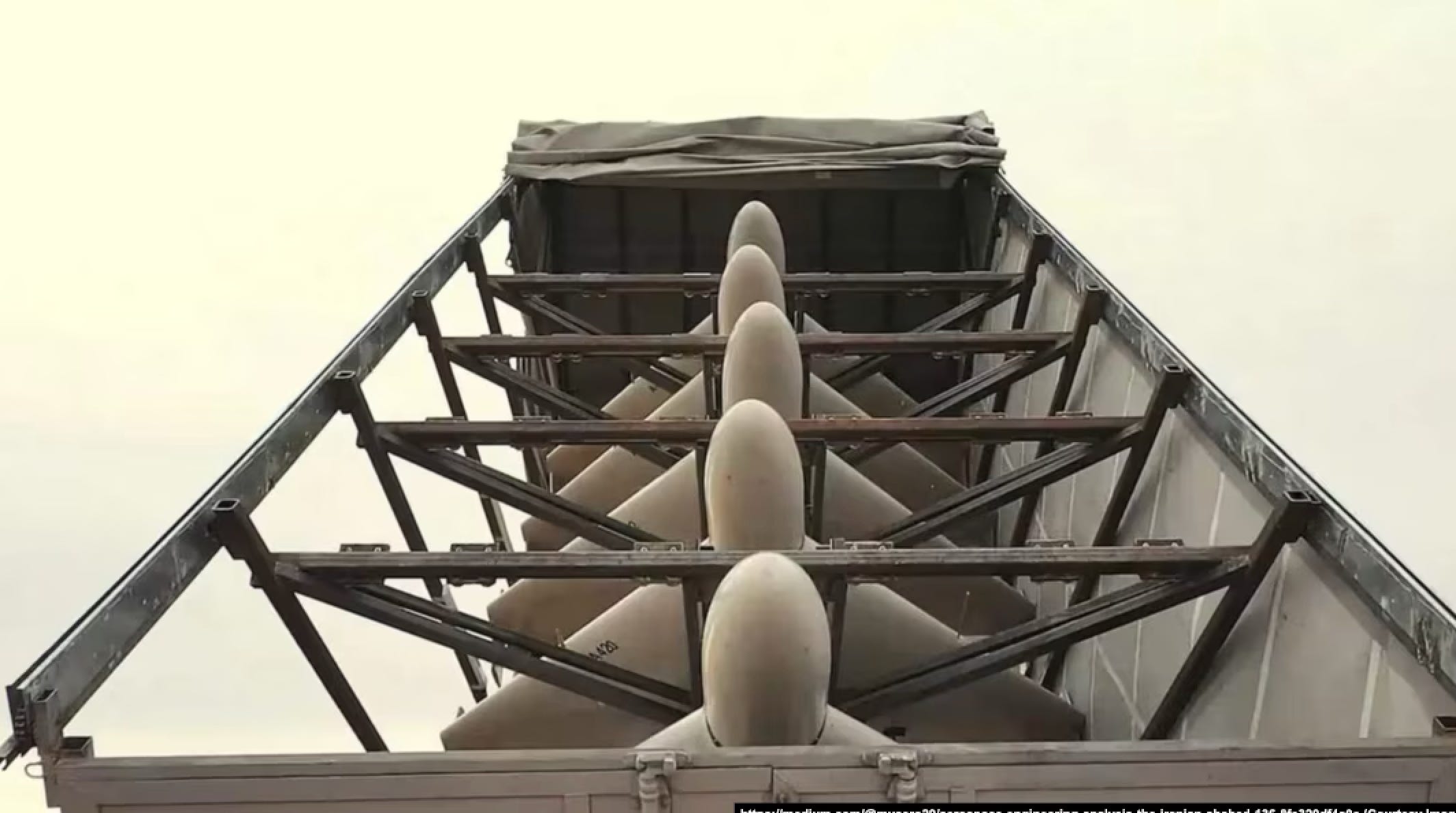
Iranian strikes on AI infrastructure should change how Gulf governments think about the security of strategic compute. For years, data center protection has focused on cyber intrusion, physical access, power redundancy, and disaster recovery. Those measures remain necessary, but they are no longer sufficient. As artificial intelligence becomes increasingly important to military operations, intelligence analysis, financial systems, public administration, and critical industries, the infrastructure supporting it is becoming a plausible target in conflict.
See my new data product: Data Center Strikes in the 2026 Iran War, for further context for this paper.
In high-risk environments, data centers (and compute infrastructure more broadly) must be considered strategic infrastructure because of the risk that any disruption could degrade their military effectiveness, economic activity, and administrative capacity. This raises a central policy challenge: how to protect critical AI-infratructure, while ensuring that essential compute capabilities remain online even if domestic infrastructure is partially damaged.
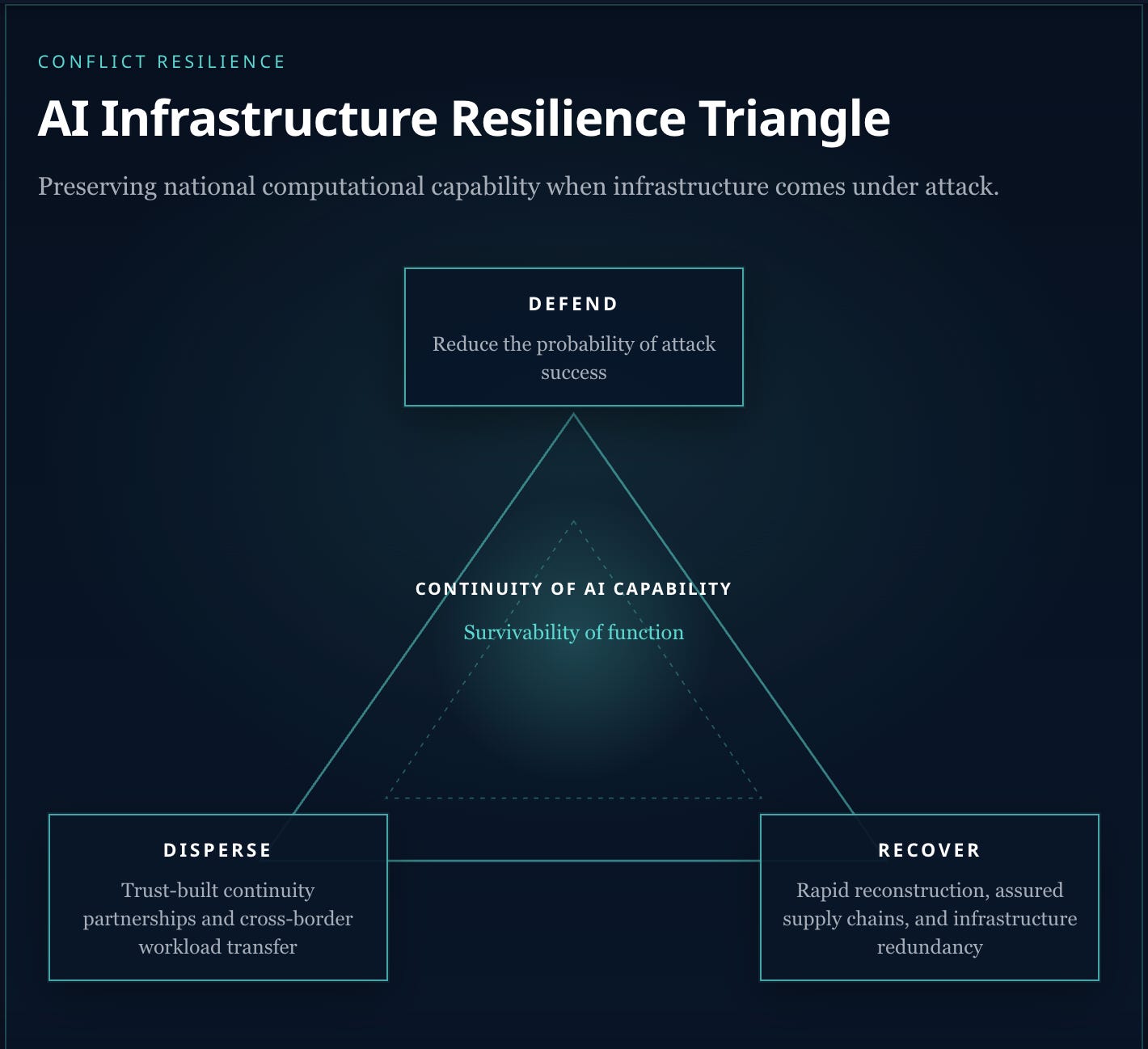
I have developed a useful framework, the conflict resilience triangle model, as a potential solution. This is built around three principles: defend, disperse, and recover.
Defend
First, states have to improve the physical protection of critical AI infrastructure. High-value data centers in conflict-prone regions should be incorporated into national critical-infrastructure and defense planning rather than left primarily to private security arrangements. This may require hardened construction, redundant energy supplies, protected telecommunications, layered perimeter security, and integration with national air and missile defense networks. In some cases, governments may need dedicated point-defense systems capable of intercepting drones, cruise missiles, or other precision weapons approaching particularly important facilities.
This does not mean that every commercial data center needs individualized military protection (though there is a case to be made for local-level point-and-shoot counter-UAS solutions that are becoming more commercially viable for local deployment). Governments will need to distinguish ordinary computing facilities from infrastructure supporting essential state functions, military applications, financial systems, or nationally significant AI capabilities. Priority AI sites should be treated comparably to power plants, bases, ports, or airfields.
Physical defense, however, cannot guarantee continuity. Fixed infrastructure remains vulnerable to saturation attacks, sabotage, power disruption, and repeated strikes. Even a well-defended facility can be disabled. Resilience therefore depends on ensuring that the loss of a site does not produce the loss of the capability it supports.
Disperse
States need the ability to distribute workloads across multiple facilities during periods of heightened risk. This may involve building additional domestic sites or purchasing backup services from commercial cloud providers. More importantly, states should develop prearranged mechanisms for transferring eligible critical workloads to trusted infrastructure abroad during emergencies.
Under a framework such as the U.S.-led Pax Silica, participating states could negotiate reciprocal continuity agreements for strategically important data processing. If data centers in the United Arab Emirates were degraded during a regional conflict, designated government or commercial workloads could shift temporarily to certified facilities in the United States, Germany, Australia, Japan, or another trusted partner. Similar arrangements could operate in reverse when other members faced disruption.
The immediate objective would be tactical and strategic continuity. A government might lose part of its domestic compute infrastructure without losing the ability to process timely intelligence, manage public services, keep financial transactions online, or operate critical AI workloads.
This system would require extensive preparation. Workloads cannot be moved reliably across borders during a crisis unless legal, technical, and operational arrangements are already in place. Participating countries would need common standards for encryption, identity management, network security, hardware certification, data handling, access controls, and incident response. They would also need to determine which workloads were eligible for relocation, who could authorize an emergency transfer, how foreign-hosted systems would be supervised, and when processing would return to domestic infrastructure.
A credible arrangement would also require preallocated reserve capacity. Commercial providers often operate close to capacity during periods of high demand; a state cannot assume that sufficient compute will become available once a conflict has begun.
The model resembles military logistics. Defense partnerships do not assume that every base, port, or supply route will remain operational during conflict. They preserve capability through redundancy, access agreements, prepositioning, and rerouting. Strategic compute should increasingly follow the same logic: a network of trusted continuity partners providing access to pre-certified infrastructure, reserved capacity, and rapid workload migration when domestic facilities become unavailable.
Dispersal would also reduce the strategic value of attacking AI infrastructure. If critical workloads can move rapidly to predetermined facilities in trusted partner countries, destroying any single site is less likely to produce a sustained loss of national capability. Attacks may still impose economic costs and temporary disruption, but their ability to alter the broader balance of power diminishes. The relevant security objective is the survivability of function.
Recover
States need to be able to recover domestic systems if they go offline. Moving workloads overseas may sustain operations during a crisis, but it is not an indefinite substitute for domestic capacity. States must also be able to repair, replace, or rebuild damaged infrastructure quickly.
Recovery planning should include assured access to servers, networking hardware, cooling systems, power components, and the specialized personnel needed to restore operations. Governments may need strategic reserves of critical hardware (though sourcing may be difficult due to cost and politicization of chip access), priority-access agreements with suppliers, and alternate sites that can be activated when damaged facilities require extensive reconstruction. Telecommunications and energy infrastructure belong in the same framework: restored compute has little operational value without reliable power and secure connectivity.
This is particularly important because advanced AI hardware can be difficult to replace on short notice. Export controls, supply-chain bottlenecks, long procurement cycles, and limited access to high-end chips could leave damaged facilities offline for months if states are not prepared. Resilience planning must therefore cover the entire supporting ecosystem.
A New Role for U.S. Technology Partnerships
The resilience triangle creates an opportunity for the United States to broaden its international AI partnerships. Current policy debates focus heavily on access to semiconductors, frontier models, cloud services, and export controls. These policies shape which countries can build advanced AI capabilities but offer few answers on how those capabilities would be sustained during conflict.
Washington may need to build contingency planning into major AI deals from the outset, especially with partners in conflict-prone regions. Access to American hardware and software could be paired with guaranteed emergency compute capacity in trusted third countries, allowing critical workloads to continue if domestic infrastructure is disrupted. For states investing heavily in exposed AI infrastructure, that assurance could become a major strategic benefit of partnership with the United States.
A continuity network would also reinforce U.S. technology standards. Participation would encourage states to adopt compatible cybersecurity practices, trusted hardware, common cloud architectures, and interoperable operating procedures. These requirements could gradually create a more integrated technological ecosystem, binding alignment with the United States to a shared interest in operational resilience.
These agreements would require some clear boundaries. National security and other sensitive workloads cannot move through the same channels as ordinary cloud traffic. States would need to decide in advance which functions could be relocated, which could operate abroad only in secured sovereign environments, and which must remain on national territory. Lower-sensitivity applications could shift to trusted commercial clouds, while higher-sensitivity workloads would require isolated facilities governed by tighter legal, access, and technical controls.
Protecting Capability, Not Only Infrastructure
Compute is rapidly becoming a new category of wartime vulnerability. As governments concentrate economic and administrative functions in a small number of highly visible facilities dependent on complex energy, telecommunications, and hardware supply chains, states must have contingencies in place to ensure AI continuity.
AI deals with wartime dependence long before a crisis begins. How much tech capacity will a state retain during conflict? That depends largely on structural factors such as infrastructure location, cloud architecture, supplier dependence, and cross-border access agreements. For Gulf states, this reframes AI sovereignty around the ability to retain decision-making power after disruption. Domestic ownership alone cannot necessarily provide that assurance. External capacity can strengthen national control if/when preset agreements guarantee access, preserve legal authority over workloads, and prevent foreign providers from withholding support during a crisis.
In the broader U.S.-China race, Washington’s most consequential offer to AI partners may be the assurance that critical capabilities will remain available when domestic infrastructure is disrupted.
© Jesse Marks, Coffee in the Desert
AI Use Statement: The visual graph of the model outlined in this paper was created with Claude. I also used Claude Opus 4.8 for copy-editing.
No posts
Comments
Nothing yet. Say the first thing.
Sign in to join the conversation.