
Over the last year, I’ve picked up and read three classics that I had often heard of, was familiar with from film adaptations, but had never actually read:

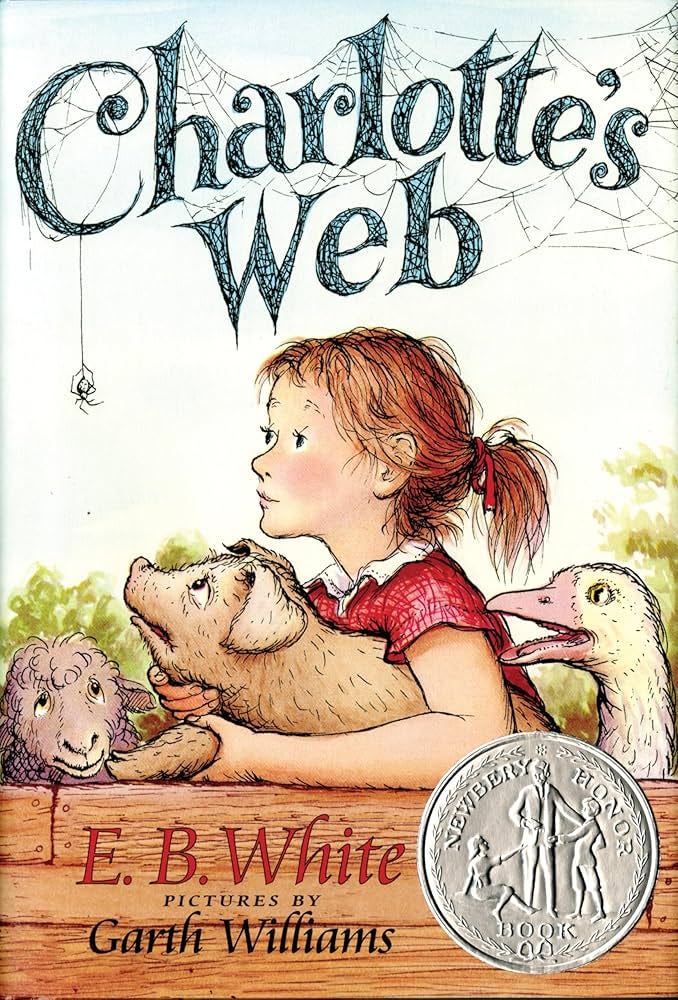

What surprised me about each one—and this is going to sound silly—was how enjoyable each was to read.
I feel like “the classics” have the stereotype of “they’re great literature on a thematic level, but are a bit of a slog to read through because of their old-fashioned language, long paragraphs, and dense writing style.”
And, yes, the writing style is old-fashioned, but that’s part of what made each book so FUN! I mean, look at this passage from Treasure Island:
[Jim Hawkins, a prisoner of the pirates, watches as the pirate crew attempts to depose Long John Silver as their leader]
The door opened, and the five men, standing huddled together just inside, pushed one of their number forward. In any other circumstances it would have been comical to see his slow advance, hesitating as he set down each foot, but holding his closed right hand in front of him.
“Step up, lad,” cried Silver. “I won’t eat you. Hand it over, lubber. I know the rules, I do; I won’t hurt a deputation.”
Thus encouraged, the buccaneer stepped forth more briskly, and having passed something to Silver, from hand to hand, slipped yet more smartly back again to his companions.
The sea-cook looked at what had been given him.
“The black spot! I thought so,” he observed. “Where might you have got the paper? Why, hillo! Look here, now; this ain’t lucky! You’ve gone and cut this out of a Bible. What fool’s cut a Bible?”
“Ah, there!” said Morgan. “There! Wot did I say? No good’ll come o’ that, I said.”
“Well, you’ve about fixed it now, among you,” continued Silver. “You’ll all swing now, I reckon. What soft-headed lubber had a Bible?”
“It was Dick,” said one.
“Dick, was it? Then Dick can get to prayers,” said Silver.
We just don’t write like that any more! Here’s how the same scene might play out in a book published today (generated by asking Chat-GPT to rewrite the passage in the style of modern trade fiction authors like Brandon Sanderson and James Patterson):
The cabin door creaked open. Five pirates crowded the doorway, shoulder to shoulder. After a moment of awkward shoving, they nudged one man out in front of the others. He moved toward Silver one cautious step at a time, as though each footfall might set off a trap. His right hand stayed clenched and stretched out before him.
“Come on, lad,” Silver called with a grin. “I ain’t going to bite you. Give it here, you lubber. I know the rules. No harm comes to a messenger.”
The pirate swallowed, found a little courage, and hurried the rest of the way. He dropped something into Silver’s waiting hand, then practically stumbled backward to the safety of the others.
Silver opened his fingers and glanced down.
“The black spot,” he said. “Just as I expected.” He turned it over, studying it. “Now where’d you get the paper?” His expression changed. “Well, now . . . that’s bad luck.” He held it up for the others to see. “You cut this out of a Bible.”
Silence settled over the room.
“Which idiot cut up a Bible?”
Morgan shook his head. “I told you,” he muttered. “Said nothing good’d come of it.”
Silver let the silence linger before speaking again.
“You’ve done it now, the lot of you. That’s cursed, plain as day. You’ll all swing for this before it’s over.” His eyes swept across the men. “So who’s the fool with the Bible?”
“It was Dick,” someone admitted.
Silver nodded once. “Dick, was it?” A crooked smile spread across his face. “Then Dick had best start praying.”
Our sentence structures today are less varied. We stick to the plain instead of poetic. We use more words to say less. Our vocabulary is nowhere near as rich.
Granted, if you don’t know what buccaneer or deputation or reckon mean, the first version might be a bit of a challenge. But for me, one of the joys of reading is coming across rare words: either old friends I learned a long time ago but haven’t seen in years, or new friends waiting to make my acquaintance.
My enjoyment of Treasure Island, Charlotte’s Web, and Journey to the Center of the Earth went beyond the rich sentences and paragraphs:
The characters!
The self-serving, ever-hungry, but easily cajoled Templeton the Rat
The mercurial, single-minded, and indefatigable Professor Otto Lidenbrock
The loose-lipped but forgivably congenial Squire Trelawney
The settings!
The sweltering, mosquito-infested jungles of a Caribbean island
The musty, lazy, hot afternoons in a barn in rural America
The wonderous, otherwordly expanse of a subterranean sea, buried miles below the surface of the earth
The suspense!
Lidenbrock and his nephew stumbling along mile after mile of rocky passages, out of water for three days1
Hawkins climbing the rigging of the adrift Hispanola to escape the back-stabbing Israel Hands
Wilbur hearing the gut-wrenching news from the old sheep that, come Christmastime, his owners intend to turn him into dinner!
This phenomenon—rediscovering the magic of old books—has also happened to me recently re-reading Lord of the Ring, The Chronicles of Narnia, and Little House on the Prairie.
What I’m saying with all this is, go read a classic!2
Turns out that the renowned writers of yore, whose books were instant bestsellers on multiple continents and have stood the tests of time, were really good at their craft.
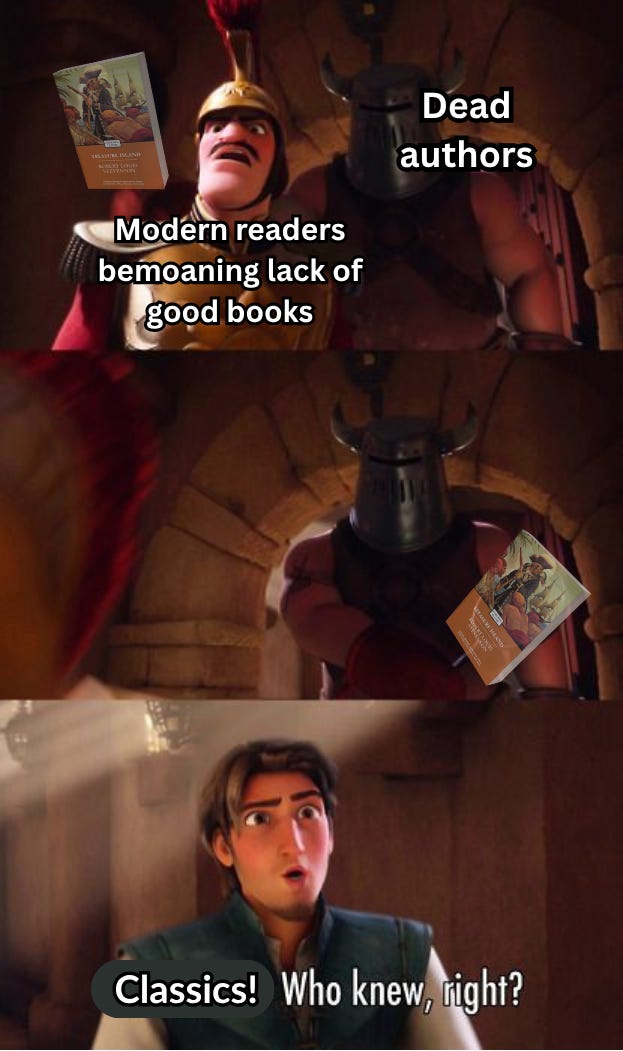
I’m putting myself and other modern authors in a dangerous position here, because, of course, if readers only consumed books written 50+ years ago, we’d all be out of a job.3
So, please still read new books (and incredible ones are released every year), but I believe strongly that when it comes to our reading habits, as in nutrition and investments, variety is a strength.
The Pyromancer’s Scroll became a category finalist for the Eric Hoffer Awards!
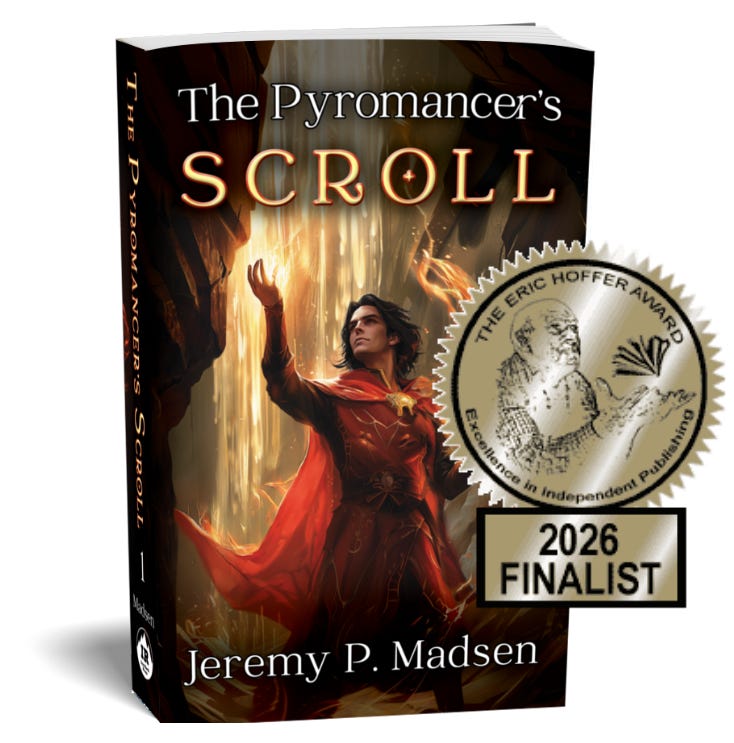
This means it reached roughly the top 10% of submissions and advanced to final judging, but did not receive a category award.
Or, as the kids say, “Close, but no giant fluffy stuffed rabbit.”4
Whether written a hundred years ago or yesterday, may books continue to transform your life!
Best,
Jeremy P. Madsen
Yes, they also had their faithful Icelandic porter with them, but the ever-stalwart Hans wasn’t “stumbling along,” so I didn’t include him in the sentence.
For purposes of this article, I’m defining “classics” as works of literature published before 1970 that were immediately commercially successful and remain popular today. Notice that this excludes early-1900s American novels like The Great Gatsby or Lord of the Flies that were initially only known in highbrow literary circles before becoming more widespread via language arts curriculums. Not saying those kinds of books don’t have literary merit . . . just that they’re often not an enjoyable read.
If you can call making $500 in annual net profit a job :)
“Close, but no cigar” originated from what sleazy carnival game operators would say when you almost won a prize, which was originally a cigar. Now they’ve switched to more kid-friendly prizes like giant fluffy stuffed rabbits, which is . . . good? (because fewer lungs are getting destroyed?) Bad? (Because the sleazy carnival game operators are marketing to children now?) In any case, I’m totally not drawing comparisons between rigged carnival games and the book-award-contest industrial complex. Really. Aren’t you glad you read the footnotes?
Comments
Nothing yet. Say the first thing.
Sign in to join the conversation.