
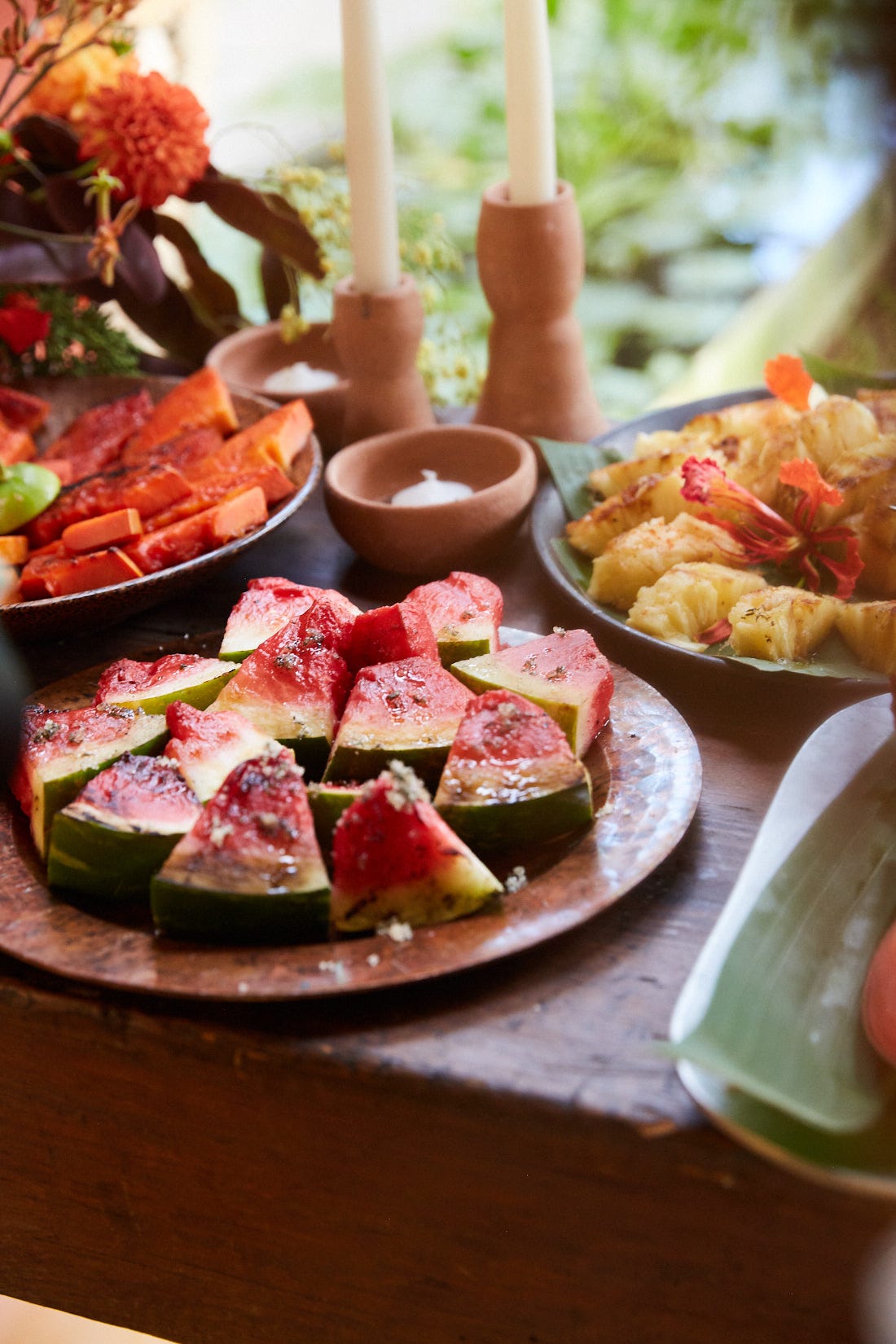
Actually, I don’t, unless it’s grilled and covered with the Key lime juice from my Mexican garden. Or from a summer farm stand, just picked and still warm from the sun.
Or dipped aged mezcal.
I read the other day about a Thai style watermelon salad with its dressing of lime juice, serrano chile, fish sauce, and peanuts. “It’s hot, sweet, spicy, salty, and savory, with a buzzing intensity that lingers long after your first bite.”
And that got my juices going, and made me think. Why, when on a salad it’s a dressing and not a sauce?
Here is my first watermelon salad from my 1986 cookbook Jeremiah Tower’s New American Classics.
And it definitely is dressed.
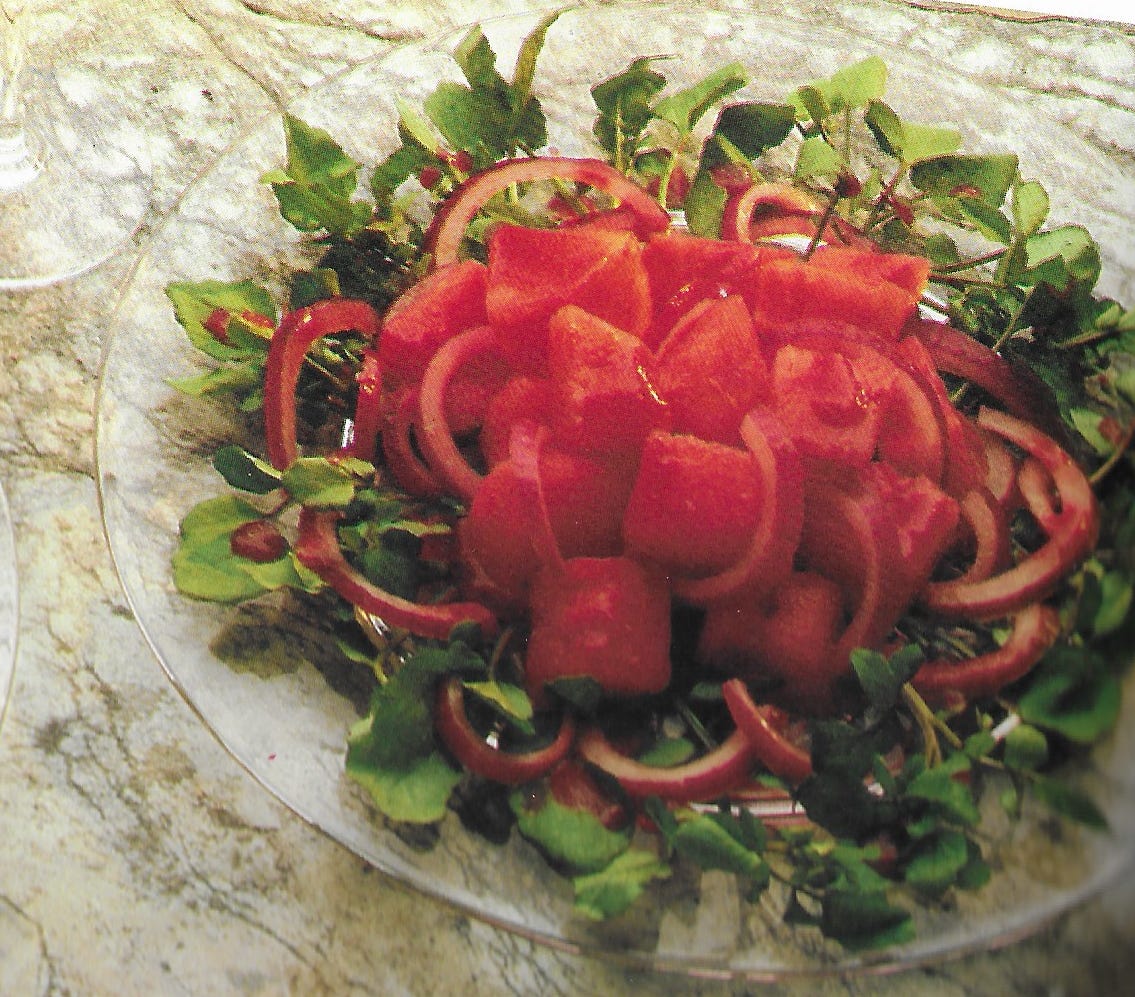
Watermelon and Onion Salad
If you can eat raw onions and like watermelon, this is a knockout in the summer, and is perfect for a lunch salad.
1 medium ripe watermelon
2 medium sweet red onions, peeled
¼ cup raspberry puree
¼ cup olive oil
salt and freshly ground pepper
3 TBS fresh lemon juice
¼ cup walnut oil
3 bunches watercress
Serves 6
Peel and cut the melon into 1-inch-thick slices. Cut around the line between the white and red part of the melon and discard all but the red. Remove all the seeds and cut the melon into cubes.
Cut the onions crosswise into 1/8-inch-thick slices.
Mix the raspberry puree, olive oil, and salt and pepper. Put the melon and onions in a bowl and pour the raspberry sauce over them. Mix thoroughly but gently. Let sit 15 minutes
Mix the lemon juice with salt and pepper and whisk in the walnut oil. Pour the dressing over the watercress in a bowl and toss quickly. Arrange the watercress on cold plates and put the melon and onions on top. Spoon any remaining raspberry sauce over the top of the melon and watercress.
Moveable Feast
Years later when cooking for PBS (Season 6, Episode 1 of “A Moveable Feast with Fine Cooking”) at a hacienda in the Yucatan, we grilled the watermelon. No sauce, just brushing it first with a little mezcal.
No garnish.
See the photo above with the pineapple and papaya. And further words about garnishes.

New York’s Waldorf Astoria
For the menu from in 1912 I would take a small army to prepare just the garnishes.
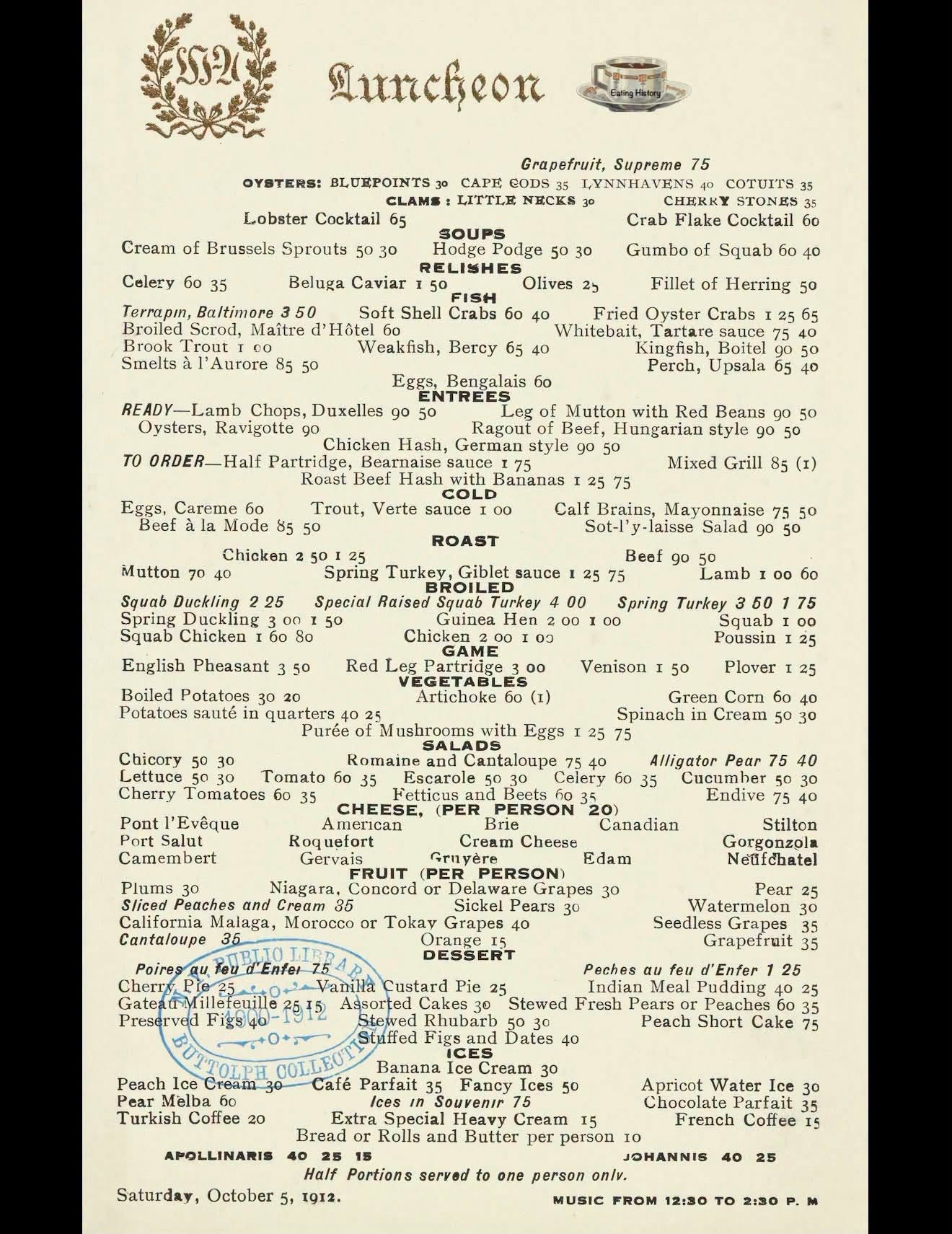
I love reading old menus, mostly to decide what I would have ordered had I been there for a lesiurely lunch.
This one is a challenge.
No Waldorf Salad so that let me off the hook for what I have always thought, after the first taste of one, an aberration. Like the American menus of that time and for 50 years later that started with celery, olives, and radishes (the big red peppery ones).
The original salad of was just celery, apples and mayonnaise. No walnuts.
Invented in 1896 by a non-kitchen man called “Oscar Tschirky, the maître d’hôtel at the Waldorf-Astoria Hotel in New York City.”
For a charity ball honoring St. Mary’s Hospital for Children.
Which explains the apples.
Often said to be the most famous salad in the world. My vote for that placement is the Caesar. Closely followed by Greek, Caprese, Cobb, and Niçoise. In all their versions.
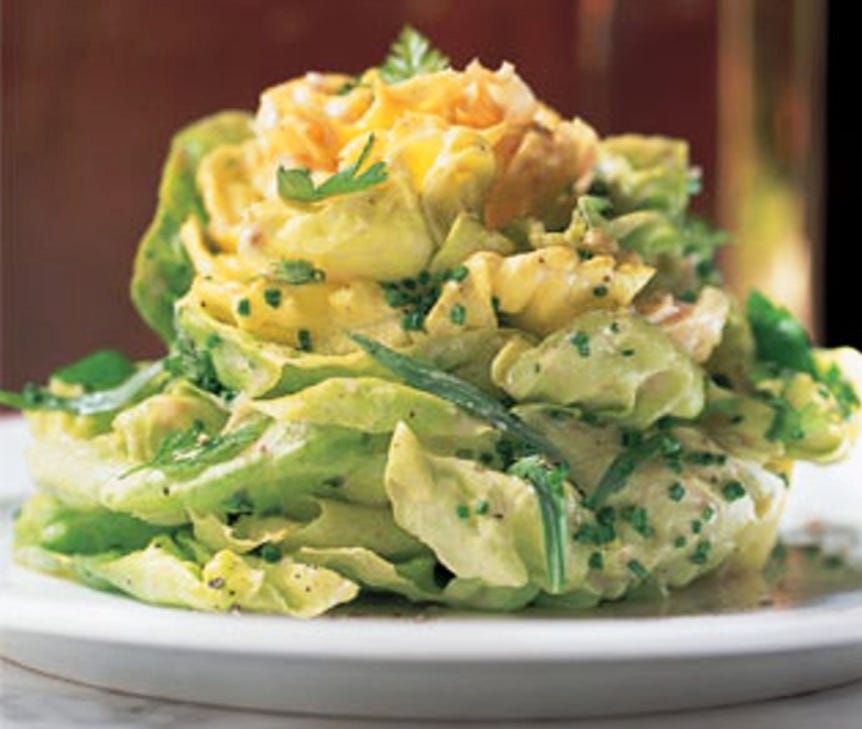
And, of course, Mixed Green. I rather like this butter lettuce one with a little fresh tarragon cream, and chives.
But back to the menu which very civilly starts off with oysters and clams and no celery.
As I look over it, I am amazed at the wide selection of ingredients. This before refrigeration. Or was it? American Jacob Perkins build a system in 1834, but the first for home use as 1913 and then 1918 a home refrigerator for anyone who could afford it.
Nothing mysterious then about the fish except where did they get enough oyster crabs? And Eggs Bengalais. Who has ever seen those again? As for Eggs Careme, first you have to make a real Sauce Nantua with crayfish. HB eggs and black truffles in a pastry timbale. But as cold on the menu, so not sure.
More mysterious is where to get enough Sot-l’y-laisses, those twin nuggets in the chicken’s back. Two per chicken. But I would have had the Half Partridge, Bearnaise Sauce which at $1.75, was more than the Beluga Caviar, so perhaps unaffordable .
No problem with the cheese from France and England, unless it was booked as cargo on the Titanic.
Watermelon not as expensive as Malaga or Morocco grapes even though it was October.
I also love the “Extra Special Heavy Cream” which I would have poured over the Stewed Rhubarb before my Turkish Coffee.
Over my coffee this morning I found a new Substack.
GUTS MAGAZINE
“An offal forward, confession booth of a restaurant lifestyle magazine.”
Is owner says “Gareth Eoin Storey is probably my favorite chef whose food I’ve never eaten.” Sharing “an affinity for offal, movies, and sandwiches.”
He gets my vote, and I miss andouillette, though no shortage of tripes in Mexico.
This is from him:
“Ever since I can remember, I’ve tried eating things I haven’t eaten before. It started with school sandwiches. The first time I didn’t get ham or processed meat in the shape of a bear at the deli counter, I chose pressed tongue.”
Was he at the Walldorf Astoria for lunch?
Though he may have had to settle for the Calf’s Brains, Mayonnaise.
“Two weeks ago” he writes, “ I was back cooking at Casa Lhasa when this next dish came to me. In Catalunya they have a tradition of mar I muntanya, the sea and the mountains, originating from trade between fisherman and farmers across the two landforms. It includes dishes like chicken in lobster sauce or braised cuttlefish with meatballs. My mind was set on cooking the cuttlefish with meatballs.
The day before cooking the dish we had to prepare the cuttlefish by pulling out the insides, separating the head and body and removing the beak. One of the chef de parties [a kitchen station head] took care of it while I blanched tripe. Ten kilos of cuttlefish takes at least an hour to clean, five kg of tripe takes longer and uses more space on the stove. He finished the cleaning, put them away, and continued his other prep for that night’s service. I let the tripe bubble away while working the line until it started to get quiet and I had time to start cutting it. While cutting the braised stomach into bite sized pieces I ruminated on what way I would cook it - the mar I muntanya idea popped up, it made sense, who needs meatballs when you have tripe?
The next day I cooked the cuttlefish until it was tender enough to cut with a spoon. I took a ladleful out and into another pot, then added a few slices of tripe and simmered it for a while. After the flavours settled I took the spoon and tasted the slight salt and sweetness of the cuttlefish and the grass and earth of the tripe, the sauce brought the two together in the harmony of Catalunya’s mar I muntanya tradition.”
I may have to abandon Merida’s octopus tacos for Catalunya! Especially for the Chicken in Lobster Sauce. At Chez Panisse in the 70’s I served chicken breasts cooked in a very light Sauternes and sauced with a Nantua.
Using the shells from fresh Sacramento Delta crayfish.
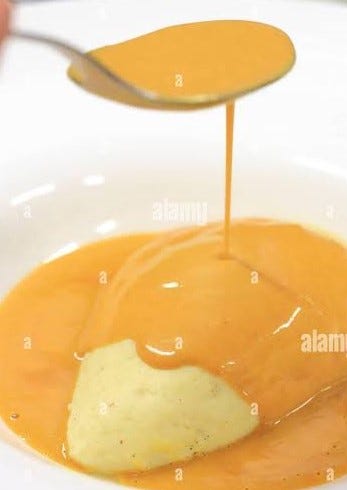
Photo of a perfect Nantua from Alamy.
Thank you for reading JEREMIAH TOWER’S OUT OF THE OVEN! Free subscribers will receive an occasional publication. Paid subscribers will receive a weekly publication, as well as menus, recipes and full access to archives, now including 200 articles, and growing.
No posts
Comments
Nothing yet. Say the first thing.
Sign in to join the conversation.