
Last week, at the first public reading of my next book, A Rule for the Rest of Us, I confessed how entirely bored I’ve become with my Substack in recent months. Not the July posts, of course—because thank you, Alyson, Ragan, and Grace! But I’m realizing I need to allow myself a little more creative freedom in this space.
I’d planned for this month to be an exploration of how my rule of life informs my writing life. Though this post may not seem to do exactly that, hopefully you’ll see the connection. Because what is a practice of a rule of life except for a practice of consistency?
When he asks, I tell my origin story—as a writer—to the new friend I’ve made at the Whitworth MFA residency. It’s precarious, of course, trying to recount a chronology that tends to look far more linear in the telling than it had ever felt in the living. There can be illusion about these things involving the creative life, as if they are somehow sprinkled in fairy dust.
“Let’s just say no one would have come looking for me if I dropped out of college,” I say to my friend. He knows the story to which I refer, a story Dr. Mischa Willett, Whitworth’s program director, recounted to Ben Palpant for An Axe for the Frozen Sea: Conversations with Poets About What Matters Most. After one quarter at Wheaton College, Willett dropped out, returned, then dropped out again. He began fitting men for shirts at the local mall, which is where his English professor, Dr. Jeffrey Davis, found him when he called. “Get back here.”
“No one would have come looking for me if I dropped out of college,” I say to my friend. This isn’t false modesty. I was a diligent, dutiful, and unextraordinary straight-A student. Throughout my early life, in school as at the piano bench, I was consistent and rule-abiding, impressive mostly for my dotted i’s and crossed t’s. Perhaps you might say that I played a mean scale—and little real music.
In college, if anyone was going to be a writer, it was my roommate. In the summer between my junior and senior years, she serialized a novella and mailed it to me in manila envelopes likely addressed, “Jen Pollock. Middle of the Sahel. Mali, Africa.” Preternatural talent I have never had. This gift was reserved for other people like her.
But if there were a gift developed at the piano bench and classroom, it was the gift of consistency—a gift honed in the repetition of the ordinary. And maybe it has served me far better than I tend to imagine genius might have. Consistency hasn’t made me brilliant and scintillating company at cocktail parties. But it has meant this: when I had the desire to write, with God’s help, I generaly exercised the discipline to do the work. I suppose when you can’t rely on your extraordinary talents, you have to work another muscle.
I tell my friend that in 2011, I had the idea to start a blog. Despite the vanity project that seemed to be at the time, a blog became a dedicated place for me to write for real readers, with public consistency. I did not imagine it would lead to more, though when that blog became a book—and that book become more books, including a sixth out in September—I was grateful for the reward to the plow horses among us. We can’t all be stallions.
As I tell the story, I’m not being intentionally self-deprecating. But I do understand I may only have this to offer to the world as the writer: the willingness to keep going and the witness to what God might do with such willingness. To sit here, in the second of two airports today, scrawling out these words longhand then typing them into my computer, I remember the costs of such consistency, especially to our baser desires. In truth, I’d rather be finishing my Stegner novel or (let’s be honest) Survivor 50.
Yet I can’t help my great hopefulness for the plow horses among us, that consistency, in writing as in life, can count for a lot.
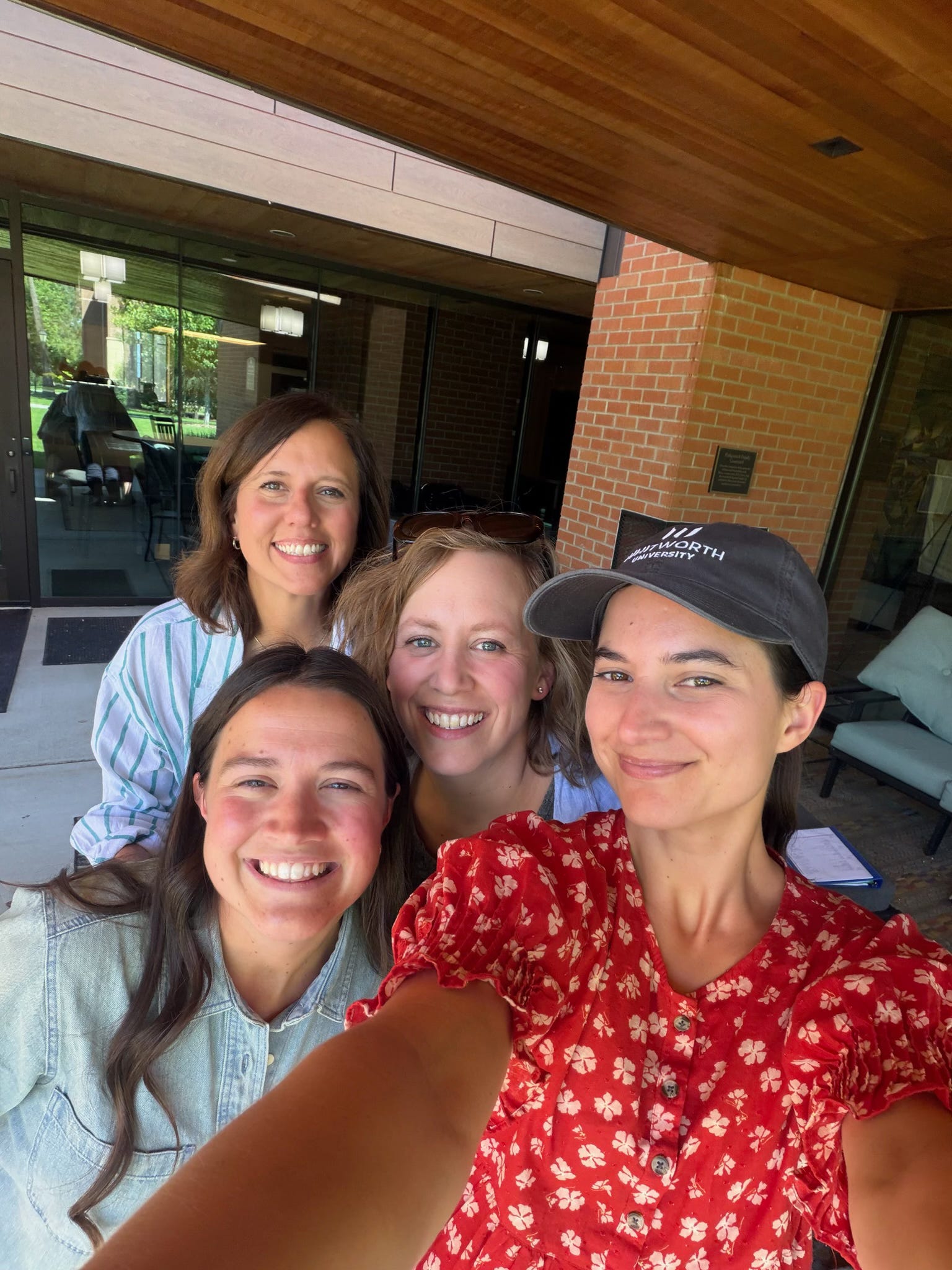
(I may have written this post for the inaugural cohort of creative non-fiction/spiritual writers in the Whitworth MFA: Emma, Leighton, and Emily! Here’s to your own formation in consistency!)
No posts
Comments
Nothing yet. Say the first thing.
Sign in to join the conversation.