
Our IVF egg retrieval process was fairly grueling, as it is for so many couples. Due to my low ovarian reserve diagnosis, our doctor recommended we undergo several egg retrievals in a row to bank the number of embryos we might need to have the several kids that we want.
After four egg retrievals within the course of a year, we achieved that goal. We breathed a brief sigh of relief, but knew our journey was far from over. We had our precious embryos, but there was another step standing between us and pregnancy: the embryo transfer.
Still, we were hopeful — so many people told us the transfer process was the fun part! I had gotten the hardest part, the egg retrievals, out of the way. The rest is a breeze.
The facts seem to support this sentiment. The embryo transfer procedure sounds like a non-event compared to the egg retrieval: no anesthesia (just a prescribed Valium if you’re lucky!), a quick, painless process that has you in and out of the clinic in an hour, and returning to your daily activities immediately following. It’s so monumental, yet so low-key.
The statistics are on your side too: many doctors quote a 60-70% chance per transfer with a euploid embryo. This is nearly three times the rate of natural conception for young fertile couples by some measures. For most people, the chances of success are incredibly high — and in the excitement of this process, it can be easy to assume it’s all but a guarantee.
So naturally when we arrived at this stage of the IVF process, we were nervous but eager to get started. Just one more step between us and our future baby. Unfortunately, it wasn’t quite that simple.
Transfer attempt #1
When we embarked on the embryo transfer process, our doctor recommended we try a medicated cycle, in which we would use estrogen pills to encourage my uterine lining to grow. This was the baseline: he shared it is the most common approach and the estrogen supplementation makes it easier to control the timing of the transfer with fewer monitoring appointments because it is more predictable than one’s natural ovulation cycle.
I had been on estrogen before, following my hysteroscopy, and it wasn’t pretty: the emotional side effects sent me off the rails. But I prepared to do it again for the sake of maximizing our chances.
I was prescribed two weeks of estrogen supplementation to prep for the transfer — and the effect was as expected (or really, dreaded). My mood swings were extreme, I cried at the slightest inconvenience, and I struggled to focus on work. I sincerely felt like I was losing my mind. And by the time I (barely) made it to my second weekly lining check, my lining had barely budged: it measured 4.4mm. For reference, most doctors want to see a lining of 7mm before even attempting a transfer.
My doctor suggested we cancel the cycle, that some people’s bodies do not respond to synthetic estrogen in the same way they respond to their own endogenous hormones, and that it likely wasn’t working for me. I was absolutely crushed. I thought there was absolutely no way I could attempt this again after a hellish two weeks. I cried to Matt, wondering how we could possibly keep going.
Transfer attempt #2
Mercifully, when it came time to discuss a second attempt, our doctor suggested we try a non-medicated (sometimes called “natural”) cycle. In a natural cycle, you simply follow your usual ovulatory cycle with incredibly close monitoring (think similar frequency of ultrasounds as an egg retrieval cycle) to ensure the transfer can be timed at precisely the right time relative to your natural ovulation. I breathed easier at this suggestion — no more estrogen pills.
At a monitoring appointment less than two weeks into the cycle, however, my lining was a meager 4mm. What’s worse, my doctor saw a cyst in one of my ovaries — I had ovulated, and very early. My cycle was much shorter than usual and we had missed the window to transfer.
I couldn’t believe we were doing this again, and that my lining measured so far below the threshold for transfer. My thoughts swirled: would we ever get there? Was this even possible?
In our cycle debrief with our doctor, he shared our concern that my lining wasn’t growing as it should. Given my history of uterine scarring, he posited that the adhesions had returned and the scar tissue was preventing my lining from growing. He suggested we complete a repeat hysteroscopy to assess the uterine environment and, if he was right, remove the scarring once more.
Hysteroscopy #2: an old friend
We always knew that the regrowth of scar tissue was a possibility. To hear that it was a likely roadblock to our transfer progress was both promising and daunting: on one hand, I felt a strange comfort that the removal could be an easy solution to our problems. On the other, I knew I had felt this way several years before, when I first learned of my Asherman syndrome diagnosis. And I now knew it wasn’t always that easy.
We moved forward with the hysteroscopy the following month. At this point — after a hysteroscopy the year prior and four egg retrievals — I felt like a pro! And after the procedure, we learned that our doctor was correct: my scarring had returned. And we were relieved to learn that he was successful in removing it.
Transfer attempt #3
With the hysteroscopy behind us, we looked forward to our next transfer attempt with tempered hope. This time, our doctor recommended a modified natural cycle: a sort of hybrid between medicated and non-medicated that follows one’s natural cycle with the addition of a trigger shot to precisely time ovulation and, for some, letrozole to support the growth of a single follicle.
At my first two monitoring appointments, my lining still hovered between 4-5mm. When my doctor suggested we add estrogen to boost its growth in the final week, I was downright scared but would have done anything to improve our chances. Thankfully, we agreed to try vaginal estrogen, and since that method causes less of the hormone to enter one’s bloodstream, the emotional side effects were minimal (phew!).
At our next check, I couldn’t believe what we saw: my lining measured 7.1mm! We got the enthusiastic go-ahead to proceed with the transfer.
Once we finally got there, the day of our embryo transfer was joyous as they say. Matt and I were giddy when we arrived at the clinic. I was incredibly nervous that we would get last-minute news that my lining had shrunk and the transfer couldn’t proceed, but all looked great (and the Valium my doctor prescribed certainly helped).
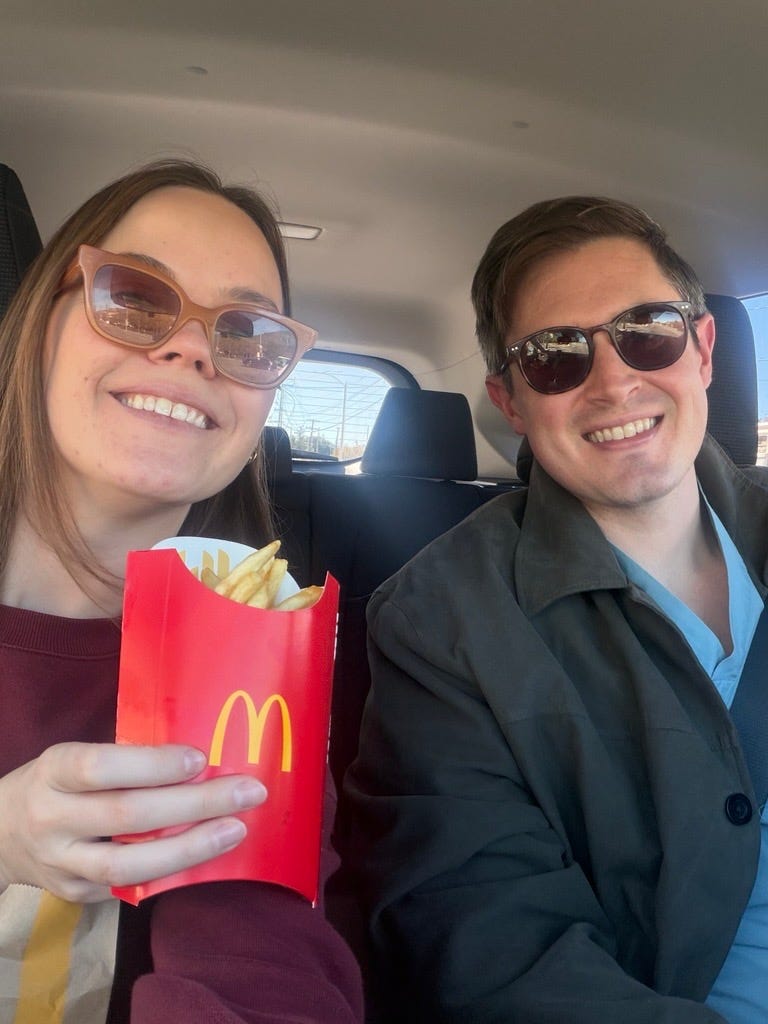
The procedure was quick, smooth, and celebratory. We’d made it! Matt and I stopped at McDonald’s for French fries on the way home (IYKYK) and spent the rest of the day reveling in the possibility of me finally, finally being pregnant.
As for our results, I’ll save that for a future post.
If all goes smoothly in the embryo transfer process, it really can be as blissful as you have heard. But if it doesn’t, it is yet another stage of IVF fraught with uncertainty. Another cycle filled with destabilizing hormones, deliberating between protocols, incessant monitoring appointments, losing sleep over supplements and lifestyle choices, and the unbearable waiting game.
If you find yourself in that messy middle, there is nothing wrong with you. Very likely, there is another strategy you can try; another way through.
As my clinic’s phlebotomist told me as I was quietly sobbing through my blood draw the day our second cycle attempt was canceled, “there are so many ways people get pregnant through this process.” I hope you find the way that is right for you.
No posts
Comments
Nothing yet. Say the first thing.
Sign in to join the conversation.