
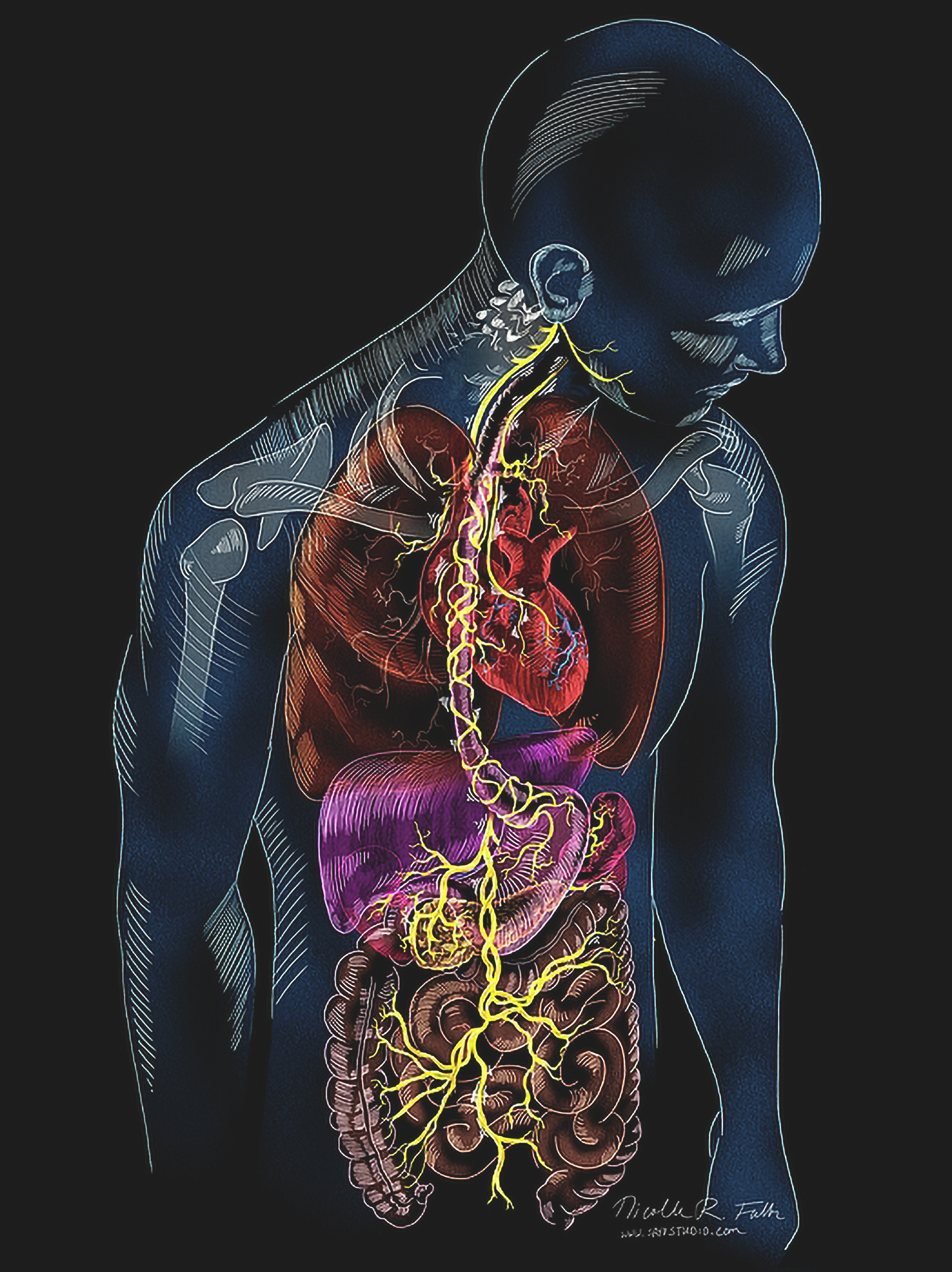
There is a traditional trap used to catch monkeys. A narrow-necked jar is fixed to the ground and filled with nuts. The monkey reaches in, grabs a fistful, and finds that its clenched hand will not fit back through the opening. The trap is sprung — and yet there is no trap, not really. The monkey could be free in an instant. All it has to do is let go.
I have been thinking about this image a great deal lately, as the conversation around Polyvagal Theory (PVT) has grown louder — and more defensive. The recent paper by Paul Grossman and thirty-eight co-authors, Why the Polyvagal Theory is Untenable, has shaken a community that had come to rely on PVT as both a scientific foundation and an emotional one. And watching the response — the pushback, the grief, the anger — I keep seeing the monkey and the jar.
We are holding something that once nourished us. We are holding it so tightly we cannot move forward. And the only thing keeping us trapped is our own grip.
How We Got Here
Stephen Porges introduced PVT in 1994, but it was his 2011 book — written not for fellow scientists but for clinicians, counsellors, trauma workers, and in my case yoga teachers — that sent it into the world at large. I first read it in 2015. I remember the electricity of it, talking to a well-known yoga teacher at the Toronto Yoga Conference, both of us lit up by the feeling that science had finally caught up with what we were witnessing in bodies every day.
Around the same time I was reading Bessel van der Kolk, Peter Levine, Gabor Maté — a whole landscape of thinkers describing how trauma lives in the body, not just the mind. And PVT seemed to give all of it a neurological address. There was a nerve. There was a mechanism. There was, at last, a scientific explanation.
It felt like solid ground. It was not.
The Theory Gave People a Meaningful Framework for Their Suffering
Before PVT, many people struggling with anxiety, depression, and trauma had experiences that felt real and debilitating but were difficult to articulate — and even harder to have taken seriously. PVT changed that. Suddenly there was a map. The freeze response had a name and a nerve. The feeling of being shut down, disconnected, or overwhelmed wasn’t weakness or imagination; it was the nervous system doing something that we could now explain. For many people, that explanation was itself a form of relief.
Grossman et al. point out that the concepts PVT describes — psychological safety, social engagement, co-regulation, emotional freezing, dissociation — pre-date it by decades. Bowlby wrote about them. Rogers wrote about them. The experiences were real and documented long before Porges pointed to one nerve. But somehow those ideas became better ideas when science arrived to ratify them. We live in a time when a neurological explanation outranks an experiential or psychological one. If a scientist can point to a cranial nerve, it feels more true than if a therapist points to a pattern of behaviour, or a patient points to their own body.
This is a profound problem. When we tell someone that their trauma experience is valid because science confirms it, we have also quietly implied that without the science, it might not be. We have made their lived experience contingent on a theory. And theories, as we are now being reminded, evolve.
The Community Built Around It Has Emotional and Professional Stakes
PVT did not remain a theory in a journal. It became a world. Clinicians trained in it. Teachers built curricula around it. Practitioners staked their professional identities on it. Books were written, workshops were sold, certifications were granted. An entire vocabulary emerged — ventral vagal, dorsal vagal, neuroception — that became the shared language of a community. To question PVT is not just to question a hypothesis about a nerve. It is to question the foundation on which many people built their working lives.
Brian McLaren’s taxonomy of 13 cognitive biases is useful here. Community bias tells us it is almost impossible to see what our community cannot or will not see. If the well-known people in my field — the experts I am supposed to trust — say PVT is true, and if belonging to their circles requires agreement, then doubt becomes socially costly.
Confirmation bias means we judge new ideas by how well they fit what we already believe; PVT fit beautifully, so we accepted it, and we continue to defend it not because the evidence demands it but because the alternative is disorienting.
This is not cynicism or bad faith. It is the entirely predictable behaviour of people who found something that worked, built something around it, and are now being told the foundation was unstable. The community that formed around PVT is real, the relationships within it are real, and the care for the people being served is real. None of that disappears because the underlying theory is untenable. But it does make letting go harder.
The Science Disconfirming It Feels Threatening Rather Than Clarifying
Here is something worth sitting with: when science validated PVT, we celebrated. We welcomed it. Science was the authority that confirmed what we already knew. Now science — more rigorous, more comprehensive, backed by thirty-nine researchers — is telling us the theory doesn’t hold. And suddenly, science is the enemy.
This is not a criticism. It is a very human response, and it illuminates something important about why we loved PVT in the first place. Our attachment was never purely to the science. It was to the feeling of being scientifically supported. When the support is withdrawn, the edifice doesn’t just feel intellectually challenged — it feels personally attacked.
I’ve read several pieces defending PVT and criticising Grossman et al.’s paper. What strikes me is that the critique of the new paper often focuses on tone, or motivation, or the absence of a replacement theory, rather than engaging with its actual scientific claims. Complexity bias is at work here too: PVT is something most of us can understand and teach; the paper refuting it is dense, technical, and difficult, and it doesn’t hand us a simpler model to replace the one it dismantles. It is much easier to defend the map we know than to accept that we may need to navigate without one for a while.
Letting Go Feels Like a Loss, Not a Correction
Perhaps the deepest resistance to releasing PVT comes from what it would mean to do so. For people who believe they healed because of it, releasing the theory risks unsettling the healing. For practitioners who used it as the basis of their work for a decade or more, releasing it risks calling that work into question. For anyone who found in PVT a language for their suffering, releasing it can feel like losing the words.
Comfort bias tells us we prefer not to have our comfort disturbed. And PVT was deeply comforting — it said that what happened to you had a physiological explanation, that your responses made sense, that healing was possible and even mappable. The paper that says PVT is untenable does not take away the suffering, or the healing, or the meaning. But it can feel as though it does.
What I want to say to people in that place is this: your experience does not depend on the theory being correct. The relief you felt when you first read Porges was real. The healing you did was real. The community you found was real. None of it is invalidated by the science moving on. That is actually the point — your lived experience is true because you lived it, not because a theory about a nerve gave it permission to be.
PVT also gave us something else I am more ambivalent about: the promise of the hack. Roll a ball over your throat. Breathe at this rhythm. Track your heart rate variability. These techniques were sold, implicitly or explicitly, as the path to healing. They worked up to a point — because intentional attention to the body does something real. But they also over-simplified. When the hacks stop working, and for most people genuinely deep in trauma they eventually do, what is needed is not a better hack. What is needed is depth. Depth psychology, mythology and story, dream work, spiritual practice — the long, slow, non-linear work of meaning-making that cannot be tracked on a wearable device.
Letting Go
I wholeheartedly agree with the conclusions of Grossman et al.’s paper. PVT, they write, “promotes mistaken ideas about how the human mind and nervous system function together and introduces new mental fictions and fantasies about the mind-body relationship, thus contributing to greater, rather than less, distance between lived experience of psychological states and perceptions of bodily functions.”
We built a story about a nerve, and the story became more important than the nerve. More important, perhaps, than the people the nerve was supposed to help.
I am not saying we should discard the vagus nerve, or dismiss the techniques we developed while steeped in PVT, or tell people that their healing was not real. I still teach Better Breathing for Trauma. I still track my HRV. The scaffold was not useless — but the scaffold is not the building, and it was never meant to stay.
The monkey does not lose the nuts by letting go. It gains the freedom to go find more.
Let go of the Polyvagal Theory, and let’s move forward together.
Thanks for reading Breathing Room. If you enjoyed reading this, feel free to share it.
Hey folks! Laura Beth Wenger and I will be offering our four-week Better Breathing For Trauma course this April. Join us for a unique perspective on breathing. No hacks. Not trying to fix you. Just some good info on physiology of breathing and stress. More info and register here.
Grossman, Paul et al. “Why The Polyvagal Theory Is Untenable: An international expert evaluation of the polyvagal theory and commentary upon Porges, S.W. (2025). Polyvagal theory: current status, clinical applications, and future directions. Clin. Neuropsychiatry, 22(3), 169-184.” Clinical neuropsychiatry vol. 23,1 (2026): 100-112. doi:10.36131/cnfioritieditore20260110
Brain McLaren on Learning How to See (podcast) - through the Center for Action and Contemplation (Richard Rohr)
Comments
Nothing yet. Say the first thing.
Sign in to join the conversation.