
As a mother, estrangement altered how I move within the relationships that remain.

Even the connections that continue are changed.
I am more guarded now. More cautious about being misunderstood. More aware that connection can feel precarious and subject to forces beyond my control. It is another quiet casualty of estrangement — living in relationships with a vigilance that did not exist before.
That vigilance can make ordinary moments feel loaded.
A friend shows you photos of her grandchildren.
Someone asks how your daughter is.
Mother’s Day arrives with flowers, brunches, and public declarations of love.
A family conversation drifts toward children, holidays, weddings, milestones.
And suddenly, you are not only in the present moment.
You are inside the absence.
In the beginning, growth may not look like growth at all.
It may look like tolerating the conversation for two minutes before you say:
I’d rather not share more about that right now.
Or:
It’s complicated, and I’m still finding my way through it.
Or maybe you use whatever small sentence you can manage to explain the absence of contact without exposing your whole wound to someone who has not earned the full story.
At first, two minutes may be all you have.
Two minutes before your chest tightens.
Two minutes before the shame rises.
Two minutes before you feel yourself wanting to defend, explain, collapse, or disappear.
But then, over time, something shifts.
Two minutes becomes five.
You are still uncomfortable, but you are not undone.
You still feel the ache, but you can stay with yourself.
Capacity is the space that slowly grows around the pain.
Maybe eventually you are able to say something more honest:
This is a painful area for me. What helps most is when people don’t try to fix it.
Or:
I don’t need advice right now. I just need a little room around it.
Or:
It helps when people don’t assume there is one simple explanation.
That is capacity.
Not the absence of pain.
Not the absence of grief.
Capacity is the difference between being swallowed by the moment and being able to remain inside your own body while the moment passes through you.
These shifts are subtle. They may not look like much from the outside.
But to the parent living them, they are enormous.
The first Mother’s Day you survive without being flattened.
The first time someone shows you photos of their grandchildren and you can breathe through the ache.
The first holiday where the absence is still present, but it does not take the whole day.
The first time you ask a friend or family member for the kind of support that would actually help you.
The first time you realize you do not have to choose between silence and overexposure.
You can have a boundary.
You can have language.
You can have grief and still remain standing.
This is not the old capacity you had before the loss.
It is something different.
Something earned.
Something quieter.
Something stronger than you may have imagined possible in the beginning.
Over time, you may begin to notice another shift, too.
You can understand another person’s boundaries without disappearing inside them.
You can acknowledge discomfort.
You can honor sensitivity.
You can respect limits.
But honoring someone else’s limits does not have to require the indefinite surrender of your own meaning.
You, too, are allowed an interior line.
A place inside yourself where you decide what can be continually edited away and what cannot.
One of the harder lessons estrangement teaches is the difference between compassion and self-erasure.
For a long time, I confused the two.
Many parents do.
We think that if we are compassionate enough, quiet enough, patient enough, agreeable enough, reflective enough, we may be granted a place again.
So we shrink.
We edit.
We explain less.
We ask for less.
We try to make our grief less inconvenient to everyone around it.
But disappearing is not the same as healing.
And self-erasure is not the same as love.
Estrangement may take more than we ever expected it to.
It may alter relationships we never imagined losing.
It may reshape roles we spent a lifetime inhabiting.
It may change holidays, family stories, friendships, identities, and imagined futures.
But it does not have to take everything.
It does not have to take your ability to think.
To love.
To choose meaning in the aftermath.
To draw a line around what remains yours.
To reclaim a life that still belongs to you.
This is part of what I tried to write toward in Now You See Me, Now You Don’t: not a tidy resolution, not a reconciliation script, but the slow recognition that even after profound loss, something within us can still endure.
The destination changed.
My authorship did not.
And what endured is worth honoring.
The destination changed. My authorship did not.
Maybe that is what capacity becomes over time.
Not the absence of grief.
Not the absence of love.
Not the absence of longing.
But the quiet strength to say:
This loss changed my life.
It did not take the whole of it.
What I know now:
Growth after estrangement does not always feel like growth. Sometimes it feels like tolerating what once would have undone you. The conversation. The holiday. The question. The photo. The silence. The absence.
If you are here right now:
Two minutes counts. One boundary counts. One honest sentence counts. Asking for the kind of support you actually need counts. These are not small things when your nervous system is still learning that the moment can hurt without taking you under.
A mindset shift:
Instead of asking, Why am I not over this yet?
Try asking, Where am I beginning to have more capacity than I had before?
Capacity is not proof that the loss no longer matters. It is proof that you are still here.
Now You See Me, Now You Don’t: Estrangement, Loss Without Closure, and the Work of Living On is available on Amazon (https://a.co/d/05YI7Zhy)
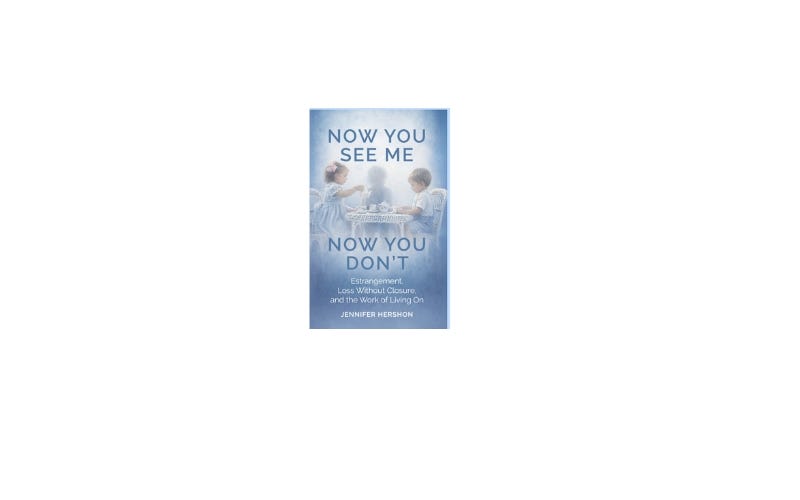
This memoir is not a reconciliation script or a book about blame. It is a mother’s story of ambiguous loss, survival, and the slow work of reclaiming a life after estrangement.
If this article speaks to you, the book may offer deeper companionship for the road you are walking.
The content of this article is for educational and reflective purposes only. It is not therapy, legal advice, or a substitute for individualized mental health care. Discussions of estrangement should never be used to minimize situations involving abuse, neglect, or necessary protective distance.
No posts
Comments
Nothing yet. Say the first thing.
Sign in to join the conversation.