
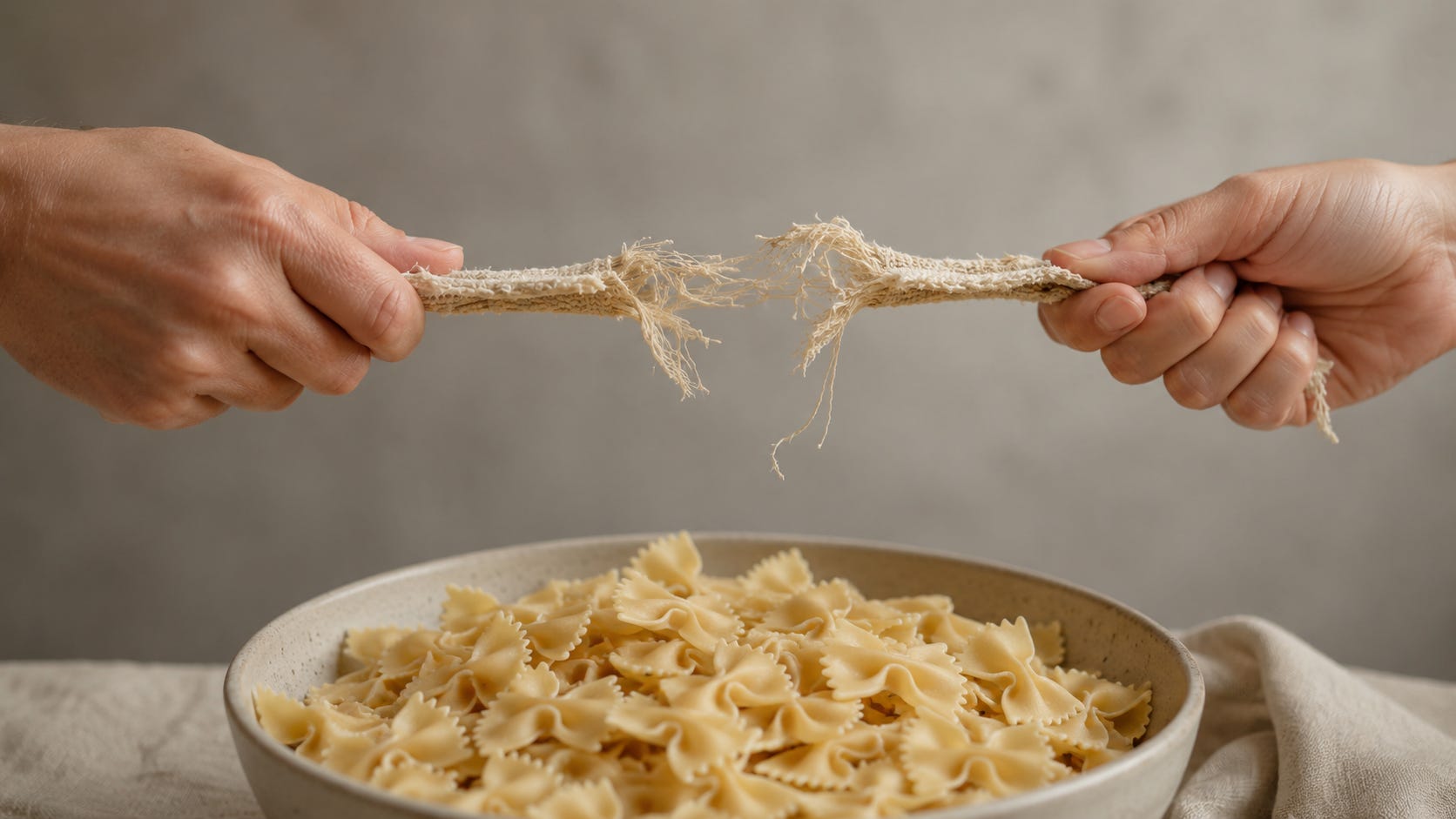
Somewhere along the way, we began to confuse healthy relationships with frictionless ones.
No tension.
No discomfort.
No awkward conversations.
No history that has to be metabolized.
No need to sit across from someone and say, “That hurt me,” or “I see it differently,” or “Can we try again?”
In this new emotional economy, friction is often treated as evidence of harm. Disagreement becomes danger. Discomfort becomes trauma. Distance becomes wisdom. And removal becomes the proof that one has finally learned to “choose peace.”
But families are not frictionless systems.
They never have been. They never will be.
Families are made of attachment, history, dependency, misunderstanding, disappointment, memory, loyalty, rupture, repair, and imperfect love. They are not smooth surfaces. They are living systems.
And living systems create heat and sometimes mess.
A family that cannot survive friction cannot offer rootedness. It can only offer conditional belonging.
So what is healthy discourse?
Healthy discourse is not the absence of discomfort.
It is the capacity to remain in conversation when discomfort appears.
It is the ability to say, “That hurt me,” without turning the other person into a villain.
It is the willingness to ask, “What did you mean?” before deciding, “Now I know who you are.”
It is being able to distinguish between cruelty and clumsiness, between danger and disappointment, between abuse and the ordinary human failure to get everything right.
That distinction seems to be getting harder to hold. We are losing our ability to ask before passing judgement.
What Dr. Joshua Coleman and others have described as the ordinary slings and arrows of family life — misunderstandings, generational differences, imperfect apologies, poorly timed comments, emotional blind spots — are increasingly interpreted through a lens of intention-driven harm.
A parent no longer “said the wrong thing.”
They invalidated!
They gaslit!
They violated a boundary!
They caused trauma!
Sometimes those words are accurate. Sometimes they are necessary. There are families where distance is protective, and no contact is the safest available choice. That truth matters and should never be minimized.
But another truth matters too.
When every wound is named as trauma, every discomfort as danger, and every hard conversation as a threat to mental health or personal peace, we do not necessarily become more emotionally mature.
We may become more avoidant.
We may teach a generation that emotional safety means never being unsettled. We may teach them that peace is found by removing the person who creates friction. We may teach them that the inability to tolerate a difficult conversation is not a developmental gap, but a boundary. We teach them not to have capacity.
I often joke, only partly joking, that in this newly expanded definition of trauma, a toddler who received penne pasta at age three instead of the requested bow tie pasta may someday have grounds for a lifelong relational divot worthy of cutoff.
It is absurd.
And also not entirely absurd.
Because the culture has shifted. Pain now comes with a vocabulary. That vocabulary can be lifesaving when it helps someone name real harm. But it can also become a cage when it turns every relational injury into a permanent identity, every disappointing parent into a perpetrator, and every family conflict into a case file.
This is where the family begins to lose its repair function.
A crucial conversation becomes too loaded to enter and disappointment impossible to hold.
The question is no longer, “Can we understand each other better?”
It becomes, “Why would I expose myself to this?”
As if the family member is not a flawed human being, but a contaminant.
As if love itself has become unsafe unless it arrives without friction.
In a vacuous culture, place value is easily traded for emotional safety. The deep belonging of family — imperfect, inconvenient, sometimes maddening, messy family — is replaced by cleaner “affiliations.” People who validate us. People who never knew us when we were young. People who do not carry the messy archive of our shared history.
There is comfort in that. Sort of.
There is also loss.
Because family is not only a place where we are just affirmed. It is also, when it is functioning well enough, a place where we learn how to disappoint and be disappointed without disappearance. Where we learn capacity that carries us through the tumult of life.
That may sound old-fashioned now.
Maybe it is.
But there is something developmentally important about learning that love can survive the ordinary injuries of being human. A forgotten birthday. A clumsy comment. A badly worded apology. A difference in memory. Something forgotten. A parent who did not understand quickly enough. An adult child who needed more than a parent knew how to give.
Not every rupture is abuse.
Not every disappointment is danger.
Not every painful history equates to permanent exile.
Healthy discourse is not the absence of discomfort. It is the capacity to remain in conversation when discomfort appears.
In this case, practice makes almost perfect.
The problem is not that people want emotional safety.
Of course they do.
The problem is that emotional safety has now come to mean a life free of challenge, contradiction, repair, and the ordinary ache of loving imperfect people and of those imperfect people loving back.
And once that becomes the standard, almost no family can pass the test.
Parents will fail it.
Adult children will fail it.
Siblings will fail it.
Grandparents will fail it.
Spouses will fail it.
Friends will fail it.
Because every real relationship eventually asks something of us.
It asks us to tolerate ambiguity.
It asks us to listen longer than we want to!
It asks us to make room for another person’s version of events, especially when yours differs.
It asks us to consider that harm and intent are not always the same thing.
It asks us to hold two truths at once: I was hurt, and the other person may still love me. I need boundaries, and I may still need conversation. I can protect myself, and I can still remain human.
So how do we turn back this tide?
Not by denying harm.
Not by demanding reconciliation.
Not by shaming adult children into contact, even if that were possible.
Not by pretending every parent did their best in ways that were harmless.
We turn back the tide by recovering the lost art of healthy discourse.
By making room again for the possibility that someone can hurt us without being dangerous.
That someone can disappoint us without being abusive.
That repair is not self-betrayal.
That emotional safety does not require a life without challenge.
Maybe the question is not whether families can become frictionless.
Maybe the question is whether we can become sturdy enough to stay human inside the friction.
Disappointment is not a diagnosis.
Disappointment is part of every enduring relationship. It tells us something hurt, something mattered, or something did not go as we hoped. But disappointment alone does not define the other person’s character. It asks for reflection before verdict.
Discourse requires pause.
A crucial conversation cannot happen when every feeling is treated as final evidence. Before the cutoff, before the label, before the moral conclusion, there is often a moment where a different question could be asked: What else might be true here?
Repair is not the same as surrender.
Repair does not mean pretending harm did not happen. It does not mean abandoning boundaries or accepting mistreatment. It means leaving room for the possibility that some fractures are not proof of danger, but invitations to understand, clarify, grieve, and grow.
Emotional safety should include resilience.
A truly safe relationship is not one where nothing difficult is ever said. It is one where difficult things can be said without immediate exile. Safety without resilience becomes fragility. Resilience without safety becomes endurance. Healthy discourse needs both.
A mindset shift:
Instead of asking, How do I avoid every person who unsettles and has disappointed me?
We might ask, What kind of discomfort is asking for protection, and what kind is asking for growth?
—
Warmly,
Jennifer
Now You See Me, Now You Don’t: Estrangement, Loss Without Closure, and the Work of Living On is available on Amazon
In this memoir, I write about family estrangement, ambiguous loss, and the long work of living on when there is no clear ending and no promised reconciliation.
The content of this article is for educational and reflective purposes only. It is not therapy, legal advice, or a substitute for individualized mental health care. Discussions of estrangement should never be used to minimize situations involving abuse, neglect, or necessary protective distance.
No posts
Comments
Nothing yet. Say the first thing.
Sign in to join the conversation.