
Gori sounds like it should be a bad place. In English, the proper noun sounds like the adjective ‘gory’, gruesome. It feels fitting for the town where Stalin was born to be labelled in this way. Even in Serbian, it was easy to remember the words for ‘worse’ and ‘worst’: gori and najgori respectively. Arguably he was the worst dictator in the world, after all.
Josef Stalin was not his real name: more a moniker given to denote his huge strength, a “man of steel”. Instead, to a shoemaker and to a laundress, Ioseb Besarionis dze Jughashvili was born. While his mother didn’t quite get her wish for her son to go into the priesthood, his father was an abusive alcoholic and his parents separated when he was young. The mother and son often moved homes. It’s unlikely that Stalin held especially fond memories of Gori.
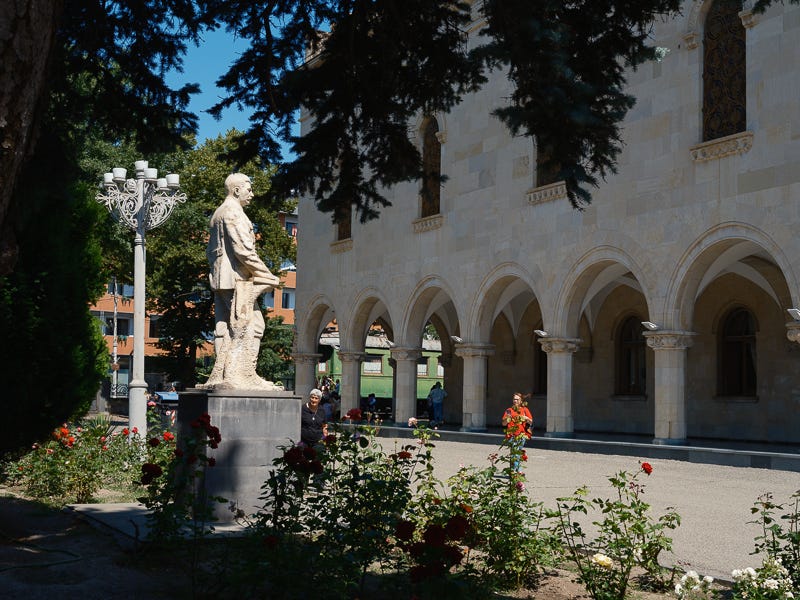
The colonnades of the museum, overlooked by the statue of Stalin
About an hour’s drive from the capital Tbilisi, these days tourists usually call in to the excessively grandiose and sumptuous Stalin Museum, before sampling the more wholesome delights of Uplistsikhe, a nearby historic cave town that’s the oldest in this ancient land. Until recently, Gori had the (in)distinction of having some of the last remaining statues of this leader of Russia and of the Soviet Union. Now President Putin is reviving his memory and his honour, so Gori’s record may be rivalled once again.
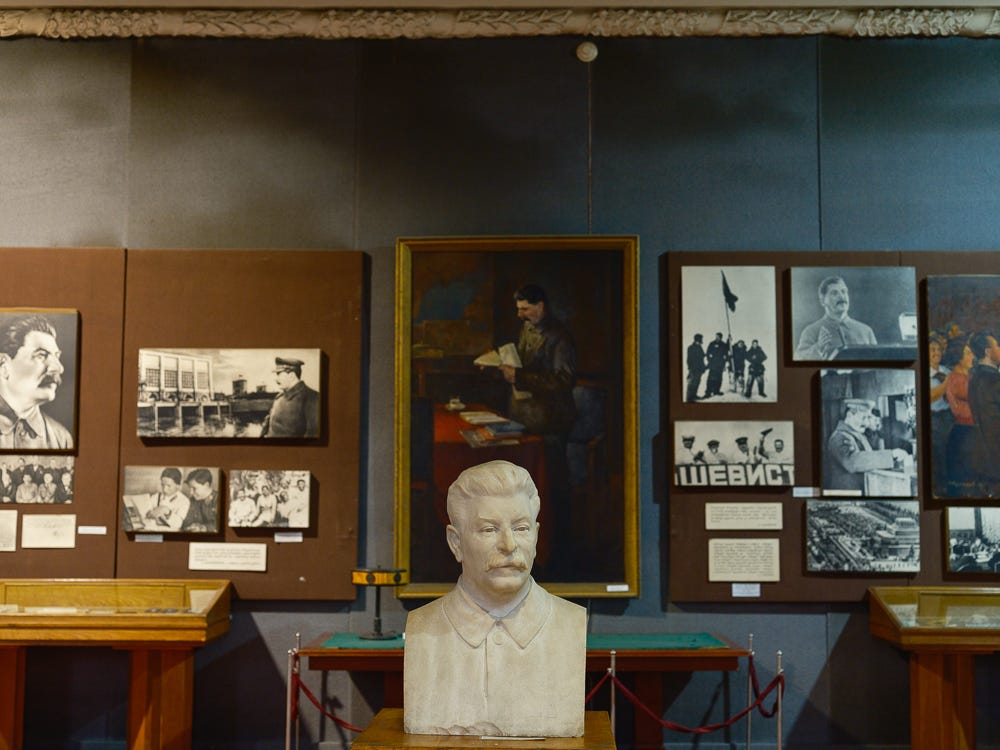
Can you count the number of pictures of Stalin here?
As a predominantly modern, social historian, I am fascinated by dictators. Ignoring that most first-time visitors to Georgia end up in Gori at some point, it was inevitable that I would. Once I’d finished my chores at the Military Hospital, I headed straight to the Stalin Museum to see what I could learn. I’ll cut to the chase: the answer was “not much”. Exhibits comprise, it seems, mainly obsequious gifts to this ordainer of 20 million people’s brutal fate. Wallhangings and tapestries adorned with Stalin’s face are labelled in Georgian and Russian, with very little in English. This is probably a mercy as, by local accounts, the museum paints something of a rosy picture of one of the most notorious men in history.
It is a beautiful building, Soviet-style colonnades providing geometric light and shadow: a centrepiece of the town, looking down on – yes – Stalin Avenue. Parties of school kids flock around their teachers, taking in turns to pose on the famous green train carriage1 that sits just outside the museum’s main building. It’s unlikely that, at their age, they comprehend exactly who this man was and - it seems - that this is shared with at least some of Gori’s other residents.
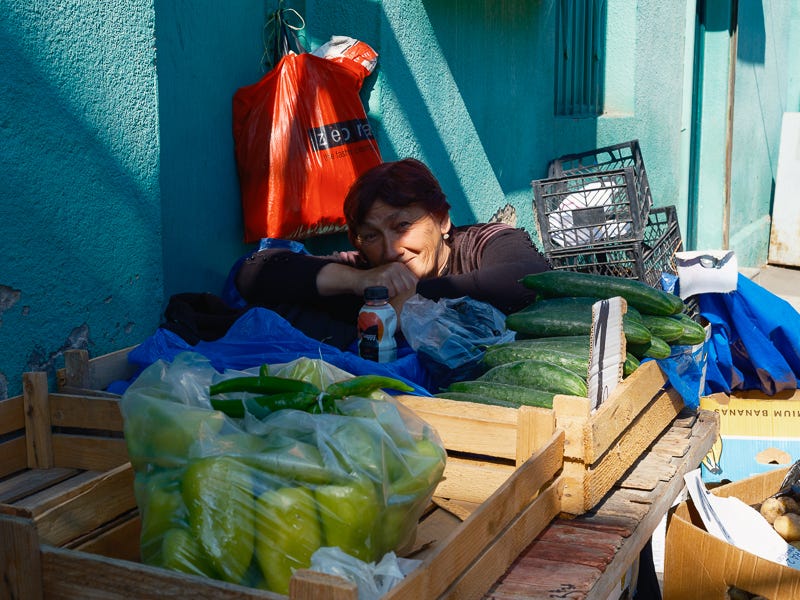
One of Gori’s market traders. She didn’t express any Stalin views to me
Gori is a contradictory town. It is clean and orderly, a delight to wander. While Tbilisi and Kutaisi are crooked and charmingly tumble-down in nature, Gori is mostly built of low-level residences, beautifully decorated with Georgian ornate balconies, internal courtyards and an abundance of vines sprouting green over trellises. Baby grapes are forming, kids ride their bicycles in the street and the living feels good. It’s easy to travel here - but Gori has a difficult past. I joined a local resident, Zhana, on a walking tour of the town, and she helped to explain some of the context of these difficulties as well as to share the other delights that day-trippers just don’t get to see.
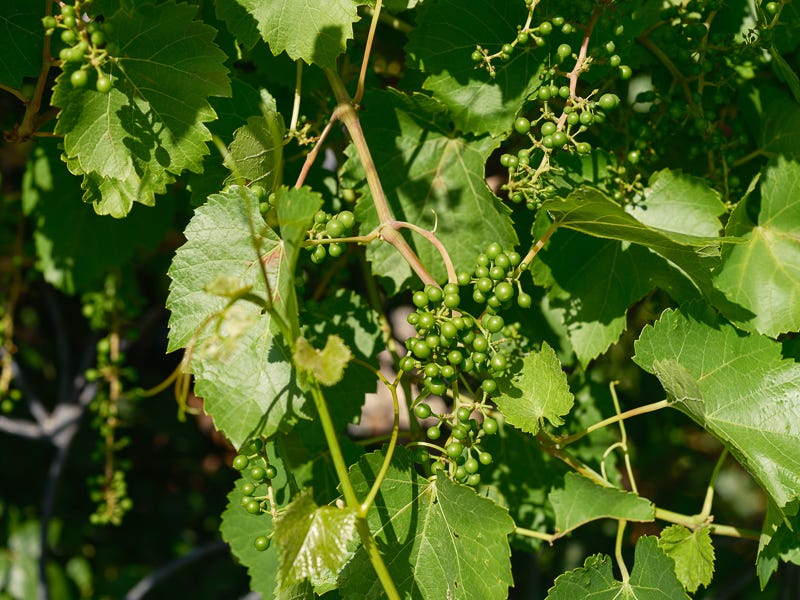
Just grapevines
Georgia enjoyed a brief period of independence after the First World War, from 1918 to 1921. It wasn’t long, though, before Russia’s Bolsheviks tired of internal politics and invaded the country. Georgia was occupied under Russia, and from 1945 under the Soviet Union, and this lasted until 1991. According to the National Museum in Tbilisi, 840,000 people died during this period. While many Georgians were killed during World War Two, an estimated 80,000 were shot by Russian soldiers in brutal repression to keep control of one of 14 non-Russian republics. The Georgian language was officially banned, as was the Georgian Orthodox Church in a deeply religious society. As the USSR floundered in the last decade of the twentieth century, 98% of Georgians voted for independence from Moscow, in 1991. A difficult decade followed, with widespread shortages and unrest as the country adapted to its new reality.
Recounting to her my adventures at the Military Hospital, Zhana told me that it’s now a very good hospital – the best in Gori – but that in her childhood (“the dark ‘90s”), it was a different story. Ill-equipped, few drugs and lacking in personnel, the hospital did what it could for its patients at the time. NATO re-established the facility and helped to turn it around.
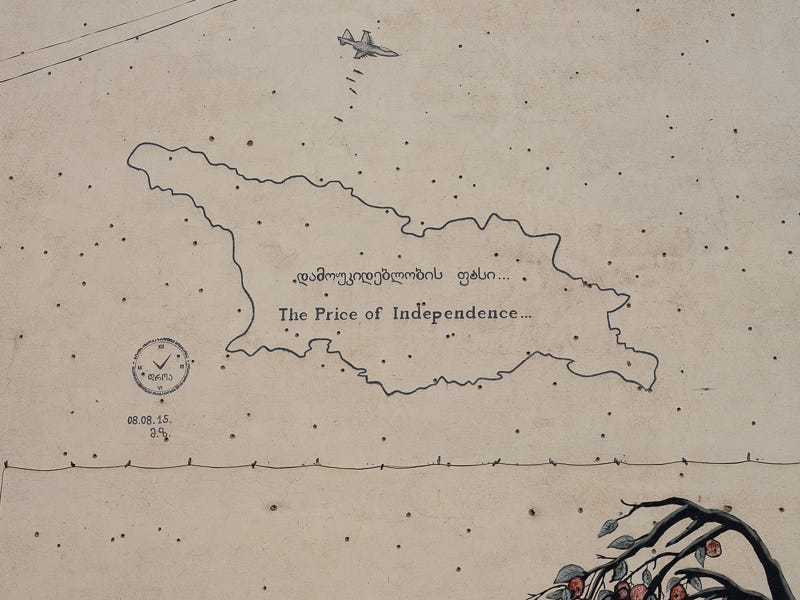
Street art that tells of the 2008 Russian invasion of Georgia. The holes in the wall are real bullet holes dating from the time.
What’s good for me is not always what’s good for Gori. NATO got involved with the hospital because Russia once again invaded Georgia in 2008, taking the regions known as Abkhazia and South Ossetia2, which they still occupy. Indeed, Gori was also briefly occupied. Across the country red and white Georgian flags fly proud, most people I spoke to offer anti-Russian sentiment despite the government’s pro-Russian stance, yet here in Gori, many people still seem to love Stalin.
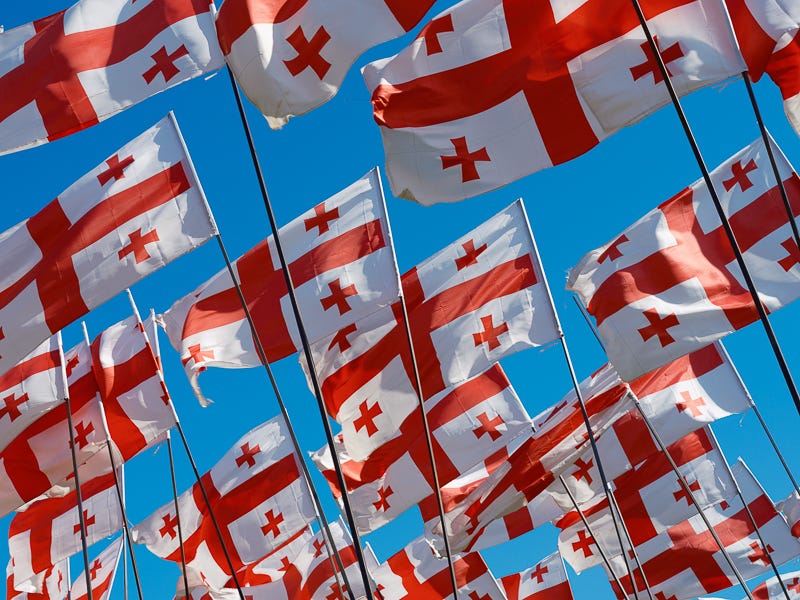
Georgian flags fly at an art installation outside Art House gallery
In many places I visit across the Balkans, sites are marked on maps as ‘tourist attractions’. When you get to them, it’s a well or perhaps an abandoned building lost to time. In other parts of the world these features would go unremarked. You could understand here in small-town Gori if local people were proud of Stalin because of his fame alone3. Whatever else he was, he definitely ‘played with the big boys’. Zhana nods when I suggest this, but says it is more than this, that especially older people actively appreciate him. A sociology graduate, Zhana points out that the teaching of history under Soviet rule sounded very different to the history that most of us were taught. The glory of the regime was always uppermost, and the tragedies downplayed. We pause outside the small and quirky Georgian War Museum where there’s a Soviet era bas relief to the fighters of World War Two. The dates are clearly marked: 1941 to 1945. According to Soviet history, the war only began once Russia was invaded as part of Operation Barbarossa. The 1939 Nazi-Soviet Pact of Non-Aggression was conveniently overlooked. If two years of active global conflict can be ignored, then so can holodomors4, show trials, and purges.
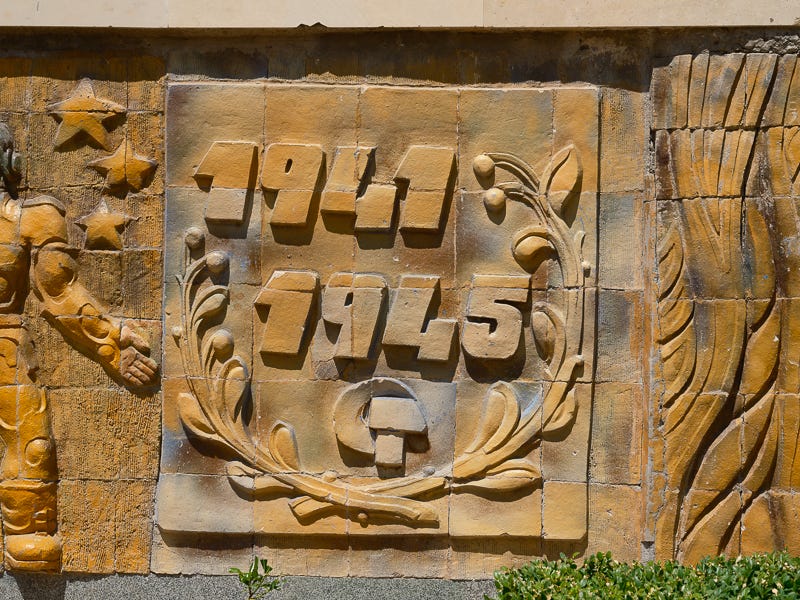
The relevant part of the Soviet bas relief outside the Georgian War Museum
Later, on our way to visit the cave town at Uplistsikhe, I ask my taxi driver Timo – a man in his 50s – what he thinks of Stalin. He doesn’t speak English and I don’t speak Georgian or Russian, so I ask in a combination of English, Serbian and body language. “Stalin good?” (thumbs up) or “Stalin bad?” (thumbs down). He gives a thumbs-up, and enthusiastically nods. “Stalin very good.” The sign language runs out of steam, however, and we don’t elaborate on the theme.
Zhana and I agree that there could be a simplicity in living under authoritarianism. Many of life’s choices are taken out of your hands. There are plentiful jobs as created by the state, and the concept of work-life balance is yet to be invented. I’ve heard similar sentiments all across Central and Eastern Europe. A wave of Yugo-nostalgia is gripping many born in the Yugoslav era, a yearning for on-the-surface equality, brotherhood and unity. Rural Romanians have told of their preference for Communist times, when it wasn’t against EU regulations to kill the bears and wolves that damage property and livestock. Most of the time we don’t sit and analyse our lives – it occurs to me that the growing sense of social isolation created by the young seeking economic opportunities elsewhere, and by the misuse of Internet technologies, has also falsely painted past times as rosier.
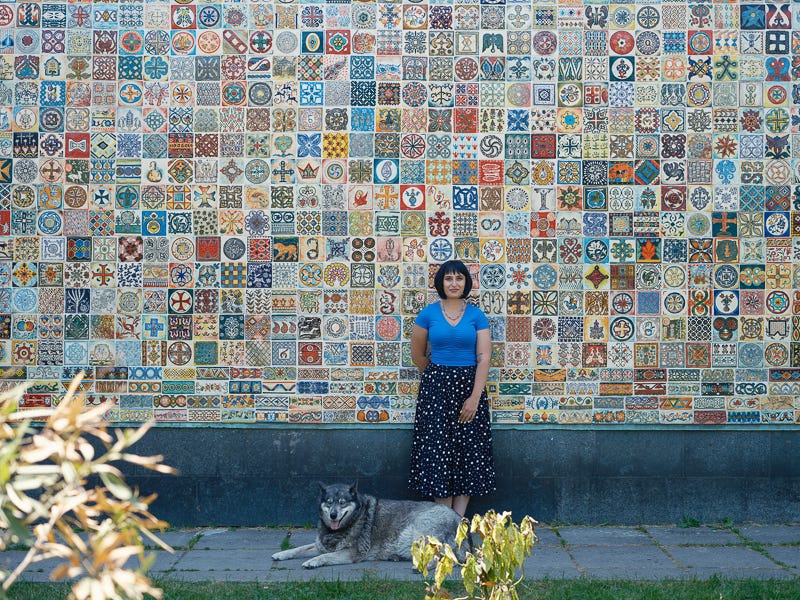
Zhana, the 1001 Tiles and a stray dog
Zhana deftly leads me around Gori’s other sights, and they are just the sort of thing that I like to visit. There’s a Brutalist-style “spomenik”5 dedicated to Georgia’s national poet, Shota Rustaveli, a wonderful and powerful photographic exhibition on 2008 by a Lithuanian photographer6, a memorial to Georgian War Heroes – depicting medieval soldiers with decapitated limbs, and a beautiful theatre. A crumbling fort sits atop a hill, symbolising for those in Gori the spirit of resistance against the (modern) Russian tyranny. Though many people here can speak Russian as their second language, and indeed have a tendency to lapse into it for tourists, Georgians are rightly proud of the survival of their own and unique language, and alphabet. In its third iteration, the script is beautifully evocative and bulbous in its form. Said to be distantly related to Hindi, the colourful Wall of 1000 Tiles on the sports centre illustrates each letter, alongside other aspects of Georgian national pride. An ancient unique wine-making culture (8,000 years’ old), ages-old and delicious cuisine, poetry, music and dance all feature on the 1001 hand-painted tiles.
By the time Zhana and I part, I feel that I have connected with a Gori that many visitors don’t get to see, and that I have a deeper social understanding of this country into which I have flitted. Straddling Central Asia and Europe, Georgia – and Gori – have a unique culture, and one that inevitably Russia has influenced before and during the twentieth century. In his own way, Stalin has done the same. While I don’t enjoy the veneration of his type of leader, I haven’t come here to judge or to impose a view. As Zhana has helped me to appreciate in any case, there’s more to Gori than meets the eye – and here it’s definitely not all about the Big Man. It was a very enjoyable couple of days here – and only 40 minutes of them were spent inside the Stalin Museum.
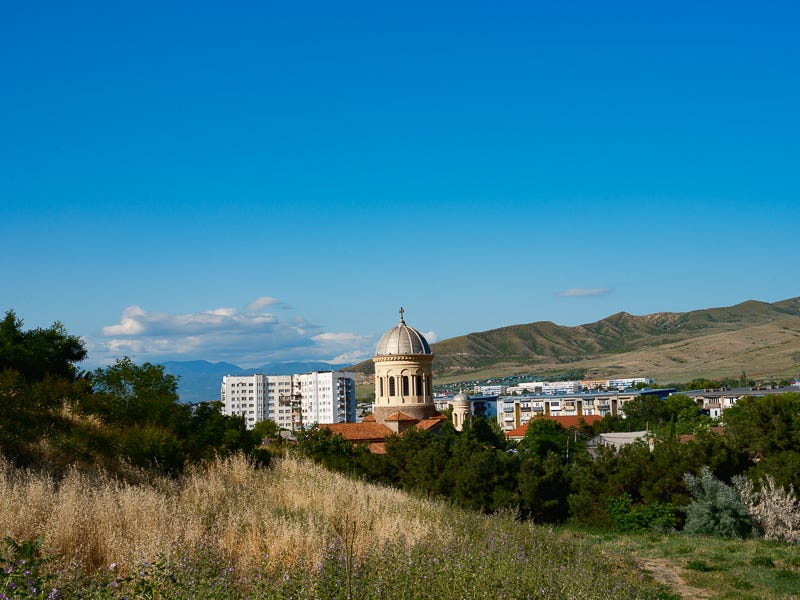
Views of Gori from the fortress hill
Zhana’s tours - free - can be booked ahead of time by messaging her on Instagram.
“Keep these stories coming and Buy Me a Bus Fare.” (Please.)
Stalin, for an ‘man of steel’, was scared of flying and used his green armoured train(s) to travel. They also served as mobile military command centres.
Georgians don’t call the region South Ossetia, but Samachablo
Georgia is not part of the Balkans, for clarity, but the Caucasus
The Ukrainian term for the forced famine caused by Soviet “collectivised” agriculture
Spomenik is the BCMS term for the types of monument you see scattered around the former Yugoslavia, mostly constructed in a post-modern style
No posts
Comments
Nothing yet. Say the first thing.
Sign in to join the conversation.