
Each month, I’m focusing on what I consider to be life-changing books. I read a lot. Like, a lot a lot. But most of them slip right through my brain. When I think about a book months after reading it, I like to share. For August, I want to bring attention to Jennifer Breheny Wallace’s book, Mattering: The Secret to a Life of Deep Connection and Purpose. I first read this book on an airplane, which, of course, means I bawled through most of it and declared it the best thing I’ve ever read. It held up upon rereading.
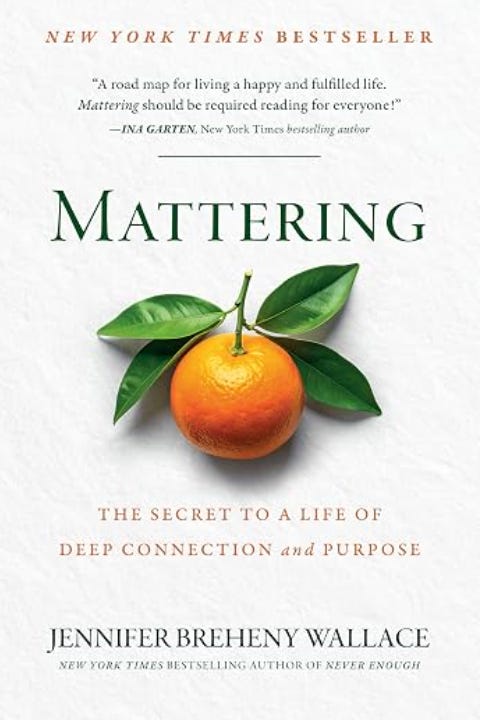
Wallace opens her book with the story of witnessing a bodega owner who brought in clementines specially for a regular customer and how the customer was moved by his kindness:
“It was a sign that someone had paid attention and remembered, proof of connection in a world that often feels indifferent. A small gesture that said: You matter.”
Wallace defines mattering as “the feeling that we are valued and have value to add to the world.” It’s the “assurance that our presence and actions are significant to others.” The self-care world puts a lot of emphasis on loving ourselves, and that’s important, but when everyone forgets your birthday or doesn’t like your Facebook post or doesn’t say thank you for holding open the door, it stings.
When we do not feel like we matter, it feels like rejection. Wallace quotes George Bernard Shaw:
The worst sin towards our fellow creatures is not to hate them, but to be indifferent to them.
This is an ancient brain thing. If we do not matter to the group, we might be expelled from the group. If they do not see our value, why would they keep us around? In days of old, belonging meant survival. Mattering mattered. It still does.
Wallace spent six years researching the book, asking people: Do you feel like you matter? As she writes, “too often the answer was “not” or “not anymore”.” Wallace outlines many factors that contribute to this feeling of not being valued: political polarization, technology replacing in-person interactions, burnout from increased caregiving requirements, fears about AI, and distrust in governments and religious institutions, among others. All of this has led to what Wallace deems a “social health crisis, a profound breakdown of the relationships that once protected us.”
Empty nesters, the newly divorced, people who’ve just moved cities, the bereaved, the unemployed, and retirees are particularly vulnerable. When you have a job, even if you have the world’s worst boss, you still get a paycheck that says there is value in what you do. When you are a parent in the trenches of parenting, you have this general sense that you are doing something valuable, even if it’s just the Mother’s Day advertising cycle at work. Even the worst spouse or partner probably says happy birthday when prompted. It might not be great, but it’s something, and when you lose these things, it’s a loss.
Last winter, I was housebound due to a combination of grief, surgical recovery, and diabolical weather. My kids were away at school. My father was mired in treatment. I wasn’t working or going to the gym or seeing friends for lunch. I was writing but had no deadlines. I got up and got dressed every day but nobody was requiring it. Nothing I did really mattered. I felt untethered, like maybe I wasn’t quite part of this world. As Wallace writes. “Mattering is like gravity: unseen but essential. It holds us in place.”
A couple of weeks after my surgery, when I felt well enough to walk, I wanted to visit the tony department store to see their holiday displays (they bring in Fortnum and Mason goodies for Christmas.) On my way to the second floor, I realized that I was not quite game ready. I was in pain and felt shaky and like I might faint. I thought I’d maybe lost my hat but could not remember if I was even wearing a hat that day. A very kind saleswoman walked with me around the store to help me locate this maybe imagined chapeau. I recognized in her the professional kindness, often seen in luxury retail and hospitality, that tells customers they matter. It starts out as transactional but eventually becomes innate.
In my first job, working in the arts philanthropy business as a student, I was trained to make people feel seen. I learned to remember names and preference and to remember people’s children’s names and pet names and interests. I learned to say “nice to see you” when meeting someone rather than “nice to meet you” just in case we’d met before. We did not want anyone to feel like they were forgettable. A woman who was known for her eccentricity came into the office for a meeting and told me she was losing her teeth. I thought she meant in a general, gradual sense like one might be losing their hearing, but she reached into her mouth and held up what seemed to be an imaginary tooth. She asked if I could hold her teeth for safekeeping. So, I got an envelope and helped her put her “teeth” inside and kept it with me until her meeting was over. As a 17-year-old from the suburbs, nobody had prepared me for this, and perhaps she was having me on, but I do know she felt like she mattered and the people I worked for thought I’d done a good job.
I see mattering as being a bit like that lovely Ram Daas quote, “We’re all just walking each other home” Sometimes we hold someone’s imaginary teeth during a meeting. Sometimes someone helps us look for a possibly imaginary hat after surgery. It’s weird because people are weird, but everyone feels seen and valued.
This week, a friend recommended I watch Always at the Carlyle, a 2019 documentary about the storied UES hotel.
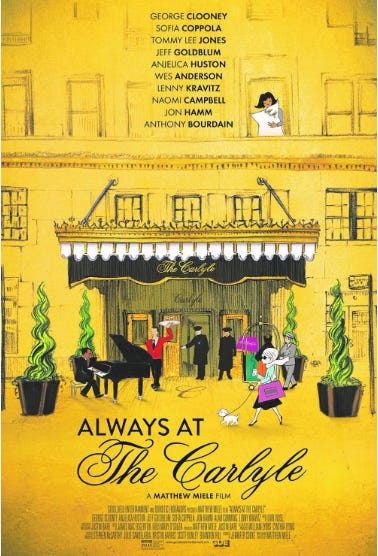
The film-maker interviews staff and guests (many of whom are celebrities) talking about what makes the hotel so lovely since it doesn’t have the fanciest amenities or newest rooms or best views in the city. The hotel staff are discrete. That point is made clear. But it’s more than just privacy and decorum. Broadway actress Kelli O’Hara, elegantly sums it up: “We go back to a time when things were simpler, and things were more - real, maybe, a little bit. More face-to-face. More human.” At The Carlyle, people matter. The Carlyle still has elevator operators even the elevator does not really require them. The staff learn people’s names and wear name tags so guests know their names too. They monogram the pillows for VIP customers. Contrast this to the chain hotel we encountered en route to Los Angeles last year that had us check in using an iPad. Your phone became your key and you never needed to see another human being. What a terrible introduction to a new city! I was traveling with my children, thank heavens. If I was on my own, I’d have wept.
In March 2023, I was staying at the New York Palace Hotel, which is my hotel of choice in NYC because of Gossip Girl (I know, I know.) I was there alone as my son was elsewhere in the city visiting his father for a few days before the two of us went on to Miami. I assume room service was still not operational after COVID, because normally that’s my go-to for breakfast. Give me a rolling table with linens and a bud vase and I’m in heaven.
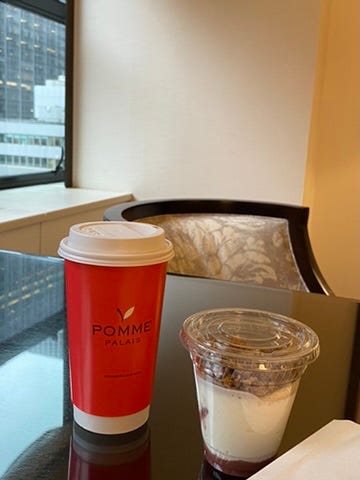
I remember that it was rainy and cold, so the first morning I just got takeout from the little coffee bar off the lobby. Eating breakfast in your room alone is depressing when you don’t have that table wheeled in.
The next morning, I decided to go to the hotel restaurant for breakfast since it’s gorgeous. The place was packed with finance bros in fleece vests from the hedge fund across the street. It was right after Silicon Valley Bank had collapsed and there were rumours that First Republic was next to go, which is like Superbowl Sunday for these guys. Of course, every single one of them had predicted SVB’s fall, as they announced to each other in booming voices.
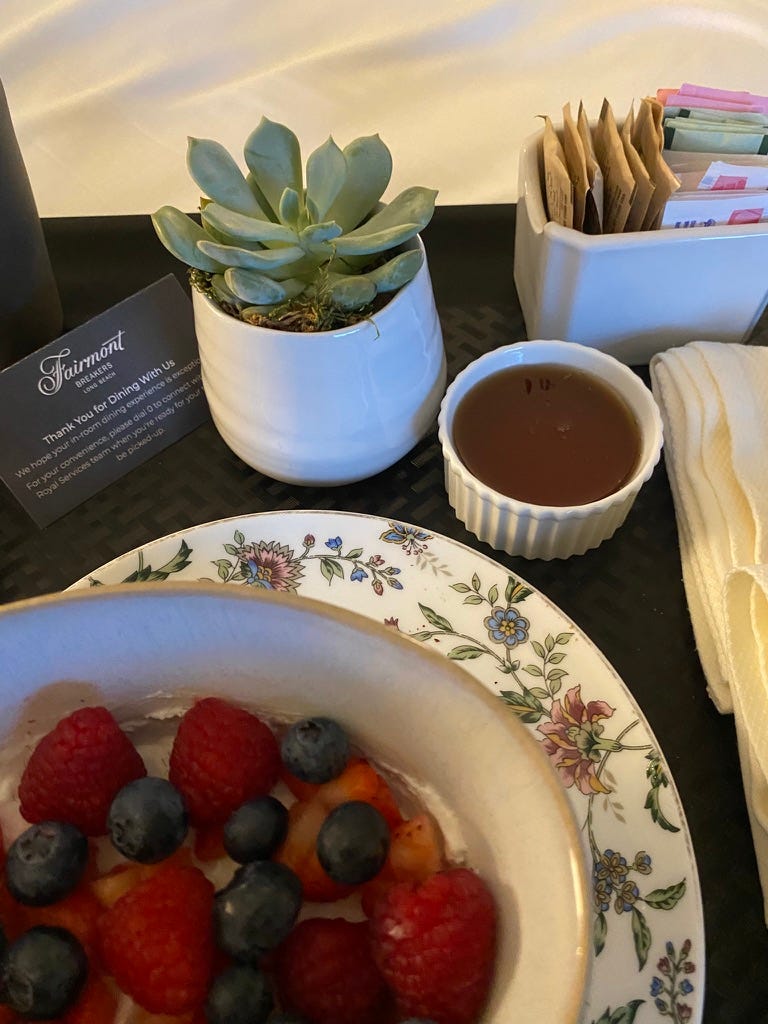
Now, if I’d wanted to have my breakfast ruined by loud men in fleece vests, I’d have stayed in investment banking. The waiter could see that I was not enjoying my $36 yogurt bowl and asked me if my breakfast was OK. I said something to the effect that the berries were spectacular and the coffee excellent but I could hardly hear myself think. He offered to set me up a little space in the beautiful Gold Room (where Serena and Blair first clashed for the GG fans out there). I was not staying in the Presidential Suite or racking up a giant bar bill but I was a customer. I mattered. It was my clementine moment. I felt heard.
As Wallace writes, “Being heard is so close to being loved that for the average person, they are almost indistinguishable.” Sadly, mattering is becoming a luxury item like everything else in this K-shaped economy. Lower cost places where one used to matter, like church or gyms or meet up groups, have become less engaged and engaging. Now you have to join Annabel’s (opening soon in NYC) or Equinox to get a human connection. Everyone else wants to run things through an app. People are still forging healthy connections among friends and family, of course, but good hearted people are busy and burned out. I hear about people not showing up for parties and even weddings. It loops back to that social health crisis idea. For some reason, people would rather stay home and talk to Claude. We are all very tired.
I’ve decided to make mattering matter more this month (how’s that for alliteration?) I’m choosing grocery stores with real people at the till. I’m shopping locally when I can and engaging with business owners. I’m leaving my house to build relationships in person. This month, I want to explore more ways to matter and to help other people feel seen. I’ll be exploring what Wallace suggests in her book. I’d love to hear what makes you feel like you matter and how you practice mattering.
See you in a week,
Xx Jen
Comments
Nothing yet. Say the first thing.
Sign in to join the conversation.