
Hello, fellow works-in-progress.
The irony of this post being about friction and inconvenience while confronting me with a lot of friction before I was able to really sit down to conceive this post in my mind and write it. But here I am, finally.
And here you are too. This tells me that you’re working through similar struggles and questions yourself. Questions like:
How might we navigate the inevitable friction and inconvenience in growing cultures of collective care especially around food?
Are the discomfort and challenges of pursuing wellbeing for all are worthwhile?
I don’t write this post from a place of inner peace and pure knowing of having “figured things out”. The struggle is definitely still real. I am confronted with it daily. Because I eat daily and am in relationships with the world daily. Perhaps, I write this as a reminder to myself of what we work against, what I know works, what I still need to work on, and maybe most importantly, what makes it worthwhile.
As inspiration, I revisit some lines from my poetic resonance of Mabi David’s sharing at Kusina, Kalsada, Kapwa, a gathering by Good Food Community last year.
We love conveniences
but it’s eroding the relationship
Hindi frictionless ang building of relationships.What will it take to move
from anonymity to recognition
from isolation to participation
from alienation to collective agency?Beyond transactional to transformational
Our participation makes a difference.
What would it take to co-produce the change we want to see?
Society has us cooking less, buying more “food-like” things vs. whole foods, doing more things online, having food delivered, having long drawn out chat threads or calls versus in-person gatherings, and just generally being less present with each other — in our homes, our offices, our neighborhoods and communities. We are often so time- and energy-starved that these paths of least resistance seem like the most desirable ways to go.
And yes, I want these options. What would I do without online calls, e-wallets and online banking, and food delivery services — particularly with the financial and temporal cost of moving around the city and nourishing myself and my family?
But changing our relationship with friction and inconvenience asks us to shift our perspectives, participation and systems. And it’s not an overnight process, and we won’t always get it right. In fact, we will probably often get it wrong first, but I need to remind myself that that’s the nature of friction and inconvenience, and perhaps it is precisely the slowness and struggle that make the pursuit of collective care more meaningful.
There is so much uncertainty and possible “failure” in trying to cultivate connection and care, let alone create change around us — in wider social systems and even in our homes. Some changes feel so intractable, but I suppose that’s where a level of stubbornness, delusion and audacity become our lifeline.
That is what I think Good Food’s Pamayanihan1 model of Community-Shared Agriculture (CSA) is. A glimmer of the future we hope for, a relic of the past we’ve forgotten — showing up in the present.
Every week, we get a delivery of organic veggies, not knowing what we’ll get, and that’s a form of being in solidarity with the farmers and the land. To purchase what farmers have from their harvest and what nature grows when the land isn’t poisoned.
This is what motivates me to engage with the work of Good Food Community and to pursue things with Hapag Ugnayan, like our Tampipi ng Ugnayan / Ka-gulay collab projects (more upcoming).
It is inconvenient, firstly, to make most if not all of our meals from scratch, more so if you have to cater to varying tastes and nutritional requirements of your household. And yes there are alternatives out there that we can buy that allow us to meet our nutritional needs. But as I wrote in my essay on Cooking as Creative Act, there is much joy in remembering we can do things, and that, when conditions are right, nourishing each other and even cooking together can really help us feel solidarity and collective care.
Here are some ideas from previous cooking gatherings with others.
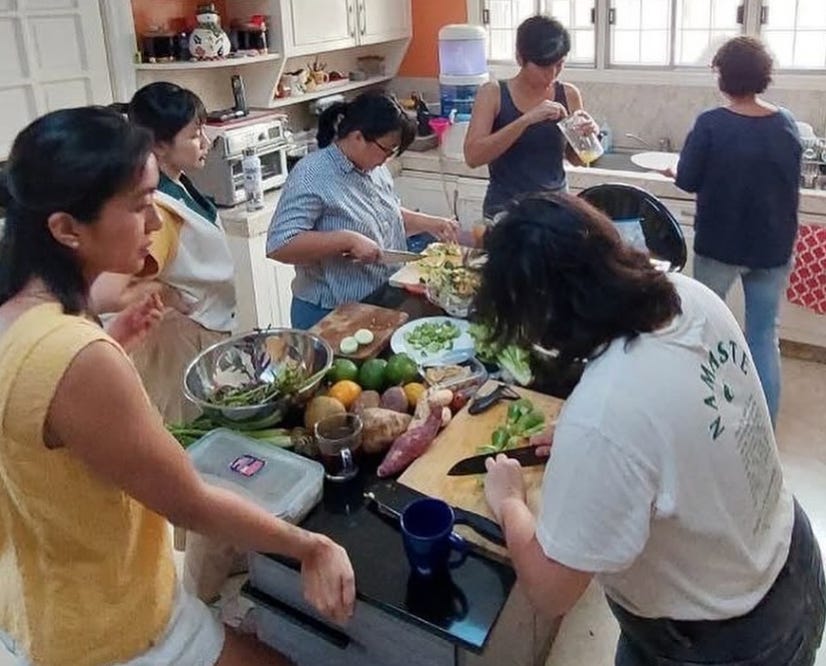
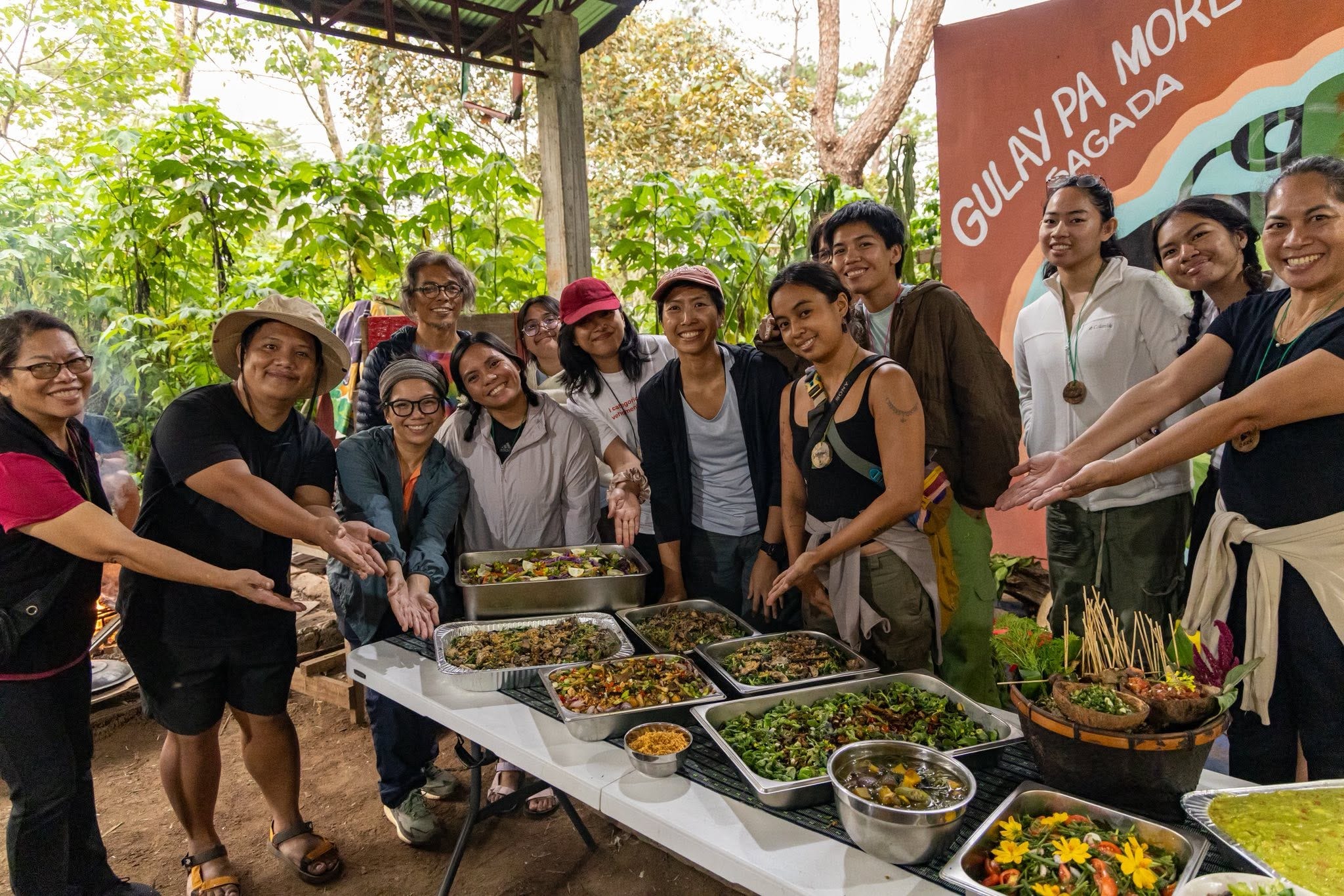
Cooking (in the more quotidian sense), like life, is an improv act.
These memories remind me to continue to re-orient my thinking and welcome the unfamiliar and the creative experiments we can do, especially with what grows organically, seasonally.
It is inconvenient, to use the mix of veggies one receives from a Pamayanihan or Community-Shared Agriculture (CSA) subscription, when we’ve gotten so used to getting what we want, when we want it. We want what’s familiar. We want choice and autonomy. The uncertainty of what veggies you will receive through community-shared agriculture reduces the choice and autonomy we have in this process. But there is something about remembering how nature works, appreciating what it chooses to grow and when, and re-learning to work with its cycles (even if that’s also becoming more unpredictable through climate change).
I’ve come to learn that the tampipis I receive from Good Food Community are a conversation with their partner farmers, and an invitation to inquire and engage further.
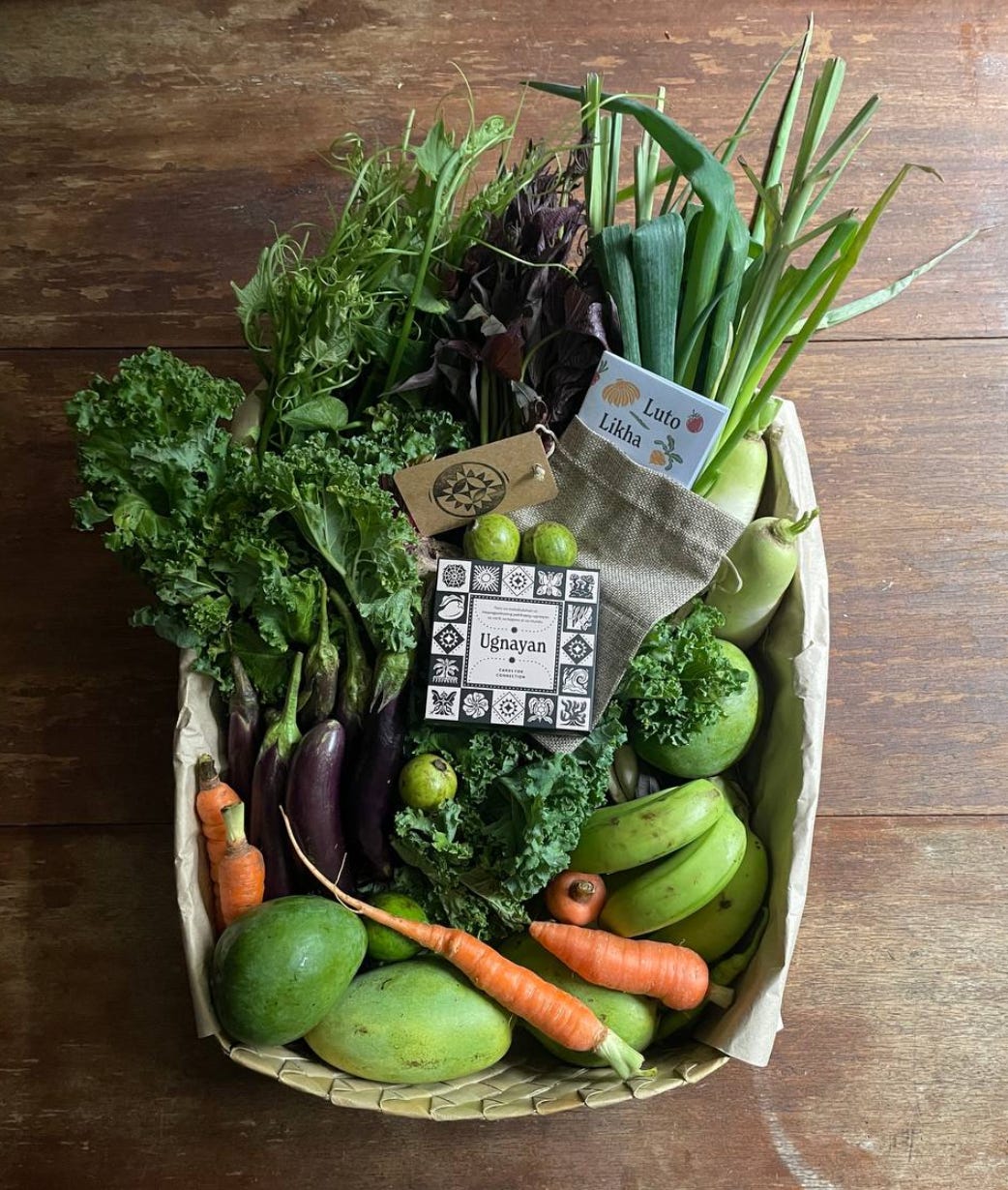
There are CSA subscribers I know who love the surprise, uncertainty and the creative challenges it brings. I wasn’t always so pleased. But I’ve come to learn more and more that the tampipis I receive from Good Food Community are, in a way, a conversation with their partner farmers, and an invitation to inquire and engage further.
Why is there an abundance of bananas of different kinds?
What makes your carrots so small? Or conversely, what makes other carrots so big?
I’ve never seen these small round red radishes. Where do they grow, and what do farmers do with them?
I got a alugbati buds in my tampipi? Is that a thing? What’s happening in the farms?
Why do I only encounter chesa and tamarillos through Good Food? Were their trees planted intentionally, or were they just inherited gifts from the land?
We don’t always like the hand we are dealt, and neither do the farmers, but we either get creative and make do with our diskarte, or get curious and ask why certain things are the way they are and what role we can play in making things better — for the land, for the farmers, and for us as co-producers or ka-gulay2.
Ease is not the point — at least not initially. But it’s my hope that eventually, it will become more easeful — for us, when we remember how to nourish ourselves as nature intended, and for farmers, when we support their efforts to bring us all back in right relationship3 with the land.
All these efforts aren’t “enough” to change the world because it requires many of us adopting these mindsets and moving in that same direction (albeit on different paths) to create transformative change. But while it may not be enough in that sense, to me, it makes a difference to try, and to continue increasing that capacity, or audacity, to try even when my attempts fall short, even when my actions are imperfect, even when I think what I do is ever really enough.
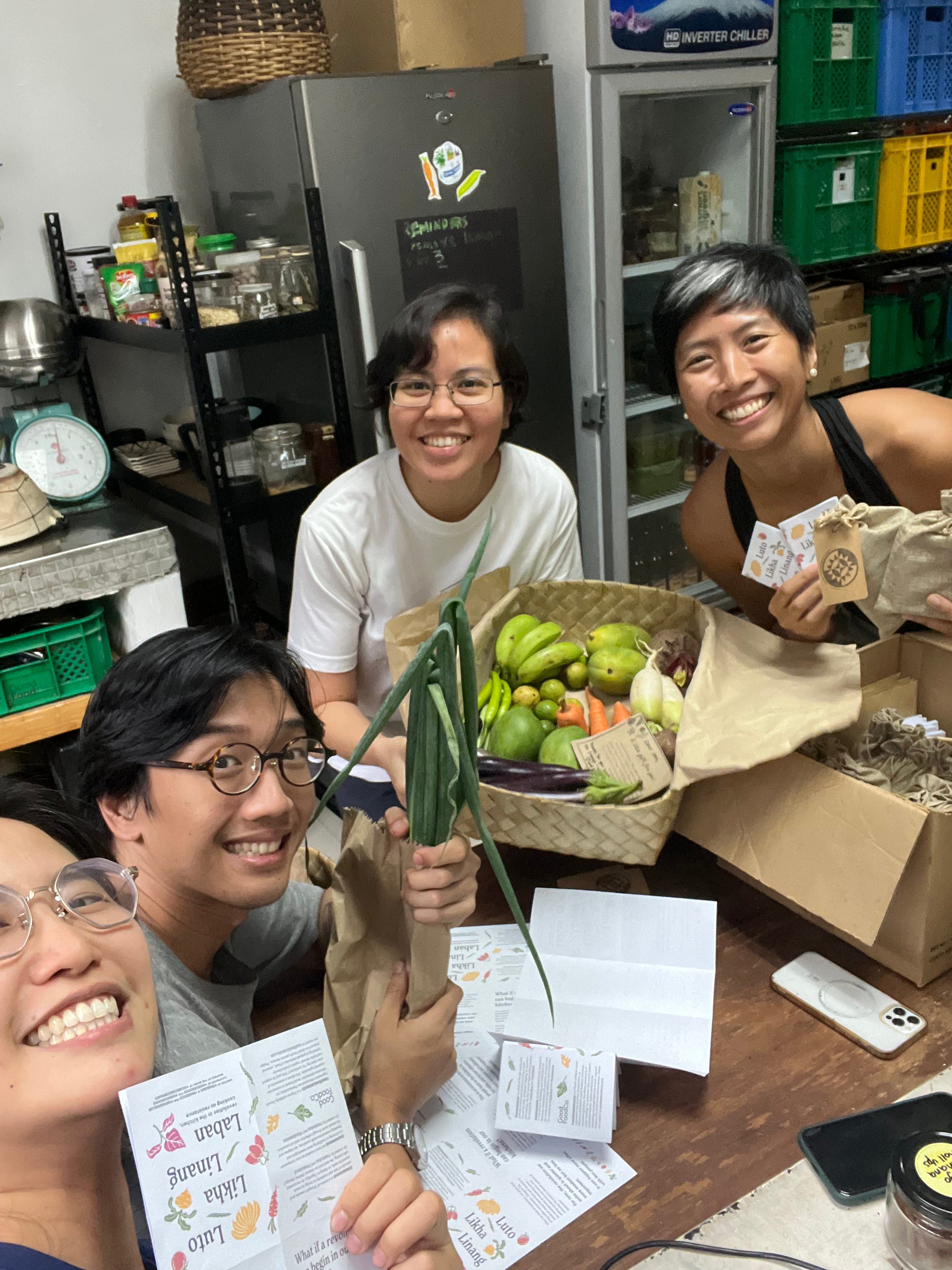
Get your Tampipi ng Ugnayan until July 6
If you’re also someone based in the US who would want to support our Tampipi ng Ugnayan fundraiser, you can also do so through the link below. By sharing your solidarity with us, you give the gift of nourishment to urban poor communities, receive the gift of connection through physical and digital tools and a gathering for connection, encourage Good Food Community’s farmer partners to farm organically, and you can also receive the gift, and help us grow a culture of collective care. Learn more via: hapagugnayan.fillout.com/us-kapwa.
In the spirit of collective care, I’d also like to invite you engage in some meaningful inconvenience to join us for Tikim at Tahi on July 19, 12nn to 4pm at Good Food Sundays, Mandala Park, Mandaluyong, a potluck of food and creativity to reconnect with the land, the kitchen and each other!
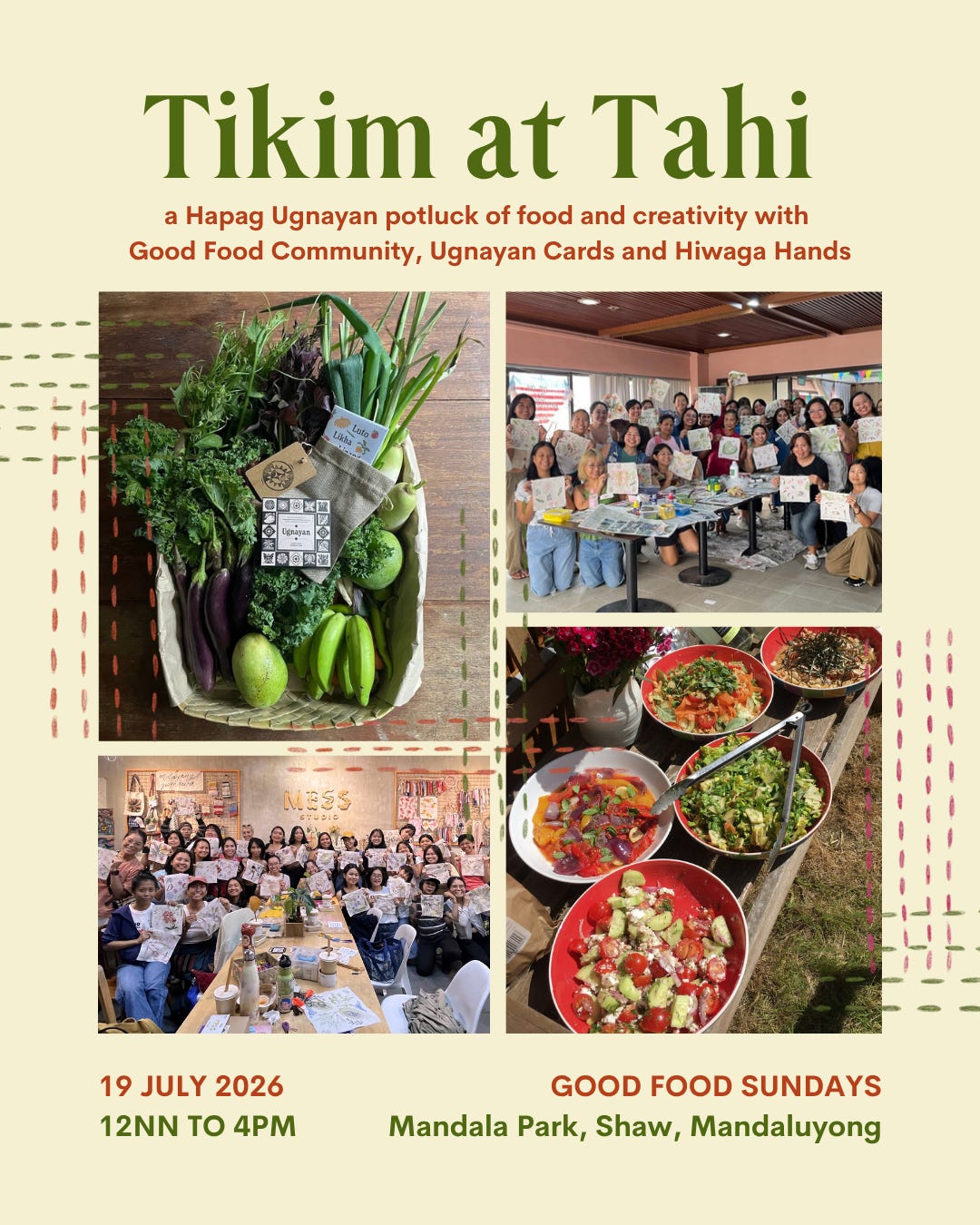
Join us together with friends from Good Food Community, Ugnayan Cards and Hiwaga Hands to:
Celebrate in community through a potluck of gulay-forward dishes
Connect with gulay friends from our friendship multiverse
Co-create with us by helping us work on a new or expanded zine around food or by stitching your solidarity on our shared table cloth
If you want to nourish yourself and others in a healthier, more relational, ecological and just way, then this gathering is for you. No cooking or sewing experience necessary -- only eating experience is required! 😆
This gathering is free for Tampipi ng Ugnayan subscribers a.k.a. ka-gulays and their +1s!
Join us for Tikim at Tahi on July 19!
I’d been sitting on this post for a loooong time. I wasn’t quite sure on how to advocate for inconvenience because I’m still struggling with it myself.
There are days when the struggle is lighter, and days when it is heavier. It doesn’t seem like a choice we would willfully make for ourselves. But to also yield to the current system of “the way the world works” doesn’t sit well with me either.
So in the meantime, I’m seeking fellow stubborn, delusional and audacious people who also believe in the possibility of better futures around food. If that sounds like you, I hope to connect with you.
Hope to see you in one of those physical or digital spaces in the future!
Tungo sa sustansya at sagana,
Jen Horn | @pagbubuo
It is a form of Community-Shared Agriculture, or a relationship where urban-dwelling folks like you commit to subscribing to Good Food Community’s (GFC) farmers’ harvest and get it delivered weekly. This assures GFC’s farmers that there’s a market for their produce so they can focus on cultivating their ecological agriculture practices. It is grounded on 4 principles:
Pamana ~ Honoring and preserving our values and heritage; creating a living legacy for future generations
Pamayanan ~ Growing community through relationship- and trust-building and collective care
Anihan ~ Celebrating an abundant, diverse, zero-waste harvest when we co-design with people and nature through agroecology
Bayanihan ~ Carrying a shared responsibility, commitment, action and accountability for the flourishing of all
In Tagalog, “ka-” is a prefix that indicates connection, partnership, or shared identity. To be a ka-gulay means being someone who shares our same gulay or veggies, and through our Tampipi ng Ugnayan, someone who engages with us through Pamayanihan or Community-Shared Agriculture, a form of pagtataya or betting on small organic farmers and on growing our ka-gulay community.
Being in “right relationship” is a phrase I picked up from adrienne maree brown’s repeated use of the phrase in her work, emphasizing an intentional and interconnected way of living and organizing that replaces harmful patterns of extraction and domination with practices grounded in mutual respect, accountability, adaptability, liberation, and love.
Comments
Nothing yet. Say the first thing.
Sign in to join the conversation.