
Hi there!
I’ve been reflecting on the different ways that culture-building has shown up in my life through different roles, disciplines and spaces. Moreover, I’m tickled when life gives me metaphors to make sense of things and integrate otherwise disparate parts of my life, so I’m leading with that in my writing today. 🌱
I break down the sucrose of my thoughts into three parts here:
From pagbuburo (fermentation) to Pagbubuo (formation)
From kombucha to companies to communities'
Culture-building lessons from fermentation
…with reflection prompts for you to ferment thoughts with me.
I finish off the post by sharing a couple of gatherings / workshops for connection and culture-building in the different senses of the term. 😊
What does culture-building mean to you in your life?
Recently, I’d shared about making kombucha in one of my gatherings at home, and it unlocked an excitement for me to share more about kombucha-making with other friends who have belatedly expressed their interest in it (even if I’d been making it since 2023).
There’s something weird and magical about making kombucha and fermentation in general. Observing the changes in my ferments feels like an adult version of playing with a tamagotchi1.
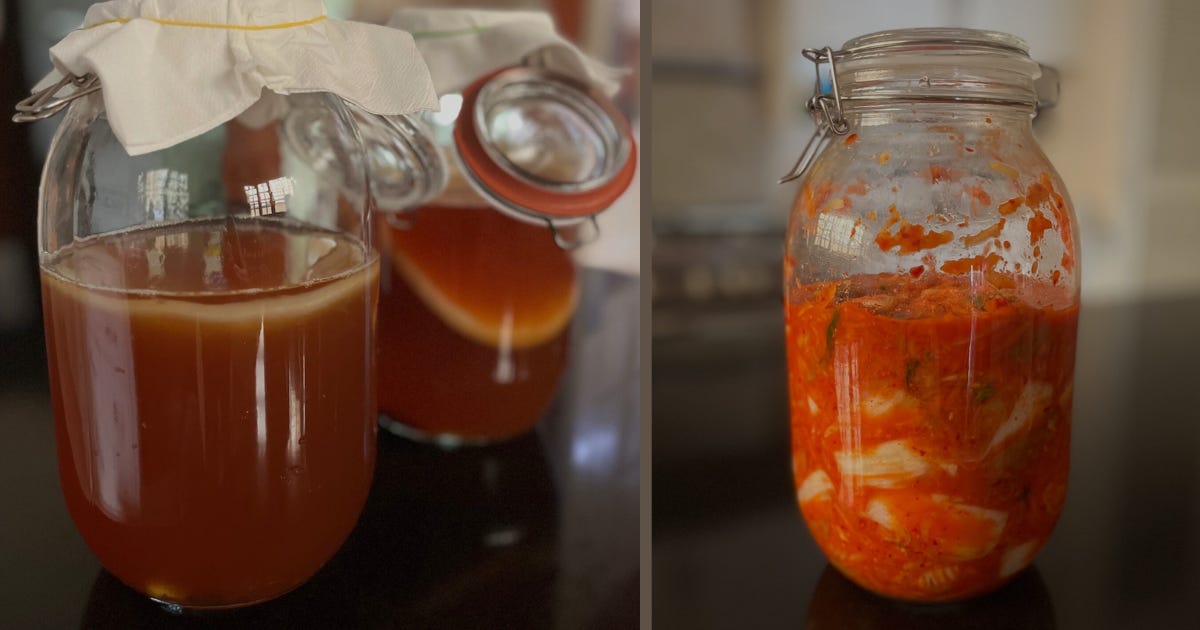
Seeing the new pellicles of my SCOBY (short for a Symbiotic Culture of Bacteria and Yeast!) form is really gratifying, especially when the new “pancakes” (or pellicles) that form are perfect disks. Seeing the bubbling up of my kimchi from lactic acid fermentation also lets me know it’s alive!
I’ve loved the metaphor of fermentation, and the metaphor is something appreciated by both fermenters and not-yet-fermenters alike. There’s even a book called Fermentation As Metaphor by Sandor Katz.2 On the Emergence Magazine podcast he shares:
In both literal fermentation and metaphorical fermentation, the fermentation is breaking down previous forms into new forms. […] Fermentation is all about creating environments and it’s the environment that determines which among the many organisms that are present on any food, in any given situation, are going to be able to thrive. In the metaphorical ferment, it’s the same thing. Our environment is shifting, and we have to shift the structure or some aspect of how we’re organizing our lives and our society in response to that.
Fermentation is about creating these environments for new growth — cultivating, culture-building. When we think of the words, culture in Tagalog is “kalinangan” from the root word “linang” or to cultivate. There is the development of something that involves the process of pagbuburo (fermentation) towards pagbubuo (formation/integration) of something new.
Looking back at my life in the past 5, 10, 15 years, I’ve come to recognize a role I’ve played whether or not I’d used the term “culture-building”.
As a casual, home fermenter, I’d say that culture-building is:
A process of developing, nurturing, and maintaining a healthy community of microorganisms — such as bacteria (the good kind!) and yeasts — to transform raw ingredients into healthy food and beverages.
As a facilitator and coach who has worked with organizations on leadership and team development, and as Manila chapter lead for Culture First (a global community dedicated to co-creating a better world of work), I’d say that culture-building is:
A process of defining, communicating and integrating values, beliefs and goals of an organization into their workplace and ways of working.
As an advocate for regenerative and just futures, before through Muni, and these days through Good Food Community and Hapag Ugnayan, I’d say that culture-building is:
A co-created process of both honoring the values and traditions of our ancestors (both human and more-than-human), integrating those with present-day needs and practices (and shifting some mindsets, if necessary) to cultivate collective care for the world we are leaving for future generations.
In each of these culture-building processes, there is a co-designing of an environment to make it conducive to breaking down something to cultivate something new where more life can thrive.
In making kombucha, it is about creating an environment that breaks down sugars and induces carbonation to create a tart, effervescent, probiotic beverage.
In organizational development, it involves creating an environment where we can break down what doesn’t work and surface what our most deeply held values are, in order build up the language, practices, systems and structures we actually want in our companies.
Similarly, in the kind of social transformation I’d like to see, it involves creating an environment that can break down oppressive beliefs and systems while supporting people with spaces and structures for more equitable and liberatory ways of being in relationship with the land and with each other.
These are fractals of transformation.
Co-design and co-creation is an important feature because there is a dynamic interaction between different organisms in each of those environments to build up their culture. It happens over time with various actors playing different roles at different points, requiring the active participation of those different actors in the culture-building process.
Fermentation is a process that involves the environment or space, time, microbes or cultures, and the experimenter (us). Here are some of my reflections for each one of those aspects, with some prompts for your own reflection too.
We wash our hands. We sterilize the jars. We create the tea. We add the sugar, making sure there’s enough sweetness for the SCOBY (Symbiotic Culture Of Bacteria and Yeast) to consume. We cover it and keep it in a cool, dark corner.
At the same time, in the laboratory of life, there is an acceptance that there are only so many variables we can control or manipulate, and that we need to collaborate with certain bacteria for the fermentation process. So, we just try to do what we can to create the conditions for beneficial bacteria to thrive and for detrimental bacteria to not develop.
In what ways is your current environment designed for personal and collective flourishing?
What ingredients and processes are needed to sustain a symbiotic culture?
Who / what are the beneficial bacteria that can help?
In a society that conditions us for speed and convenience, the process of fermentation is an intentionally slow one — “a creative space between fresh and rotten” as Sandor Katz puts it.
We sometimes need periods of slowness to generate greater value. At the same time, those periods of slowness call for us to still be active agents in creating the environmental conditions that make that transformation process generative and life-giving vs. rot-inducing.
What time, space and compassion can we give ourselves to explore that creative space between fresh and rotten?
How might we discern when are we fermenting or letting ideas ripen, and when are we putting things off because we’re scared?
In the first fermentation stage of kombucha, we can’t expect new SCOBY to form if we keep moving or micromanaging the container. It’s in those times that we need to trust the SCOBY to do its magic in the environment we created for it. “We move at the speed of trust,” adrienne maree brown said when talking about movement-building.3
Oftentimes, we just need to create the starting culture and trust that over time, the work will feed other “microbes” or organisms in that system, and help them to create new cultures too. It’s not a heavy-handed orchestration.
We trust ourselves as one of the microbes in a larger system of change. We trust that the other microbes will also do the work in the right conditions for mutual flourishing. And we trust that even when change is not so visible, smaller changes are still happening when we chose to instigate something.
What needs to happen for you to trust yourself and others more?
What do you need to relinquish control of or be more patient about?
In life and in fermentation, there is a stress balance that we need to navigate. Some stress is good for us (eustress in psychological terms4), but as the experimenter, we also need to know when we need to ease that pressure — either by slowing down the fermentation process, stopping it altogether, or even burping a bottle to release the accumulated gas.
I’ve opened enough bottles of kombucha to know that I want to avoid getting to that point, unless I want to clean kombucha off of the kitchen sink, counter, my face, hair or clothes…you get the idea. In some cases, maybe I filled the bottle too much. In other cases maybe I neglected it in that second fermentation stage, when I should have been paying more attention at that point.
What are your signs of accumulated pressure?
What might a healthy release look like for you?
In line with this week’s letter to you, I wanted to share two (2) upcoming gatherings for both literal and metaphorical culture-building this coming April 8 and 9.
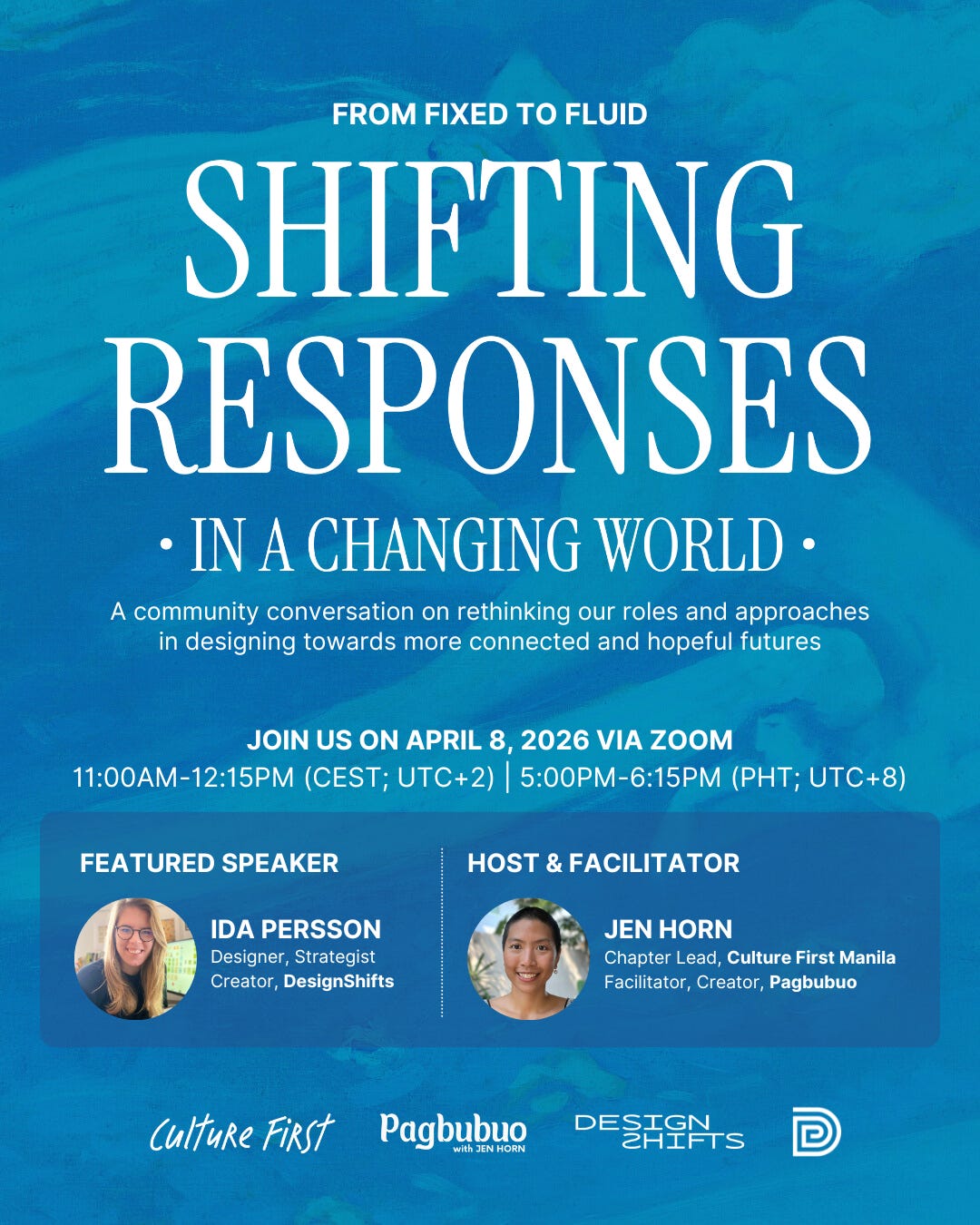
As Manila chapter lead of Culture First, a global community of people geeks who are moved to co-create a better world of work, I’m hosting and facilitating this community conversation with Ida Persson of DesignShifts on how shifting from fixed roles to fluid responses can help us move through discomfort and uncertainty towards more connected and hopeful futures. As someone who has both struggled and resisted giving herself one label / role / response, I’m looking forward to what this conversation might unlock for myself and others. 😊
What possibilities might open up for us and society when we learn to acknowledge and embrace the multitudes inside and beyond us? What if we have more capacity to co-design better places of work and a better planet to live in than the current operating system of extractive capitalism leads us to believe?
Learn more here: tinyurl.com/shifting-responses.
Sign up for free here: tinyurl.com/culturefirst-x-designshifts.
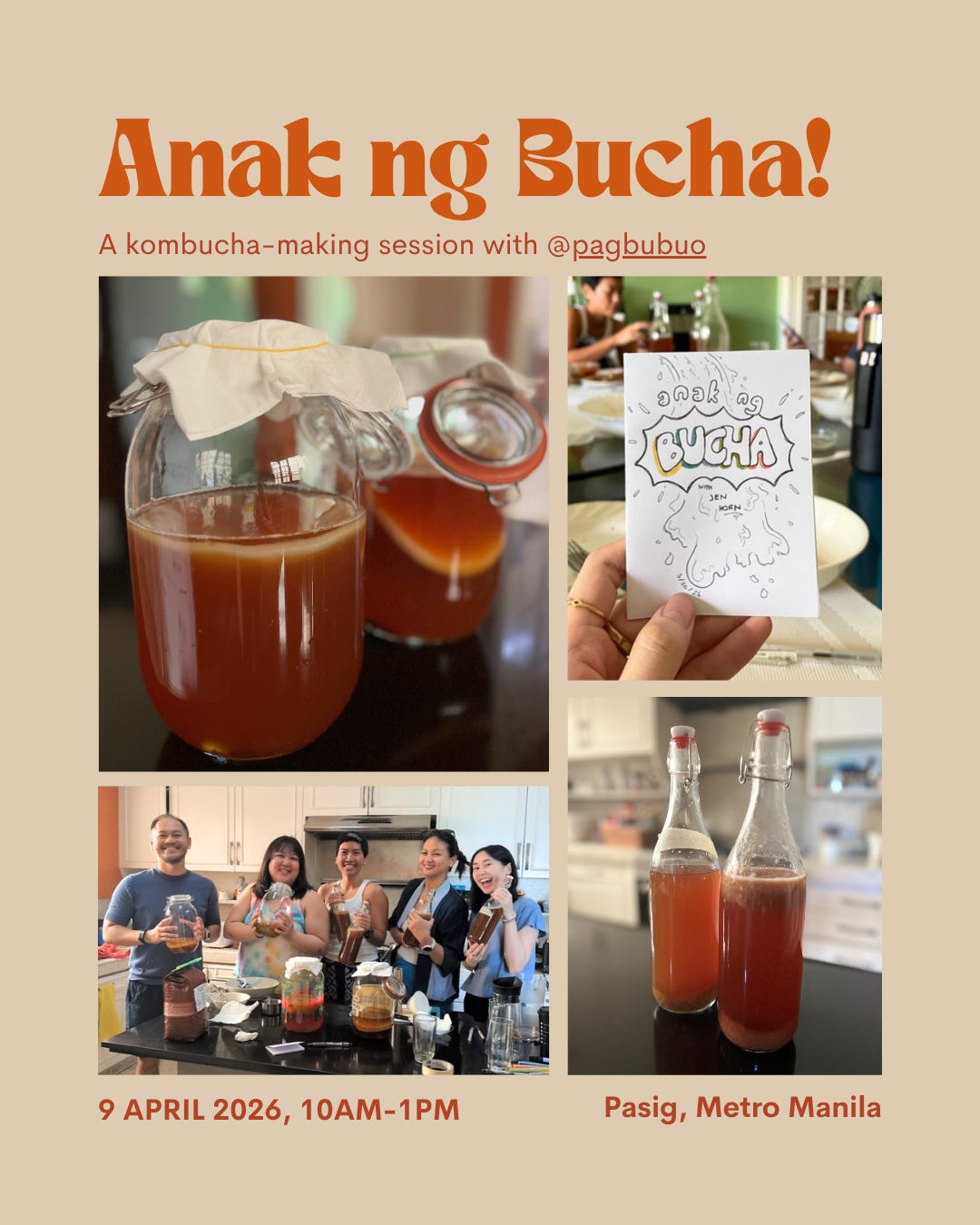
More friends have asked to buy kombucha from me recently — even though I have no interest in making this a commercial endeavor. The nth friend asked me to sell kombucha to her about a month ago, and it was the needle on the haystack that inspired me to offer a private kombucha workshop, and now, a public one. Because I’d rather share how you can easily create it on your own!
Literally, anak ng bucha ko yung ibibigay ko sa inyo! Join me on this “bonus day” (holiday) for a simple intro to kombucha-making from a playful and relaxed home brewer.
WHAT TO EXPECT
Get a brief background on kombucha and fermentation
Learn the basics of kombucha-brewing, including do’s and don’t’s to avoid mold
Sample different flavors of kombucha and discover ways to flavor your own
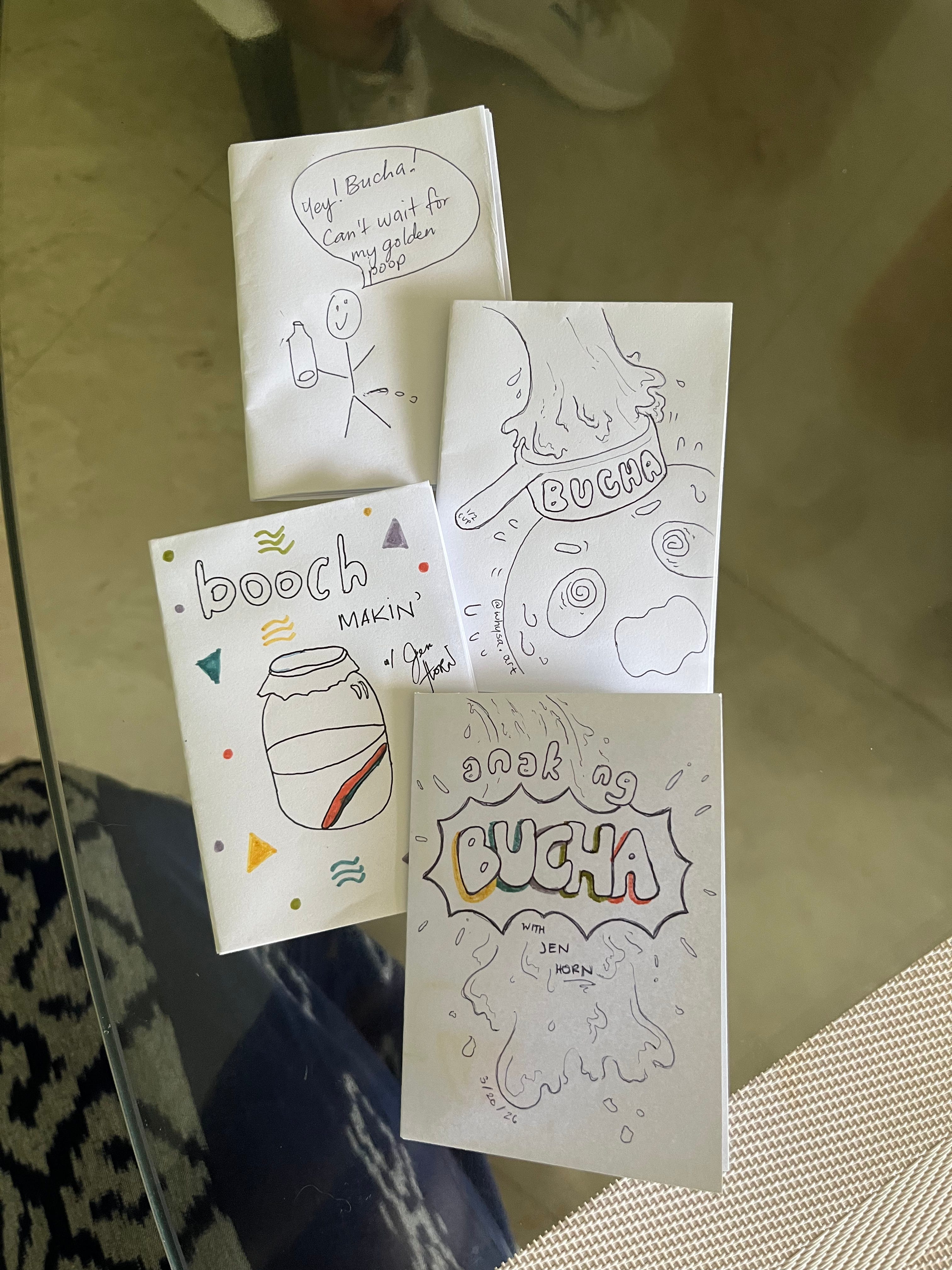
Reflect and create your own zine with fermentation as inspiration
* This workshop is not intended for commercial kombucha-making, nor do we make any therapeutic claims.
Off to ferment! ‘Til the next time!
Jen Horn | @pagbubuo
Sandor Katz is a “fermentation revivalist” who has written several books on fermentation. You can also listen to him talking about fermentation as metaphor on the Emergence Magazine podcast or read the interview transcript here.
A footnote from a previous post:
Comments
Nothing yet. Say the first thing.
Sign in to join the conversation.