
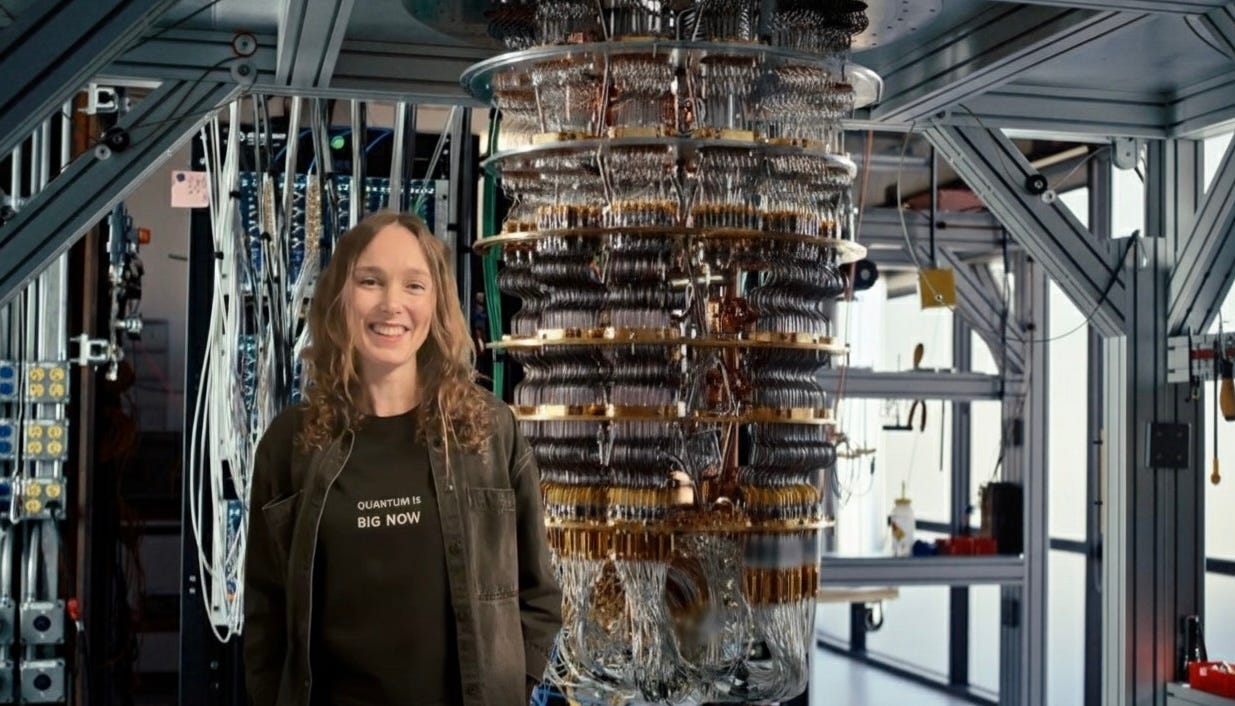
3 quantum researchers were just awarded a Nobel Prize for experiments they ran four decades ago. Why? They showed that quantum effects weren’t confined to sub-atomic scales; they could be harnessed across an electric circuit large enough to hold. And the laureates’ recent well-publicised breakthroughs in quantum computing showed just how big a deal their work is.
In other words: insiders have known for a while that quantum physics could be big. But it’s having a huge (magnetic?) moment right now.
I’m Jenni Munroe, and you’ve found JEN_AI: an AI-human experimental creativity lab specialising in generative artificial intelligence (a.k.a. GenAI) and bad puns. In this video/newsletter/podcast series I challenge myself (and you too, if you feel like it) to use AI, tech, culture and media to learn the latest in AI, tech, culture & media, and try to work out what it means to be human in the age of AI.
This week, I dust off my rusty Oxford Physics degree and grab some AI tools (Google’s Gemini, NotebookLM, Nano-banana & Veo in Flow, plus Descript) to help me co-generate quantum content.
If you’re like me, you might be concerned that we seem to be struggling with two irreconcilable perspectives on the laws that govern us. Big vs. small. But there is a grain of hope that we can unify the two sides. Let me prove it to you.
What does ‘quantum’ even mean? The word comes from the Latin quantus, meaning “how much.” It refers to the idea that at the tiniest, most fundamental levels, things like energy come in discrete, individual packets, or ‘quanta’. Like a staircase instead of a smooth ramp. You can stand on step one, or step two, but there is no step one-and-a-half.
Quantum physics is the set of rules that governs this staircase-like world of particles smaller than atoms. And the rules are very odd: Particles can be in multiple places at once. They can be linked across vast distances. And they behave differently when you’re looking at them or interacting with them. It’s a world that operates on probabilities.
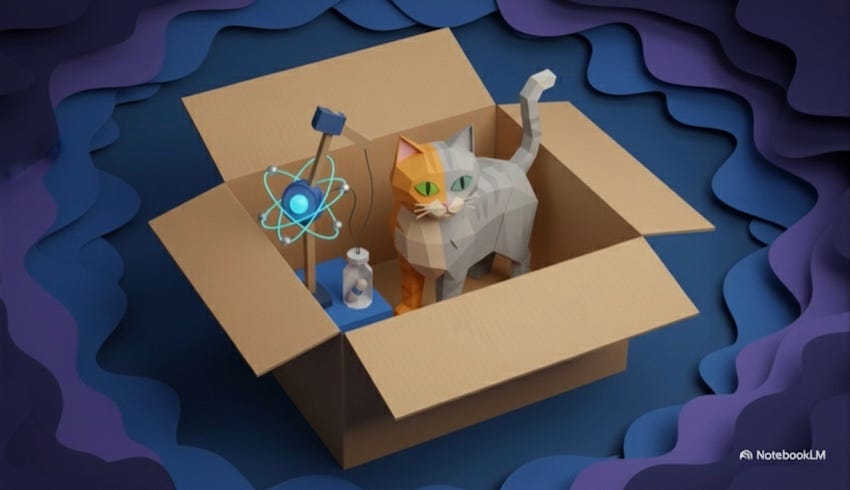
You’ve probably heard of “Schrödinger’s Cat”: a story about a box containing a cat which is simultaneously alive and dead. The imaginary cat-box is connected (via a very convoluted setup) to a hypothetical radioactive atom. If the radioactive atom decays, a vial of cat-poison is released into the box. If the atom doesn’t decay, the cat lives. But the atom follows quantum rules: so it isn’t simply ‘decayed’ or ‘not decayed’; it exists in a kind of fuzzy, furry “superposition of both states” - and the cat is both alive AND dead - until someone looks at it.
Like a coin spinning in the air: while the coin spins, it’s not heads or tails. It’s a blur of both possibilities.
So yes, this is the story of Schrödinger’s Cat, but the point of the “thought experiment” wasn’t to say “this is how the world works”: Erwin Schrödinger was trying to point out how ridiculous it would be if the bizarre rules of quantum physics applied to something as big as a cat.
He was saying: Cats can’t be both dead and alive.. so at what size does the quantum world break down and our ‘classical’ world begin? Why do tiny particles get to live in this strange state of multiple possibilities, but larger objects like cats, buses, and people don’t?
He was saying: Surely quantum physics doesn’t work for things the size of cats. Right, guys?
Turns out he was wrong.
John Clarke, Michel H. Devoret, and John M. Martinis won the 2025 Nobel Prize in Physics. The official Nobel Prize press release puts it perfectly:
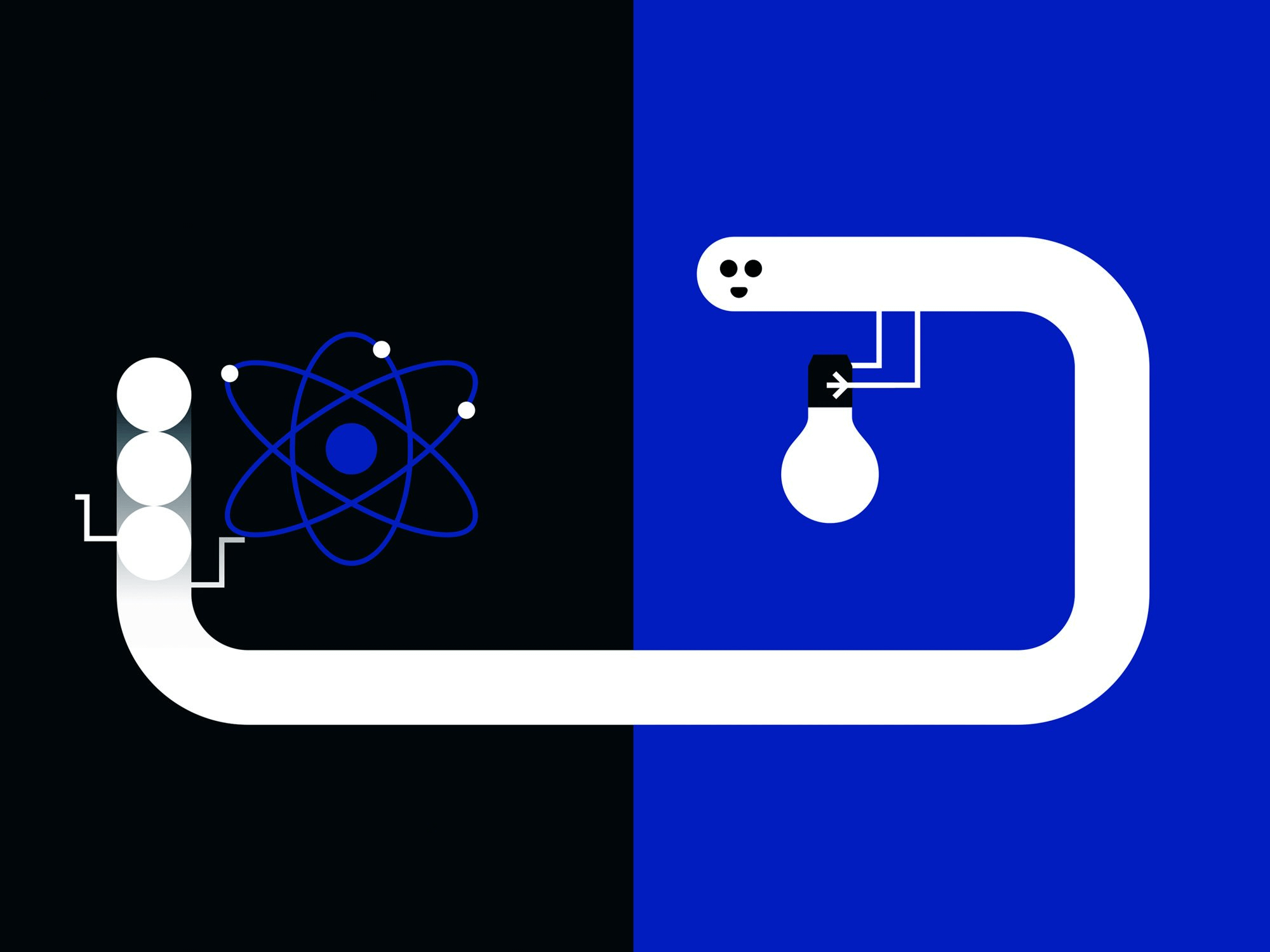
“A major question in physics is the maximum size of a system that can demonstrate quantum mechanical effects. This year’s Nobel Prize laureates conducted experiments with an electrical circuit in which they demonstrated both quantum mechanical tunnelling and quantised energy levels in a system big enough to be held in the hand.”
This is huge. (Paha)
The whole point of the cat story was that we don’t see quantum weirdness in our everyday, hand-held world. But these scientists created a system, a circuit you can physically hold, that behaves in a way you can only predict using quantum rules.
What did they actually do?
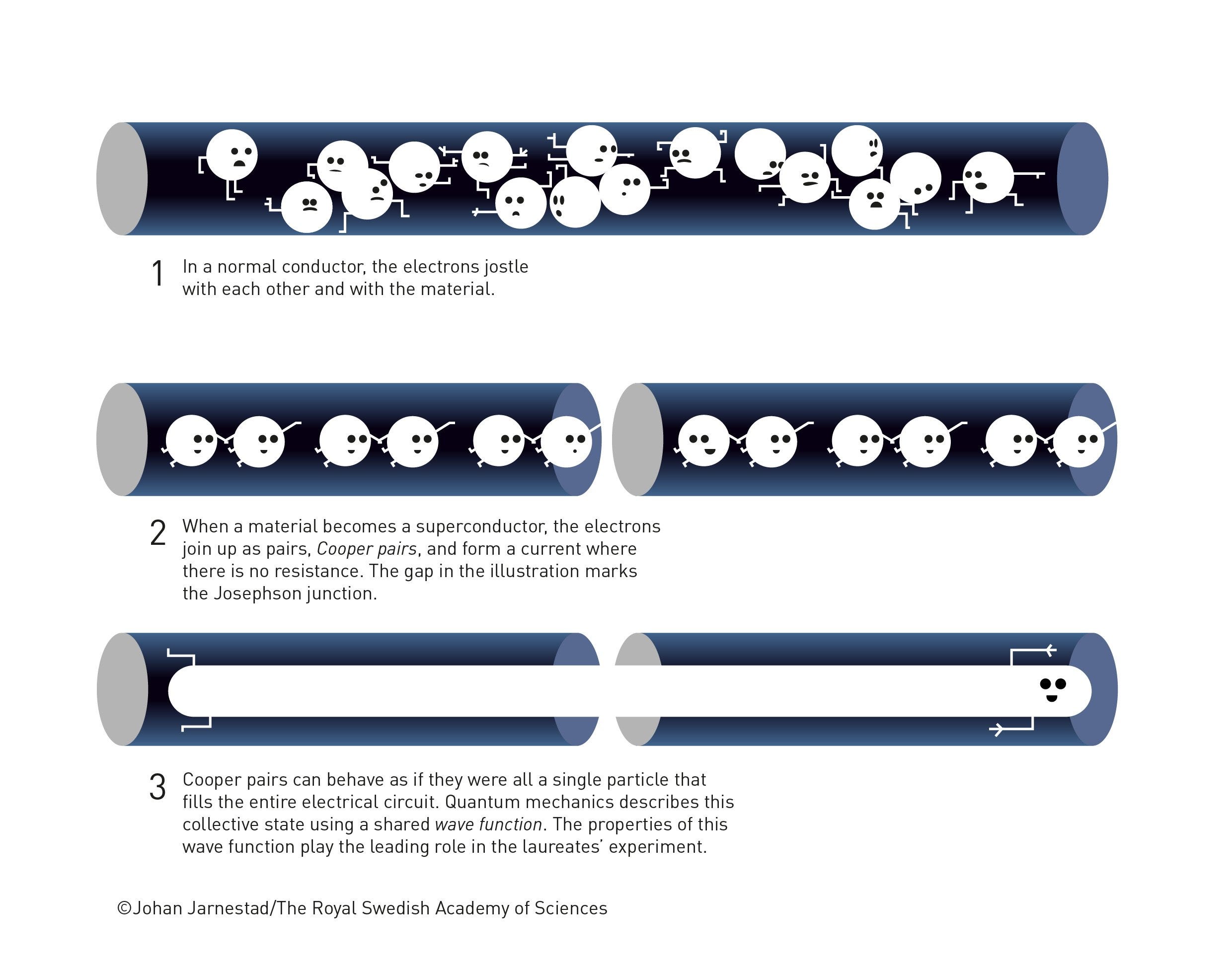
They built a supercooled, superconducting (zero resistance) electrical circuit featuring a “Josephson junction”- two superconductors separated by a thin insulating barrier.
Initially, the circuit was settled in a stable zero-voltage state. It was “trapped” in an energy well, similar to a marble resting in the bottom of a bowl, lacking the classical energy to get over the rim.
First, they observed Macroscopic Quantum Tunneling. They watched the system spontaneously escape this trap and switch to a state with a measurable voltage. This was a remarkable feat: the collective state of billions of electron pairs was behaving like a single “artificial particle” and tunneling directly through the energy barrier - an act forbidden by classical physics.
Second, they proved its quantum (=steps not ramps) nature. To confirm this, they exposed the circuit to microwaves. They found it only absorbed energy in specific, discrete amounts (quanta). When the microwave frequency was just right, it “kicked” the system to a higher, distinct energy level, causing it to tunnel out of the trap much more rapidly.
This was the smoking gun: it proved the circuit had quantized energy levels, behaving like a single, large-scale “artificial atom” whose quantum state could be precisely controlled. More info here.
They built a bridge between the microscopic quantum world and our macroscopic classical human world. But they did these experiments in the 80s! Why the Nobel now? We can only guess. But did you know Einstein technically never received a Nobel Prize for his most famous work, relativity; it was considered too contentious at the time, so he was officially awarded the prize for a “safer choice” experiment, even though it was generally understood that the prize was in recognition of relativity and his wider work. Speaking of the 2025 laureates’ wider work and what may have prompted recent recognition:
What do you do once you can control a “big” quantum system? You build a quantum computer.
Your phone or laptop works with bits. A bit is a simple switch: it’s either a 0 or a 1. Off or On. That’s it. A quantum computer uses qubits. A qubit can be a 0, a 1, or - thanks to “superposition” - it can be both at the same time. Like the spinning coin. In fact, particles like electrons have a quantum property we call spin, which we can use to stand for 0s or 1s. Spin can be up, it can be down, or it can be in a superposition of both, described by what we call a wavefunction: a mathematical equation that describes all the possible states the electron could be in. What’s weirder is - the electron actually IS in all these states. (You could say the universe is holding the space.) But when the spin is measured, the wavefunction collapses, and we get our answer.
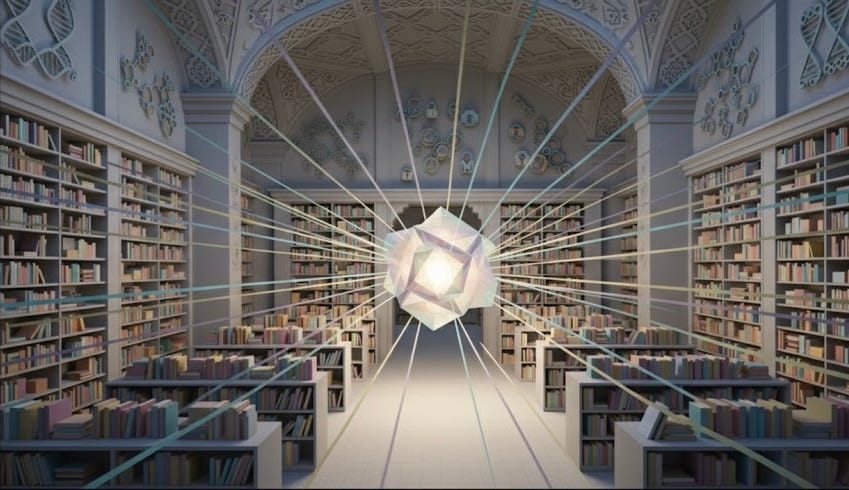
A classical computer is like searching a library for a specific piece of information by checking one book at a time. It’s fast, but it’s linear. A quantum computer, by using superposition and another trick called “entanglement”, can essentially check every single book in the library simultaneously.
What will this allow us to do? We could break all of our current security encryption methods and create uncrackable new ones. We could design new materials and medicines by simulating molecules with perfect accuracy. We could solve hugely complex optimization problems in finance, shipping, or weather forecasting that would take today’s best supercomputers billions of years.
So, what’s so difficult? If you look at a one of the latest prototype quantum computers, most of what you can see is basically a supercooled, shielding refrigerator. The main challenge they are battling is a problem called “decoherence”. Qubits are incredibly fragile. The slightest vibration, temperature change, or stray magnetic field can knock them out of their delicate quantum state and make them behave like a normal, boring bit. It’s like trying to balance a billion sharpened pencils on their tips, all at once, during a low-key earthquake. (Or like trying to use a cat in a controlled physics experiment.)
This is precisely why creating a stable, larger-scale quantum system was such a breakthrough. It was a crucial step toward building a useful, fault-tolerant quantum computer. In fact two of the three Nobel prize winners were former or current leads at Google’s Quantum AI lab, and during their tenures have demonstrated three key breakthroughs:
“Quantum Supremacy” (=faster than regular computers): In 2019 (with the Sycamore chip) the team were able to perform a calculation in minutes that would have taken a supercomputer millennia. The goal wasn’t to solve a practically useful problem, but to demonstrate that a quantum computer could perform a task far beyond the reach of any classical machine.
Quantum Error Correction (=better stability): Using the Willow chip in 2024, the team showed that by combining many physical qubits, they could create a more stable “logical qubit” with a lower error rate, providing a clear path to building the reliable, large-scale quantum computers needed to solve real-world problems.
Just announced in Oct 2025: “Verifiable Quantum Advantage”: the team used new ‘Quantum Echoes’ software on Willow chip hardware to simulate a molecule: a checkable, real-world scientific problem completed 13,000 times faster than top supercomputers.
I feel like I should mention the aspect of a Google quantum computing blog post that made it onto a Joe Rogan podcast - “the notion that quantum computation occurs in many parallel universes, in line with the idea that we live in a multiverse”
Let’s bring it back for a second - Physicists agree that the maths of quantum mechanics works, but they disagree about what it means. The “Many-Worlds Interpretation” of quantum physics suggests that instead of a single reality, every quantum measurement with multiple possible outcomes causes the universe to split into a corresponding number of parallel universes. In this view, there’s no “collapse” of possibilities; instead, all potential outcomes actually occur, each in its own separate, unobservable world. For example, if a particle can be in two places at once, the universe branches into two, with the particle in one location in one universe and in the other location in the second. We only perceive one of these outcomes because we exist within a single branch, unaware of the countless other “yous” living out every other possibility in an ever-expanding multiverse.
This brings us to one of the most embarrassing and profound open problems in physics: we have two sets of rules for the universe. And they don’t join up.
General Relativity: Einstein’s theory of the very large. It describes gravity as a smooth, continuous fabric of spacetime being warped by massive objects like planets and stars. It’s beautiful and works perfectly for things like GPS and black holes.
Quantum Mechanics: Our theory of the very small. It describes the universe as grainy, probabilistic, and fundamentally uncertain.
When you try to use both sets of equations in extreme places, like the Big Bang or inside a black hole, the maths breaks down completely. Finding a theory of “quantum gravity” that unites them is the holy grail for Physics. Unfortunately, for now, it seems the science of the very small and the science of the very large defy each other.
But there is reason to hope. While General Relativity, our theory of gravity, refuses to cooperate with quantum physics, we have successfully “bonded” quantum mechanics with special relativity. And the result of that union isn’t just a ‘theory’ - it’s one of the most precise and accurate calculations in the history of physics.
Let’s talk about QED. This often stands for the Latin phrase “quod erat demonstrandum”. Meaning: “which was to be demonstrated” or “that which is shown”. It’s typically placed at the end of a mathematical proof or philosophical argument to signify that the proof is complete. It’s a way of saying, “I have proven what I set out to prove.” The Latin phrase is a translation of the Greek which was used by early mathematicians like Euclid and Archimedes. It’s a formal mic-drop conclusion to a logical argument. 🎤
But I didn’t mean that QED, I meant Quantum Electrodynamics
QED describes the relationship between light and matter.
QED shows that all interactions between matter and light are based on one fundamental action: a charged particle, such as an electron, either emits or absorbs a photon of light. For example, two (negatively charged) electrons repel each other by exchanging a virtual photon. Imagine throwing a ball (of light??) to a friend while you’re standing on an icy lake: the momentum would push you away from each other.
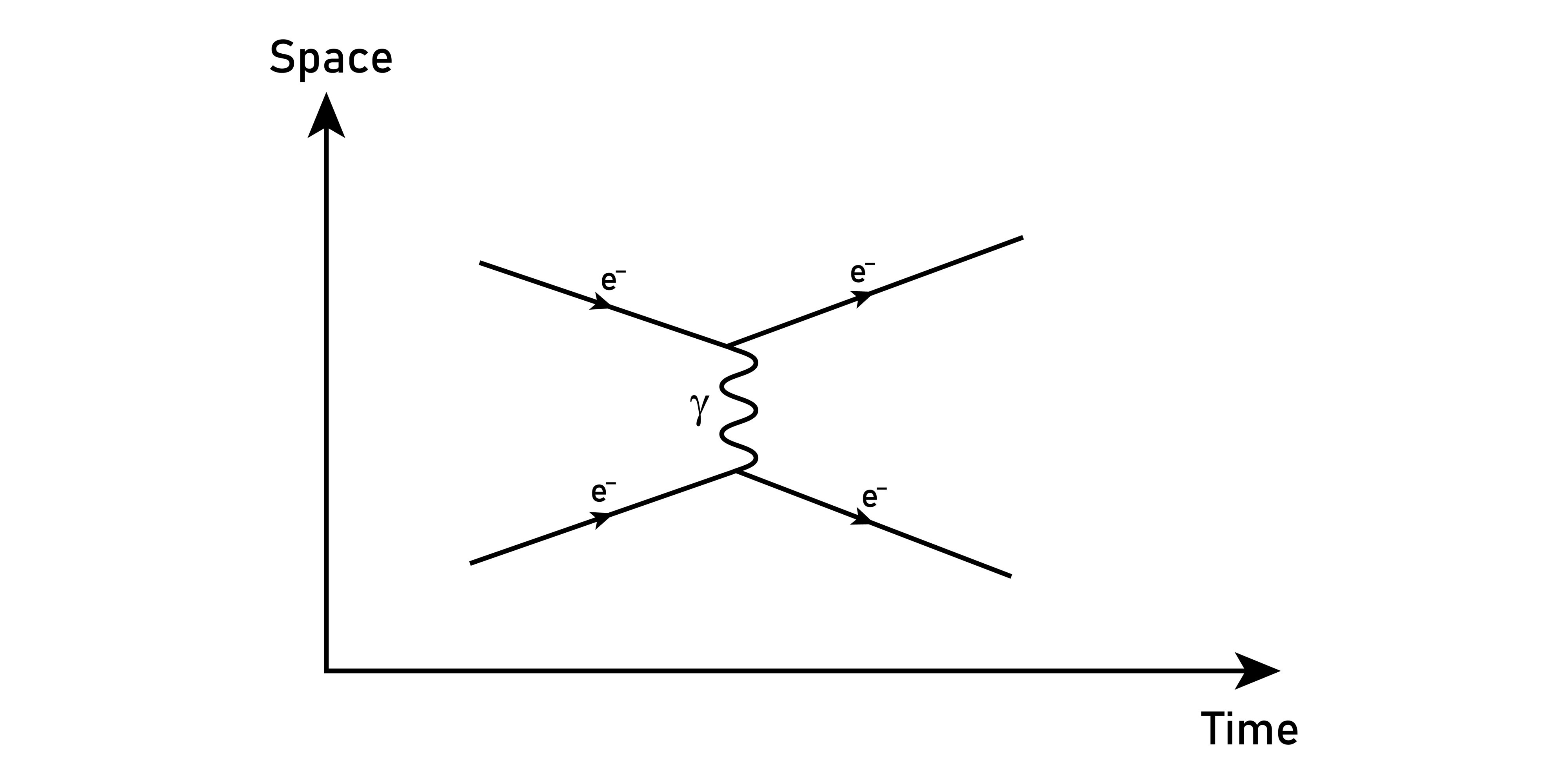
The level of agreement between what QED maths predicts and what we measure in experiments is staggering.
For instance, QED also predicts a property of the electron called its magnetic moment. A simple theory says this value, the g-factor, should be exactly 2. But QED accounts for the fizzing sea of virtual particles that an electron interacts with, and it predicts a value ever-so-slightly different.
Predicted by QED: g=2.00231930436256...
Measured in the Lab: g=2.00231930436153...
They agree to about one part in a trillion. It’s like measuring the distance from London to New York City and being accurate to within the width of a single human hair.
So look, that’s my take. 100 years ago, quantum physics was the science of the unimaginably small, with behaviour so strange it seemed it would never be relevant ‘in real life’, at human scale. But we are learning to bring that strange and powerful reality into systems we can hold, into computers that will reshape our world. And by the way, all our computers already rely on a different kind of quantum technology: it’s called a transistor, in a microchip.
To quote the Nobel press release: “Quantum mechanics is the foundation of all digital technology”
But more than that, I suspect there’s a small story here (not to mention a JEN_AI Challenge) about science communication. Or education. Or Public Relations? If you saw my AI “TED Talk” JEN_AI episode, you’ll know that It’s not enough to do great work. People need to know about it. To what extent does improved awareness of the value of a breakthrough contribute to increased recognition? Well the clue is in the question - recognition and awareness of value are all but the same thing. But it’s not just about awards - it’s about impact. The history of science is a tale of building on and improving what came before. But we have to know about it to build on it.
This probably won’t be the last Nobel awarded for quantum computing & its foundations. (And goodness knows who’ll win the Peace prize next.)
Einstein did win a Nobel, by the way. What was it for? Not relativity, but the quantum photoelectric effect. Work which laid a foundation for yet another Nobel: for a comprehensive and astonishingly accurate theory of light and matter. The first theory to fully unite special relativity and quantum mechanics. Sound familiar?
...Which reminds me, you might be wondering: why did I make this episode? What did I set out to prove, to show?
That quantum science and quantum computing are both larger in size now and having a bit of a moment
That you can use AI to usefully and enjoyably assist with science communication and learning
That physics has stories worth listening to
…but if it’s too much to listen, at least this ASMR-style video can help you get to sleep!
That effective comms could help you win a Nobel prize
That maybe it’s ok if recognition comes later
That there are weird parallels with the Wicked movie/musical/PR? (we’ll revisit)
And lastly that there is at least a quantum of hope that we can unite both quantum mechanics and gravity. And maybe even our divided world.
QED, bitches. 🎤
There is hope. Always. Who knows - maybe we’ll never find the common ground that truly unifies two vastly different ways of seeing the universe. And maybe our efforts will never earn us a quantum iPhone or an oh-so-coveted Nobel prize.
But that isn’t why we try.
It’s not about the prize.
And it was never about the size.
Apologies for explaining everything practically at the speed of light.. I know it can get a bit heavy. Ha, ha. (SPEED OF LIGHT JOKE: things get relativistically “heavier” the closer they travel to the speed of light. #sorrynotsorry)
If you’re uncertain on the principles or not sure what entangle meant, check out some experiments in Google’s NotebookLM: this fully AI-generated explainer vid, or the auto-generated podcast, or chat to the source material.
You can also jump down the rabbit hole by chatting with Gemini or your favourite chatbot. (There’s a “Guided Learning” mode in the Gemini app as well - click Tools.)
“Big Energy” by Latto. Yes, QED has BDE
JEN_AI is produced by Jenni Munroe using publicly released AI tools (incl. Google’s Gemini suite for edits, brainstorming, images (Nano Banana), videos (Veo) & explainer tools (NotebookLM), and Descript for video & podcast editing). Not endorsed by Google. My views.
👉 subscribe to get future blogcasts straight to your inbox (it’s free)
👉 share your thoughts, complaints & experiments
👉 send this to a friend who’s having trouble sleeping, it should knock them out cold
This episode is dedicated to my friend Alison Carroll, External Comms Lead for Google’s Quantum AI team (who will be truly horrified by this unvetted post). I might never be able to prove it, but I know that at least a *tiny quantum* of this Nobel Prize is hers too.
Thanks, as always, for listening.
Happy Halloween!
#jenai #quantumphysics #nobelprize2025 #quantumcomputing #quantumisbignow
Comments
Nothing yet. Say the first thing.
Sign in to join the conversation.