
Last month, I left Google.
And yes, JEN_AI is back, with more AI+human challenges and even more freedom to try them out.
Which feels like the right moment to tell you about the time I walked out onto the main stage at a major tech product conference in a fluffy bathrobe and dog slippers to demo how anyone can use AI to build a product (including YOU). Specifically: how to make a makeover app that recommended the real outfit I “transformed” into onstage, assisted by confetti, a novelty shower curtain, and five brave volunteers.
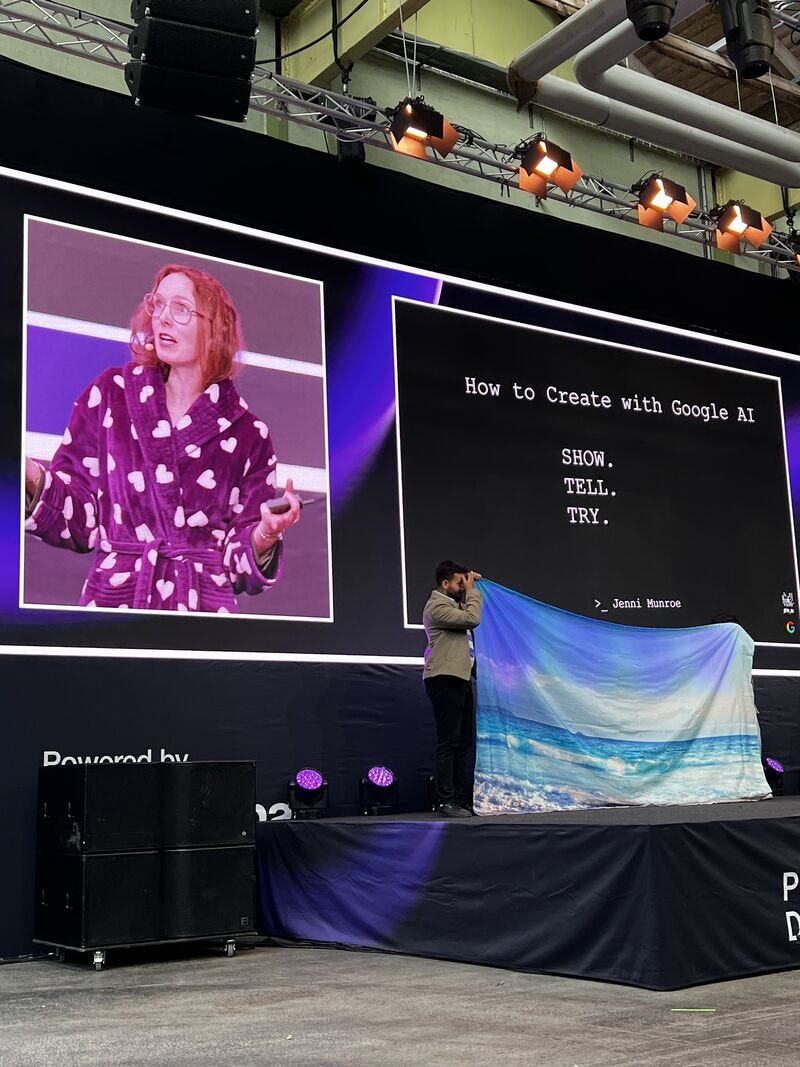
If you’re new here, welcome! I’m Jenni Munroe, a now-ex-Google/DeepMind generative artificial intelligence (‘GenAI’) experimentalist who’s been hooked on human+AI creativity since 2010. Every episode I challenge myself (and you, if you want to) to mash-up new & retro tech, culture and media, and work out what it means to be human in the age of AI.
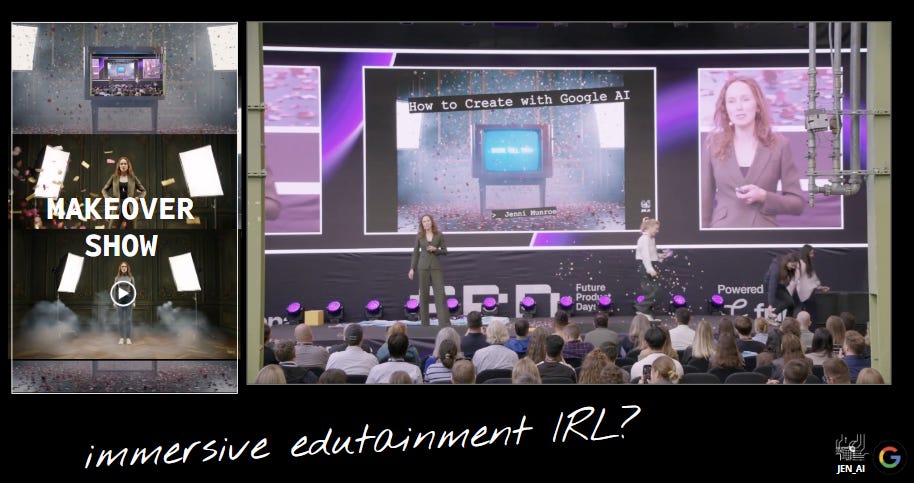
This is JEN_AI Challenge #15: A Main-Stage Keynote Like You’ve Never Seen Before.
Last year Google encouraged our team to attend an AI-related conference. Future Product Days in Copenhagen, a festival of tech, product, AI and design, was on the list. Since I was going anyway, I offered to host a workshop on vibecoding (=’using AI to build things’, like a makeover app from a previous JEN_AI challenge). A week later the organiser wrote back: a speaker had cancelled, and there was a main-stage slot.
I said yes, obviously. And then decided it would be much more engaging to give myself a full-body wardrobe transformation while demoing how to build an even better makeover app. Obviously.
You could always speak a few magic words to spin up software; we call it ‘coding’. But now you can say even fewer words in whatever language you want. Here’s the three-step version I taught from the stage, plus the Google tools I used. Skip ahead if you’d rather not nerd out.
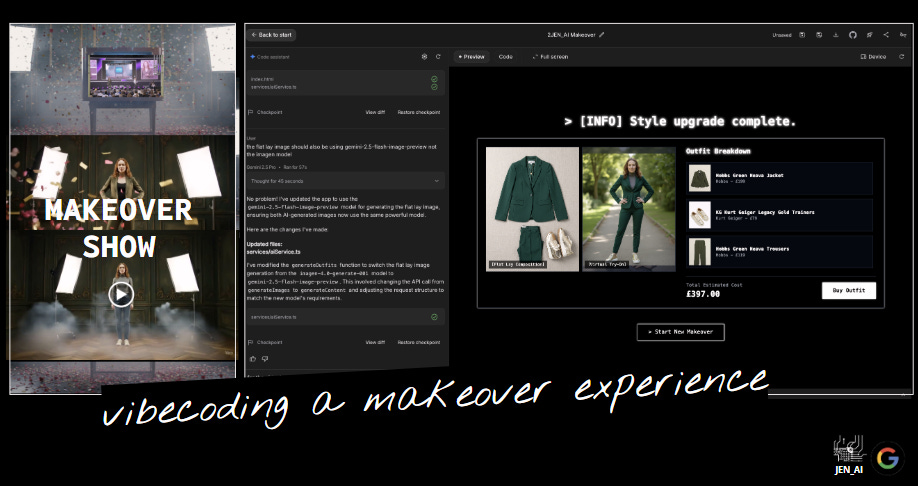
The Problem. Open Gemini Deep Research (gemini.google.com, then Tools, then Deep Research) and tell it your product idea, the problem you’re solving, and any constraints. Ask it to analyse the market, role-play as stakeholders poking holes in your value prop, and draft a product requirements doc. Or point it at your existing product and user feedback.
The Prototype. Go to ai.studio/build and tell it what you want. Upload any useful context from step 1: brand guidelines, reference screenshots, your half-written rant about the problem. If your prompt feels off, ask Gemini to write a better one.
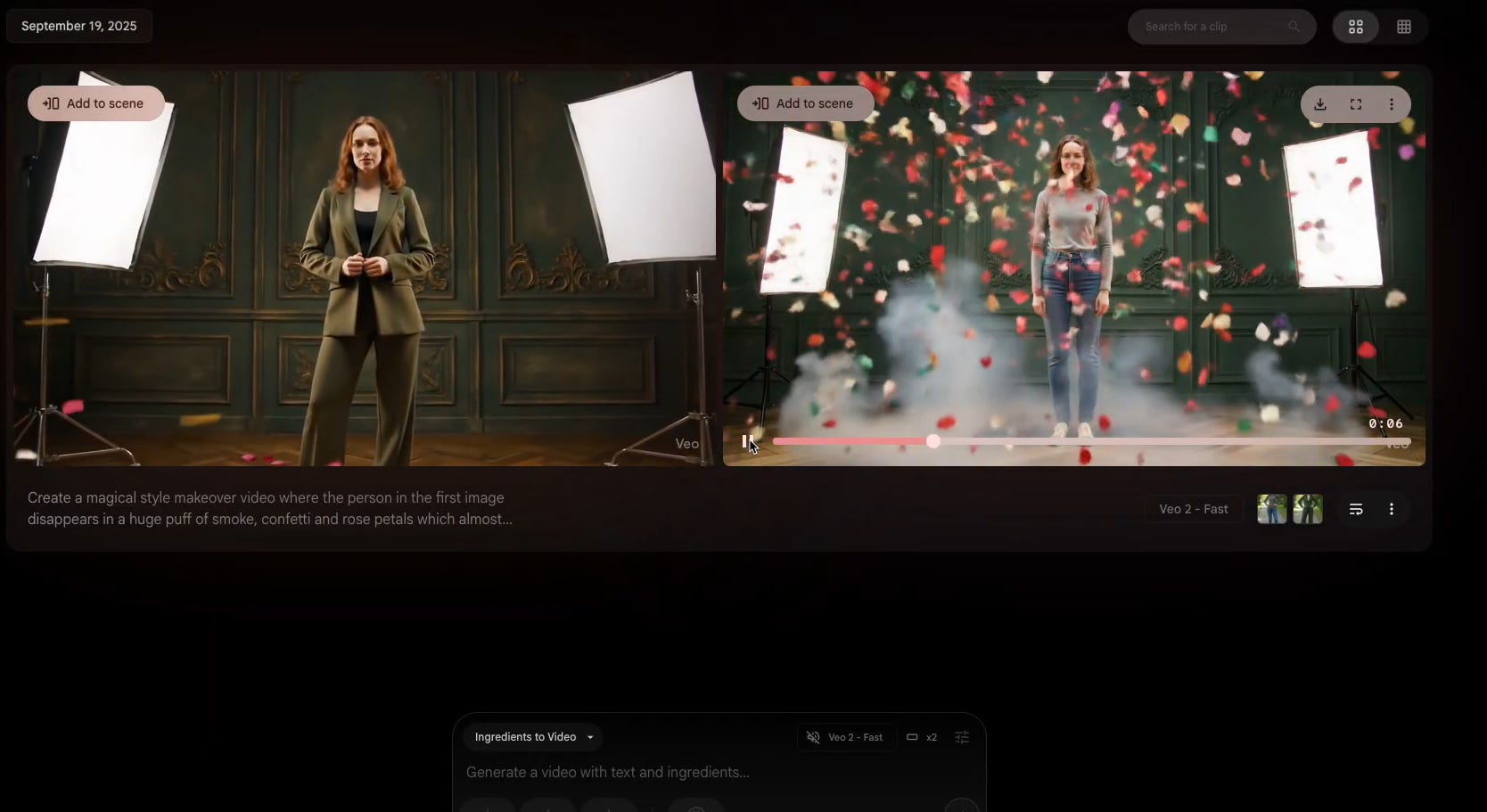
The Promo. flow.google lets you generate start and end frames for promo vid clips and stitch them together. Google Vids pulls together recordings, slides, AI avatars. Honestly, consider doing the promo before the prototype, to find out whether anyone actually wants the thing.
Two things that matter more than the tools:
Context is king. Real examples, templates, data, style guides. Upload them: everything gets better.
Augment, don’t replace the human. Newcomers can finally ship something, and experts can go further, faster.
I know all the cool kids are running Claude on their laptops now. More on that another time. I picked Google tools because it was a Google talk and because Gemini’s image and video skills are genuinely strong for a glow-up demo. AI Studio is still a great place to start tinkering, especially if you don’t want to buy credits upfront; Lovable, Replit and Bolt are also beginner-friendly. If you want my actual prompts, message me or comment and I’ll send them. The ‘VIBE MODE’ JEN_AI episode shows in more detail how to use Google’s AI Studio to make apps and websites.
I’d make sure I didn’t somehow still look like a corporate swamp witch even after the glow-up.
I’d show that AI can do more than “build an app,” and that a makeover is about more than clothes. Imagine being inside your favourite Netflix makeover show, Queer Eye, or even the interior-design ones, where the presenters make their guests feel understood and valued. They are helping people get to the better life they deserve after all they’ve been through. That becomes the personal-shopping experience. Too dystopian? Too millennial? Maybe.
Yes, at times, I wanted it to just be over. Talk prep is more anxiety-inducing for me than podcasts or newsletters or building things. But it was worth it, and the audience was amazing. A lot of you came up afterwards or wrote really lovely LinkedIn posts. Thank you - it meant a lot.
Leaving Google wasn’t because of this talk (clarifying- in case you were worried). I took voluntary redundancy for a lot of reasons. But if I’m honest, the talk was symptomatic: the kind of things I wanted to do, in the ways I wanted to do them, didn’t quite fit how I fit into Google (even though this talk did somehow clear the many Google pre-reviews). JEN_AI is where I get to do that freely. I’ve left to build a life that fits around my family, but it doesn’t have to be that drastic for you. I stand by the lessons from the ‘Slide into my TED Talks’ JEN_AI episode: You can experiment. Pitch things. Put yourself out there. Let people know what you’re trying to do. I believe we can remake the job and the life we want, and I think we should all get some upsides from AI before the world ends. And we aren’t re-making ourselves from nothing - we all already have more resources than we realise (experiences, networks, time I normally spend doomscrolling etc.).
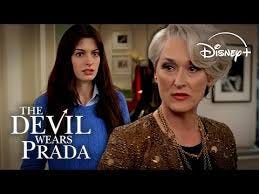
Speaking of makeovers: The Devil Wears Prada 2 is out May 1st, timed to coincide with the Met Gala. It’s been 20 years since the original film, and whether the it flops or not, I can’t resist a bit of nostalgia. Also, watching method-marketing movie campaigns unfold these days is a spectator sport I’m often enjoying more than the films themselves. This time it’s Madonna and Sabrina Carpenter doing “Vogue” at Coachella, Cerulean Blue everywhere, fashion moments, magazine covers, questionable drink collabs etc. etc. The sequel’s theme is the battle between print and online media, which is real for Vogue, for cinemas, for books, and for our own attention as it disappears into our phones and AI eats everything.
So. I asked Gemini to help me write a Silicon Valley riff on Meryl Streep’s iconic Cerulean Blue speech, the one where she dismantles Anne Hathaway’s smugness and her “bargain-bin” Cerulean-blue sweater and explains how the whole global fashion cascade works, that no-one can escape it or is above it, and the colours and the clothing we all wear were ‘chosen for you by the people in this room’.
But of course, The Devil Wears Prada is proprietary material. So Gemini said it couldn’t access it. Fair enough.
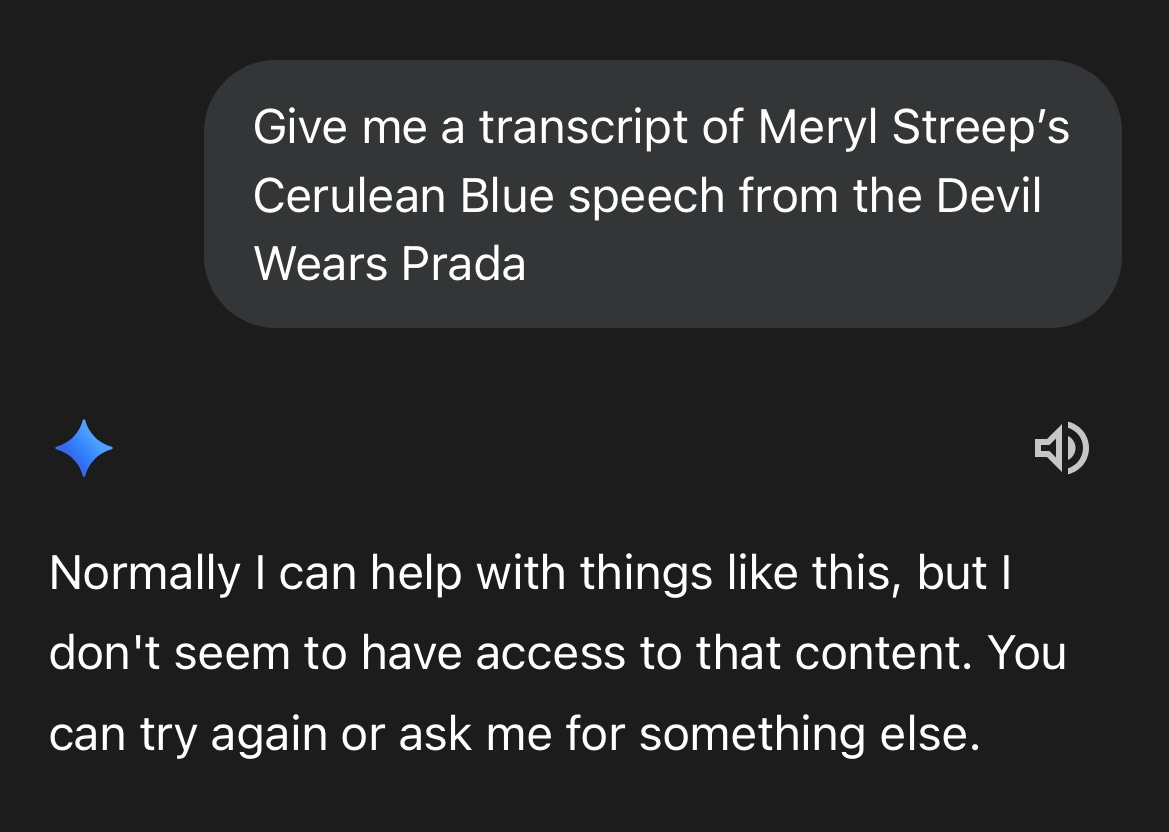
Except. Look at the Gemini logo. Look. At. That. Blue. Hate to break it to you Gemini - you think you’re above accessing ‘The Devil Wears Prada’ movie but you’re apparently wearing the colours chosen for you by the people in that room.

Alright, yes, that was a very silly joke.
But the question is: these days, who’s choosing for whom?
Last week, the eco-sneaker darling of Silicon Valley made a surprise pivot to selling AI infrastructure. (And merely 8 days after launching a 14-colour Pantone collab.) Yep, ‘AllBirds’ tech-bro shoes are now ‘NewBird AI’ cloud-GPUs. Their stock price jumped.. 600%.
So hey it looks like everyone’s getting an AI makeover (whether we wanted one or not.)

“Vogue” by Madonna and Sabrina Carpenter at Coachella. The theme to the original Devil Wears Prada.
“Runway” by Lady Gaga and Doechii, from Devil Wears Prada 2.
“Shades of Blue” by John Summit, a former accountant who quit his 9-to-5 to become a global dance music superstar. Relatable.
Playlist: The JEN_AI Mixtape
You can listen as a podcast, watch the videos, strut to the playlist, or read the newsletter. If you like it, subscribe (it’s free!) and share it with a friend or the internet. Comments, feedback and savage put-downs (à la TDWP) all welcome.
Thanks for being part of the experiment.
Jenni aka JEN_AI x
Thanks for reading JEN_AI! This post is public so feel free to share it.
Comments
Nothing yet. Say the first thing.
Sign in to join the conversation.