
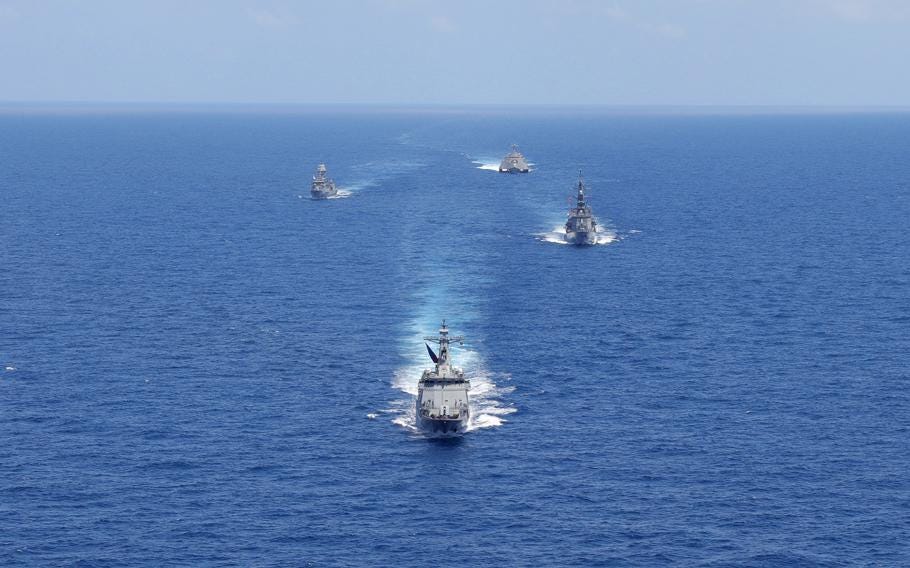
The South China Sea is one of the world’s most dangerous flashpoints—but it’s also one of the most misunderstood. While headlines understandably focus on ships and treaties, a deeper battle is about narrative: who belongs, who commands, and who controls the story of the sea. By turning to the fiction of Joseph Conrad, we can understand this contest not as a straightforward military confrontation, but as a murky performance of power. Literature, in this case, shows us what strategy often conceals.
In August 2025, Philippine officials condemned China for launching a rocket across the South China Sea. This latest event follows a series of perceived provocations, like the Chinese Coast Guard’s decision to use high‑pressure water cannons against a civilian research vessel in May 2025. The Philippines reasserted that U.S. support under the 1951 Mutual Defense Treaty remains “ironclad.” While similar tactics occurred before, this incident marked a notable escalation in tone. The Philippines also paired up with India, also in August, for joint naval exercises that China certainly noticed.
For years, Chinese naval pressure in the South China Sea has operated in a legal and strategic gray zone: never quite war, never quite peace. The strategy relies on ambiguity—civilian boats acting like military proxies, “historic” maps surfacing with no legal standing, artificial islands sprouting up in contested zones. But as China increases its pressure and Manila strengthens its diplomatic posture, the fog is thinning.
Or is it thickening?
Joseph Conrad knew this sea. Not literally—the South China Sea only appears indirectly in his fiction—but he understood the deeper terrain: lawless waters, confused jurisdictions, rival claims, and the stories empires tell to justify their presence.
In Heart of Darkness, the narrator Marlow remarks,
“There is a taint of death, a flavour of mortality in lies—which is exactly what I hate and detest in the world—what I want to forget.”
That “flavour of mortality”—the moral rot at the core of imperial narratives—is not just a relic of 19th-century Europe. It lingers in modern disputes cloaked in legality but fueled by projection, intimidation, and the performance of legitimacy.
In Lord Jim, Conrad portrays a young seaman who flees responsibility during a maritime crisis, only to spend the rest of his life trying to rewrite his legacy. China, in many ways, is rewriting its own maritime legacy in the South China Sea. So is the United States. So are the ASEAN claimants. Everyone is narrating their version of the shoal.
Law Without Presence, Presence Without Law
The West often treats international law as a system of rules. But at sea, especially here, law must be enforced—or it vanishes. China understands this better than most. Its so-called “Nine-Dash Line,” rejected by a 2016 arbitral ruling, continues to function not as law, but as theater. Coast guard ships, surveillance drones, and fishing militias fill in for what paper cannot establish.
This is Conrad’s domain.
“The conquest of the earth, which mostly means the taking it away from those who have a different complexion or slightly flatter noses than ourselves, is not a pretty thing when you look into it too much.”
Damn, Joe.
There’s no need to update that sentence. Replace the British gunboat with a Chinese research vessel. Replace ivory with rare earth minerals. The structure remains intact.
What is being contested in the South China Sea is not just territory—it is perception. China wants regional actors to believe it is inevitable. The U.S. wants partners to believe it is still reliable. The Philippines wants its domestic public to believe it is sovereign and unbowed.
Conrad, as both sailor and novelist, understood that physical geography was never enough to control a place. You had to shape the story. The fog is a feature, not a bug.
“It seems I am trying to tell you a dream,” Marlow says, trying to explain the unexplainable. That line could easily be spoken by a Vietnamese diplomat trying to describe China’s maritime maneuvers. Or a Filipino coast guard commander giving a press conference in a driving rain.
Realpolitik Can’t Read Fiction—But Should
IR theory tends to ask who has more guns, more money, or more friends. But Conrad helps us ask who owns the narrative. Who has the moral high ground? Who controls the language? Who defines the map?
We live in a world where ships matter less than stories. What matters is whether China can convince its neighbors—and the world—that it belongs in the South China Sea more than anyone else. And what matters is whether the U.S. and its allies can provide a compelling enough counter-story.
Conrad did not write international law. But he knew the fragility of maps. He didn’t invent deterrence. But he understood fear and hesitation better than most strategic theorists.
Indeed, there is a world of surface-truth, and then there’s the undercurrent. Conrad always wrote from the undercurrent.
That’s where we are now: not on the surface of treaties and white papers, but in the deeper tides where presence becomes power, and narrative becomes deterrence. If you want to understand the next crisis at sea, start not with Clausewitz or Mahan—but with Conrad. He won’t give you answers. But he’ll clear the fog long enough to see the storm behind it.
Jeffery A. Tobin is an advisor with Pan-American Strategic Advisors and an ABD doctoral candidate in Political Science at Florida International University, where his dissertation examines the intersection of corruption and organized crime at the subnational level in Argentina and Mexico.
No posts
Comments
Nothing yet. Say the first thing.
Sign in to join the conversation.