
Undoubtedly philosophers are in the right, when they tell us that nothing is great or little otherwise than by comparison.
From Gulliver’s Travels (1726) by Jonathan Swift
Webster was much possessed by death
And saw the skull beneath the skin;
And breastless creatures under ground
Leaned backward with a lipless grin.
From Whispers of Immortality by TS Eliot
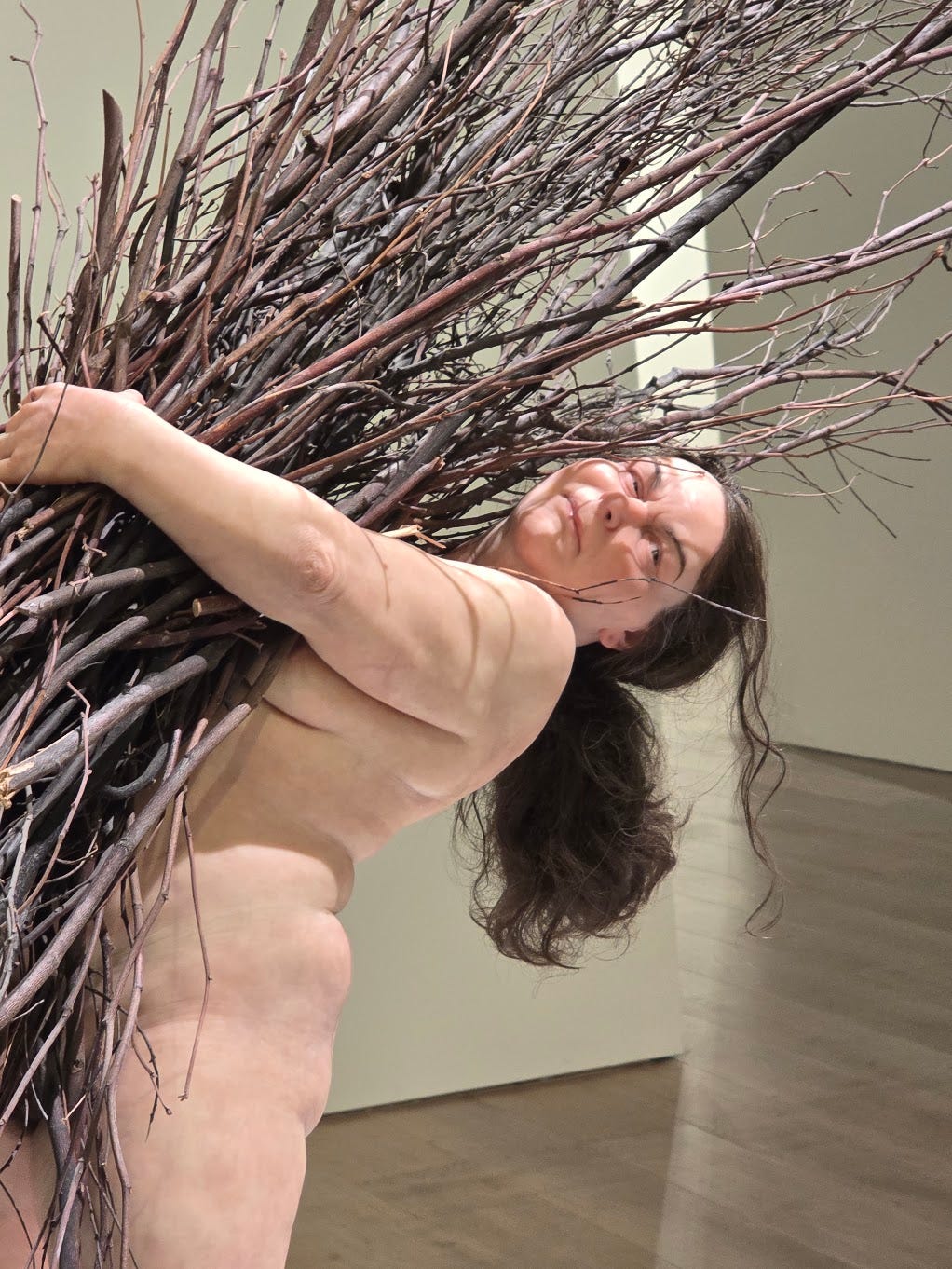
The exhibition rooms of the Mori Art Gallery, where I recently saw an exhibition of Ron Mueck’s work, seemed not only populated by his sculptured figures and spectators but also haunted by other presences.
The first imaginary presence was Hamlet, who I sensed lurking near the first exhibit, Woman with Sticks (2009 - see above image). Immediately, the words that came to mind when I saw the figure struggling with her heavy and bulky load were from that famous speech by Hamlet about life and death: 1
Who would fardels bear,
To grunt and sweat under a weary life
The curators pointed to the work’s narrative potential, its suggestion of a fairy-tale scene, but I took it as a reflection on the grunt and the sweat that life can represent at times. I’d arrived with an association of Mueck’s name with the Spanish word ‘mueca’, which means grimace. Maybe that’s why I immediately focused on the strained look on the figure’s face.
Exiting that room, I came across another realm where the presiding genius was now Lemuel Gulliver...
The immense size of the figure in Bed (2005) immediately made me think of Gulliver among the Lilliputians (and also of the 1960s sci-fi drama, Land of the Giants).
‘Get a sense of proportion,’ people used to tell me when I overreacted to seemingly trivial incidents earlier in my life. But Mueck’s work seemed to be inviting us to abandon our usual sense of proportion in dramatic or subtle ways, a shift in perception I found curiously invigorating.
In other works, the effect of disproportion came from something more subtle than a giant figure. The couple in Young Couple (2013) were a little below normal size, almost hobbit-like. This made them feel even more vulnerable and added power and poignancy to this oddly disquieting work.
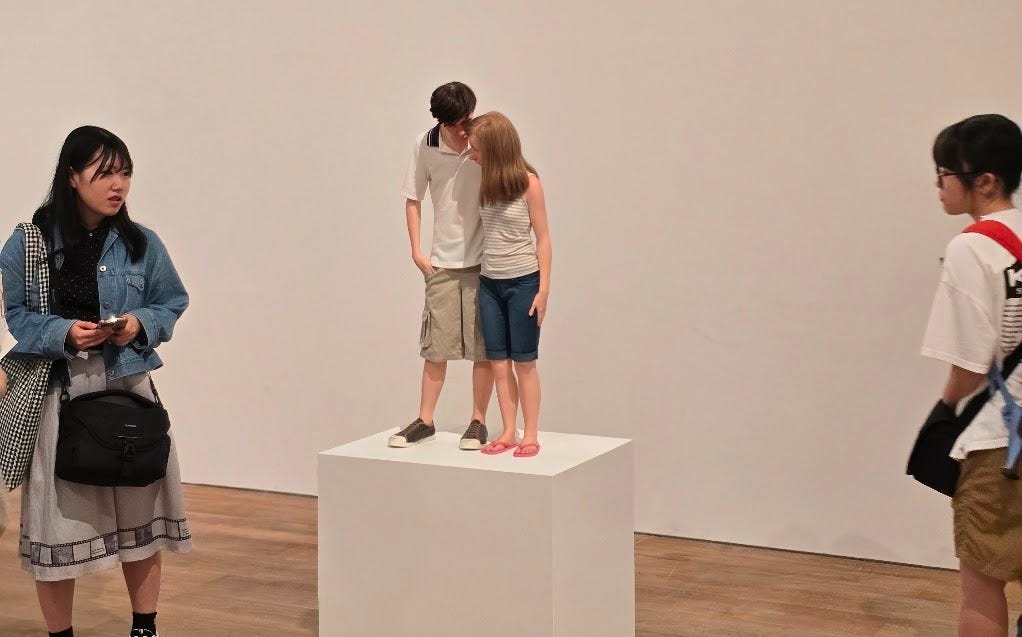
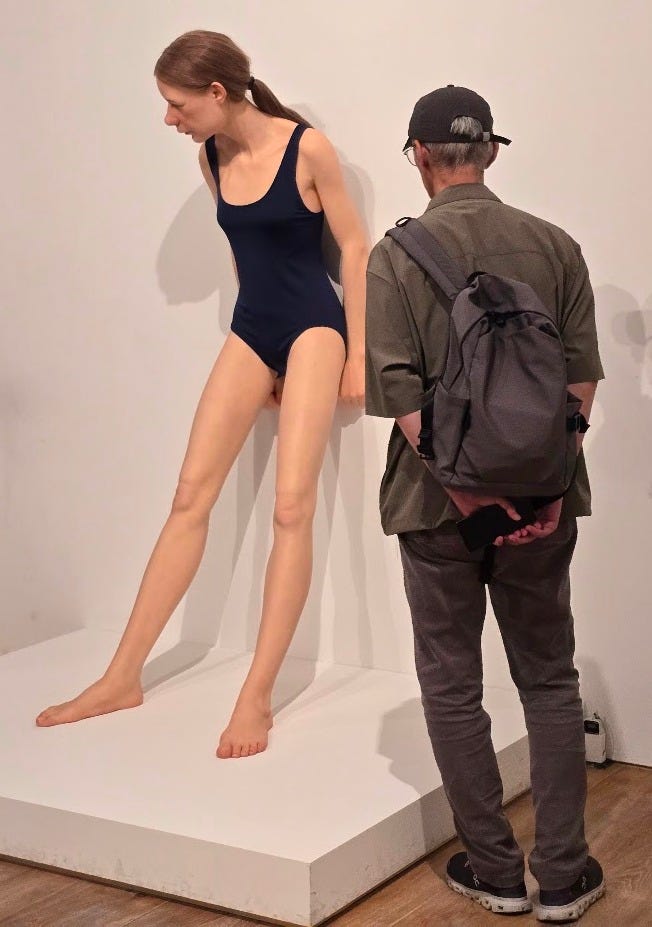
And the teenage girl in Ghost (1998/2014) was a little taller than life, which combined powerfully with her gaucheness to lend the spectator/sculpture relationship at times a curious leering quality.
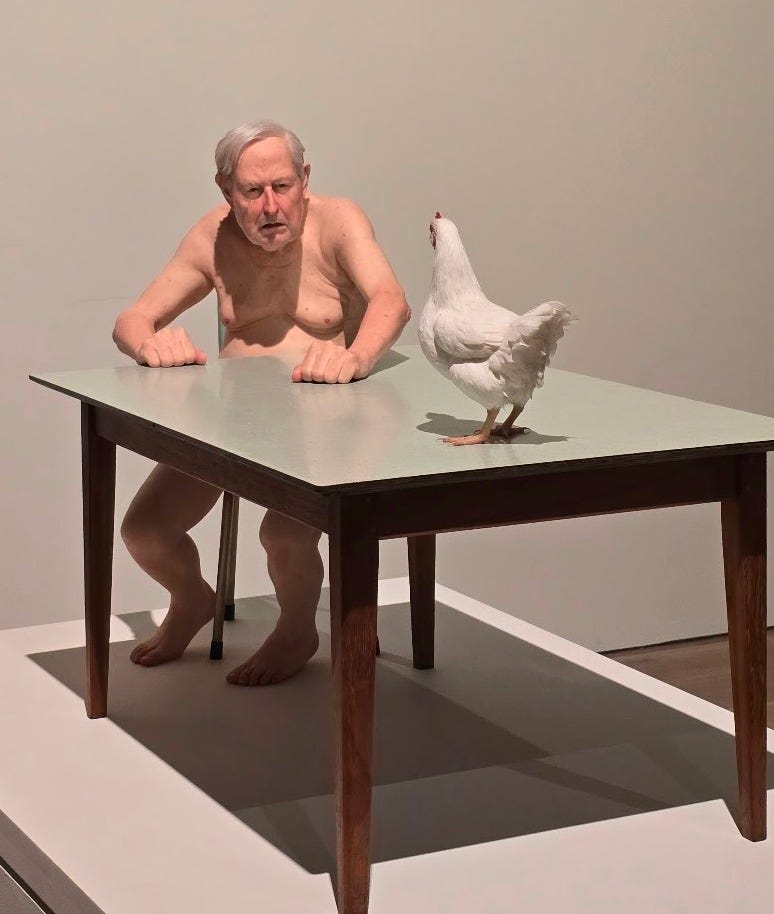
And just as disconcerting, it was sometimes hard to figure out who was looking at who. When I first encountered chicken/man (2019), apart from thinking of Barry Humphries’ cultural attaché alter ego, Les Patterson, my initial reaction was to wonder, probably along with everyone else, what the chicken was doing there.
But very soon, I began to wonder what the man was doing there. Finally, the questions in my mind changed to ‘What was I doing there? Who was looking at who? Was everybody looking at everybody else?’ 2
*
Mueck was born in Australia to German parents in 1958. The family business he grew up with was puppetry and doll-making. Having worked in TV and film, he first achieved prominence as a sculptor when his work Dead Dad was shown in the 1997 exhibition Sensation at the Royal Academy of Arts. He is now based in the UK.
*
This was a rare exhibition in which I wanted to keep other visitors in my photos to preserve a sense of scale. The art gallery, according to the critic Claire Bishop, can “invite a passive mode of reception” when compared to “the active co-production of collaborative art”. But here I almost felt as if we were co-producing, or at least active participants.
So I found myself wanting to include them in my gaze – I mean, other visitors, like me – as interlocutors of the figures by Mueck. The figure in Man in a Boat (2002), for example, who drifts into view, apparently marooned like Robinson Crusoe – who or what was he looking at? And why did I sense at times that he was just another visitor?
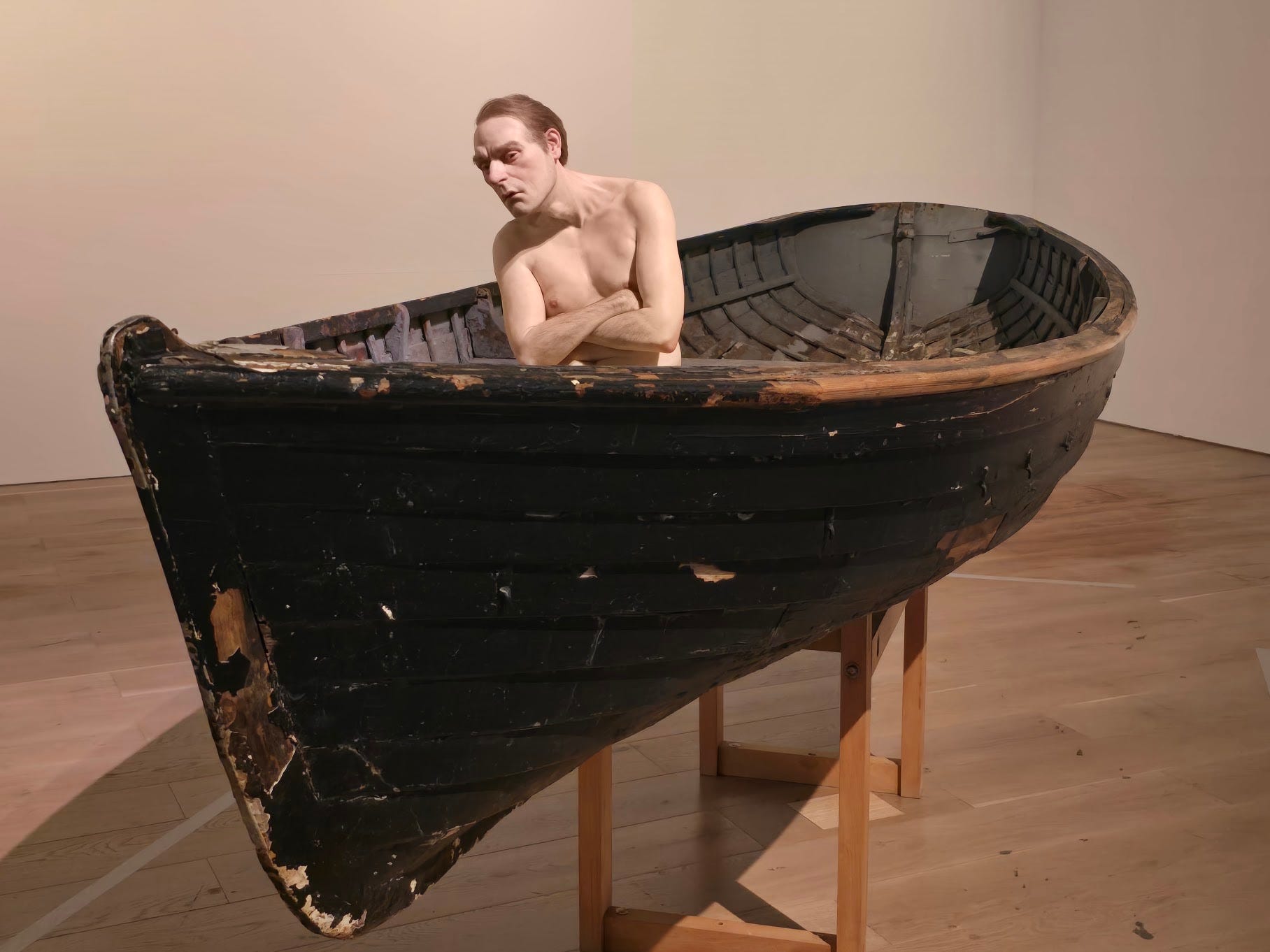
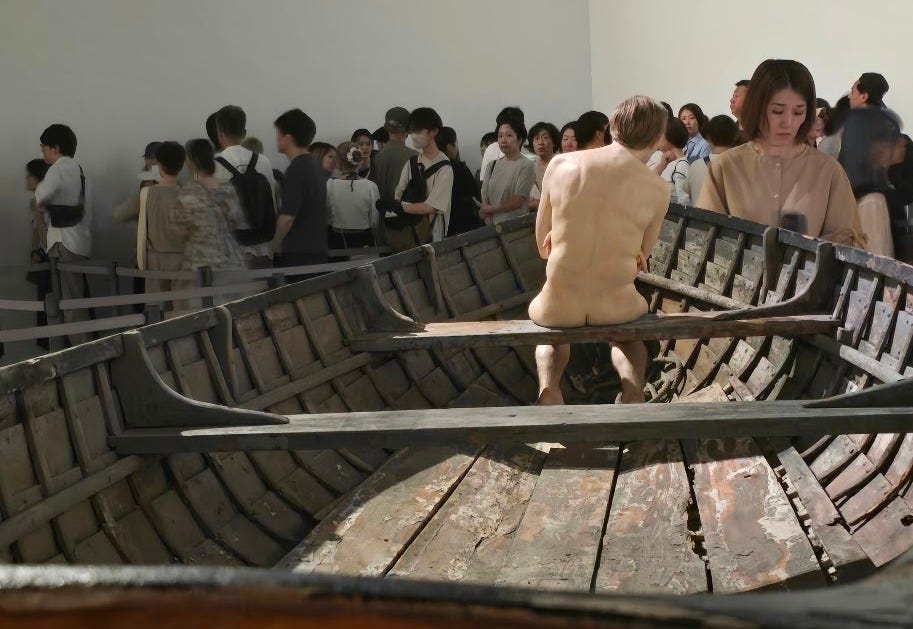
And as I wandered around the work, revelling in the generous space, I saw that from certain angles, the man in the boat was watching other visitors queue up to see the intense face sculpture hidden in a darkened room – Dark Place (2018). He seemed absorbed and almost jealous of the attention given to that other work.
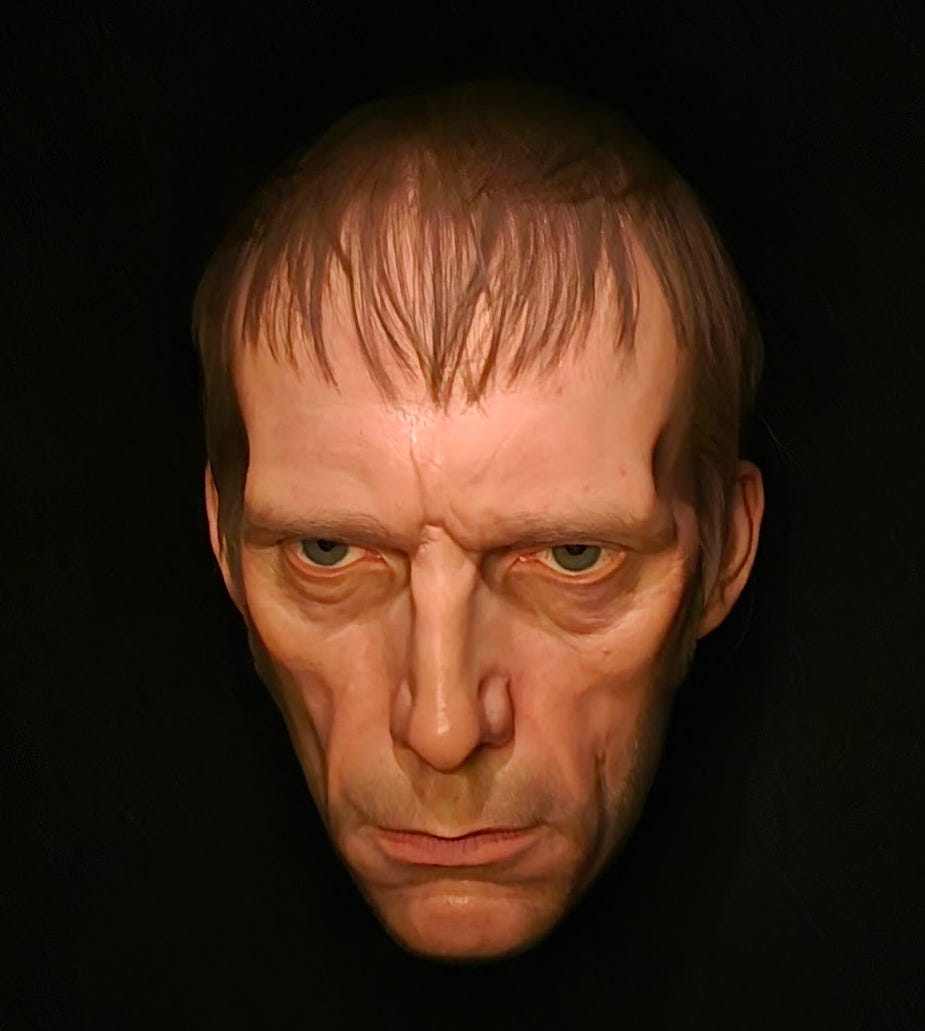
The face in Dark Place had most of the intensity and even a hint of the horror of Francis Bacon’s Study after Velázquez’s Portrait of Pope Innocent X (1953).
Bacon himself once said, “Great art is always a way of concentrating, reinventing what is called fact, what we know of our existence—a reconcentration…tearing away the veils that fact acquires through time. Ideas always acquire appearance veils, the attitudes people acquire of their time and earlier time. Really good artists tear down those veils.”
*
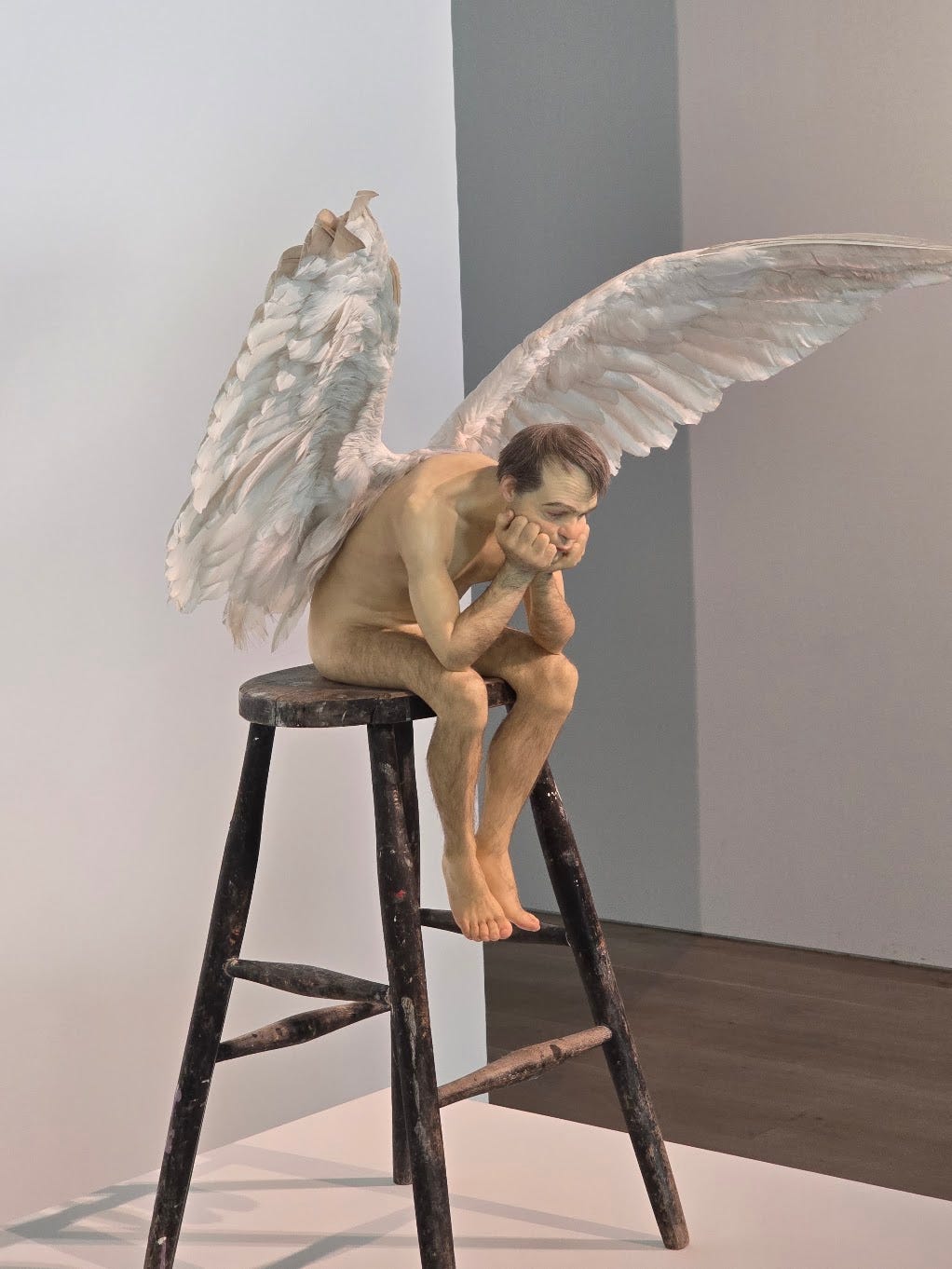
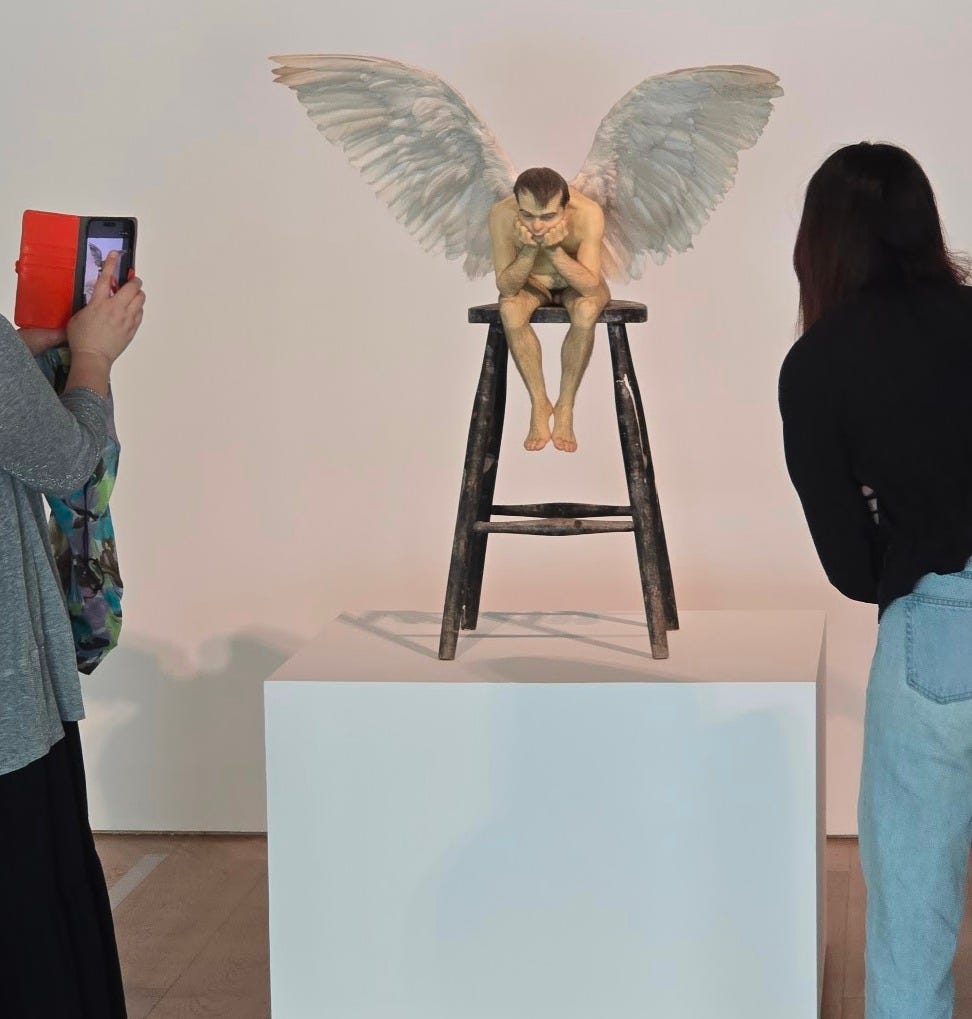
A particular feature of Mueck’s work is his striking attention to detail, which makes his sculptures appear almost hyperreal. This quality achieves a vertiginous effect in one of the most famous pieces in the exhibition, the early work, Angel (1997).
Other angels – for instance, those in Wim Wenders’ film Wings of Desire (1987), as well as an eternity of angels in the Western art tradition – seemed to hover over this figure.
But Mueck’s dejected angel, with a realistic (if small) human body, was directly inspired by a figure in An Allegory with Venus and Time by Giovanni Battista Tiepolo (c. 1754–8 – see below). The painting features the winged embodiment of Time, who has the face (and beard) of an old man.
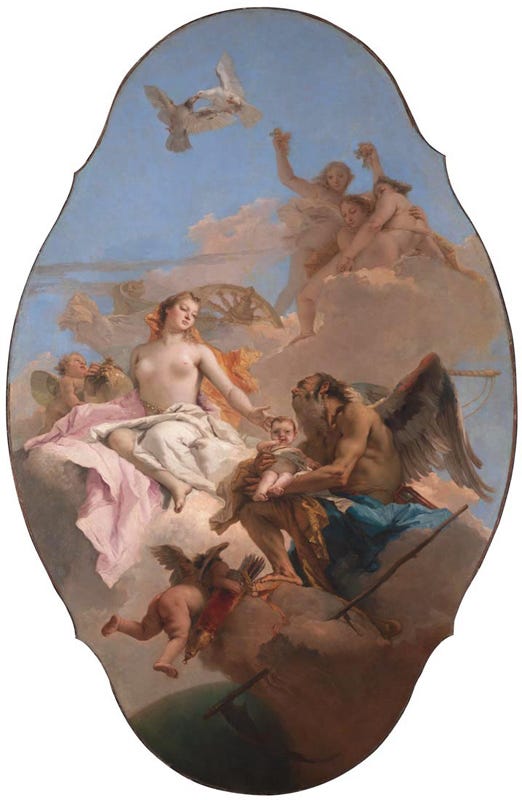
The winged figure inTiepolo’s work has a key role to play in the allegory. But Mueck’s angel looks curiously like an out-of-work actor or model, waiting for the next job offer to come along.
*
By the time I got to the rooms filled with giant skulls, a work that Mueck called Mass (2026-17), I was back with Hamlet (and the Land of the Giants) – this time, the gravedigger’s scene. 3 In the play, every skull tells a story, a rich human one, but they are excavated and then carelessly tossed aside by the gravedigger as he holds forth while digging a grave for Ophelia. 4
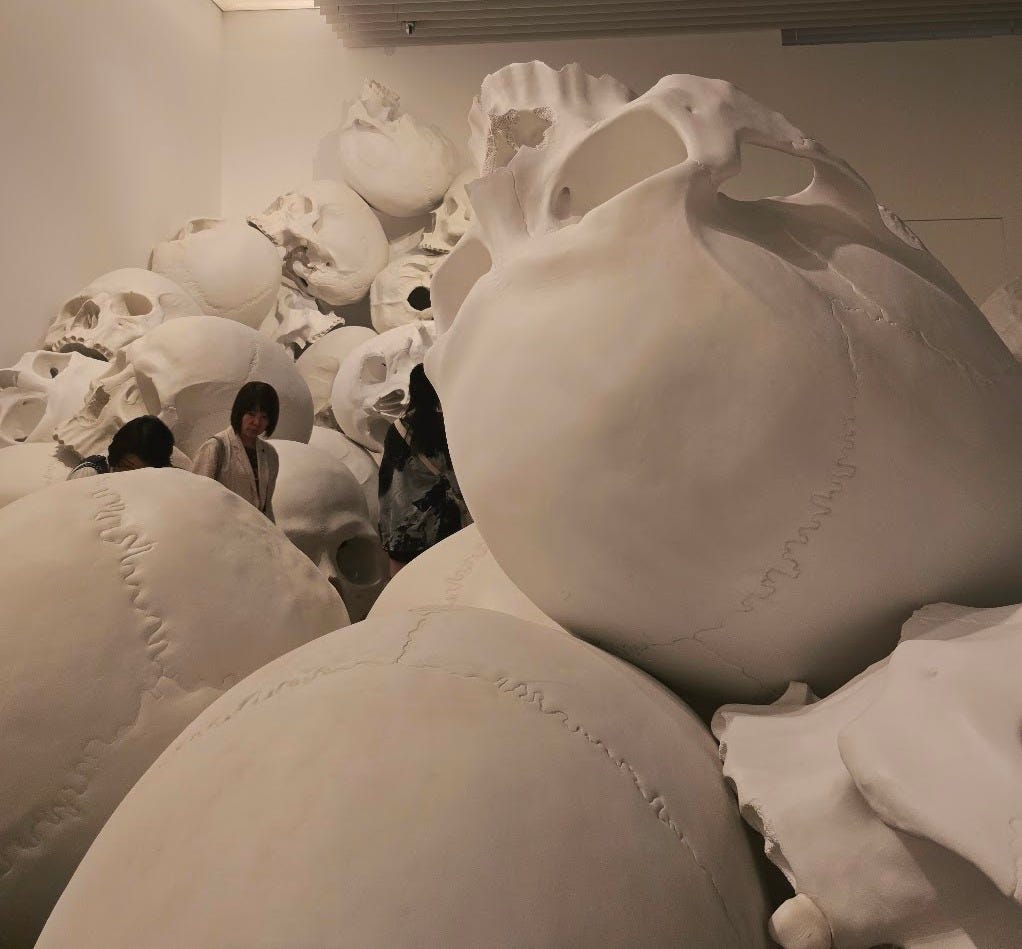
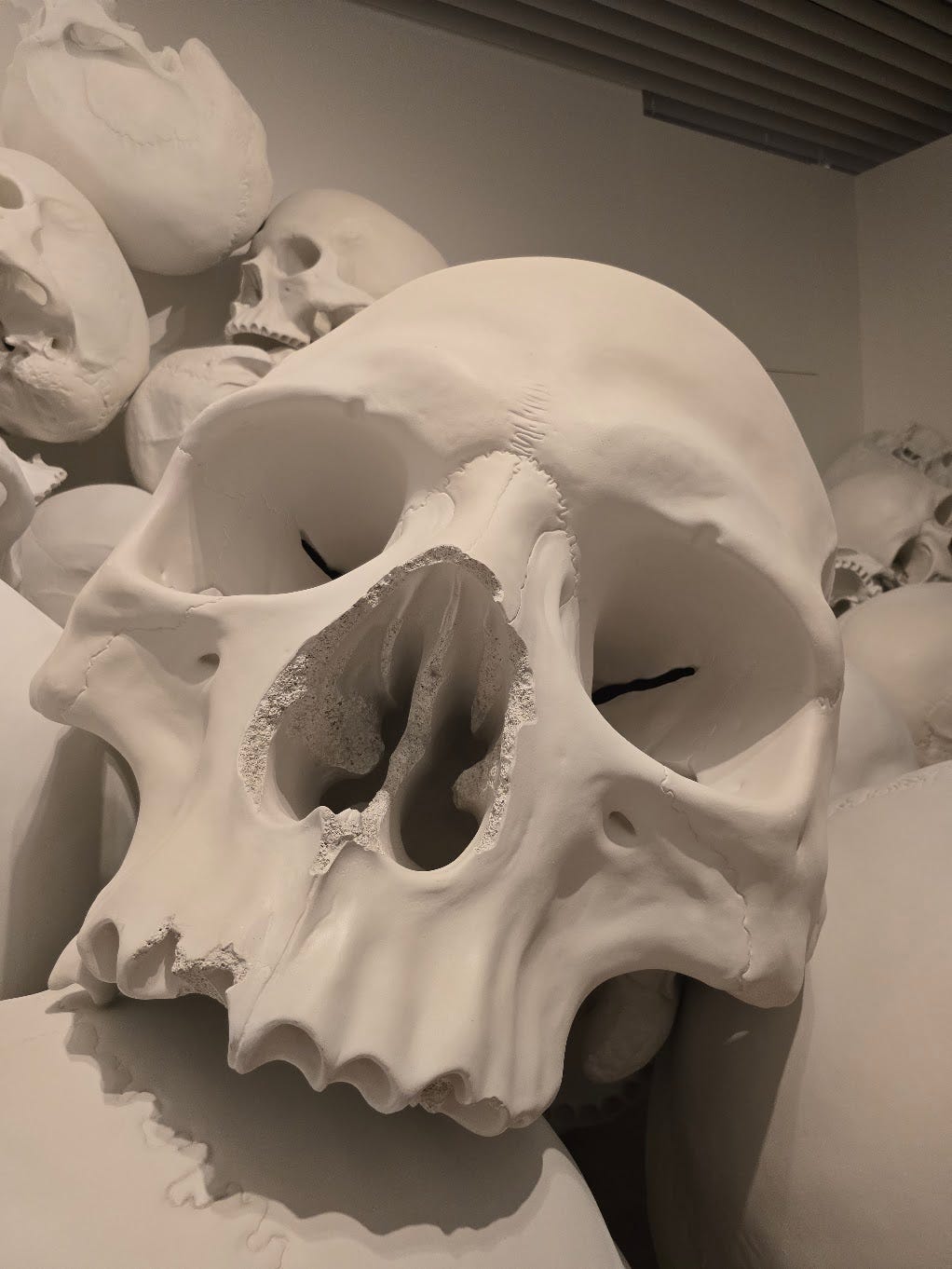
I understand that Mueck doesn’t generally say much about his work, but in this case the explanatory note on the wall of this room quoted a laconic commentary from him, apparently adapted from a dictionary.
Mass
A large amount of something that has no particular shape or arrangement
To come together in large numbers
The amount of matter in any solid object
A religious ceremony
Reflecting on the religious meaning of Mass, I thought of these words from the Dies Iraes:
Dies irae, dies illa
Solvet saeclum in favilla
(This day, this day of wrath
shall consume the world in ashes)
And I found the sheer scale and mass of the skulls almost overwhelming.
But I was more troubled when the thought of ‘mass graves’ came to my mind, and with it, marching through my head like Fortinbras’s troops in Hamlet, came images of terrible scenes of death – those abominable scenes of mass murder that haunt our memories of the 20th century.
In this way, it seemed to me, an exhibition that began evoking the burdens of life and then, with mournful playfulness, provoked reflections on our place in the world ended on a note – if such a thing is possible – of muted wrath.
*
The show had attracted many younger people, not the usual grey-haired crowd I see at exhibitions in the city. It turns out that Mueck’s photogenic works had been a social media hit, a “succès de IG”.
As I left, many of the younger members of the audience, for whom the terrors of the 20th century might seem very distant, were busy taking selfies as they walked among the giant skulls.
Turning to glance at the surreally massive graveyard scene one last time, I couldn’t help wondering what they’d made of it all and whether, for them, Mueck’s brilliantly disturbing sculptures had indeed torn down the veils of appearances, the thin skin of illusion that keeps at bay the lurking consciousness of our mortality.
The speech that begins wth “To be or not to be”, Hamlet, Act III, Scene I
It continues:
But that the dread of something after death,
The undiscovered country from whose bourn
No traveler returns, puzzles the will
And makes us rather bear those ills we have
Than fly to others that we know not of?
This work in particular seemed to play with the “esse est percipi” doctrine, “to be is to be perceived”. But the theme could be felt in other works, such as Man in a Boat.
Hamlet, Act V, Scene I. Hamlet, holding Yorick’s skull, thinks of his mother and her mortality: “Let her paint an inch thick, to this favour she must come.” It’s a graphic image of the final stripping away of the veil that we must all face.
Comments
Nothing yet. Say the first thing.
Sign in to join the conversation.