
The following piece was sent to 13 subscribers on November 4, 2021—our third ever post. We now share this modestly revised version with the 4,000 or so who have subscribed since those early days of the humanities revolt.
The humanities offer us a treasure trove of wisdom and insight. Ironically, that wisdom is sometimes obscured or falsely represented by pithy “mic-drop” quotation memes carelessly circulated in social media exchanges and the wider popular culture.
Like Mark Twain and Albert Einstein, Confucius is one of the most frequent victims of erroneous quote attributions. A prominent example is the circulation of a meme attributing this quote to Confucius: “Before you embark on a journey of revenge, dig two graves.” The statement creates a striking image worthy of moral contemplation. It is also something Confucius never said.

Popular media also play a part in advancing these false attributions. In episode 13, season one of the fictional TV series, Criminal Minds, behavioral analyst Jason Gideon says, “Confucius warned us, ‘Before you embark on a journey of revenge, dig two graves.’”
This misquoting of Confucius may be linked to the belief that the sage advocated for “returning good for ill.” Here we run into another problem. In “Things Confucius Never Said,” Sun Jiahui explains that the available record of Confucius’ ideas suggests this belief is also mistaken. Consider that, in Book XIV of The Analects, an important source of Confucian thought written around 475 BCE, we read:
“1. Some one asked: 'What do you think about the principle of rewarding enmity with kindness?' 2. 'With what, then, would you reward kindness?' asked the Master. 3. 'Reward enmity with just treatment, and kindness with kindness” (Ch. XXXVI).
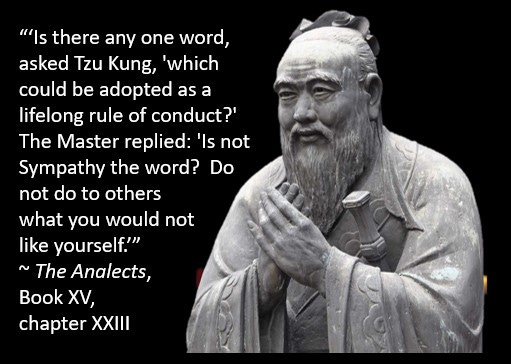
Confucius did advocate the virtue of “Ren,” the compassionate concern for others. When a disciple asked him for a single principle to live by, Confucius offered a version of the Golden Rule instructing us to refrain from doing to others what we would not like done to us. In Book XV, we find these words:
“‘Is there any one word, asked Tzu Kung, 'which could be adopted as a lifelong rule of conduct?' The Master replied: 'Is not Sympathy the word? Do not do to others what you would not like yourself’” (Ch. XXIII).
In addition to teaching his students to think critically about their interpersonal conduct, Confucius taught that they should avoid bandwagoning. Specifically, he cautioned against uncritically affirming others' negative or positive assessments of people.
“Though all hate a man, one must investigate the cause; and though all like him, one must also investigate the cause” (Book XV, Chapter XXVII).
Needless to say, there are plenty of Confucian teachings worthy of being quoted online and in TV shows.
There are a number of reasons erroneously attributed quotes flood our culture. Innocent error is probably the main culprit. Someone accidentally attributes an interesting quote to the wrong thinker. That misattribution makes its way into a meme, book, or movie, and then spreads quickly and easily through social media.
Another cause of these misquotations is that we lack awareness of our own irrationality. We often make the mistake of thinking that we are primarily rational beings. Though we can and do, sometimes, think rationally, our default mode of thinking tends to be uncritical and significantly reliant on irrational influences.
The psychologist Howard Gardner contends that we are intellectually moved by seven “levers of mind change.” These include two reliable sources of making sense of the world: reason, making good, logically consistent arguments; and research, turning to empirical observations of the world to identify the facts.
The other five levers of mind change include rewards and resources: being moved when an idea benefits us; representational redescriptions: accepting messages we’ve heard expressed in lots of different ways; real world events: embracing a message that is made to feel more compelling in light of a recent event; resonance: finding an argument or claim more compelling because of its relation to something or someone else familiar to us; and overcoming resistances: our tendency to accept an idea or belief once core objections or barriers have been lowered.
Most of us are impacted and even deploy these levers of communicative and symbolic influence. We tend to give greater weight to an idea or claim if it has the endorsement of a respected cultural figure. Our resistance to a way of thinking can be overcome if it is linked or attached to an idea, belief system, or person that we admire or defer to. When an idea is attached to a lauded sage, the idea is more likely to resonate with us. Ancient thinkers are particularly useful to those leveraging resonance since the thinkers’ absence ensures they won’t raise any objections to the ideas or arguments attributed to them.
But it’s important to realize that the success of a falsely attributed quote rests less on the originator and more so on those of us who uncritically absorb and parrot the idea. Being honest, we have to acknowledge that we all sometimes repeat what we see or hear, irrationally assuming something to be true despite a lack of reasoned or evidentiary support.
As social beings we are naturally inclined to “go along” and “get along,” especially when something is repeated and becomes familiar. A 2007 study published in the Journal of Personality and Social Psychology found that familiar and repeated statements, even from a single source, significantly shape our judgments. By coming to terms with our irrational tendency to parrot ideas, both verbally and in our wider social media interactions, we can reduce our likelihood of repeating misquotations and other misinformation.
Someone may well ask, but what’s the harm in misattributed quotations? Isn’t this much ado about nothing?
In the first place, I think there is an ethical wrong in distorting the ideas or practices of those who put significant effort into developing those ideas or practices. Imagine that, 100 years from now, a meme circulated that attributed this statement to Socrates:
“It is better to live life without care than to spend one’s existence in perpetual contemplation.”
Such a statement is an inversion of Socrates’ contention that “the unexamined life is not worth living.” The philosopher was so committed to this principle that he refused to betray his philosophical ideals to avoid a death sentence. While we don’t injure the dead by distorting their arguments and principles, we do potentially undermine part of their posthumous life-projects and the ideas they sought to advance. Perhaps most important of all, we deprive the broader public of the possible benefits of the actual idea the thinker advanced.
One could also argue that attempting to advance our own beliefs or agenda by falsely attributing certain ideas to important spiritual or philosophical thinkers of other societies is a kind of unethical cultural appropriation. But my main objection is that our emphasis on attaching famous names to an idea or argument we approve of implies an uncritical deference to authority and tradition.
That Confucius or Socrates purportedly said something does not make that something true or worthy of adoption. At best it means we ought to consider the idea or argument. Ultimately the merit of the idea ought to be determined independent of who said it. Special credit should go to whoever devises an insightful idea rather than credit going to an idea that happens to have been (possibly) uttered by a sage.
As someone who teaches courses in the humanities, I think cultural traditions of the past along with great thinkers like Lao Tzu, Confucius, the Buddha, Jesus, Socrates, Aristotle, and Epicurus offer invaluable insight into the human condition and living lives of meaning and excellence. (We also learn quite a lot about what not to do and think, and how societies and well-intentioned human beings go wrong.) But the potential benefits these traditions and ideas are not conferred when we are passive; they are granted to us through active and critical contemplation and conversation.
Instead of simply “relaying” what an ancient thinker had to say, we need to consider and interrogate their ideas. What did they mean? How does this idea hold up, today? When Confucius said that we should “Reward enmity with just treatment, and kindness with kindness,” the reader is left to consider what “just treatment” looks like, in practice.
Is just treatment retribution? Is just treatment holding the person responsible through punitive action, or is just action accountability with the opportunity for redemption? Is it more important to “get back” at others or for them to “get what they give,” or does justice entail edification, moral improvement, toward the goal of the wrongdoer learning from their mistakes? These are open questions that are worked out through contemplation and dialogue, not through one-liner mic-drops.
The fact that someone who is today revered said something doesn’t mean it’s necessarily right or worth affirming, let alone adhering to. Do we really want the validity of our favored argument to rest, alone, on the unimpeachable reputation or character of an ancient thinker? Not likely, since it’s difficult to think of any person of the distant past who has not said or believed things that are, upon reflection, misguided if not flagrantly wrong. (And if we’re being really candid, we’d acknowledge our human imperfection and that we are all often wrong, even the so-called “best and brightest” among us.)
Besides, a great idea doesn’t need the endorsement of an intellectual celebrity. An idea or argument doesn’t accrue intellectual value based on who authored it. What makes an idea of the past valuable is that it remains helpful in understanding either the past or the present, without undue deference to author’s title or position.
I am not saying that there is something wrong with noting or sharing a powerful quote from a great thinker in human history. My suggestion is that such ideas ought to be the starting point of critical reflection, dialogue, and elaboration rather than used as overly confident endcap exclamation marks on a subject of debate.
Whether we are those creating the meme or sharing it, we tend to be less concerned with the accuracy of the quote attribution than making an impact. Take the example of the quote on revenge that began this post. Some of us think people would be better off realizing that retaliatory violence is the path to mutual destruction. Plenty of ancient thinkers are available to lend support to this idea. In The Analects we can read that Tseng Tzu, one of Confucius’ disciples, lauded a friend for enduring offense without retaliating (Book VIII, chapter V).
But intellectual honesty and a basic commitment to rational dialogue requires us to make sure that we have our facts straight. If it’s important enough to add Confucius’ name to a quote, then we ought to make sure it really is his idea. If we don’t have the time or desire to do that kind of research, then we can simply share the quotation without attribution, indicating that we don’t know who said it. Even better, we can briefly comment on why we think the quote rings true to us.
We all love a pithy quote. But quotes should rarely be the beginning and end of a communicative interaction. A great quote—whoever the author might be—is an opportunity to engage in dialogue with the idea and others' perspective on that idea. Great quotes alone cannot clarify the world for us. Clarity comes through active conscious thought and dialogue.
We should reject the idea that a quote, meme, essay, lecture, or book “speaks for itself” or “stands on its own.” We should, instead, embrace our intellectual agency. We should reaffirm the motto of the enlightenment. As Immanuel Kant put it in his 1784 essay, “What is Enlightenment?,” that motto was, “Dare to know! (Sapere aude.) ‘Have the courage to use your own understanding.’” In other words, we should exemplify independent, critical thinking rather than leaving the task up to others.
Let’s explain what we think a quote or idea means and why it’s important. Let’s consider its merits and weaknesses. Let’s relate it to our life by considering the idea’s logical implications and offering plausible extrapolations. Above all, let’s exchange parroted information for original thinking and genuine conversation. Doing so will not only elevate and create openings in public discourse—much of which takes place in the sphere of social media whether we like it or not. Doing so will also nurture our own creativity, intellectual confidence, and self-knowledge. And these are all goals the humanities aim to help us achieve.
If you enjoyed this piece, you might enjoy…
No posts
Comments
Nothing yet. Say the first thing.
Sign in to join the conversation.