
Part I showed that embracing a plant-based diet combats environmental devastation and enhances our own health. But these are not the most compelling reasons to stop eating animals. Part II argues that we should go vegan for the love of animals—and our integrity.
“All tremble at violence; all fear death. Putting oneself in another’s place, one should not kill nor cause to kill.” — Buddha, Dhammapada (1st century BCE), trans. Bhikkhu
You and your child are fawning over the cute, precious pot-bellied pig at your feet. The petting zoo of your local zoo is teeming with ebullient children squeezing between one another for a chance to pet, brush, and commune with pigs and goats. As you smile at the interspecies lovefest the delectable scent of barbequed ribs wafts through the air. Your nose guides your eyes until you locate the source: the zoo’s barbeque stand, a few yards from the petting zoo. Inspired by hunger, you interrupt the child-animal bonding, bid farewell to the pig with a quick pat on the side of its belly, and hurry from the petting zoo to the barbeque stand for tender ribs.
This scene describes the morally disjointed world most of us inhabit. We move in incoherent patterns in which we engage affectionately with members of a species that we will at another time of day unthinkingly consume, an act that, as strange as it may seem upon reflection, requires extreme violence—killing and dismemberment. We compound this moral dissonance by condemning and even punishing people for abusing or killing cats or dogs or bemoaning the killing of trophy animals such as elephants and lions without so much as considering the moral equivalence of our unnecessarily killing of cows and pigs. Suffice to say, our relationship with the animal kingdom is confused and logically inconsistent.
With integrity at stake, we must confront difficult questions. Questions like these:
What entitles us to eat the bodies of other living beings who value their lives?
Why should we be entitled to prioritize our taste buds over their preference to be free of cruel confinement and premature slaughter?
For most, these are strange and awkward questions. If you’re like me, you grew up eating fish, chicken, hamburger, pork chops, steak, ribs, ham—without ever asking yourself such questions or having someone else ask them.
We might say that questioning human entitlement to the bodies and byproducts of sentient beings in our society would be akin to questioning God's existence in the same society. My guess is that most are more comfortable privately questioning God's existence than questioning whether or not we have the right to eat the bodies of other sensitive and conscious creatures.
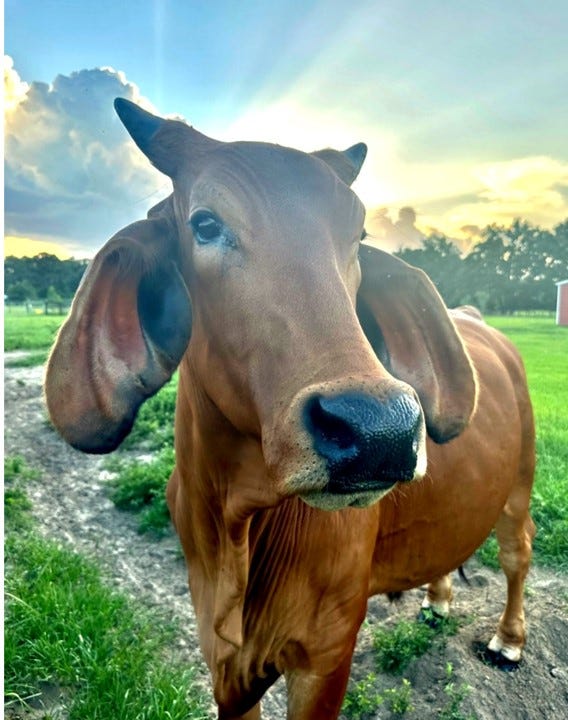
Once these kinds of questions are posed they are difficult to ignore or get around. There is only one way to authentically face them: head-on.
Many have become aware of the various forms of unearned privilege they benefit from at the expense of those excluded from socially exalted status. Those knowledgeable of the facts of social inequality and its systemic character understandably believe that, for example, male privilege and white privilege are anathema to an authentic vision of justice and fairness.
According to official statistics from the United States Department of Agriculture (USDA) for the year 2025, the quantity of land-based animals slaughtered for food in a single year in the United States is estimated at 29 million cows, 128 million pigs, 2 million sheep, and 9.6 billion chickens.1 Considering that our objectification of these animals is born of cultural normalcy rather than existential necessity, might it also be said that we humans all benefit from an unearned human privilege?
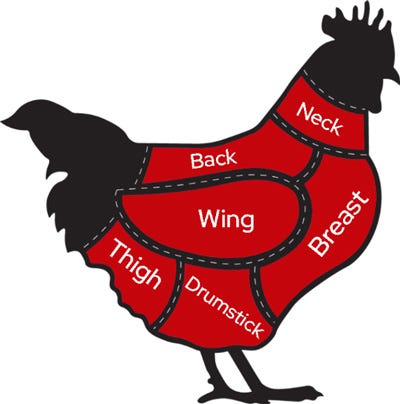

Whatever one concludes on the question of animals’ rights, the fact that so few of us have even pondered the very question of whether or not we are entitled to literally consume animals suggests we are benefactors of a radical form of privilege which has come at the diametrical expense of the nonhuman animals we have for so long felt entitled to do with whatever we wish to.
Students in my Introduction to Ethics courses are always significantly impacted by the question of whether animals are entitled to rights. Even or perhaps especially impacted are those students who previously gave the subject little to no thought. I think the reason the topic impacts people so forcefully is that most have deep connections to animals such as dogs and cats.
What’s more, our humanity endows us with a basic sense of what it means to be logically consistent. Yet we exist in a culture where mainstream cultural opinion—common sense—has us sign petitions to protest and speak with outrage over mistreatment of cats or dogs; where a person is sentenced to prison for fighting dogs for sport, but where the very people most outraged by such abuses articulate those outraged feelings over pleasantly prepared meals comprised of factory farmed animals who endured inexplicable suffering—suffering more perpetual and systematic than fighting animals for sport.
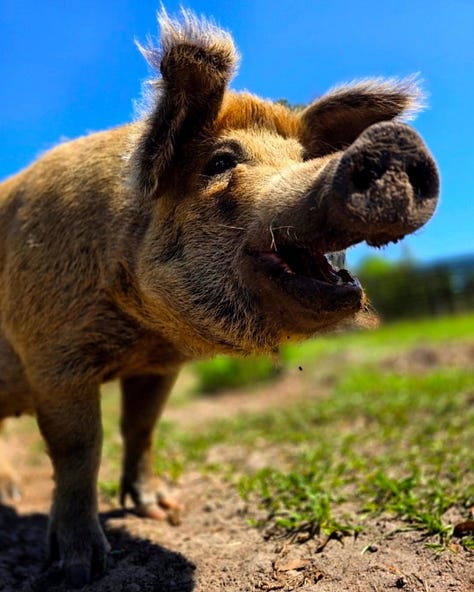
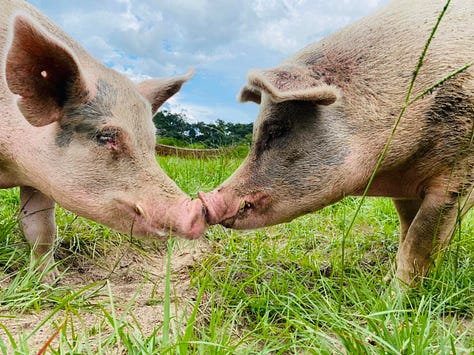
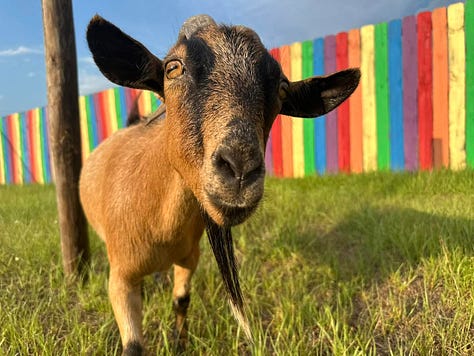
Western Carolina University professor of psychology Hal Herzog observed that we criminalize fighting chickens for sport despite the fact a “McDonald's chicken suffers a much worse fate than a cockfighting rooster.” Herzog does not believe cockfighting should be legalized, but adds, “it is a bit of a paradox that people get so bent out of shape about fighting roosters, and the suffering of chickens is probably the world's greatest animal welfare problem.”2 Herzog is wrong on one point: this is not a paradox but a blatant moral contradiction.
In 2016, I drove from Vero Beach to North Georgia fleeing Hurricane Matthew. The cabin I stayed at was on a big, open piece of land. I noticed cows grazing on the fenced-in adjacent property. Later I learned that this property belonged to the owners of the cabin. They ran a small chicken and dairy farm. They had their own little store governed by the honor system. Locals could freely walk in to the unattended store, pick out the eggs or meats they wanted, and leave the appropriate payment.
Wandering around the property, I first encountered emaciated cows whose protruding ribs were easy to spot. These young cows were still of a suckling age and did their best to suck on whatever limb you gave them. Later, my hospitable hosts generously gave me a tour of their operation. I learned that the suckling calves are quickly removed from their mothers after birth to ensure the lactating mother’s milk can be saved for human consumption. When I was given a tour of the chicken coop I found egg-laying hens crammed into filthy pens that looked a lot like the ones I had seen in videos showcasing the horrors of factory farms. Many of the chickens were without feathers due to the cramped living conditions and obvious distress they endured.
Chickens at the family farm I visited in North Georgia while evacuating from Hurricane Matthew (2016). Video by the author.
Many thoughtful human beings have not been able to stomach the suffering caused by animal agriculture. For the simple reason that giving up animal products is so counter-cultural, it’s worth mentioning some familiar names of people who adopted the vegan or vegetarian ethic.3
Fifty years before passing away, the preeminent primatologist and global change agent Jane Goodall became vegan out of concern for the suffering, climate destruction, and health detriments caused by consuming animals.
Renowned musician, Prince, proclaimed his love of animal life and denounced the cruelties of dairy in two songs including “Animal Kingdom” (1998)4 and “Joint to Joint” (1996). In the latter, Prince raps about a prospective partner who doesn’t really know him.
“Oh great, now you think you’re my soulmate / You don’t even know what kind of cereal I like / Wrong! Cap’n Crunch with soy milk / ’cause cows are for calves.”
Prince understood the suffering inflicted on cows used by the dairy industry—the misery I witnessed at the Georgia family farm. In Mind If I Order the Cheeseburger (2013), legal scholar, Sherry F. Colb observed that female cattle, as with female mammals more generally, “produce milk as a complex hormonal response to pregnancy and birth.” Yet female cows are “regularly and forcibly” placed into breeding stalls and subject to forced artificial insemination. Mother cows are naturally inclined to nurse their babies for upwards of 10 months. On dairy farms, mother cows are separated from their offspring within 24 hours, causing significant emotional distress. “Cows bellow,” wrote Colb, “sometimes for days on end, and behave in ways that plainly exhibit desperation and misery, including a lack of interest in eating and a tendency to pace around the area where they last saw their calves.”
Speaking to Chris Hedges, philosopher Gary Francione explained the inconsistency of consuming dairy and adopting a feminist ethic opposed to reproductive exploitation.
“The fact that we will take a cow with a natural life span of 30 years, impregnate her six times and take away her baby six times and kill her after she has had mastitis for five years is dreadful. This is the commodification of the reproductive processes of a female other, the commodification of a mother and her baby. The reproductive process and the relationship of a mother and her child become a product. I don’t understand how someone can say, ‘I am a feminist, but I drink milk.’”5
One feminist—and pioneering Civil Rights champion—who recognized the wrong of the dairy industry was Coretta Scott King. King spent the last decade of her life as a vegan. Her friend, Barbara A. Reynolds described King as a “strict vegan.”6 King was inspired by her son, Dexter’s embrace of veganism. In a 1995 interview, Dexter Scott King described the elimination of animals from our diet as a logical extension of his father’s philosophy of nonviolence. “If you’re violent to yourself by putting [harmful] things into your body that violate its spirit, it will be difficult not to perpetuate that [violence] onto someone else.”7
Other vegans include the uncompromising public intellectuals Chris Hedges and Glenn Greenwald, Swedish peace and climate activist, Greta Thunberg, comedian and commentator, John Stewart, former Congressman and steadfast proponent of peace, Dennis Kucinich, pioneering black intellectual and activist, Angela Davis, and former football player, Colin Kaepernick, best known for his Black Lives Matter protests during the NFL National Anthem. For many including not only Dexter Scott King but also filmmaker/musician, Rob Zombie, it’s the unmitigated violence of “meat” that is most repulsing.
When the curtain is drawn, few sensitive to suffering can stomach the cruelty and carnage of the animal agricultural industry. The challenge to such revelatory feelings is that the violence—not to mention the environmental and health harms—of our meat and dairy is hidden within nondescript industrial warehouses; the kind of buildings we drive by without taking notice. Sometimes it takes an artist to notice the overlooked. That’s how the classic horror movie, Texas Chainsaw Massacre, came to be.
The 1974 film analogized the cannibalistic horrors a group of teenagers are subjected to during a road trip to the violence nonhuman animals are subjected to in slaughterhouses. Texas Chainsaw Massacre’s writer and director, Tobe Hooper, was one of those who did notice the slaughterhouse and contemplated its hidden horrors. Hooper said he was “always disturbed” by the slaughterhouse he drove by on his way from Austin to Dallas, Texas. In the film, the teens pass the very same slaughterhouse, foreshadowing the carnivorous doom they would face at the hands of the Sawyer family—serial killers who treat their human victims as meat.8
The teens in the movie are alerted to the slaughterhouse by the putrid smell it emits, forcing them to roll up their van windows. After noticing cows tightly packed in a pen, the teens engage in a brief dialogue that not only ominously foretells their fate but also reveals the ethical inconsistency that continues to mar our conscience. “You see those buildings there?,” observes Franklin. “That’s where they kill them. They bash them in the head with a big sledgehammer.” Distressed, Sally says, “Franklin, I like meat, please say your joking.” “That’s terrible,” Pam replies. “It’s still going on.”9
In one of the film’s most terrifying scenes, Leatherface, who wears a mask of human flesh, thrusts his victim, Pam, on a meat hook through her spine. “I gave up meat while making that film,” said Hooper. “In a way I thought the heart of the film was about meat; it’s about the chain of life and killing sentient beings, and it has cannibalism in it, although you have to come to that conclusion by yourself because it’s only implied.”10
The link between “meat” and horrific violence was made by Guy Zaken, an Israeli soldier who participated in the real-life carnage in Gaza. Zaken said he stopped eating meat after his traumatizing experience of running over hundreds of Palestinians as a bulldozer operator in Gaza where the Israeli military has killed more than 70,000 Palestinians, about half of which were children.11 Zaken testified before the Israeli government that some of the people he was tasked with running over were still alive. “Everything squirts out,” Zaken said, describing his experience. “When you see a lot of meat outside, and blood… both ours and theirs (Hamas), then it really affects you when you eat.”12
I spent the first 23 years of my life eating very little other than meat and wheat. I grew up in a household where the words “vegan” and “vegetarian” were never uttered. My paternal grandfather and grandmother raised purebred German Shepherds in the Redlands, south of Miami. We were a family of dog-lovers, and I spent considerable time helping my grandparents care for the dogs they raised.13 And when dinner time came around, whether at home or my grandparents, no meal was complete if it lacked the centerpiece of meat. At home where money was always tight, we ate a lot of chicken, especially as my parents became more health conscious and tried to limit hamburger. As for my tastes, I inherited my father's bizarre distaste for most fruits; and I ate vegetables the way most people pay taxes: out of obligation. Among my favorite foods were gyros, meatball subs, hamburgers—I loved Whoppers from Burger King—meaty burritos and enchiladas, and, my favorite, barbeque ribs.
The first time I meaningfully considered vegetarianism was when I was a freelance features reporter for Florida Today, in Brevard County. I received a punk band compilation album, Liberation Songs to Benefit PETA (2002).
Without thought or knowledge of People for the Ethical Treatment of Animals (PETA), I put the CD-ROM in my desktop and a video popped onto my screen. It was a video titled, Meet Your Meat (2002). I watched the short video, narrated by Alec Baldwin, which showed the inexplicable horrors of normal industrial farming. Cows and chickens mutilated without anesthesia; pigs and chickens in pens or cages so confining that they could not really move; male chicks discarded like refuse. I never ate meat again.
Few are hungry for a beef burger or ribs immediately after plainly seeing how the “meat” gets made. Philosopher Lewis Vaughn summarizes the charges against the animal agricultural industry this way: “the animals are subjected to appalling suffering, including lifelong confinement in spaces so small the animals can hardly move, isolation of veal calves in small crates (and, some say, in almost total darkness), routine mutilation or surgery such as branding and cutting off pigs’ tails and chicken’s beaks, and the slaughter of chickens and livestock without first stunning them or using any other methods to minimize pain and suffering.”14
Philosopher Michael Allen Fox wrote: “It is easy to see why we call the economic sector that generates these statistics ‘the meat industry’; but we could just as well label it ‘the torture and indiscriminate killing industry,’ because that is a more accurate description.”15
People confronted with the shocking footage of ordinary animal agricultural practices respond with visceral, unfiltered emotion. There is moral wisdom in such reaction to suffering. It teaches us something about what human beings truly believe about what entitles something to “moral status” or “moral concern.”
When I learned the shocking normality of animal abuse in the animal agricultural industry I was taking an art and cuisine course as part of my undergraduate coursework. We were assigned to do a multimedia presentation connecting art and food. I decided to make the most of my freezer full of meat including a few racks of ribs. I bought a meat hook from eBay and a heat lamp and created a modest but visceral art installation. Participants entered a small darkened classroom where they encountered two TV sets. One played a scene in Texas Chainsaw Massacre on a loop: Leatherface placing his female victim, Pamela, on a meat hook. The other continuously played Meet Your Meat. Between the TVs, participants passed tables with the uneaten and defrosted meat from my freezer under a heat lamp. The simple aim was to reveal the common sentience of humans and the animals we objectify as mere meat.
After surviving a harrowing crocodile attack, the Australian ecofeminist philosopher, Val Plumwood, wrote, “We act as if we live in a separate realm of culture in which we are never food, while other animals inhabit a different world of nature in which they are no more than food, and their lives can be utterly distorted in the service of this end.” In reality we humans are no less “meat” than the animals we kill and consume by the billions, added Plumwood, who was a vegetarian at the time of the attack and remained one afterward. We are just as “edible” as they are.16
Virtually all psychologically healthy human beings are profoundly disturbed—shaken—by the suffering of sentient beings. For all the claims about the relativism of morality, almost all of us seem to agree that unnecessary suffering is bad. This is why we object to dog fighting, and it’s why we all know there is no excuse for eating animals when alternatives that are healthier for us and the planet are easily and cheaply obtainable.
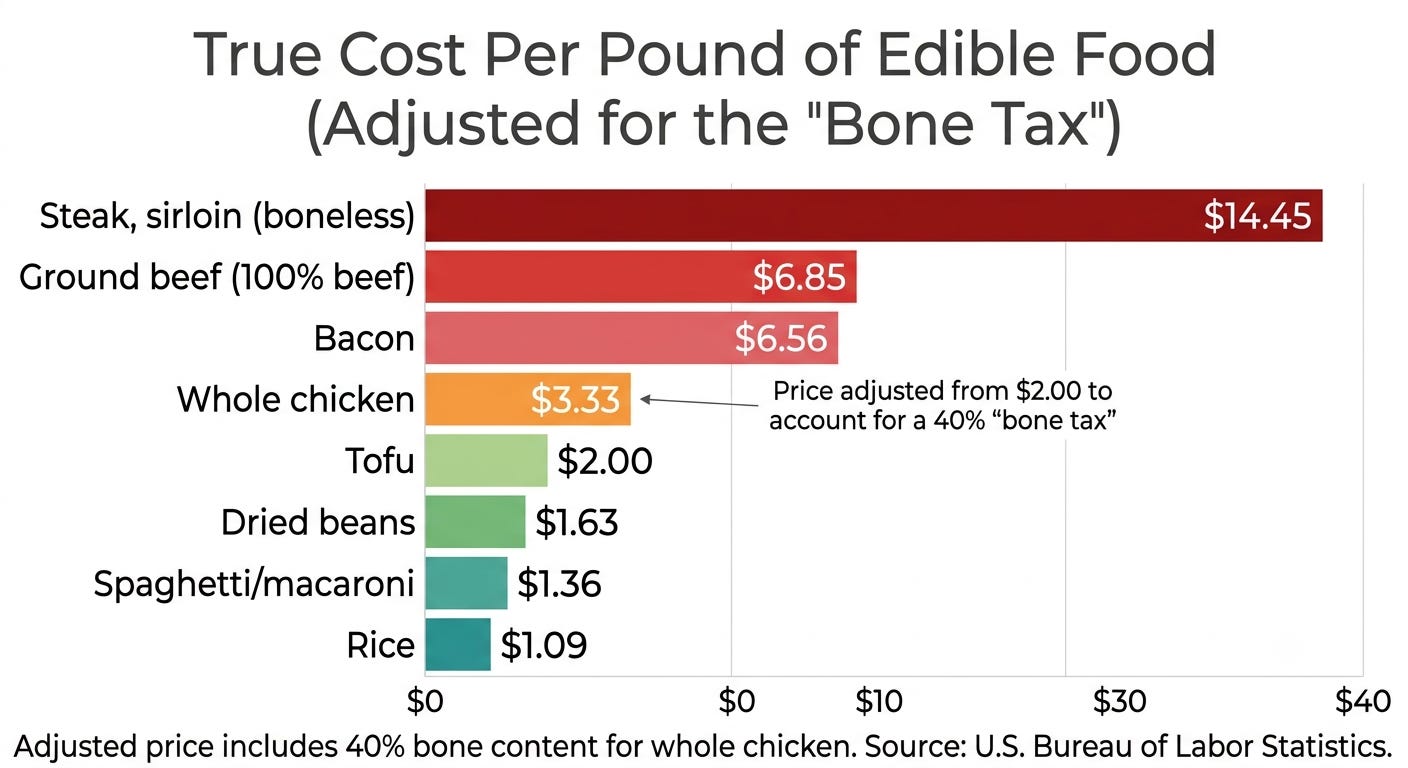
For those skeptical of this final claim, consider that, according to the U.S. Bureau of Labor Statistics, the “meat” of cows sells for more than $6 a pound, pigs over $4, and chicken around $2 per pound.17 Grains, beans, and legumes can all be consistently purchased at prices well below the cheapest chicken. And even when we buy cheap chicken, we’re paying for bones we don’t eat. When we buy beans, rice, and grains we get to eat everything you buy.
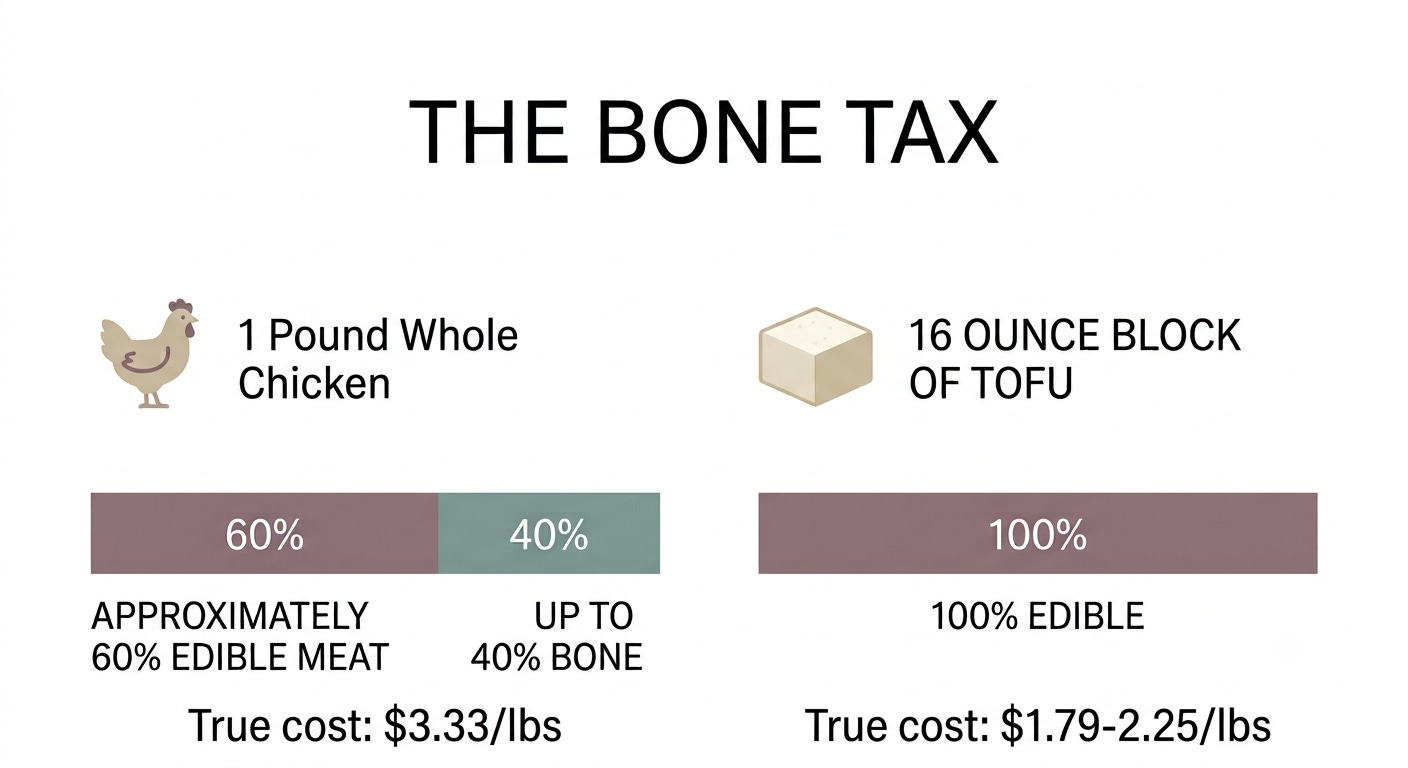
Even a pound of tofu, a staple of many vegan diets, can be purchased for under $2 at Aldi or $2.25 at Walmart—prices comparable to cheap chicken. The difference is that consumers buying chicken—or rack of lamb, ribs, and steak—also buy bones—a “bone tax” for eating living animals. Only 60% of a “ready-to-cook” whole chicken, for example, is “meat.” Most of the other 40% is inedible bone.18 A 16 ounce package of tofu is 16 ounces of food. (As attested to by cookbook author, Andrea Nguyen, the listed net weight on tofu, unlike other packaged foods, indicates the actual weight of the tofu block, not the water in its container.) So the real cost of a $2 per pound whole chicken is closer to $3.33 per pound compared to $2 for a pound of tofu.
As I see it, the animal agricultural industry is incompatible with love of life and the living. It is incompatible with opposition to violence and our best efforts to embrace a life of nonviolence—opposition to necrophilia. In The Heart of Man (1964), psychoanalyst Erich Fromm explained that the necrophilous orientation to life was composed of a love of force, control over others, and mechanization. “The necrophilous person is driven by the desire to transform the organic into the inorganic, to approach life mechanically, as if all living persons were things.” The biophilous orientation to life, by contrast, is rooted in a love of life. Fromm wrote,
“The person who fully loves life is attracted by the process of life and growth in all spheres. He prefers to construct rather than to retain. He is capable of wondering, and he prefers to see something new to the security of finding confirmation of the old. He loves the adventure of living more than he does certainty. His approach to life is functional rather than mechanical. He sees the whole rather than only the parts, structure rather than summations. He wants to mold and to influence by love, reason, by his example; not by force, by cutting things apart, by the bureaucratic manner of administering people as if they were things. He enjoys life and all its manifestations rather than mere excitement.”
By eliminating the inherent cruelty of taking babies from mothers, of confining them in conditions that prohibit the natural joys we sentient beings enjoy—fresh air, movement, companionship, growth, play—and unnecessarily killing animals in the prime of their life, we affirm a genuine love of animals—and a broader love of life.
This giving of love recalls the Daoist wisdom that we are filled by emptying ourselves. By embracing a biophilous diet—loving animals at breakfast, lunch, and dinner such that we keep them off our plates and out of our stomachs—our own cup of life overflows; overflows with personal wellbeing; overflows with the joy of moral integrity, whereby our love of animals and efforts to be good stewards of the environment are no longer undermined by what or rather who we eat.
I am not making the ethical case for veganism with clean hands of guiltless conscience. I spent the first half of my 46 years of life as an omnivore who delighted in cheese, bacon, sausage, beef, and ribs. My goal is not to scold or reprimand but to invite deep ethical reflection and genuine self-examination.
As a perpetual student of the humanities and philosophy, and also as a teacher, father, and husband, I’ve come to appreciate how difficult integrity is to accomplish.
Sadly, “integrity” is a word thrown around without much precision. Most use the word to mean honest, good, or moral. The deeper meaning of the concept is confessed in the way someone might say that a ship sunk because it “lost its integrity.” In this sense the ship sank because it broke into pieces; it didn’t stay together. This metaphor conveys the essence of the important human ideal of integrity. To have integrity means that we are consistent with ourselves; that we do not undermine our own principles, and that we have achieved a significant degree of intellectual, moral, and behavioral coherence.
I believe that the most important reason we need to end the consumption of animals is because it is inconsistent with our ethical principles, namely our objection to the infliction of unnecessary suffering—pain and misery—on sentient beings. And every day we continue to quite literally objectify animals by eating their bodies and byproducts, we fail to achieve the level of principled integrity that we all desire.
By deciding to take animals and their byproducts off our plates and out of our mouths, we experience a joyful wholeness. The walls of our compartmentalized love of animals fall, and we no longer need to avert our eyes from the suffering in the food we eat. Our lives become harmonized with the part of us that knows and respects the richness of animal consciousness, with our desire to combat environmental catastrophe, and with our efforts to live long and healthy lives. Biophilia—the love of life—and moral integrity are restored to the very fiber of our being, woven from our deepest convictions.
If you enjoyed this piece, you might enjoy…
Noteworthy vegetarians include farmworker rights’ advocate Dolores Huerta, iconic feminist activist Gloria Steinem, and both Mister Fred Rogers and the contemporary children’s educator who has stepped into his empathetic shoes, Ms. Rachel. In 1983 Fred Rogers said he had stopped eating animals in part because “it’s hard to eat something you’ve seen walking around.” He added that he noticed children who made the connection between animals and their food similarly struggled. “That’s something I’ve noticed in my work with kids. When they first discover the connection between meat and animals, many children get very concerned about it.” Paul Obis, “Fred Rogers: America’s Favorite Neighbor,” Vegetarian Times, November 1983.
In “Animal Kingdom,” Prince sings, “No member of the animal kingdom nurses past maturity / No member of the animal kingdom ever did a thing 2 me/ It’s why I don’t eat red meat or white fish / Don’t give me no blue cheese / We’re all members of the animal kingdom / Leave your brothers and sisters in the sea / Animal, animal kingdom {x2} / Who told us we should eat the swine? / You can bet your final money it damn sure wasn’t no friend of mine / What about the clams on the shore? / Souls in progress, here come the fisherman - soul no more.”
Barbara A. Reynolds, “The Real Coretta Scott King,” Washington Post, February 4, 2006.
Jill Howard Church, “Dexter Scott King, Son of Rev. Martin Luther King Jr., On Veganism as a Form of Non-Violence and Spiritual Growth,” Vegetarian Times, October 1995.
Kate Mulleavy and Laura Mulleavy, “Tobe Hooper,” interview with Tobe Hooper, Interview, July 14, 2014.
English chef, Allegra McEvedy’s 2013 tour of a slaughterhouse makes it clear that Pam is right that “it’s still going on.” Pam’s reply in the movie makes more sense when viewed through the context of the original screenplay. There Pam replies to Franklin by saying, “People shouldn’t kill other animals for food.” Sally answers, “I like meat... I just don’t like to think about those places.” Chiding her, Pam replies, “Sally! That’s terrible. They’re still killing them; just because you don’t have to see.”
Calum Waddell, “Tobe Hooper,” interview with Tobe Hooper, Bizarre Magazine, November 2010.
Later I would also call into question the breeding of dogs.
Lewis Vaughn, Doing Ethics: Moral Reasoning and Contemporary Issues, 4th ed. (New York: W. W. Norton & Company, 2016), 496.
Independent investigations have shown the commonality of cruel conditions endured by animals in the industry. An undercover animal rights investigator whose pseudonym is “Pete” contends that many standard practices appear cruel but are legal. He also says that he has witnessed illegal activity at “every single facility, whether it is a corporate facility or a family farm” he has ever investigated. Pete also explains that many states’ efforts to impose what are called “ag-gag” laws, which criminalize investigative journalism that showcases animal cruelty in farming, are a response to the effectiveness of investigators’ efforts. “Undercover Activist Details Secret Filming of Animal Abuse & Why 'Ag-Gag' Laws May Force Him to Stop,” interview with Pete, Democracy Now!, April 9, 2013.
“Due to a relatively small body size compared to larger species of livestock, poultry is often available as a whole bird at the butcher shop or grocery store. They are typically found as ready-to-cook (RTC) carcasses without giblets (WOG), though some do include the giblets (heart, liver, and gizzard) and neck. Consumers may see giblets more commonly with whole turkeys for Thanksgiving. Giblets and neck account for roughly 7% of live bird weight. The RTC [Ready-to-Cook] carcass is around 60% meat and 40% skin and bones.” Kester, Kimberly. “Bird Breakdown: Exploring Yields and Cuts of Poultry.” University of Wisconsin–Madison Extension. Accessed July 17, 2026. See also James H. Denton and David B. Mellor, “Cost and Yield Comparisons of Ready-To-Cook Chicken Products,” Texas A&M AgriLife Extension, published February 19, 2026.
No posts
Comments
Nothing yet. Say the first thing.
Sign in to join the conversation.