
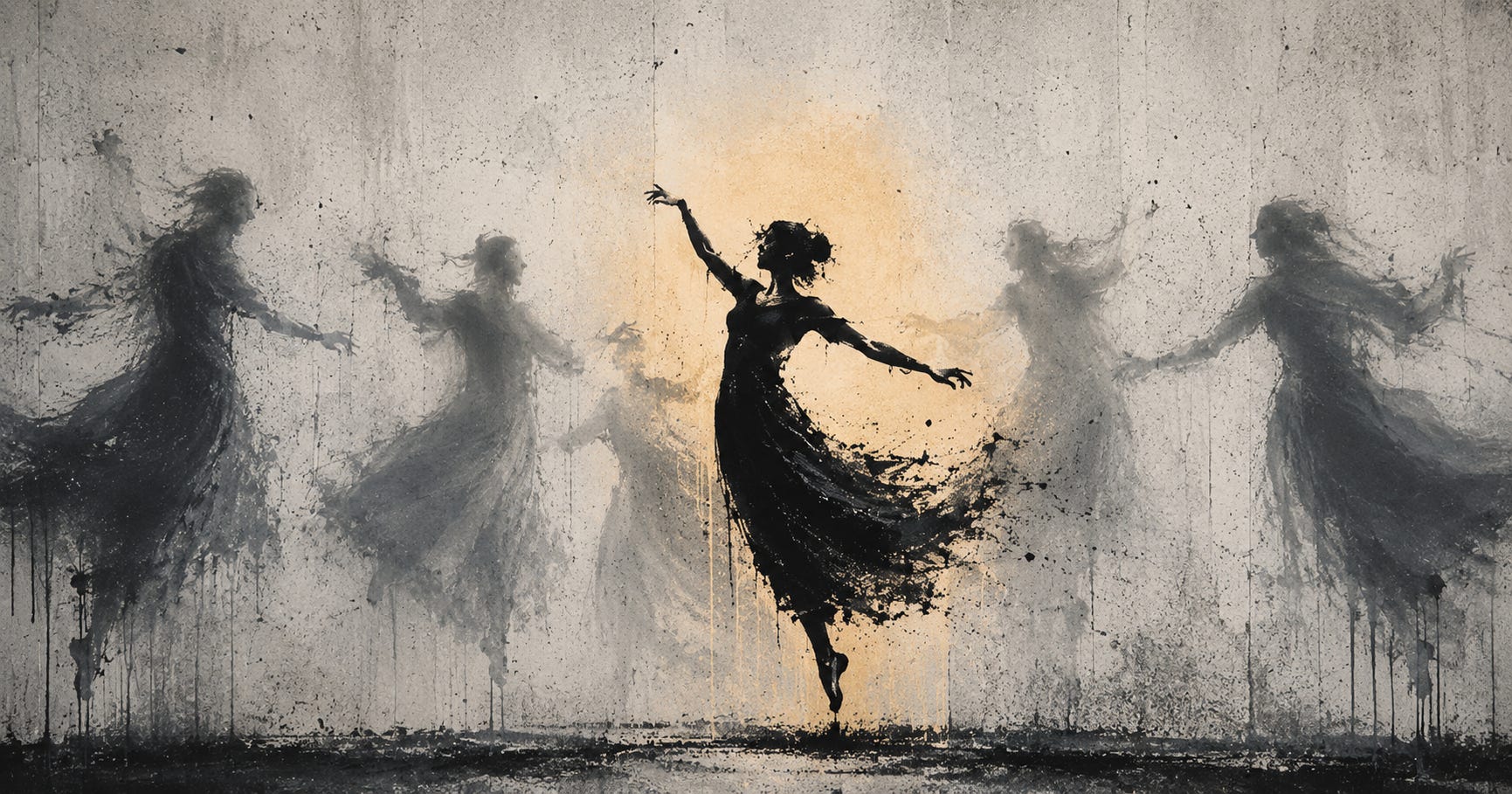
Computer algorithms that decide who is seen and what content is shown to everyone online are built into every platform. They are the “black boxes” of the Web. No one quite knows what they do and how they do it.
But they decide who is important and what is important.
It was simple once as most people knew what the rules of the game were. But what’s happened since is a dilemma that dogs, fogs and confounds me.
I started on Twitter, Facebook and search engines when the algorithms were simple.
Everyone who played was more noticeable because they knew the rules of the game.
Able to be watched. And I could dance with the machines. It felt like I had a chance to win.
In 2026, the power of AI is built into everything. The machine has the rules built in. And I am starting to feel almost powerless. As the rules are invisible.
The AI algorithms determine what’s visible.
To be shown in the feed of the social media machine
To be found on a search engine.
To be visible as a personal brand.
To build a business that works online.
Unless you pay.
So my thought is this and questions that rise:
Is this just a frustration I sense?
Does more effort no longer work?
Is persistence futile?
Does the research back it up?
Should I pack up and give up?
So I stopped guessing. And I went looking for the evidence. Here is what I found.
There is a black box on every plane. It records the whole flight. Every sound. Every choice. And you never get to open it. Unless you crash.
The web now runs on a box like that. It watches what you make. It reads every word you write. Then it decides who gets seen. And it never tells you how.
You used to be able to study the machine and learn its moves. Not anymore. The box got smarter. And it went quiet. You didn’t crash but you got buried.
I remember the old dance. You watched what spread. You spotted a pattern. You leaned in, and the machine rewarded you. It was a game two could play.
Now only one side can see the board. The platforms. Nobody voted for this. It just became normal, one small default at a time.
And here is the part that should sting. You helped build it. Every post fed it. Every article trained it. We handed the box our life’s work, one upload at a time, and it never signed a thing.
For years the deal was simple. You write something good. You show up in search. The reader clicks. The reader arrives.
That deal is breaking.
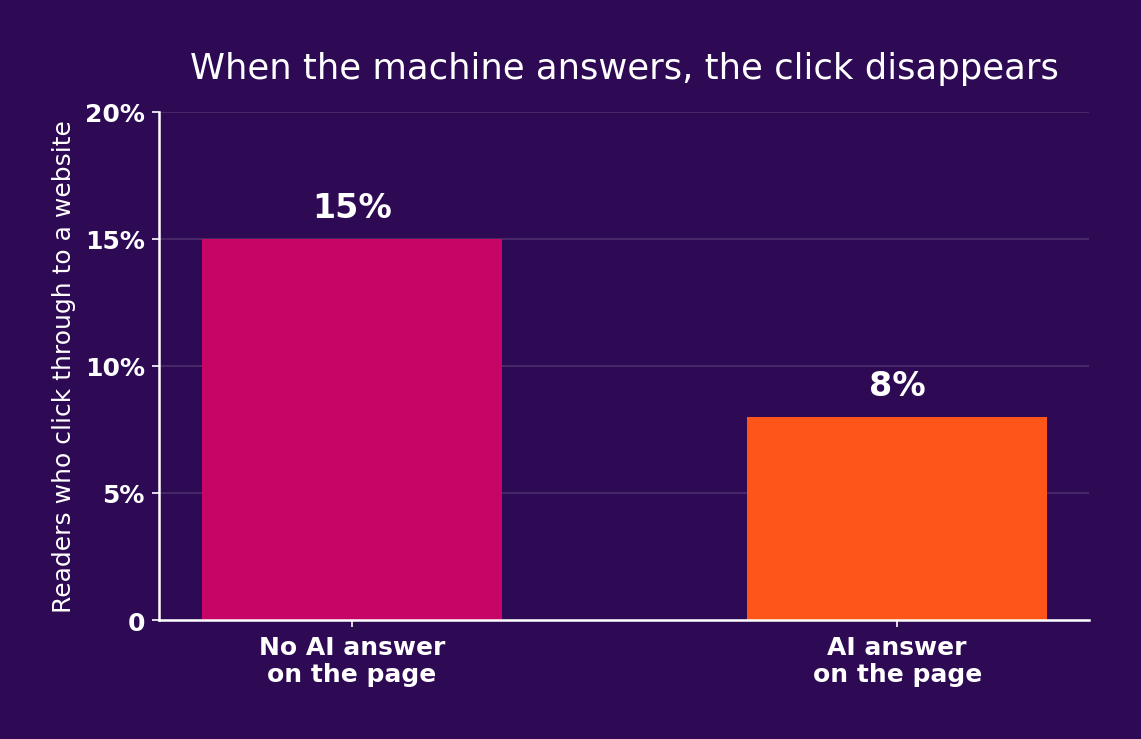
Across 68,879 real Google searches, when an AI answer sat on the page, clicks to a website fell by nearly half.
Source: Pew Research Center, 2025
The wider count is worse. Out of every 1,000 Google searches, only about 360 now send a person to the open web.
Six hundred and forty people ask a question. The machine answers. The door to your work stays shut.
You still win the argument.
The reader still never arrives.
Once, a page you built could reach the people who followed it. That was the whole promise of social media. Post, and be seen.
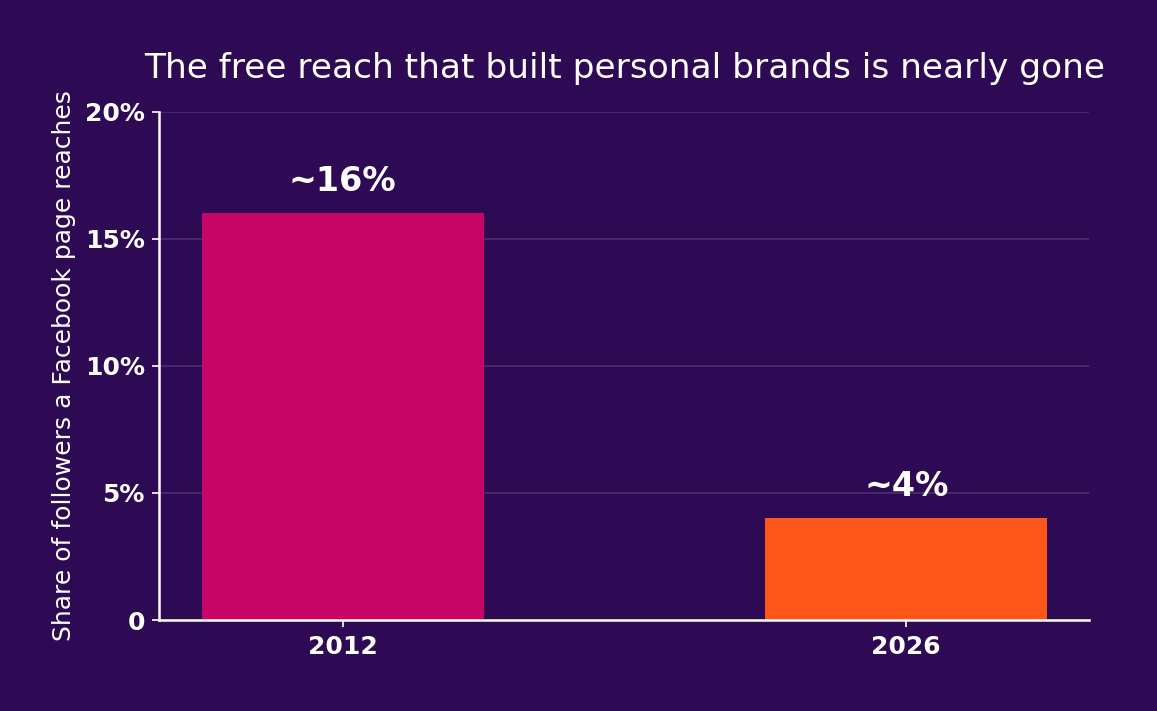
In 2012 a Facebook page reached about one in six followers. Today it is closer to one in twenty-five. LinkedIn reach has dropped about a third.
Source: Social Media Examiner / industry data, 2026
You did not get worse.
The house changed the odds.
It is like renovating a rented flat. You make it beautiful. Then the landlord changes the locks.
Here is the number almost nobody shows you.
Cloudflare measured how many pages each company takes from the web for every single visitor it sends back.
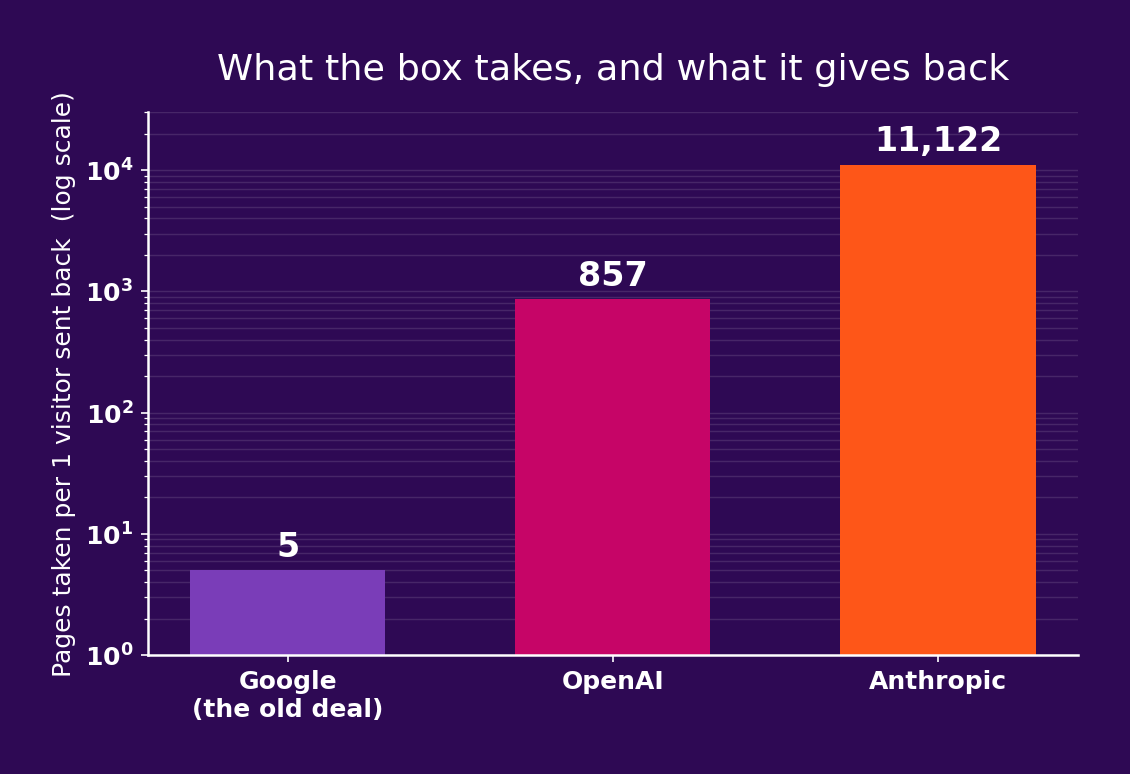
The old search bargain: five pages taken for one visitor returned. The new one runs to hundreds, then thousands, for one.
Source: Cloudflare Radar, May 2026
The old search deal was five pages taken for one visitor returned. A fair trade.
The new deal is different.
For OpenAI, it is more than eight hundred pages for one visitor.
For Anthropic — the maker of the very assistant helping me research this — it is over eleven thousand.
Picture a shop.
A machine walks in. It photographs every item on every shelf, eleven thousand times over. Then it buys one thing and leaves.
That is the box.
It takes almost everything.
It gives back almost nothing.
And what does it do with what it takes? It learns from it. You spend ten years finding your own way of saying things. The box copies that style in an afternoon, then hands it to a stranger for free, with your name stripped off.
And building a business on top of all this? The ground is tilting.
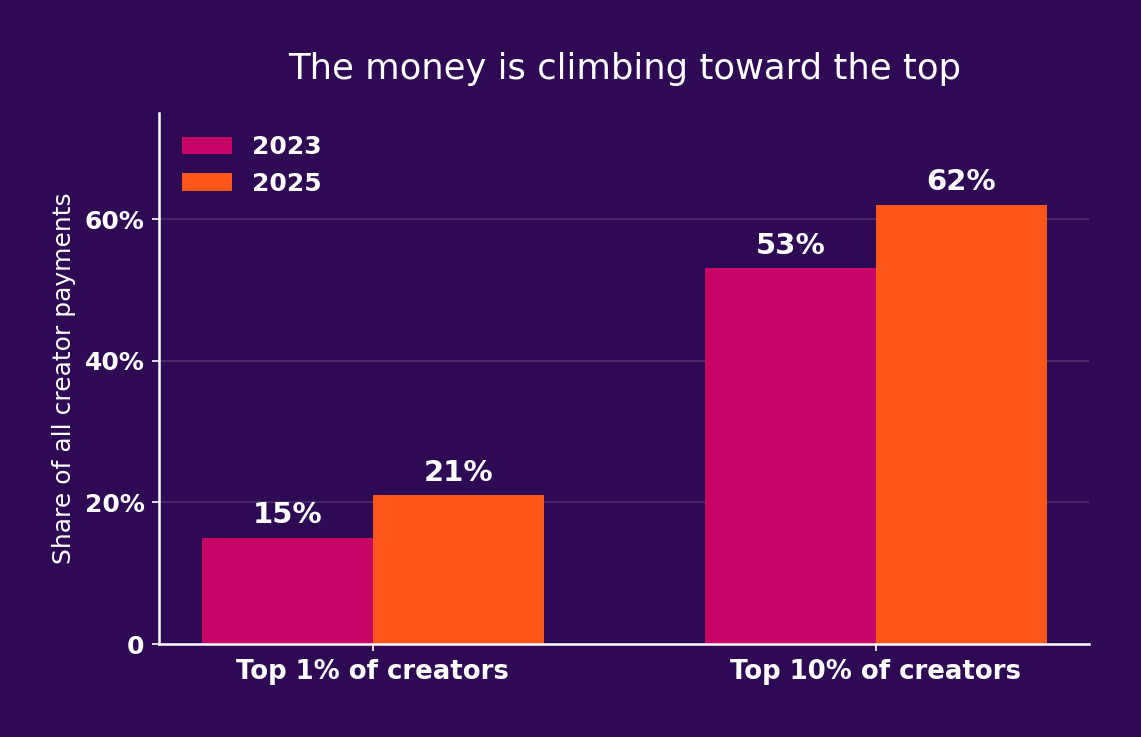
The top 1% of creators now take 21% of the money, up from 15% two years ago. The middle is being squeezed out.
Source: CreatorIQ State of Creator Compensation, 2026
The top 1% of creators now take 21% of the money. Two years ago it was 15%. The top 10% take 62%.
The middle is vanishing. The writer with 20,000 real readers who used to pay the rent from her work. The steady voice with a small, loyal following. They are the ones losing ground.
This is where “unless you pay” comes from. It feels like a toll booth. Pay, or stay invisible.
Hold that thought. Because here the story turns.
I blamed the slop.
The flood of cheap, machine-made words. I said it was burying us. Stealing our light.
Then I read the data.
And the data says I was wrong.
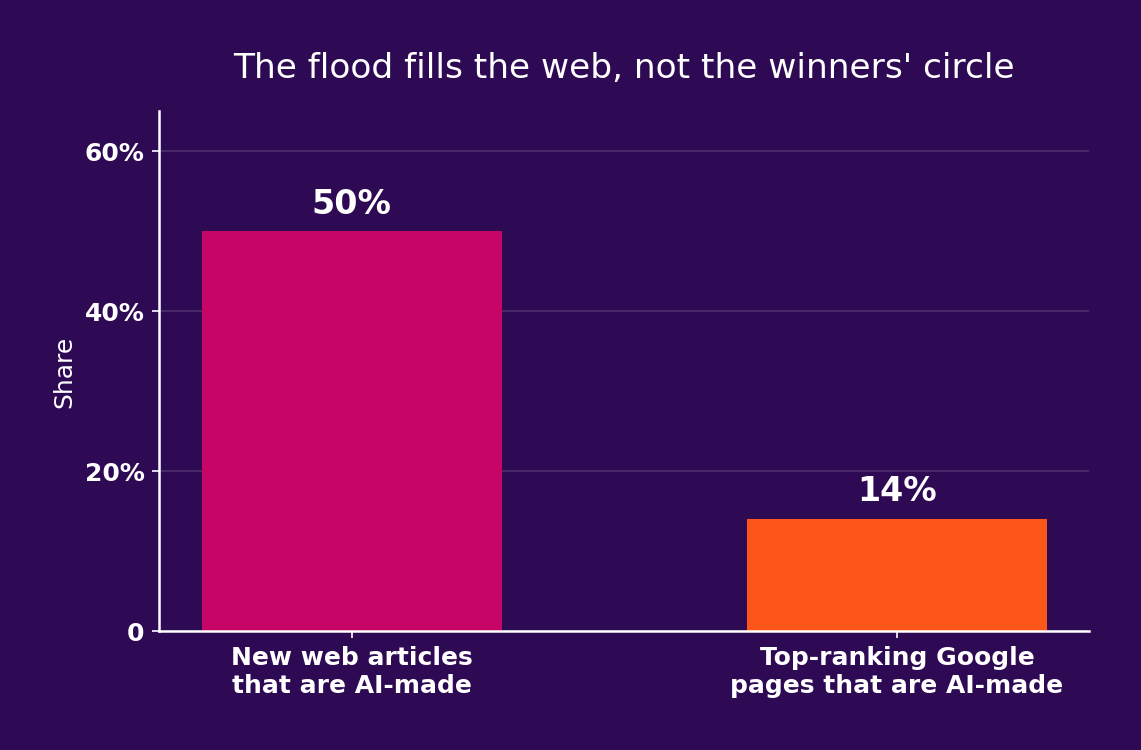
Half of all new web articles are now made mostly by AI. But only 14% of the pages that win the top spots are.
Source: Graphite / Common Crawl, 2026
Read that again.
The flood fills the web. It does not fill the winners’ circle.
The slop is drowning in itself.
And you cannot pay your way past a power law.
The top 1% did not buy their seats. No cheque moves you there.
So the villain is not the toll booth.
The villain is simpler, and worse. The kind of writing most people sell has just become free.
Think of the plain how-to post. “Seven ways to be more productive.” “A beginner’s guide to email marketing.” The box writes those in seconds, at no cost. So that kind of writing is now worth close to nothing. Anyone can make it. Everyone does.
One machine can make the average thing for free. So the average thing is worth nothing. That is the whole story in one line.
I have had the same cleaner for fifteen years.
She knows my history. I know hers. She has watched my family grow.
She is part of the family. I could never swap her for a robot.
Why not? A robot can do the task.
Because it was never only a task. It was a relationship.
The box can handle a task.
It cannot hold a relationship.
The box can copy your words. It cannot feel them.
A robot can do a job. It cannot be part of a family.
That same line runs straight through your writing. The box can copy what you know. It can never copy who you are.
Now turn it around. Look at the person on the other side of the screen.
They are drowning.
A feed of sameness. A search page of summaries. A thousand posts that sound like one machine wrote them — because it did.
Somewhere in that flood sits one person in a small office. Scrolling. Thinking the same three words you once thought.
There has to be more.
They are not starving for more content. They are choking on it.
They are starving for a human. A real one. A voice with a pulse.
Not a brand. Not a logo. Not a feed. A person who has lived something and is willing to say it out loud.
That is your opening. That is your whole business, right there.
The web is full of copies now. One real person, saying one true thing, is the rare one in the room. That person can be you.
Five hundred years ago the printing press made words cheap. The scribes panicked. Their craft was copying, and copying was now free.
But something strange happened.
When words became cheap, the writer became precious. The named human. The voice. The one you trusted.
The machine has done the same thing again. Words are cheap now. So the person behind them is the rare and valuable part.
So here is how you win against a machine web.
Not by feeding it more.
For years the answer to every drop in reach was the same. Work harder. Post more. Publish faster. Feed the machine what it wants.
That answer is dead. You cannot out-work a machine that never sleeps and never asks to be paid. Every hour you spend making another me-too post — another “ultimate guide” the box could write for free — is an hour you set on fire.
Effort pays now in one place only. On the things the machine cannot make. Your own story. The client you actually helped, and how. The mistake you actually made, and what it cost you. The opinion you are a little scared to publish.
You win by owning the ground under your feet. Look at Substack. More than eight million people now pay for writing there, and writers earned over $450 million last year. Not one of them bought their way in. They own the door. No landlord. No locks.
An email list is the one asset on this whole web that no algorithm can throttle and no landlord can seize. You built it. You keep it. It is yours.
You win by being the voice people trust, not the pile of words a machine skims. When anything can be faked, people stop trusting polish. They start trusting proof that a real person was there. So show your working. Name the real client. Post the ugly first draft next to the finished one. Say “I got this wrong last year, and here is what it taught me.” A machine cannot do that. It was not there. You were.
You win by being recommended, not ranked. Ranked is being result number four on a page nobody scrolls. Recommended is being the person a friend texts about: “you have to read this.” One of those you fight the box for. The other, the box cannot touch.
You win by trading reach for depth. One reader who opens your email every week is worth more than a hundred strangers who scroll past a post and forget it by lunch.
You win by counting the right things. Not clicks. Not follower counts. Not the numbers the box wants you chasing. Count the people who would notice, and care, if you went quiet for a month.
And you win by being no one but yourself. Do not write “five tips for better emails.” Write “the email that got me fired, and the three things it taught me.” The first, a machine can write in a blink. The second, only you can, because only you lived it.
Here is the catch. Knowing which story is yours to tell — the point of view only you carry — is the hard part. That is the problem I am building Zyrro to solve. It reads your patterns back to you and shows you the signal underneath your work.
Step onto the Zyrro waitlist →
See what runs through all of it? Every move points the same way. Away from what the machine does well — cheap, fast, average. Toward what it cannot do at all. Be a person.
The machine scales your output. It cannot scale your soul.
You were never the customer
Let me stop and tell you what really happened. Plainly. Because once you see it, you cannot unsee it.
A platform needs two things to get rich. A huge crowd of people. And a steady flood of content to keep that crowd staring at the screen.
Making that content costs a fortune. So the platforms found a cheaper way. They got you to make it. For free.
Here is how the trick worked.
In the early days, they gave reach away. You posted, and thousands saw it. No charge. It felt like a gift.
So you kept posting. More articles. More videos. Your best thinking, poured onto their platform, for nothing. Millions of people did the same.
All that free work is what made the platform worth billions. Your content was the bait that pulled the crowd in. And the crowd was the thing they sold to advertisers.
You thought you were the customer. You were not. You were the free labour that built the whole thing.
Then the building was finished.
Once everyone had moved in, and the platform had all the content and all the attention it would ever need, it stopped needing you. So it turned the free reach off. Quietly. No warning. No email.
The reach that was free now cost money. Pay to be seen, or disappear.
You were not the partner. You were not even the product. You were the scaffolding. And once the building stood on its own, they took the scaffolding down.
That is the whole con, in one line. They used your work to build their business. Then, once it was built, you became collateral damage.
The same trick, three times
And here is the part that should stop you cold. This is not the first time. It is the third.
The first time was Facebook. It handed out free reach until hundreds of thousands of writers and businesses had made it their home. Then, in 2012, when it went public and had to make money for its new owners, it choked that reach off. A post that once reached a hundred thousand people now reached a few hundred. Overnight, and there was nothing you could do.
The second time was Google. For twenty years it sent you free visitors, until the whole world wrote its websites to please it. Then Google began answering questions itself, right there on the results page, and kept the visitor for itself. Your work fills the answer. Nobody arrives at your door.
The third time is now. It is AI, and it is the largest grab of all. The machines read almost everything you ever wrote — for free, without asking — and used it to build tools that now do your job. They took a lifetime of your work as raw material, and hand you back almost nothing.
Same trick, three times. Dangle something free. Feed on the work you give them. Then, once they have won, cut you off, or replace you.
You survived the first two. You will survive this one.
But not by playing their game. You cannot win a game where they own the board and change the rules whenever it suits them.
The box is real. The battle is real. The research says so.
But the box has one blind spot, and it is the size of a human being.
It can take your words.
It can rank your page.
It can copy your style.
It can never be you.
So stop trying to beat the box at its own game. You cannot. It never sleeps, and it works for free.
Play the game it cannot play at all.
Tell the truth. Sign your name. Be the person it can copy but never become.
Be the signal.
Finding your own signal is the work of a lifetime. It is also the one thing I am building Zyrro to help you do. If that speaks to you, the early list is open.
No posts
Comments
Nothing yet. Say the first thing.
Sign in to join the conversation.