
Last October, as I stood at the front of a lecture hall at Cambridge, looking out at a room full of people ready (again) to hear yet another talk about AI (again), I found myself wanting to begin somewhere simpler and more honest.
Not with hype.
Not with panic.
Not with the tired question of whether AI is “good” or “bad” for writing.
What I wanted to say was this:
For some of us, generative AI is not a shortcut. It is a scaffold.
And for some of us, it can feel a lot like a survival strategy.
That was the real heart of my talk.
I wasn’t speaking as someone observing the technology from a safe intellectual distance. I was speaking as a writer, teacher, and researcher who has spent the last few years living inside this experiment… using ChatGPT across research, teaching, public writing, creative work, and the ordinary mess of everyday composing. Over time, what started as curiosity became something more substantial: a record of how a neurodivergent mind works with a machine, not because the machine can think for me, but because sometimes it can help me hold onto the shape of my own thinking long enough to keep going in my writing process.
That distinction matters to me. It matters academically, certainly, but it also matters personally.
Because when people talk about generative AI and writing, they often talk as if all writers move through the world with the same cognitive ease, the same internal storage capacity, the same relationship to attention, sequencing, memory, and overwhelm. But we don’t. Some of us have always needed to build the path while walking it.
I am one of those writers.
I’m neurodivergent, and that means my writing process has never looked especially tidy from the outside. In fact, it’s a bit of a mess!
My mind is associative, recursive, sometimes unruly, often intensely overworked, and not always interested in proceeding in a neat little line from Point A to Point B. I can make astonishing conceptual leaps and, in the same hour, lose the thread of a paragraph because too many competing ideas are trying to arrive at once. I can hold a big vision and misplace a small sequence.
So for most of my life, I have relied on scaffolds.
Outlines. Lists. Color coding. Diagrams. Notes written in margins and on scraps of paper and in documents with names like “final_FINAL_v2_reallyfinal.” External structure has never been extra for me. It’s been how I write at all.
That’s one reason I get impatient with simplistic claims that AI makes writing “too easy.” Easy for whom? Compared to what? And under whose assumptions about how writing is supposed to happen?
My experience has been the opposite of that caricature vision of writing. AI hasn’t removed the labor of writing for me. It’s simply redistributed a bit of that labor so that I can spend more of my energy on what actually matters: judgment, argument, meaning, revision, ethics, voice, you know — metacognition (that’s my own em-dash).
To put it more plainly: AI doesn’t make me think less. It helps keep me thinking when my attention would otherwise splinter under the weight of too many moving parts.
There is already a vetted term for what I’m describing: cognitive offloading (Risko & Gilbert). In the simplest sense, it means shifting part of your mental workload onto external supports so that your brain can focus on higher-order tasks. Lists do this. Calendars do this. Whiteboards, notebooks, post-its, citation managers: all of them hold something for us so that we don’t have to hold everything at once.
This isn’t cheating. It’s being a person with a finite mind in a complicated world.
In my Cambridge slides, I summarized Risko & Gilbert’s cognitive offloading as the deliberate shifting of mental work: “remembering, computing, sequencing, and verifying onto external supports so limited attention and working memory can be used for judgment and meaning-making instead.”
That definition is scholarly, yes, but it is also my lived experience.
For me, large language models (LLMs) have often functioned less like ghostwriters and more like rhetorical mirrors. I can ask generative AI to help me hold the structure of a piece while I test ideas. I can ask it to reorganize, reflect back patterns, draft a rough frame I will definitely revise, or help me move from the pile of thinking to the shape of an argument. Sometimes I need it to help me transition. Sometimes I need it to help me begin. Sometimes I need it to sit there like a patient interlocutor while I circle my way toward clarity.
That’s NOT outsourced intellect; it’s supported cognition. Sam Gilbert returned to this idea in 2022, with the publication of a study on “Intentional Offloading,” the notion that we purposely offload what we need to, based on how we experience the world. His conclusion: intentional offloading is incredibly effective.
And, for neurodivergent writers specifically, the results matter.
Because I am a writing scholar and, frankly, incapable of resisting a process question or data of any kind, I thought I might study what I was doing rather than just doing it.
So I began treating my own LLM writing history as a dataset. I chose ChatGPT since I have been using that specific LLM with the same account since 2022.
The analysis I presented at Cambridge drew from conversations between 2023 and 2025 (the data set that ChatGPT could collect and export) and included more than 1,500 writing sessions and over 6,000 exchanges.
First, I grouped all of those conversations into broad rhetorical categories such as brainstorming/ideation, editing, and single-shot utility tasks. What emerged from that analysis felt immediately familiar to me, even before it felt publishable.
Most of my use clustered around brainstorming and editing.
Not surprisingly, those are the parts of writing where my mind is often most alive and most vulnerable at the same time. Brainstorming invites possibility, but it can also become a kind of cognitive weather system. Editing brings control, but it also demands sequencing, inhibition, prioritization, and endurance.
The data showed me using AI where writing gets most cognitively dense.
That external scaffolding mattered because it challenged a lazy public story about AI doing the writing for me. If that were the case, I suspect the distribution would look quite different. Instead, what the data showed was recursive engagement: idea generation, reshaping, tightening, revisiting, checking, clarifying. Less “write this for me” than “help me stay with this until I can write it the way I mean it.”
By the time I gave this talk at Cambridge, I had analyzed 1,560 ChatGPT conversations comprising 6,258 complete exchanges. What stood out was not just the volume, but the pattern: a median of three iterations per session, increasingly shorter recursive loops over time, and a 166% increase in activity from 2024 to 2025: evidence of sustained, scaffolded engagement with writing, not of automation.
Earlier threads (2023-2024) were often longer, more exploratory, and more visibly effortful. Later threads (late 2024-2025) showed quicker cycles of drafting, revising, and moving on.
I do not read that as dependence. I read it as familiarization. Once a scaffold becomes trustworthy, you don’t always lean on it with your full weight. Sometimes you just touch it on your way forward.
That’s one of the most important things I have learned from this analysis. The goal of scaffolding is not permanent reliance. The goal is stability, continuity, and enough cognitive support to keep meaning-making intact. Once that support becomes part of your process, the rhythm changes. You stop spending all your energy on not dropping the thread and can spend more of it on the thread itself.
That has certainly been true for me.
This is also where my own frameworks enter the story.
The Rhetorical Prompting Method (RPM, available as OER) grew out of my desire to make the writing process visible and teachable inside AI-supported composing. At KSU and on Coursera, we’ve tested this method with more than 10,000 learners. RPM is a means of externalizing planning and versioning: outline to draft to edit in a single thread, so working memory doesn’t become a bottleneck.
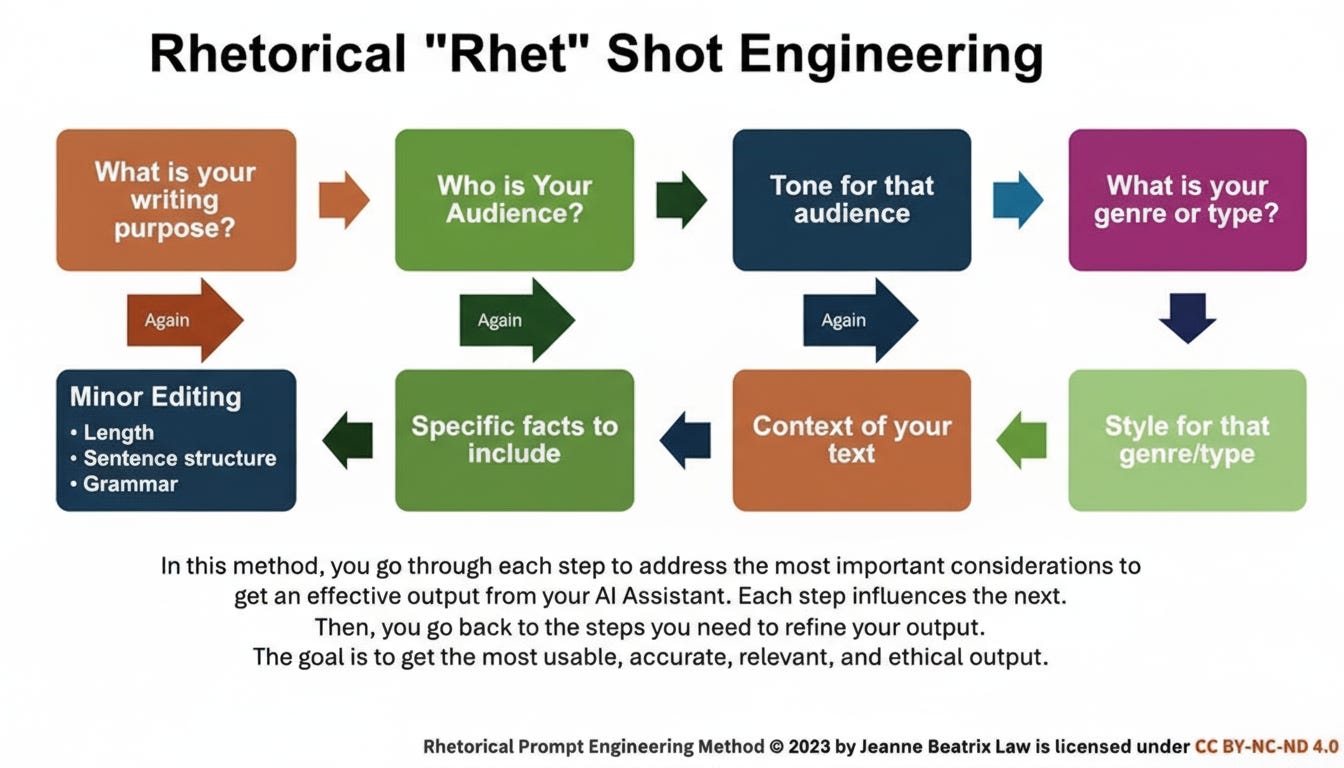
That formulation still feels right to me.
RPM mirrors what many writing teachers already know: writing is recursive, not linear. We move from idea to shape to revision and back again. For neurodivergent writers, that recursion can be especially generative, but it can also be especially difficult to track internally. RPM gives that movement a visible structure.
My Ethical Wheel of Prompting (available as OER) does related work from another angle. If RPM helps externalize the process, the Ethical Wheel externalizes responsibility. In the Cambridge materials, I framed it as a way of making usefulness, relevance, accuracy, and harmlessness a routine.
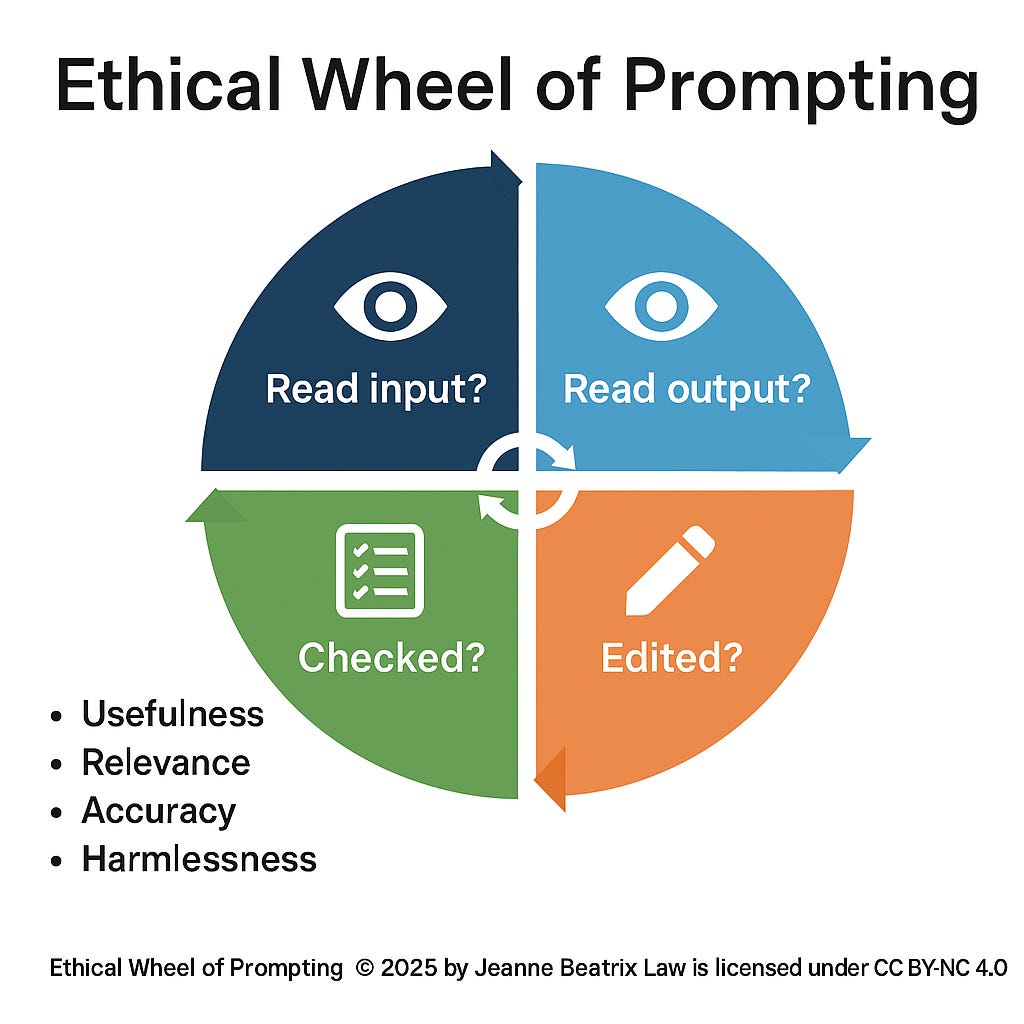
That matters to me deeply because I do not want an AI-assisted writing pedagogy that is merely efficient. I want one that is accountable and one that preserves my voice.
Human judgment stays at the helm. It always must.
That is why one of my core questions remains so simple and so stubborn: Did I edit the output for usefulness, relevance, accuracy, and harmlessness? If the answer is no, the work is not done.
This is where the personal becomes pedagogical.
Too much of writing instruction still assumes a default student: internally organized, linearly progressing, able to hold multiple constraints in mind without external support, and largely unaffected by the sensory and attentional realities that shape actual human cognition. That student exists, I’m sure. I have probably taught a few. But they are not the whole classroom.
When we design pedagogy around invisible cognitive labor, we privilege the students who can perform that invisibility most easily.
What interests me about AI in writing is not replacement. It is the possibility of designing for a visible process. If students can externalize brainstorming, planning, rhetorical decisions, ethical checks, revision steps, and moments of uncertainty, then writing becomes more teachable because it becomes more observable. And once it becomes more observable, it becomes more discussable, revisable, and more equitable.
That is especially important for neurodivergent students, but it is not only useful to them. In my experience, the scaffolds that support ND writers often clarify the work for everybody else too.
Accessible design has a habit of helping more people than the category initially named.
After three years of AI-Jeanne convos, I keep coming back to one basic conclusion.
AI did not make me write less. It made my writing process more visible, more sustainable, and, in many cases, more honest.
By honest, I mean that it revealed the extent to which writing has always depended on supports, interlocutors, tools, drafts, feedback loops, and externalized thinking. What AI has done is make that collaboration more explicit.
Sometimes that explicitness makes people nervous. I understand why. We should be cautious. We should be critical. We should be asking hard questions about labor, ethics, environmental costs, bias, surveillance, authorship, and harm. I certainly am.
But we should also be precise.
Because sometimes the technology is not replacing thought at all. Sometimes it is helping hold the pieces together so that thought can happen. For some writers, especially those of us who live with differently wired attention and memory, that distinction is not minor. It is the whole story.
My autoethnographic work eventually led me to a question bigger than myself.
If AI-supported scaffolding could help stabilize my own writing process, what might it reveal about student writers working in real time?
That question is now at the center of my Think-Aloud Protocols research. In these IRB-approved studies, students record themselves writing while narrating their decisions as they go. Rather than evaluating only the finished essay, we get to observe the actual movement of composing: the hesitations, revisions, false starts, prompt changes, checks for evidence, ethical uncertainties, and moments of discovery.
That matters because the public discourse around student AI use is still far too blunt. It tends to collapse a wide range of activity into a single narrative of either cheating or efficiency. But the TAPs research my colleagues and I are doing at KSU suggests something much more complicated and much more interesting. Students are often not simply asking AI to spit out prose. They are negotiating with it. They test language, challenge responses, reshape prompts, compare options, check themselves, and return to their own emerging judgment. The process looks far more like collaboration than automation. Stay tuned for peer-reviewed publications and presentations this Spring and Summer on our results.
Note Bien: This post grew out of my Cambridge Conference on Education & AI, my ongoing autoethnographic analysis of my ChatGPT writing corpus, and my current TAPs research on student writers and AI-supported composing. I am happy to share my slides and other work.
No posts
Comments
Nothing yet. Say the first thing.
Sign in to join the conversation.