

Another day, another AI buzzword. This week I looked a bit further into the term “agent harness” to understand what we really need to know. I also put Claude to the test with some data analysis tasks inside Excel. If you’re just here for the news, feel free to skip ahead to the end. Welcome back to The Clique.
What separates an LLM from an AI agent is the ability to actually do things. This could be reading files, browsing the web, sending emails, or really anything that involves taking an action on your device. Behind the scenes, the agent is still using an LLM to generate text. This text is used to help it reason through a problem and identify what actions should be taken next. Generally, agents follow a loop that will look something like:
Think > Act > Reflect > Repeat
The LLM does the thinking and evaluation and can even determine the appropriate action by generating the text-based commands that can then be run. But it still requires some code to link each of these steps together and turn it into a smooth workflow. This piece of code is known as an agent harness; it’s the scaffolding that sits around the LLM to turn it into an agent.
Obviously, it’s a bit more complicated than just chaining a few prompts together. It manages what tools the model can use, what permissions it has, what it can remember between steps, and when to pause and check with a human.
We also have different harnesses for different tasks. Claude Code will use one harness that’s more specialised for writing code. Claude Cowork will use a slightly different one. Each agent has its own harness tailored to the specific set of actions the agent may need to perform.
LLM + Harness = AI Agent
The reason I think this is particularly important to be aware of is that the harness is also the layer responsible for security and safety. When the LLM-brain decides an action needs to be performed or a line of code needs to be run, the harness is the hard-coded, deterministic filter that prevents unwanted or potentially harmful actions—or at least gets human approval first.
You can plug Claude directly into Excel (via an in-built Excel extension) and have it analyse data, write formulas, summarise tables, and flag anomalies, all inside the spreadsheet you’re already working in. I ran a few tests with this last week for some data analysis work, and it’s honestly pretty good.
I started out by asking Claude to conduct some initial analysis of a dataset to get a sense of what it contained, how some of the variables were distributed, and anything important I might want to know—basically all the things I’d usually spend the first 30 minutes or so doing manually when I first get my hands on a new data source. A few minutes later, it came back to me with a full set of charts, tables, and a brief summary of some key points about the whole data source. Pretty much exactly what I would have done, just in one twentieth of the time.
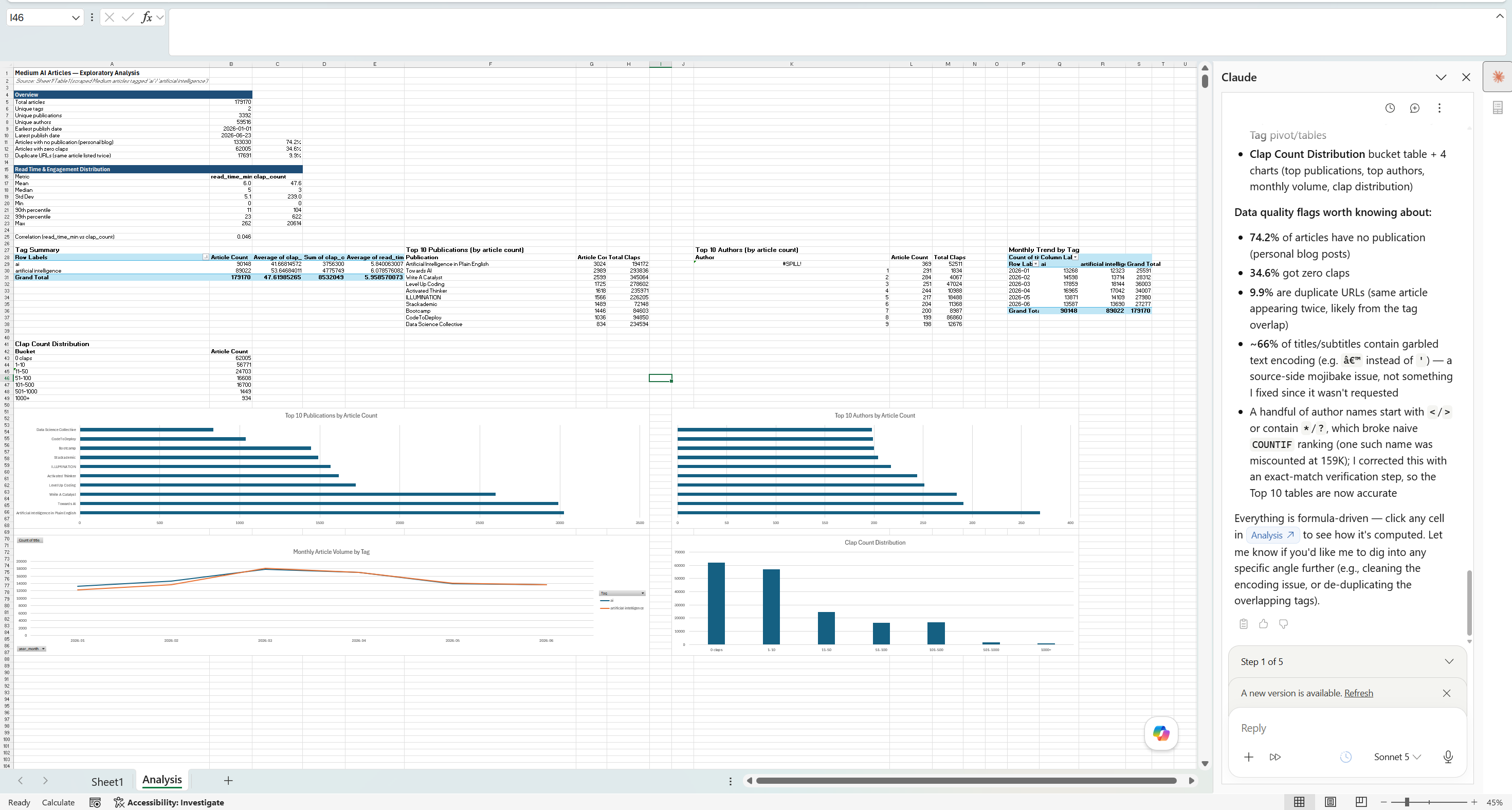
I then asked it to make a few changes to the charts, which it again did really well. It even managed to grey out some of the bars of a bar chart where the sample size was too small. If you’ve never done this in Excel, it’s not complicated, but it's a manual task—there’s no built-in button for it (at least not that I’ve found). Claude managed it in a matter of seconds.
I then tried its hand at statistical analysis. With some assistance from me, it came up with a research question and conducted 3 different statistical tests to find an answer. Surprisingly, it did a really thorough job of this, analysing the distributions of specific variables before determining what tests would be most suitable. Now I’m not a professional statistician, perhaps an enthused amateur at best, but Claude did at least as good a job as I would have, if not better, since the whole thing only took about 5 minutes.
My one complaint with everything so far is the lack of auditability. Claude tends to work with code running against the source data rather than with Excel formulae. This means that tables of data will appear out of thin air, with no way to verify that they're actually coming from the right place. When it does generate cell formulae, they’re excessively convoluted and try to do everything with a single line of code rather than splitting it across multiple cells as a human might.
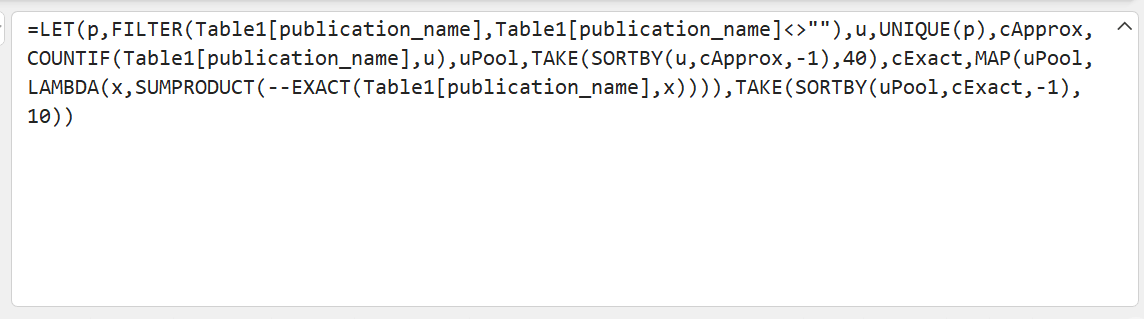
Yeah, I have no clue either.
This isn’t a tool I’d use for repeatable data processing workflows, and probably not for anything accuracy-critical given how hard it is to validate what it’s done. But for a quick bit of exploratory work, it saved me a lot of time.
AI models and research
Anthropic launched Claude Sonnet 5 on June 30th, making it the new default for free and Pro subscribers; the model runs agentic tasks, tool use and autonomous reasoning at levels that previously required the larger and more expensive Opus models, at a substantially lower cost.
Also on June 30th, Anthropic released Claude Science in beta, an AI workbench for researchers that connects to more than 60 scientific databases and can carry out computational biology and drug-discovery tasks with minimal instruction; early adopters include Sanofi, the Allen Institute, and UCSF, with paid Claude subscribers able to access it now.
Mistral launched OCR 4, a document intelligence model that extracts structured output with bounding boxes and confidence scores across 170 languages; it runs in a single container for organisations that need to keep sensitive documents on their own infrastructure.
Meta’s research team demonstrated Brain2Qwerty, a system that converts real-time brain signals directly into typed text; the work represents a step towards practical non-invasive brain-computer communication for people who cannot use conventional input devices.
Hardware
OpenAI and Broadcom unveiled Jalapeño, OpenAI’s first custom AI inference chip, built from initial design to production in nine months, with OpenAI’s own models used to accelerate parts of the development process; gigawatt-scale deployments are planned before the end of 2026.
Policy
The White House asked OpenAI to restrict the rollout of GPT-5.6 to a small group of government-approved partners, citing cybersecurity capabilities the administration considers on a par with Anthropic’s Mythos; it is the first time a US government has preemptively limited a domestic AI model release before launch.
Industry
Google DeepMind lost four senior researchers to rivals in six days: Nobel laureate John Jumper, lead developer of AlphaFold, is joining Anthropic, Transformer co-author Noam Shazeer is moving to OpenAI, and two further senior researchers are also heading to Anthropic; Alphabet shares fell more than 7% in a single day during the same week.
Microsoft’s AI chief Mustafa Suleyman confirmed at Build 2026 that the company has seven frontier models in active development, following a renegotiated agreement with OpenAI that removed the previous restrictions on Microsoft building its own frontier AI systems.
Anthropic published its June 2026 Economic Index, a monthly analysis of how Claude is actually being used across industries and occupations, based on real interaction data rather than surveys; the report tracks which tasks are being handed to AI and which remain human-led.
Tools and products
Proton updated Lumo, its privacy-focused AI chatbot, to version 2.0, adding image recognition and generation while maintaining its policy of not training on user data.
Cursor launched an iOS app that lets users monitor, approve and redirect AI coding agents remotely from a phone, moving the management of autonomous agents beyond the desktop for the first time.
Claude is now available in Microsoft Foundry on Azure, giving enterprise teams native access with their existing Microsoft identity, billing and governance infrastructure in place.
Workforce
Ford has been rehiring human quality inspectors at some facilities after AI-based quality control systems proved inadequate for the complexity and variability of the work.
A Forbes survey found 76% of workers are using their own AI tools at work rather than employer-provided options, as corporate AI programmes continue to lag behind what employees are already using independently.
A report on professional services finds AI is breaking the hourly billing model in consulting, legal and other knowledge-work fields, as practitioners navigate how to price work that AI can complete in a fraction of the time.
New analysis from SignalFire found engineering jobs are among the most resilient to AI disruption, with companies classified as high-intensity AI adopters seeing overall headcount rise by more than 10%, and entry-level hiring up 12%, contrary to the prevailing narrative.
Thanks for making it this far!
James
No posts
Comments
Nothing yet. Say the first thing.
Sign in to join the conversation.