
As my book reviews tend to be, this article is a long one. Your email may truncate it. Get the original at http://jdanielsawyer.substack.com
Apparently reviewing books is popular (and dangerous). My review of the novel Yesteryear prompted two new requests for reviews from paid subscribers—one to review an essay by Aldous Huxley about self-transcendence, and the other to review Communion by J.D. Vance.
The Huxley commentary is coming up in the next couple weeks. This is the Vance review/commentary—and as you have come to expect, dear reader, this review is exhaustive and deeply interrogates the book from several different angles.
But I should get something out of the way up front: while this article talks in some depth about political and religious topics, it is neither a review with a partisan perspective nor is it aimed at persuading you of anything with regards to politics or religion.
I really hate it when people ask me to talk about politics. I have a very unusual political philosophy and I really hate the team-sport aspect of it. In today’s world where political tribesmanship has replaced sports-fandom, national pride, class coherence, ethnic identity, and religious adherence—a marked downgrade, all in all—finding oneself in the position of constantly thinking “you’re wrong for the right reasons” or “you’re right for the wrong reasons” or “the reason this idea makes sense and the reason this idea is crazy are the same” is a really good way to earn looks of disapproval, dis-invitation to parties, and a noose on a gibbet.
But when a paid subscriber calls, I listen. Like everyone else, I’ve gotta eat. So I decided to do the Vance book first, to get it out of the way.
Therefore, with a great sigh of “oh well, if I must” I picked up J.D. Vance’s book Communion, which is described on the cover as a memoir of the author’s “faith journey” aimed at those seeking “reconciliation with God.”
When a book is potentially controversial, deals with sensitive topics (like religion and politics), and is tied to prominent public personalities, it is only fair for the reviewer to disclose his biases, expectations, and prior understandings of the subject. Therefore, here were my priors going into Communion:
Vance is a potentially world-historical figure due to the timing of his rise to power and the various cultural and political tribes that he serves as a junction for.
He has a demonstrated ability to do the statistically impossible (rising from Appalachian dysfunction to the Vice Presidency in just 20 years with a lot of other really interesting stops along the way). I thought Trump’s pick of him for VP was an inspired move of political gamesmanship, as Vance brought several new factions to the ticket (as well as the ability to speak coherently while preserving the common touch). It was a political move on par with Bill Clinton hiring James Carville to run his Presidential campaigns.
I expected this to be a cynical volume aimed at positioning Vance for a Presidential run, not (as the cover advertises) a sincere religious memoir.
I expected a pretty good reading experience on the level of technical craft. Vance is a successful VC, he’s a Yale graduate, he’s a pretty-decent public speaker and impromptu raconteur, and (if all else fails) he’s rich enough to hire a damn good ghostwriter who can deliver exactly what he wants. This is the very picture of someone who can give good prose.
I was not expecting to be dazzled by the strength of his argumentation for re-embracing religion, but I was expecting to be impressed by the execution of his argumentation.
It’s worth noting that “being impressed by the strength of the argument” is a very poor reason to read a book of popular religiosity or of memoir (and this book is sold as both). Instead, one should expect to find value either in the original thought about an important topic by a public figure, or a glimpse into the mind of such a figure so that you can more accurately model their future behavior (which is pretty important when that public figure is an elected leader).
Based on Vance’s willingness to go for blood in public speeches and to otherwise court controversy, I expected to encounter an above-average mind with a ruthless intellectual style (which is the style I prefer—you may have noticed).
As an obviously intelligent man, a Catholic married to a Hindu, and the Vice President in a country that is explicitly non-religious, I expected to find some interesting passages where the author wrestles with the issues involved with sharing a fate (or a society) with someone whose worldview is radically divergent, and perhaps a few insights into forming heuristics towards those ends.
I expected to find some pretty well-delineated ideas about the role of religion in reasoning and its proper place in society.
I expected to better understand the author by the end of the book.
I am not a Christian.
By this I am not confessing to apathy or ignorance. If you read me regularly you’ll know that religion and mythology are enduring interests of mine, though you may not know how deep that goes.
Here’s how deep:I have written a book on Christian ethics (withdrawn from the editor before publication due to my apostasy), I’ve written articles that were used as texts in Christian college classes, I was educated in Christian schools. I come from a missionary family. I learned Greek passably enough that I could (with the help of dictionaries) poorly translate Bible verses from the critical text before I reached Jr. High. I have been involved in evangelism and street ministries. I know Christianity, Christian history, Christian culture, Christian sectarianism, Christian theology, and Christian heresies better than 90+% of Christians who have ever lived (growing up in the house of a devoutly religious historical theologian with unfettered access to his entire bookshelf and to all the professors at every school where he taught will do that to you). I spoke to God multiple times every day. I bet everything in my life up until nearly the age of 30 on my religion.
And, tragically, as a result of my studious devotion, I was eventually unable to believe.
Because I respected my family, my community, and the truth, I dealt with this fact by quietly withdrawing my church membership and letting my fellows know that I was no longer a brother Christian, and I left it at that. I have never tried to push another human towards apostasy. The decision to tell the truth cost me my professional life, my lifelong friendship network, and (for a time) my family.
In other words, I am not a “secular person” or a “non-believer,” I am an apostate who knows—as certainly as I know that the Arctic (which I have never visited) is dark for several weeks every winter—that the doctrinal and historical claims at Christianity’s core are not true.1
Most apostates are apostates for emotional reasons (such as a lack of felt connection with God, anger at the circumstances of life, etc.) or for sophomore-philosophical reasons (such as the problem of evil). I was an unwilling apostate forced out of the fold for epistemic reasons, so I tend to have a fairly unsympathetic attitude towards apostates (transient or not) of the average sort.
As a consequence, I went into Communion expecting to be disappointed by the book because I am always disappointed by books in this genre.2
Those are my priors and expectations.
I am sorry to report that I was not disappointed in my expectations of disappointment—but that I was disappointed on many other fronts.
However, in all transparency, I must admit that some of my priors turned out to be dead wrong. This book did find some ways to surprise me.
Communion more-or-less fits in the genre of the “conversion story.” This a personal memoir in which the writer recounts the manner in which he arrived at his current religious or ideological position. This is a very old genre—we have extant examples going at least as far back as The Confession by St. Augustine of Hippo, The Golden Ass by Apuleius, and before that (depending on your position on dating and authorship) some passages in the letters attributed to St. Paul. The genre likely stretches back much farther.
Some popular genre titles that have been seen cultural-phenom status in the last twenty or thirty years are entries like The God Delusion by Richard Dawkins (late 2000s), Surprised by Joy by C.S. Lewis (which had a big resurgence in the 1990s), and The Language of God by Francis Collins (late 2000s).
Every genre has particular conventions. This genre’s object is persuasion-through-testimony: “I’m sharing my intellectual/spiritual journey because I think I’ve discovered something that you might benefit from.” It’s a strange nexus of self-help, polemic, preachment, and philosophy—which is why a well-written book in this genre can be so absorbing, entertaining, or enriching even when you find the actual philosophical/theological/spiritual/political end-point to be uncongenial, objectionable, offensive, or silly.
Memoirs—including conversion stories—are interesting because they allow the reader to experience how another person thinks. And, for the same reason, they can be intolerably irritating.
Over the rest of this article, I will engage with specific ideas and arguments raised by Vance in his book. But first, I’ll give those of you who are considering picking it up my completely honest and incredibly biased review.
Here it is:
This is not a good book.
The Confession and Surprised by Joy and The Golden Ass are good books. They’re well-written, engaging, and provocative. They’re thoughtful, and, though the quality of the thought varies, the integrity of thought (meaning: the thought is integrated and self-consistent) is fairly high. The God Delusion is an okay book. It’s entertaining and clever, but not exactly an exemplar of high-quality thought or integrity of thought (note that I’ve just given higher marks to three religious books with which I deeply disagree vs. an irreligious book with which I am inclined to agree on particulars more often than not).
Vance’s Communion does not rise to the standard set by any of those other books. It also doesn’t rise to the standard of the The Case for Christ by Lee Strobel, which is readable despite being thoroughly dishonest (not to mention fraudulent) on several points. Strobel isn’t a good writer, but he’s a better writer than Vance (at least where this subject is concerned).
What makes Communion a bad book?
To start with, the prose style is bad. There’s no flow to the language, and no aesthetic sense. For a book that concerns itself extensively with spirituality and beauty, this is an unforgivable flaw. These are matters that depend on soul to be intelligible at all, and while it is apparent that Vance really cares about this topic, earnestness does not, in itself, make for effective communication. The sentences are clipped and simplistic. Ideas don’t naturally build upon each other. Consider this representative sample from page 5 of the hardback edition:
In becoming a husband and father, my world simultaneously narrowed and expanded. I began to think about virtue and vice and sin without having the vocabulary to understand them.
Stylistically speaking,3 that’s the kind of thing you expect to hear from a college freshman writing a position paper (back when college freshmen could write). There is a reason that professors routinely employ graders to read their papers: this kind of prose is dull. Dishwater dull. Butter-knife dull. It’s an absolute slog to read more than a few paragraphs of it.
Read that paragraph again, because there’s something else going on that’s interesting in the way that it fails as prose.
First, consider the rhetorical structure: Thesis statement, followed by expansion with implicit promise of development. Style-wise, this is called “on the nose”;4 it says what it means to, and nothing more. This is a literary sin, but not an unforgivable one. However, if the implicit promise of further development is not met, then it is unforgivable. And, in this book, Vance generally fails to deliver on such implicit promises.
Second, notice the dominant clause in the second sentence. He talks about “virtue, vice, and sin.” This is, at first blush, redundant. Vice and sin are, in common parlance, synonymous. If Vance were a better writer, he would immediately have unpacked what he sees as the difference between “vice” and “sin”—after all, in Christian theology there is a difference: “vice” is a subspecies of “sin.”
In Christian theology, “sin” is anything that invites (or causes) evil, frustrates virtue, and/or separates humanity from God.5 Vices are hedonistic (and often habitual) sins of commission (i.e. bad things that you do to gain pleasure/advantage or avoid pain) while “sin” is a broader category which includes original sin (i.e. humanity’s fallen nature, which is hereditary), sins of omission (i.e. virtuous acts or duties that one fails to rise to), sins of commission (actions which separate us from God and our fellow humans, of which vice is the most common subspecies), and sins of imperfection (impure motives and thoughts, etc.).
I have just given you a more comprehensive picture of the Christian understanding of sin than Vance does in the entire book of Communion. That is a problem for a book that is attempting to advocate for, and demonstrate the deep meaning and purpose that can be found in, the Christian life.
There are also other problems with the style that are simply annoying.
First, and most obvious, is the flashy and inconsistent censorship. Though Vance himself assiduously avoids profanity and vulgarity (even in places where it would enhance the style and quality of the text), when quoting the writing of other people, he seems content to let vulgar language (like “asshole”) through.
However, when quoting the speech of others, he aggressively censors words like “shithead” (“sh**ead), “pussy” (p***y), and even “piss” (p*ss). Most of the censored words come when he’s quoting his late-and-lamented grandmother, whom he credits as a singular and lasting influence on his political and religious life. This is infelicitous, clunky, and—worst of all, disingenuous and performative.
If Vance wanted to protect the delicate eyes/ears/minds of his conservative audience, he’d speak around such terms—but he doesn’t. He wants to be seen as protecting them and deferring to their hang-ups, but he nonetheless is happy to put the full force of the words in the minds of the readers. The effect is the same as watching grown adults say “the n-word” or “the f-word” instead of “nigger” or “fuck,” as if they’re five-year-olds trying to avoid getting their mouth washed out with soap. This kind of infantile ploy for plausible deniability is as transparent as it is contemptible—doubly so as Vance is the Vice President of the first President in US history to use words “shit” “fuck” and “pissed-off” in full-view of the public (to say nothing of “in official remarks”). Who the hell does Vance think he’s fooling? God?
Okay, okay, I know, this is a petty thing to get hung up on, but it shows up the deeper problem involved in this book:
At every juncture, this book is trying far too hard to please its audience. It wants to be companionable through being inoffensive. Memoirs are supposed to be self-focused, but this kind of approach is like reading a performative church lady who’s trying to rally the troops and failing miserably. For this same reason, the book gestures constantly in the direction of “spirituality” while never once dealing with anything disturbing, numinous, overwhelming, or offensive-to-modern sensibilities (which all spirituality is).
These are not, unfortunately, the only literary sins (here defined as “acts which separate the reader from the text”) that Vance commits. There are two others, and both are—to my mind—unforgivable.
This book simply does not know what it wants to be. It floats freely between memoir, evangelism, personal therapy journal, and political advocacy. In more capable hands, this kind of free-floating chain-of-consciousness narration can create a beautiful spell of whimsy and discovery, but those elements are completely absent here for one simple reason: there is no apparent flow or method to these wandering thoughts. The narrator’s leaps between talk of family, talk of politics, talk of values, and reminiscences are often unmotivated and jarring. Where a skillful writer (or raconteur) might lead the audience from a tale about his children’s tyrannical breakfast demands into a series of reflections on desire, deferred gratification, and/or meaning, an unskillful writer will merely talk about his demanding children and how it tries his patience, then move on to another topic that he has not bothered to construct a good segue to (Vance does this on at least two occasions).
This leads us into the final problem with the book: It has no real structure. The narrative loosely follows the timeline of Vance’s life, but it’s marked by constant leaps forward and backwards, and by frequent discursive (and often incomplete) tangents into political and social matters. The cumulative effect is that of listening to the hyperkinetic and poorly-connected musings of a mildly-intoxicated wine mom.
The book is not without content or point-of-view—it does however lack both structured argument and adequate attempts at persuasion to advance that point of view (or, indeed, make it fully intelligible). This is a fatal flaw in any book advocating for a set of ideas or opinions—doubly so for a conversion narrative.
The lack of structure leaves a lot of questions on the table at the end as far as what this book was meant to achieve. Is it intended to serve as a personal witness in support of faith? A political manifesto? A covert announcement of an intent to withdraw from political life after the current term ends? It’s hard to say—I’m not even sure if the author knows.
The result is that, at just under 300 pages, this short volume reads as if it were north of 700. It’s slow, and it does not reward reader patience with a bang-up or sharply-focused end.
But that doesn’t mean it doesn’t have some very interesting points.
Throughout the book, Vance visits the topic of virtue and the lack thereof several times. In the paragraphs following the passage quoted briefly above (and elsewhere later on), he talks about his worries about giving his children a coherent worldview, and especially a moral framework grounding them in virtue.
Worrying about virtue is an old American tradition. It was famously on the mind of James Madison, the young man who drafted the Constitution, who said of the American project:
“If men were angels, no government would be necessary. If angels were to govern men, neither external nor internal controls on government would be necessary.”
—Federalist No. 51
And, of course, there is the famous quote by John Adams:
“Our Constitution was made only for a moral and religious People. It is wholly inadequate to the government of any other.”
—letter “To the Officers of the First Brigade of the Third Division of the Militia of Massachusetts,” October 11, 1798
The early American Republic was not a particularly religious or Christian place by the standards of its time, but several of the Founding Fathers (particularly, those who hailed from New England) believed that, were the experiment to succeed, the art of virtue must be internalized in order to prevent the country from descending quickly into the kind of anarchy that would invite tyranny. Thaddeus Russell’s A Renegade History of the United States discusses, at length, the depths of anarchic lawlessness in Boston in the years leading up to the Revolution, and the nature of the concerns that the WASP6 Founding Fathers had on this score. He markedly does not discuss Patrick Henry, a Founding Father from the Appalachian Border region (and cultural forbear of JD Vance), who exemplified his American Nation (the Scots-Irish)7 in disagreeing radically with the idea that naturally follows from this view: that it is the responsibility of the Government to foster moral conformity among its people.
Jefferson and Franklin also dissented from the New England view, for different reasons and in different directions (they both had different ideas of virtue, and how it ought to be pursued).
In the book, Vance’s view seems to descend from the WASPish view advocated by Madison and (especially) Adams, but it’s…squishier, and more than a little bit confused.
We get our first glimpse of this vision on page 29-30, when Vance recounts a passage from Christopher Hitchens’s counter-apologetical polemic God is Not Great. The passage tells a story of a much-loved schoolmistress who attempts to instruct her charges (including a nine-year-old Hitchens) in God’s enduring love by asking them to consider the beauty of the grass. God, she says, has made the grass to be pleasing to our eyes with its beautiful greenness. Wouldn’t it be horrible if the vegetation were orange, or purple? How garish that would be?
Hitchens recounts feeling acute, “toe-curling” embarrassment on behalf of his teacher, as he recognized immediately that this rhetoric gets things exactly backward. It was quite obvious to him, even at such a young age, that our eyes and minds are so made as to respond to the vegetation, not vice versa.
Vance’s first line after this quotation is telling:
“Setting aside Hitchens’s hilarious lack of humility—What nine-year-old curls his toes in embarrassment at a kindly instructor?—this is a common theme [in atheist apostasy memoirs]. A teacher makes a religious claim, its absurdity is instantly obvious, and that sets a young mind on the path to rejecting faith.”
Is it really so hard to believe that a nine-year-old could be sophisticated enough to feel embarrassed for a loved adult in whom he spots an elementary error of thinking? Or an elementary moral failing (such as hypocrisy)? Not in my experience. At that age children are highly capable of sophistication where basic reasoning is concerned. If they weren’t, anyone who insisted that they be forced to take responsibility and accept punishment for their own intellectual or practical missteps would be monstrous indeed.
Anyone who remembers their own childhood well is likely to have very sharp memories of the disappointment and distress caused by catching their parents or teachers in a lie, or a ridiculous fantasy, or any other such misstep that demotes them from “unimpeachable authority” to “fallible, human, and sinful.” Indeed, it is this very awareness that prepares a child for the storm of rebellion that arrives at adolescence—the drive to differentiate and act upon one’s own judgement in defiance of authority wouldn’t have nearly the teeth it does if the child had grown up in the presence of adults who are unimpeachable in their conduct and unassailable in their reasoning.
This is the reason that such tales often appear in apostasy narratives (which are, themselves, a subspecies of the conversion story genre).
But look how Vance reacts to this—he’s not just glibly dismissive (in defiance of even the most basic awareness of human development), he is eager to characterize such a reaction as a sin. And not just any sin, but (on the Christian view) the deadliest of all sins:
Pride.
Later in the book (I failed to note the exact passage as I was reading), he resurrects this same criticism and aims it at his adult self for thoughts that are similarly reasonable.
Pride, the sin of Lucifer—the primeval sin from which all other sin descends—is a label that Vance applies to…discerning and speaking the truth in a situation that might make someone else uncomfortable or embarrassed.8 On this view, lying to clumsily glorify God is not sinful (even if it sows the seeds of apostasy). Endangering a child’s life and berating him for being frightened is not sinful (see footnote 8). But speaking the truth—or even being aware of an inconvenient truth that you do not voice out of love for the speaker—is uppity and sinful.
This shows not only a horrifically shallow understanding of his own theology, but a view of virtue that is either entirely performative or entirely captured.
Allow me to explain. Among virtue ethicists, correct behavior is seen as acting in accordance with a set of cardinal virtues. In the Catholic tradition, these virtues are prudence, justice, fortitude, and temperance (or, to give them their modern names, good judgment, proportionality, courage, and moderation/self-control). The virtuous person uses this kind of royal behavioral code to guide their actions—these are the classical virtues, and thinkers who concern themselves with virtue usually put “fortitude” as the chief among equals.
You can see why. A “virtuous ruler” must be able to do—and credibly command others to do—intimidating things. “My fellow Americans, we must go to war/wade into a disaster zone to rescue survivors/pull together to beat this economic depression” doesn’t work well if the leader saying so is deemed a coward by most citizens. A leader who is deemed rash may inspire loyalty, but he won’t easily inspire trust. A leader who is shot through with double-standards creates factionalism instead of unity. And a leader who is not disciplined cannot well formulate or achieve ends he desires.
But notice what is not in this list of virtues. Totally absent are “virtues” like humility, chastity, patience, and gentility.9 Whyso? Because these are not desirable qualities in a person acting as a force for good in the world.
Doubtful, you say? Would you honestly prefer a leader (whether in politics, in business, or in a community) who doesn’t know his own position, is a eunuch, infinitely defers decisions, and devotes the bulk of his energy to making people feel good? I humbly suggest that such a character would become tiresome the moment the need for leadership arises (if not within a few minutes of their induction into their position).
Since it’s the issue that Vance brings up the most times in his book, let’s take humility. Pride is the deadly Christian sin—but what is pride? It isn’t just “feeling good about oneself” or “taking pride in one’s work,” it’s doing so unjustly. Giving yourself more credit than is due another person with the same accomplishments. Feeling (or acting) as if you are uniquely entitled to some position or boon based, not upon your accomplishments, but on your desire for that thing. Pride is the Greek arch-sin of hubris: a wrapped-up bundle of arrogance, ambition, complacency, and entitlement. Implicit within this concept is that pride is a lie that the prideful person tells himself.
The virtue ethicist has a number of low-rent, mass-market subspecies, and the most common type (which the conservative American Christian generally falls within) is the legalist. The legalist conceives of “virtue” as “not doing bad things.” He compiles a list of sins and then sets his mind towards becoming hyper-conscientious with an aim towards purifying his own behavior and motives of all potentially bad things.
To this kind of mind, “virtue” consists not of doing right, but of not doing something that might be wrong (or might lead to wrongness). This kind of focus creates its own enemies.
Consider, for example, the issue of rape. Virtue ethicists and sin-avoiders both consider rape to be a wrongful action. For a virtuous person, to force oneself upon an unwilling partner is not merely unjust, it also exhibits an inability to master oneself—it is thus a failure of both justice and temperance.
The story for a sin-avoider is different. Rape is a categorical sin (i.e. its sinfulness does not arise from its transgression of virtue), therefore one must avoid anything that might lead to it. On this model, it’s a good idea never to be alone with a person of the desired sex, lest temptation rear its head. It’s probably a decent idea to avoid stimulating the sexual appetite at all, whenever possible so that one does not have an excess of desire that might tempt one to rape. In fact, it’s a good idea to simply not look at desirable people, ever—maybe even not your spouse10—because you don’t wish to give ammunition to the demon of lust that might tempt you to rape or other sexual sins (such as adultery, whoremongering, masturbation, or focused sexual desire).11
The virtuous person masters himself. The sin-avoider purifies the world around him in order to avoid the impossible task of mastering himself (this is why the burqa exists). And here’s the fun bit: sin-avoidance doesn’t lead towards self-mastery or virtue, it leads away from it. Sin-avoidence encourages neuroticism, paranoia, and disgust. Institutionalized sin-avoidence gives these things a structure and a rationale to keep these destructive thought patterns and emotions tolerable for the individual while encouraging the hobbling of character and strength that necessarily follows.
The result? A personality that is tuned towards constant hyper-scrutiny of one’s own motives—a self-obsession that demands the world change to assuage one’s own temptation and guilt.12 And, because it’s hyper-focused on purity of self, it presents a powerful incentive to the sin-avoider to rationalize away or studiously hide his own true desires (even from himself). The result is is a sense of entitlement to set the terms of the moral environment, because your personal self-scrutiny makes you a better judge of morality than your fellows.
Sounds kind of like what a certain light-bringing angel in Catholic mythology is supposed to have done, doesn't it?
This is why so many priests, preachers, and public moralists wind up getting outed as pedophiles, adulterers, embezzlers, etc.
And this is why Vance’s conception of humility betrays a highly neurotic and fretful temperament that inclines itself easily toward authoritarianism.13
The accusation of neuroticism is not one that I’m inventing—it’s a charge Vance levels at himself several times in the book. Take, for example, a passage where he talks about an exchange with his wife after a visit to the pumpkin patch with their young son (this took place before Vance was elected to the Senate). On the drive home, she notices he’s mentally chewing on something, so she asks. He replies with a solid page of text detailing all the ways he’s hyper-aware of the potential threat environment: scanning every face for signs of kidnappers and rampage killers, worrying about out-of-control drivers mowing down the stroller in a parking lot. Imagining being t-boned by a semi at an intersection. Fantasizing about a bridge collapsing under their car and developing elaborate plans about how to instruct his wife in the emergency that they find themselves sinking into the river below.
This is nuts. Genuinely, amazingly nuts.
As someone who has worked security, and who has shepherded women and children through very dangerous neighborhoods, and who once stood between a home invader and a group of younger children with a gun when I wasn’t yet a teenager, I know a few things about situational hyper-vigilance. A guard-dog with PTSD can’t turn the hyper-vigilance off. A guard-dog who is emotionally integrated can do the job without anxiety and turn it off when in a low-threat situation.
Vance is not describing the thoughts of either sort. He’s not describing the mind of a man who is responsible for protecting his family, he’s describing the racing, obsessive thoughts of a boy who is terrified that the universe is going to sweep in and ruin him, because that’s the way he understands that life works (this is a common dysfunction mode for people who grow up around unstable adults, as Vance most assuredly did).
Now, credit to the author, he characterizes this thought mode as “psychotic,” and the confession of this nutty thinking is serving a narrative purpose. It’s part of a pattern of behavior he reveals about himself in order to make the case for why he needed Catholicism: he found himself unable to govern his inner chaos well enough that he could trust himself not to sabotage his relationships. It’s nuts, and he talks about how nuts it is.
The narrative arc demands that this thought pattern be soothed (even if it’s not decisively remedied) by the end of the book. In such an arc, the presence of God and the rhythms of the religious life alleviate the disordered and paranoid thinking, allowing the main character to grow in grace. Vance himself tells us several times over the course of the book that his wife is supportive of his religiosity because “it’s been good for you.”
That’s the arc the book is aiming for, and I am inclined to believe that Vance believes this arc is real.
Nonetheless, late in the book he describes himself thusly:
“…the unfortunate—perhaps tragic—and unavoidable fact about my psychology is that I am permanently terrified things will unravel. My life often feels like a fairy tale, and I am certain that soon the fairy tale will end.”
There are two ways to interpret Vance’s account of his own mind:
Either he’s so neurotic as to potentially represent a danger to those around him (not a good quality in a manager or a venture capitalist or a soldier, let alone in political leader who may have custody of the nuclear football at a moment’s notice), or he’s performing a very severe and unhealthy neuroticism and moral paradigm in order to make himself feel more relatable to the audience, and is thus engaging in some fairly insidious and deceitful manipulation.
Neither of these are particularly promising.
Unfortunately, the last three chapters—where Vance talks politics in a more focused way than elsewhere in the book—the thinking follows the same pattern as in the passage above. They reveal a mind that is very good at noticing problems in its local political/sociological environment…and incredibly poor at solving most of them.
Vance’s self-reported political and social worries are all derived from the same basic foundation. When talking about Western civilization, he says:
“…I am very much afraid of losing this story. Of losing the glue that connects me to my grandmother, the generations that came before her, and the generations that will thrive—or not—long after I’m buried.”
In other words, he cares about cultural continuity.
It’s not a stupid thing to worry about. We stand at a very delicate moment in world history, where the forces of institutional decay and capture, the weakening of the geopolitical order, the overbalancing of the financial system towards indebtedness, the advance of technology, and profound cultural dissolution have converged upon a point that is forcing us to live through a change in ages as profound as that wrought by the Black Death or the Fall of Rome. This sort of thing happens fairly dependably every five hundred years or so. I’ve discussed the big picture of what’s going on in my initial Unfolding the World series.
Vance elucidates these concerns at some length in musings scattered throughout the book, and singles out the issues of immigration, birth rate (including abortion), family integrity (including the death of dating), worker’s rights, and what he calls “hypersexualization.” He worries particularly that all of the problems in these areas stem from a failure of Christian morality and a general increase in irreligion. If you remove the Christian foundation from Western culture in general, and American culture in particular, he believes, you get the mess we’re in today. Thus, to reverse the damage, you must restore Christian morality, and the government is in the best possible position to nudge the public towards this end.
To bolster his case, he credits Israel’s barely-above-replacement birthrate to religion. He might have done better to credit the Amish birth rates to their religiosity, but in both the case he argues and the case he overlooked, he is incorrect.
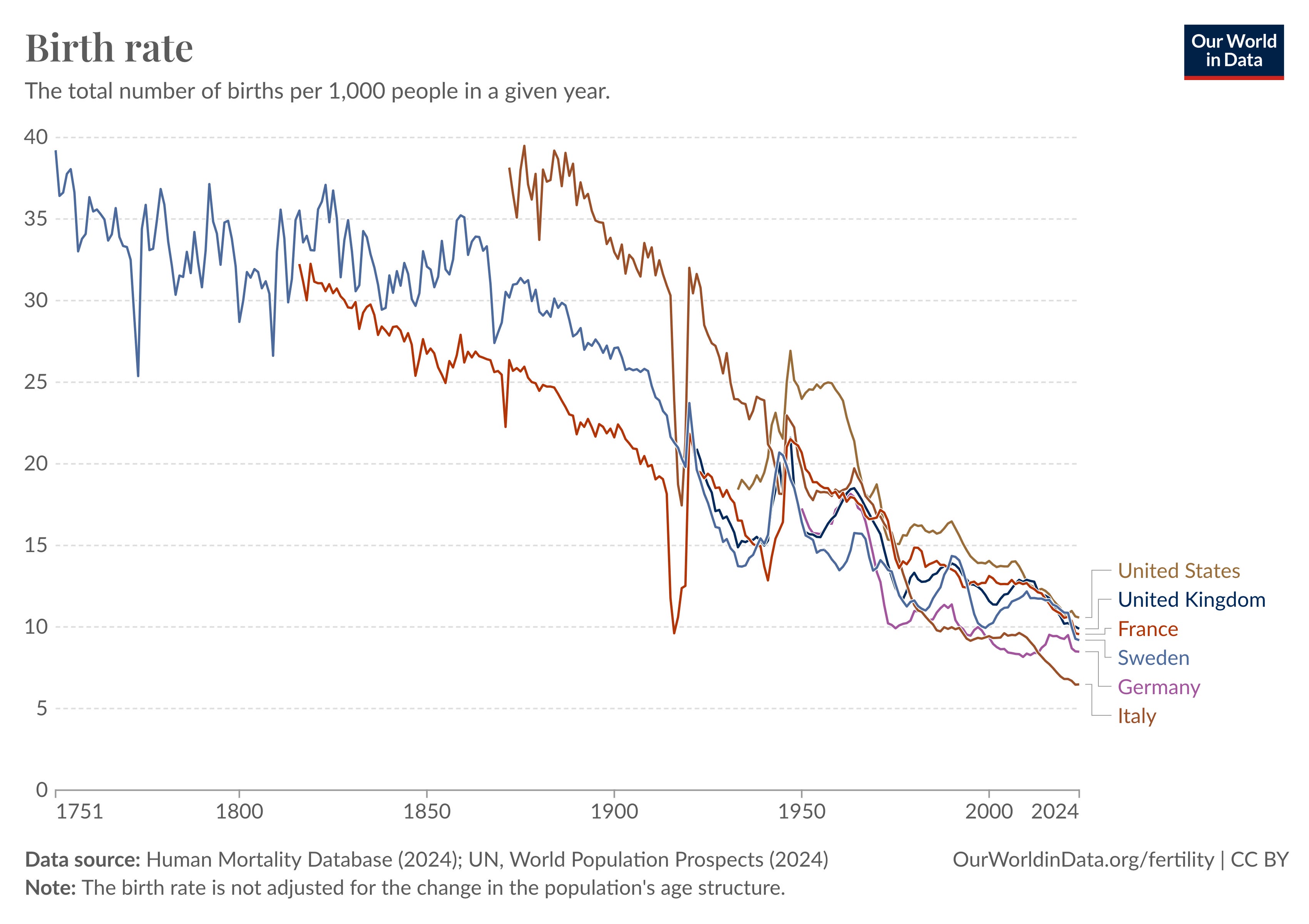
The birth rates in the West declined precipitously beginning in the mid-to-late 19th century, and only recovered briefly during the post-WW2 Baby Boom. While there is a case to be made that factors like television, the Internet, and smartphones sped the trend along to it’s current “extinction-lite” level, the case is not terribly strong: the drop in birth rate after the Baby Boom is fairly steady, and is on the same trajectory as the pre-Baby Boom curve.
It has not been aided by the importation of large minority populations into the West—not so long ago there was an argument floating around that the chief long-term advantage of immigration from Latin America and the Middle East was that these areas of the world, being highly religious, would maintain their high birth rates after they reached the West.
This has not happened. While these populations show birth rates higher than their contemporaries among European descendants, they have still fallen with the same kind of clockwork regularity—and, since at least the 1970s, those birth rates have been on the decline in the ancestral lands of these immigrants, as well.
What’s more, the populations in the US that one might expect to maintain high birth rates due to their devoutness and relative insularity (such as conservative Christians and Mormons) have also declined to at-or-below replacement levels.

And even Israel, which Vance lauds on p. 243, has birth rates that are descending towards replacement levels.
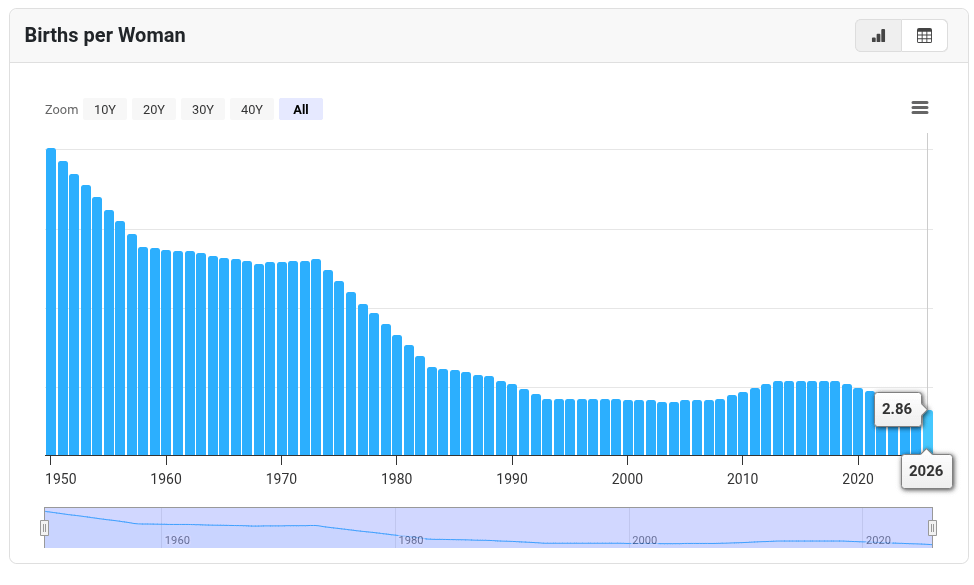
Something changed in the 19th century, and that change has propagated out to every corner of the globe, infiltrating nearly every subculture regardless of the strength of their religious traditions.
Further, “hypersexualization”14 and the lack of Christian morality (by these two terms Vance means the public nature of sexuality, the presence of sexual images in advertising, the easy availability of pornography, the lack of social pressures around virginity-until-marriage, etc.) can also not be credibly tagged as a causal factor here, since prostitution was legal nearly everywhere and common everywhere until the early 20th century, and drunkenness and drug use to excessive degrees (by modern standards) were the standard-operating-procedure of the non-monied social classes right up until World War 2, despite the early 20th century social crusades that banned both prostitution and drinking in the US. If one is to make an argument about a relationship between moral restraint and the birth rate, it is crystal clear that as actual (not merely performative) moral restraint increases, the birth rate decreases.
Our ancestors knew this well. These moral crusades (and others of the time, such as the crusade against romantic literature, nude photography, “obscene” films, and the institution of eugenics laws) were undertaken with the explicit aim—among other aims—of reducing the birth rates among the poor and the young so as to stem the flood of unwanted children who swelled the ranks of the poor and the criminal classes and “threatened the future genetic health of the race.”15
And, when you think about it, it’s hard to imagine why moral rectitude would increase the birth rate. Careless sex created almost every pregnancy ever gestated in within the body of a woman. Drinking, drugs, and heady romantic feelings all lead to careless sex. It’s self-evident that increasing moral agency and conscientiousness would tank the birth rate.
However, given that the great moral crusades really gained traction after the birth rate stared declining, and doesn’t appear to have made a dent in the general trendline, even “moralism” is not a sufficient hypothesis to explain the problem.
To understand the birth rate problem, we need a hypothesis that reaches farther back:
To the urbanization brought on by technological disruptions in agriculture and manufacturing.
When people move off of farms and into cities, children become expenses instead of assets. When a craft gets industrialized, family businesses go under and people move from ownership to serfdom employment. To aid industrialization, economies shifted towards leveraged finance and central management with the goal of encouraging consumption.
What else erodes when you move from a small village surrounded by people with whom you share an identity and a community to a large city surrounded by strangers with different customs, in an environment governed by technologies, diversions, and schedules that are a law unto themselves?
That’s right. Religiosity.
In small towns, a church is a community center.
In the big city, it’s a social club and an entertainment hub. This latter social role is far less sticky than the former—and the plain fact of the matter is that most of the time, in most eras, and in most places people are not “religious” in the sense of “deeply believing in the myths and doctrines of their church.” They are, instead, “religious” in the sense of “following the customs of their people.”
When the people you most frequently associate with (at your job, or in your neighborhood, etc.) go to church, you generally go too. When they don’t, you don’t. It’s only weirdos like me who actually care whether the religion they profess is true. It’s only weirdos like Vance who actually care whether the religion they profess is useful. For most people, what matters is that their religion is a convenient and reliable part of life—when it’s not, it ceases to be their religion.
If all that is true, and the birth rate is not causally related to religiosity (but both are instead results of common causal factors), what are we to make of the Israelis, the Amish, and the Post-WW2 global Baby Boom?
The Israelis and the Amish do not lack for group solidarity and common purpose, and consequently they both are very invested in the continuance of their culture. It’s also worth noting that both communities are experiencing a fertility decline (albeit one more modest than the Western mainstream).16
And the Post-WW2 Baby boom? A few factors were at play. First, the destruction of World War 2 culled 5-7% of the developed world’s population, but more importantly it destroyed or seriously injured the entire world’s industrial base (excepting that of America). It also kept an entire generation of young men sequestered and rootless and dreaming of hearth, home, and family for half a decade. That, plus the economic opportunities and government incentives offered by the post-WW2 industrial build-out, are ideal conditions for family formation (not to mention the pregnancy opportunities afforded by the extended civilizational victory party after the guns went silent).
From this angle, Vance is on to something when he mentions (as he does on several occasions) how the decline in manufacturing jobs, the dependency-inducing nature of the welfare state, the rising cost of living, and a lack of opportunity are also culprits in the dissolution of culture and the decline of the birth rate, but in all of it he misses what I think is the obvious, single, connecting set of issues that tie all of these straight back to the beginning of the birth rate decline:
A falling birth rate is a disease of identity erosion, access to easy comforts, and, most importantly, of the stripping of ownership, self-determination, and social position from the common people.
In a particularized society such as the one that characterized the Western world (and especially the Anglo world) since the Middle Ages, self-determination, ownership (of property and businesses), family stability, and social position were the norm. The ways in which these things happened varied from age-to-age, but civilization simply could not exist without the individual functioning as the default unit of will and the family and local community forming the default units of solidarity and belonging.
In an industrial (or post-industrial) world ruled by its attendant ideologies (financialism, managerialism, mass-culture, various forms of collectivism, etc.), people derive their identity from their possessions and incidental characteristics rather than their abilities and community standing, they own very little, and they are stripped of their self-determination by a world that only works when it controls their spending, their aspirations, and their very thoughts.
We are standing at the end of a road stretching back to the 1890s-1900s where civil society has been bulldozed in favor of central control of finance (national banks and income taxes), commerce (bureaucratic regulation and managerialism), culture (open and covert government funding of the arts, national and international censorship regimes, IP expansion and consolidation, national school systems), and identity (the elimination of state militias and military units constituted of soldiers from the same state/region, the progressive discouragement of nationalism and patriotic sentiment in the developed world, and the progressive discouragement of ethnic solidarity across the west).
During that same time, the mortgage has moved from being a dangerous last-ditch finance option for the landed gentry to a rarely-affordable prerequisite for the common person to buy property, and the welfare state has materialized and become ubiquitous (and so structured that it’s almost impossible to escape).
Add all that on top of the way urbanization and industrialization shattered communities, curtailed family businesses, and reduced property ownership on a grand scale, the moral censure around pregnancy undertaken by anyone who can’t expect to send their child to college or furnish it with a rather luxurious middle-class life, and the recent overwhelming majority preference for foreign-born workers over native-born workers in hiring (at least in the US), is it any wonder that the will to screw recklessly and embrace a burgeoning bevy of babies have all but disappeared?
At last, it’s time to dive into the primary stated purpose of Vance’s memoir:
To share his faith journey in the hopes that it will encourage others to follow.
There is a secondary stated purpose (healing American culture through returning it to Christianity—hopefully of the Catholic variety), which I’ll deal with after.
Vance describes himself as loving his Christian life as a child, of valuing deeply the spiritual teachings he received at the knees of his grandmother and his father. The sort of faith he describes during this period of his life is “cradle Christianity.” He was raised in and nurtured by the religion, his worldview was formed within it, and he engaged the world based on its expectations—but the core of his belief in the doctrines and spiritual teachings of the religion was something he got on credit from his elders. When it came time to believe on his own, without the support of his home and church communities, he didn’t find the whole church thing as compelling as chasing girls, partying, and pursuing career goals.
Without the church environment and the community that supported it, he found himself feeling aimless and rootless. When he left home for the Marine Corps, he felt keenly that lack of meaning and rootedness, and so he turned to religion to support him again. He took the complete works of C.S. Lewis to Iraq and read them through, found them greatly valuable and comforting, but by the end of his tour he had lost interest and moved on to other things.
Vance describes the next phase of his life the era when he was an “atheist.” He never really tells us what he means by this term. He obviously had read Hitchens’s book God is Not Great and is familiar enough with it to pull passages to suit his narrative needs (he refers to the book at least thrice over the course of Communion), but he doesn’t give us more than that. By “atheist” does he mean “irreligious”? Does he mean “doesn’t believe a God exists”? Does he mean “decisively disbelieves in God/Christianity/both?” Or does he merely mean “doesn’t really have a firm belief about the supernatural?” There’s not much in his direct word to give us a hint—this is a major failing for a book about a faith journey, because without knowing the structure of his unbelief, it’s much harder to understand who Vance was without God in his life.
But here’s what we can piece together:
We have Vance’s own testimony about his fretfulness and unease of mind. He touches on a discomfort with Christianity due to the Problem of Evil; on a couple of occasion he mentions his disgust with the obligatory empty platitudes of the Christianity he grew up with. His father went to the grave refusing medical care because “God will heal me.” The people Vance grew up around would respond to great misfortune with the duck-billed platitude “God has a plan.” But aside from such expressions of distaste and pain, when Vance talks about his thoughts on religion during this period of his life, it reads less like the experience of an unbeliever or a disbeliever and more like the experience of a seeker.
It’s notable that Vance never discusses any substantial engagement with irreligious thinkers. He did not discuss reading the early moderns like Spinoza or Bacon or Hume, or later influential minds like Rousseau or Russell or William James (or even Jefferson’s theological writings), or the off-beat influential thinkers like Nietzsche, Frazier, or Gardener. He demonstrates no familiarity with religious studies beyond a fairly narrow slice of the Christian tradition. Nor does he report having read atheistic critical philosophers and postmodernists such as Camus, Foucault, or Derrida. He also does not discuss having encountered and digested the work of Biblical critics such as Hector Avalos, Rudolph Bultmann, Richard Carrier, Burton Mack, John Dominic Crossan, Robert M. Price, or Morton Smith (the closest he comes to any of these is reading very recent liberal Anglican theologians).
On the other hand, he discusses his love for a number of religious thinkers during his atheist period (which includes his college and grad school career, carries through writing Hillbilly Elegy and his marriage, and the birth of his first kid). He describes his delight in reading the philosophy of Aquinas and the appreciation he developed for St. Augustine, both of whom impressed him with their reasoning capacity and convinced him that Christian belief is compatible with reason (which ran counter to the claims of the New Atheists). He discussed religion extensively with Peter Thiel, whose Christian faith inspired him and who introduced him to the writings of the postmodern Orthodox philosopher René Girard (who was one of Thiel’s mentors at Stanford). Girard’s work convinced Vance that Christianity is a workable solution to the problem of the madness of crowds and the human need for scapegoating. While he did engage with Girard, he never testifies to having read the critical Catholic philosophers (such as Friere and the other Liberationists) whose thought so contributed to the cultural decline of the West that Vance laments.
Looking at the above, we see something important for understanding the nature of his faith journey:
Vance never selected his reading like he was an apostate. When he abandoned his active adherence to Christianity, he never underwent what Nietzsche calls “transvaluation.” This is an extensive (and often painful) process by which one examines all one’s values, usually one at a time, and evaluates (not just rationally, but also on a values-and-emotions basis) whether one should still hold onto that value, and on what basis. It also involves behavioral re-conditioning: a serious Christian—and even most cradle-Christians who never take their religion seriously in adult life—have a series of habits that reinforce the mental frame of the religious worldview. They throw off brief prayers (however insincere) for help or courage. They glance up at the ceiling out of annoyance when something unpleasant happens and say “Are you serious?” or “Why are you doing this to me?” They reflexively use phrases like “God help us” or “God bless you.” When things are tough, they agonizedly wish they had someone to pray to in earnest. A thousand little cognitive and behavioral micro-habits tether them to their milk religion like hooks and loops in Velcro fabric.
Velcro is strong stuff. It holds spacecraft components together. With enough hooks and loops, behavioral Velcro holds a person to faith even when they do not believe. That Velcro can be ripped off through transvaluation and behavioral re-conditioning, but, absent that, it sticks through life.
What then are we to make of Vance’s testimony of his journey through the valley of unbelief?
I think that what we find in his words is not the diary of a man who does/did not believe so much as it is the diary of a man looking for reasons to believe.
It is notable, too, that despite his shallow intellectual engagement with unbelief and his deep engagement with the thinking of believers,17 it took something other than intellectual satisfaction to usher him into the arms of Holy Mother Church:
The hunger for a father.
Vance’s early life was one of profound disorder. He lost two fathers: his biological father—who he reconnected with in adolescence only to lose again to cancer, and his adoptive stepfather divorced his mother, after which their relationship effectively ended.
His mother was not a competent parent, so Vance found refuge in the house of her parents through his late childhood and adolescence. His love for his grandparents does not mask the instability he found there.
He was also churched in Pentecostal Christianity, a subspecies of Protestantism that trades on a paper-thin theology and uniquely shallow biblical hermeneutics, and is shot through with personal prophecy, faith healing, melodramatic displays of emotionality, hucksterism, and social mercuriality.
His upbringing was so filled with instability and uncertainty that he gravitated to the military in the midst of a war. He found there a structure that was comforting and stabilizing, and he there sought to find grounding and fill his felt-void of purpose through service. He later transferred this search to diligent program of advancement in the ranks of secular society.
He got a law degree from Yale, and entered a profession he did not want to practice (the law). He left that profession in favor of investing. His investments paid off and he became an accredited investor, qualifying him to practice business as a venture capitalist. This won him personal access to, and the friendship of, some of the most powerful people in the world, but it did not satisfy his need for meaning and order.
Along the way, he married, and fathered his first child, and in doing so he found himself desperate both to quiet his own obsessive and neurotic thought patterns and to provide for his children the stability and grounding he had lacked. He was terrified of being a failure as a father, and desired something that would give him the standards he needed to measure himself against.
During this time he read Rerum Novarum (“Of New Things”) a Catholic encyclical by Pope Leo XIII that lays out the Catholic program for reclaiming post-industrial society and putting it into godly order. Vance cites this reading as a turning point in his faith journey. He says it “felt more right than any theory of human nature I’d ever read.” He reports being impressed by its concern for worker’s rights and its vision of a just society that transcended the dialectic of modern American politics, pointing the way to something hopeful, new, and practicable.
It was a turning point in his journey. Vance narrowed his seekerly reading to concentrate mainly on Catholicism, delving particularly into the works of G.K. Chesterton (whom he quotes favorably, and at some length, on the subject of human nature). He talks of the attraction he felt to an institution (the Catholic Church) that represents an “unbroken tradition” going back to “the beginning.”
A year later, he converted to Catholicism, finding there the purpose, meaning, and authority he’d been seeking all his life. It gave him a sense of hope for the continuation of the West. His wife tells him that his return to faith has been good for him. He says that, if nothing else, it beats therapy (which, I grant you, is no small thing).
This is the meat of Vance’s faith journey.
Intellectually, it reveals some interesting gaps.
It ignores, for example, the deeply polyschizmatic nature of Catholic theology going back to the earliest days of the Church (not even James and Paul agree entirely on the mechanics or nature of salvation, Origen and Augustine differ markedly on many important points of doctrine, there was famously a great schism between the Catholic and Orthodox traditions over, among other things, a point of trinitarian doctrine—I could go on nearly forever) in favor of a series of rose-colored glasses.
According to Vance, his wife Usha was of two minds on his conversion. On the one hand she was delighted that he’d found something that would let him set his mental and emotional house in order. On the other hand, she was not particularly excited about the idea of sending their children to Catholic schools in light of the myriad molestation scandals that have publically rocked the church for the past 35 years.
Vance gives this topic a cursory going-over, and leaves us in the audience convinced that he was convinced that it was a “few bad apples combined with bad PR incentives” situation. He and Usha came to an agreement on how to proceed, with an emphasis on fostering a relationship with their children whereby they could be confident that any child thusly approached would not be shy about reporting to them what had happened.18 One might hope he would have had greater pause if he appreciated the full scale of the problem (Pope Benedict, for example, was complicit in efforts to hush-up such behavior as far back as the late 1970s—a recent instance where the tip of a thousand-plus-year-deep iceberg peeked above the water).
He also talks lovingly of the Catholic Church’s concern for the poor and suffering, but it’s a concern that’s hard to credit as being more genuine than that of any other NGO in light of the cynicism of Mother Theresa19 or the fantastic amounts of wealth spent by the Church on its political and marketing efforts while the vast majority of its adherents have lived in such poverty that the Church’s financial conduct has been a perpetual scandal since at least the High Middle Ages.
These are real and substantive problems with Vance’s avowed reasons for gravitating towards Catholicism. A moral order propounded by an institution cannot be uncritically trusted when that same institution has a thousand-year-plus track record of declining to hew to it. Surely an institution deputized by God and guided by the Holy Spirit should be able to do that much…but it does not.
So let us turn finally to that encyclical and the politics it represents. This is particularly important in light of the deep value Vance places on civilizational continuity.
You can find the encyclical here. I have summarized it, point by point, in the footnote that follows this sentence.20 Vance’s high praise for this encyclical is why I received this book to review: the reader who sent it to me wanted my take on whether or not it indicates that Vance has aligned himself with Catholic Integralism.
Integralism is the school of political thought that holds liberal and secular civilization as a failure, with its remedy being the re-establishment of Catholicism as official state religion. It holds, among other things, that individualism is a cancer upon the body politic, and that traditional liberal freedoms (especially freedom of speech and freedom of religion) are fatal to any civilization—especially to Christian civilization (which it avows that the West definitively is)—and must thus be “reasonably” curtailed. Patrick Deneen’s Why Liberalism Failed is a bracing introduction to this school of thought.
So what does this encyclical have to say?
In its own words, it attempts “…to define the relative rights and mutual duties of the rich and of the poor, of capital and of labor.”21
As a whole, it lays down a definitive statement about how the Church sees the proper ordering of society, incorporating a theory of human nature and subsidiarity (that is, the proper subdivision of labor and responsibility throughout society). It champions charity, the defense of trade unions, the formation and protection of private societies (charitable clubs, mutual aid societies, professional organizations, and fraternal orders), the sacrosanct rights of private property, the right of workers to a living wage (defined as “a wage sufficient to allow a frugal man to raise a family and still save money to invest and ascend to the rank of property and/or business owner”), the replacement of class warfare with honor and charity between the social classes (as each class recognizes the importance and dignity of the others), and holds that this sort of social ordering will satisfy the most needs of the most people most effectively, obviating the bulk of the motivation for criminality and corruption. It also champions the importance of cultural continuity, beautiful things, family unity, and national solidarity, and condemns the relentless financialization of value metrics (i.e. it argues that there are other, more important kinds of value than those which can be measured on a balance sheet).
It decries what we now call “wage slavery” and singles out for censure all employment arrangements that resemble serfdom (including, implicitly, the life of the obligate renter/tenant) as a profound injustice that insults the dignity of humans made in God’s image.
It repeatedly avows the civilizing effect that ownership works (ownership of property, familial ownership of children, ownership of position in a community), as people are naturally inclined to treat their own property as having value and requiring sensible stewardship.
It further argues that the State should rule, regulate, and tax with a light hand and take care not to transgress the aforementioned rights, and should, whenever possible, put a thumb on the scale of justice and law in favor of the poor and the workers, since these are the people who do not have the resources necessary to advocate effectively for themselves.
So far, on most points that vision sounds like something most Americans (at least, those who are not hardcore socialists or hardcore anarcho-libertarians) could get behind.
But there are a few stings in the tail.
It also advocates that private societies should not be encouraged or protected (or perhaps allowed, though this is implicit only) if they are formed along pagan or “ill” lines. This means not just secret criminal societies such as the mafia, but also nominally pagan and/or deistic societies like the Freemasons. It holds up instead anything formed with a specifically Christian agenda under the authority of the Catholic Church—and further dictates that these societies should be exempt from State oversight entirely.
It also avows categorically that none of the above will have a hope of working unless the Catholic Church is the official state religion.
This encyclical, in other words, means what it says when it talks about Christian civilization—a civilization run by the Catholic Church, which holds official legal status in all the nations so constituted. A latter-day resurrection of the Holy Roman Empire.
This encyclical isn’t exactly an Integralist manifesto—Integralism has evolved since it was written, and has taken on a far more radical and less charitable cast of mind—but it is the document from which Integralism takes its initial marching orders. It can be fairly characterized as a road map for returning to a civilizational arrangement that very closely mirrors pre-Enlightenment Europe (but without the serfdom).
Unlike most modern pontificators (pun intended), I actually know a thing or two about the Middle Ages. It was not the squalid font of misery as is so often depicted in film and fiction—if you leave aside the fairly-frequent wars and the occasional plague (which are common to all of human history), the middle-and-late parts of the period were an exceptionally pleasant time to be alive by pre-Industrial (or even early Industrial) standards. The world was colorful, community life was rich, international trade was a hopping scene, arts and culture were ever-present and that which survives was of exceptional quality (many of our most cherished modern myths are based on tales handed down from that time). Those who were not serfs were taxed lightly by modern standards, hunger was usually rare, nutrition was generally high, and most people (again, serfs excepted) owned their own businesses and, through those business, held positions of honor in their communities.
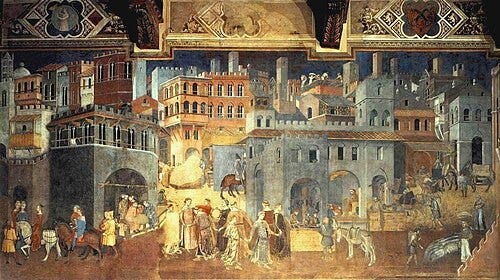
One must ask, therefore, why such a world came to an end?
The Black Death put a decisive end to it, but had the civilization been healthy at that point one might have expected the generations after the plagues to pick up the old ways and carry on with them. But they didn’t.
Why not?
By the end of the High Middle Ages, the economic situation looked a lot like the economics of our time. Labor was in oversupply relative to demand, but productivity was exceptionally high. Despite these factors applying downward pressure on prices, the guild system retarded affordability by bullying or killing competitors that did not pay high dues for the privilege of doing business (leading to a rather large outlaw population that lived rough in the wild areas—this is the world where the tales of Robin Hood find their home). There was a lot of excess wealth, but it was mostly siphoned up by the Catholic Church through tithes, taxes, and by selling salvation/the remission of sins (yes, literally—the term was “indulgence”). The Church mostly used that money not for charity, not to foster economic growth, or any of the other social goods that the encyclical summarized above advocates, but to raise money to maintain and build Church infrastructure (including and especially the Gothic Cathedrals and the more impressive parts of the Vatican) for the purpose of shoring up renewing devotion (and donations) to the Church, which were both having trouble after the political chaos following the death of Charlemagne. The Church also pushed considerable resources to diplomatic activities (i.e. bribing princes to behave according to the Church’s wishes in their disputes with one another).22
The corruption of the Church was legendary in scale.
When the waves of Plague wiped out around half of the European population in the mid-to-late 14th century, workers suddenly became valuable. For the same reasons that there was a massive economic boom after World War 2, there was a massive economic boom after the Black Death. The dearth of workers spurred mechanization, which broke the back of the Guild system. Opportunity was everywhere, because consumer demand due to re-population and rising wealth grew much faster than worker supply (workers take a couple decades after they’re born to reach the point where they could run their own shop). This is called “base effect” growth, and is the most dependable—and the most transitory—form of economic growth.
People who were newly wealthy and relatively free wanted education, and one fellow23 made his fortune by inventing the movable-type printing press, so literacy exploded. This broke the Catholic Church’s monopoly on knowledge and swept in the Reformation, the Renaissance, and the Enlightenment.
Importantly, all of the animating political and economic ideas of the Reformation, Renaissance, and Enlightenment were pagan ideas.24 Classical approaches to logic were now available to the literate masses straight from the pen of Aristotle, not as filtered through Aquinas and available mostly to theologians and their pupils. Herbalist texts now circulated freely, disintermediating the monks as apothecaries.
The size of the shift over the course of the century-and-a-half following the Black Death cannot be overstated. Before those pesky fleas killed everyone off, Europe was locked in a downward economic spiral of increasing opulence at the top and increasing desperation at the bottom. In the four generations after the Plague swept through, Michelangelo painted the Sistine Chapel (cryptically portraying God as a figment in the human brain), Galileo recorded the rings of Saturn and the mountains on the moon, Columbus made landfall in the West Indies, Shakespeare wrote all his plays, Luther and Calvin put an end to Catholic Hegemony in Europe, Elizabeth I fully established the Church of England, and the Spanish swept through South and Central America (bringing with them a swine flu plague that eventually wiped out 90% of the natives).
While the bare majority of Europeans continued to be Christians (at least nominally) right up through the mid-20th century, and while most nations continued to have established churches until after World War 2, the Christian civilization of Europe—a civilization defined by Christian ideas and customs, ruled by Christian princes who were managed by Church authorities through outposts in every city that enforced ecclesiastical law—ended in the late 14th century. What took its place was a return to classical (Roman) law, classical (Greek) thought, and a mishmash of a moral system that incorporated these with some features of Christian and local pagan morality, and driven to constant change and adaptation by dizzying and ongoing technological progress on a scale of warfare hitherto unknown on the face of the earth.
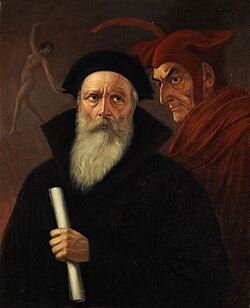
What finally emerged from the chaos was what Oswald Spengler calls the “Faustian” civilization because of its singular devotion to mastering all knowledge and ruling all nature. Our Faustian world is individualistic, hubristic, knowledge-driven, conquest-minded, ruthless, and ambitious to the point of recklessness. It is this civilization and mindset that gives birth to liberalism in all its forms, as well as Communism, Fascism, vaccinations, rockets to the moon, drone warfare, germ warfare, telecommunications, and nuclear weapons. Christian civilization was constituted under the Christian God. Faustian civilization was constituted under the God of the deists and is oriented entirely, in all its various ideological tribes and incarnations, towards the project of turning humanity into gods.
The Catholic Church has been, since the beginning, the enemy of this civilization, and it has sought to pull the West back into that balanced, moderate, and arguably healthier state that prevailed in the run-up to the High Middle Ages…because the Catholic Church, like all great institutions, covets power above all things.
The problem with the vision set forth in this encyclical is not that it is pernicious, it’s that it necessarily belongs to a time when humans lived, worked, and organized in a face-to-face manner, un-intermediated by machines, where causes of conflict could be limited by amity because non-local worldly information and access to leveraged power were out of reach of the peasantry (and most of the nobility). To re-create such a system now would require the most brutal dictatorship—which is why the Church grudgingly assented to the rule of Mussolini, and did not loudly oppose Hitler, and has been one of the primary breeding grounds for Marxist philosophy in the latter half of the twentieth century.
I do not think Vance realizes or appreciates this. As smart as he must be, given his credentials, the picture I get from his book is that of a man with the faith of a hopeful child (just as Jesus exhorted his followers to be). He trusts the Church because it is wise, and old, and appointed by God, and because Catholic intellectuals are often of an uncommonly high caliber.
When Vance discusses policy, he frets mostly about morality. About treating people with mercy and dignity, and of protecting freedom of conscience even as he fantasizes about putting into place policies that curtail speech, privacy, commerce, and association.
And there is reason to think that Vance may not really buy into Integralism in a serious way. The other great influence on his policy thinking that he cites is the economist Oren Cass who is decidedly not a Catholic. In Cass’s book The Once and Future Worker (which Vance cites), the central economic hypothesis is that “a labor market in which workers can support strong families and communities is the central determinant of long-term prosperity and should be the central focus of public policy.”25 On his view, the focus of the policy-making class on values like GDP and consumer welfare miss the boat because neither of these things predict a healthy nation or economy as well as does the flourishing of workers and entrepreneurs in an environment of strong communities and stable families.
It is therefore distinctly possible that when Vance read the encyclical, he was drawn to the echoes of Cass’s influence on his own thinking. On this view, Vance would not be an Integralist so much as a man who is willing to celebrate the sources from which he cherry-picks. But that possibility remains just that: possibility, not confident probability.
Normally, this would be an interesting diversion, largely meaningless. The United States has had leaders who are far more religiously or ideologically imperious than Vance has ever seemed to be (whether in this book or in his public appearances), and those leaders haven’t successfully sunk the American experiment (though they have violently refactored it a couple of times).
What makes the prospect of an Integralist—even a kind and good-hearted Integralist-lite with great loyalty to the Constitution—more worrying at this point in history can be found implicit in the above historical account:
Our civilization sits upon an apex eerily similar to that of the High Middle Ages before the Black Death. Moments like these are where political leadership actually matters…because moments like these are when civilizations end.
When I came to the end of the book, I was shocked by how wrong many of my priors proved to be. I expected good writing—I didn’t find it. I expected to wrestle with a razor-sharp mind, but that wasn’t here either.
I expected to read a volume that laid the foundation for the kind of cult of personality that’s necessary for a Presidential run, but that, also, isn’t here (or if it is, it’s a tremendous misfire).
Most interestingly to me, I expected to find a ruthless and canny operator who was aiming for a particular endgame in life and taking every available opportunity to get there. But the man I got to know through these pages is a different cat entirely.
Consider the structure of his arguments. I’ve mentioned how, time and again over the course of the memoir, Vance slides from reminiscences into discussions of political or theological or moral ideas without a clean or orderly transition. I have not told you how he structures these discursive passages.
They’re not structured by, or as, arguments.
They are instead prefaced by tentative dips into a topic, then pulling out again. This is then followed by hedging, introspection, expressions of uncertainty, preemptive forays into dealing with objections to a thesis the author has not yet advanced, reaffirmations of solidarity with the audience and the struggling people and the future of civilization, then a bit more hedging laced with some platitudes. At length, Vance eventually works himself around to stating his thesis outright, but then he generally treats these thesis statements as conclusions, followed again by a reaffirmation of a shared value set with his audience.
This isn’t persuasion. There’s no sales pitch here. There’s no rapport building. Nor is there humor or wit to leaven difficult topics (indeed, the entire book is remarkably free of either). There’s no argument for why Vance’s solution to a given problem is the proper one (though there are a lot of “it seems to me” type of assertions to that end), nor any substantive engagement with even straw-man versions competing ideas—indeed, he treats the headline-level pronouncements of his ideological opponents as if they are entirely earnest and serious, which is a fatal error in rhetoric—nor is there any backstory about “why things are the way they are,” which is an essential part of any “buy my solution” sales pitch.
So if this isn’t argument, or persuasion, or rapport building, what is this strange stochastic narrative style?
It is appeasement.
This is the communication style of a person who expects to be abused, misconstrued, and slandered, so in order to ensure his survival in a social encounter he (please forgive the uncharitable choice of words) sucks up to his audience. Every move is a “feeling out” maneuver.
Usually feeling someone out happens in the first couple steps of a conversational dance. This communication style renews this “feeling out” phase with every single step of the dance. People are seen to be undependable and untrustworthy, so the speaker must re-secure buy-in after every conversational move.
By conducting oneself thusly, one guarantees that one always controls every conversation they’re in, even when they’re being buffaloed by dominant narcissistic blowhards who scream whenever things don’t go the way they want (not that I’m insinuating that there might be anyone in Vance’s current life that could be thusly characterized).
Kinksters call this kind of tactic “topping from the bottom.” Secretaries call it “the power behind the throne.” Southern women call it “letting men think they’re running the show.” Whatever label you put on it, this form of passive-aggression is not what I expected as the default mode of communication from a man who has climbed the ranks of society as rapidly and well as Vance has, or who so deftly deflects and amuses his interlocutors in media appearances.
But maybe I should have. After reading this book I re-watched Vance’s recent appearance on The View, and I noticed all the same tactics in use, they just looked more natural because he was doing most of his consent-re-securing with eye contact and other non-verbals. I recognized the style immediately as the soft, passive-aggressive manner of a youth pastor in an evangelical church—the kind of man who is highly and aggressively opinionated, but who knows that if he speaks his mind outright he will not be respected, so he instead soft-pedals his views in a manner that overemphasizes all points of reasonableness and buries any sharp edges.
This presents a problem when it comes to having the kinds of hard conversations required of a world leader. Take, for example, his avvount of attempting to discuss the immigration issue with the Papal delegation in Rome (which had previously admonished the Trump administration on this point in loud, but unspecific, terms).
By Vance’s account he sought the counsel and criticism that the Holy See had to offer, but he was met with only platitudes. To us, the audience, he expresses his annoyance at the Church’s’s determination to communicate exclusively in vagueries (it is a bit odd that having this realization of Church vacuity while in the Vatican did not give him pause about his decision to pledge his spiritual life to this institution, but I digress).
How does a man who won’t say what he means without doing this kind of dance climb from the east Appalachian underclass to the Naval Observatory in the space of a little over twenty years? How does a man who won’t press his critics in socially fraught contexts expect to wield power?
Were he elected President, I suspect that Vance is American enough that he would probably not to bow to a foreign prince (i.e. take policy direction from the Pope), but he nonetheless portrays himself an appeaser that desires more than just honest debate and a challenge to his ideas—he wants to know what others want so he can make them happy.26
The unhappy truth of the world is that complex problems can be litigated endlessly and earnestly without a solution in sight—a good thinker recognizes such an impasse as a sign that the issue is being debated at the wrong level, and a competent politician or other leader knows that discussion and debate are often less useful than decisive action (even when the course of action selected later proves anything from erroneous to disastrous). It’s often easier to right a moving ship than it is to bail water while waiting for a perfect plan.
The greatest irony of my experience as a reader of Communion is that it induced in me the opposite effect that I expected. I had expected to come out of this book respecting Vance more (as a writer, rhetoriciaian, and operator) and finding him less likable as a person (it’s hard to get me to sympathize with the emotional arc that takes one from freethinking to Catholic, and there are numerous cultural points on which I expected to find Vance’s approach intensely irritating). But instead, I found myself losing massive amounts respect for him as a politician,27 leader, and operator while finding him…oddly lovable in a condescending, sympathetic kind of way. His insecurities and neuroticism and his insanely irritating writing style made me think “I hate reading his work, but he’d be a fun guy to drink and argue with about Big Ideas.” I also found his struggle to overcome his fears of fatherhood both endearing and touching.
As a consequence, my opinion of Vance the man has been considerably revised. When he was tapped for the VP slot in 2024, I thought it was a strategically brilliant choice—not only was Trump securing the Borderer vote and an alliance with the tech oligarchs, he was hiring himself a good bulldog to distract from some of the heat Trump regularly generates for himself.
Now I think that, while Vance makes a good bulldog (at least when his heart is in the matter), he’s a bulldog who needs a handler and probably shouldn’t be let off leash.
I had long considered him a savvy operator, but after reading this book I see that his savvy is not the savvy of man who knows what he wants or values and goes after it, but the savvy of an abused child who has learned how to play the right role in a given room in order to ingratiate himself well. By his own account, his rough upbringing did not harden or temper him, it merely scarred him, and these are not the same thing at all.
His account is most revealing when recounting his years in the academic and professional world, where he did quite well but found little joy, and only rediscovered joy when he first married a woman with a strong enough personality to take the emotional place of his grandmother (he quotes a mentor as saying this directly), and second when he converted to Catholicism and adopted an entire pre-packaged worldview along with it. This is the tale of a man who is able to survive and do well on his own, but not a man who enjoys the exercise of agency or power (even over his own life).
This is perhaps the most important revelation of all, as someone who does not enjoy agency or power should never be placed in a position where he must exercise both, every day, as a condition of his job, especially when the lives and welfare of other people hang in the balance.
Want more? Find fresh stories, nifty novels, short stories, visions, and dreams (along with some how-to books and literary studies) by clicking here.
If you’re feeling adventurous click here to find a ridiculous number of fiction and nonfiction podcasts for which I will eventually have to accept responsibility.
This column is a big part of how I make my living—bigger now due to recent exciting events which you can read about here. Because of this, I’m offering a 20% lifetime discount off the annual subscription rate. If you’re finding these articles valuable, I’d be honored to have you join the ranks of my supporters!
This does not, of course, mean that my knowledge is correct—we all must make judgments based on incomplete information and sometimes those judgments are erroneous. This also does mean that there aren’t Christians out there who know this stuff better than I do—there are, and I’ve known some of them. But it does mean that I know my way around this topic in some considerable depth, so I have very high standards. This will become important as the review progresses.
Other examples of the genre include C.S. Lewis’s Surprised by Joy, Francis Collins’s The Language of God, and Thomas Merton’s The Seven Storey Kingdom. For my money, Merton is the best of these in terms of his intellectual sophistication and persuasiveness (though I obviously don’t find him ultimately persuasive), Lewis is not philosophically interesting but is worth reading for his delightful and emotive writing style, and Collin’s memoir is unremarkable, shallow, and worthless (though still less outright fraudulent than similar books by people like Lee Strobel).
Those of you who are into writing, pay attention—you’re about to get a short masterclass in style.
“On the nose” is not exactly the same as “clear.” Prose which is “clear” communicates what it intends to. Prose that is “on the nose” is (usually) clear, but it is also shallow. There’s nothing to the words beyond their bare lexical meaning and/or most obvious metaphorical sense—the writer is thus not really presenting you with ideas to consider, he’s reporting to you the ideas he’s had. Or, to put it another way, the writer is not making an effort to rope in the reader—he has mistaken “conveying bare information” with “good communication.”
An excellently-written and accessible book on the topic is Sin: Radical Evil in Soul and Society by Ted Peters.
That is: White Anglo-Saxon Protestant
See Albion’s Seed: Four British Folkways in America (1989) by David Hackett Fischer.
Later in the book he talks about riding as a child in a car with his mother, who’s careening all over the road in a life-threatening fashion. He relates how he yelled at her to pay attention, then jumped into the back seat to protect himself against what he believed was the inevitable coming crash. Rather than granting that he might have not understood what was happening (as he wasn’t a driver yet), he chastises his younger self for exhibiting a startling lack of “humility.”
The three “theological” virtues for Catholics are faith, hope, and charity—not humility or chastity, etc. For the doubtful, here are the cardinal virtues and their history: https://en.wikipedia.org/wiki/Cardinal_virtues
Yes, this is extreme and fairly unusual, but this is nevertheless the underlying logic for a number of religious proscriptions regarding sex in some sects of Christianity, Islam, and Judaism.
Sounds nuts, right? Well, here it is right from the source:
“You have heard that it was said to those of old, ‘You shall not commit adultery.’ But I say to you that whoever looks at a woman to lust for her has already committed adultery with her in his heart. If your right eye causes you to sin, pluck it out and cast it from you; for it is more profitable for you that one of your members perish, than for your whole body to be cast into hell. And if your right hand causes you to sin, cut it off and cast it from you; for it is more profitable for you that one of your members perish, than for your whole body to be cast into hell.” —Jesus, Matthew 5: 27-30, NKJV
You may have heard me argue elsewhere that “the woke” are just 1990s Religious-Right types marching under a different banner. This is why.
I am not accusing Vance of being a fascist. But this neurotic bent goes a long way towards explaining many other puzzling things about this book and the things it reveals about the author.
See this article for a full treatment of this issue:
The Erotic is Political (But Why?)
·
January 13, 2025

This post is long with many images. Your email client may choke on it. If it does, read the original at http://jdanielsawyer.substack.com
This is a very rough paraphrase of a late 19th century eugenics text—I think by Francis Galton—that I read several decades ago. I can no longer recall the title well enough to scare up an exact quote.
For the Amish, see https://www.tandfonline.com/doi/full/10.1080/00324728.2021.1883725. For the Israelis, see https://www.taubcenter.org.il/en/pr/israel-demography-2023/.
This includes engagement with the most surface-level atheist thinkers and some of the most depth-plumbing Christian thinkers.
This is a wise plan in any environment.
See The Missionary Position: Mother Theresa in Theory and Practice by Christopher Hitchens
What follows is a point-by-point summary of the encyclical following the opening remarks:
Section 3 links (via assertion and implication, not argument) that the disestablishment of Church authority and the dissolution of guilds are causally linked phenomenon. Thus, since the dissolution of the power of craftsmen has led to their being left at the mercy of employers, therefore it is the disestablishment of the Church that has created this great evil in society. “Public institutions and laws set the ancient religion in place.”
Section 4 condemns socialism as motivated by envy (a deadly sin), unjust, and likely to cause the chief harm to the poor whom it purports to help.
Section 5 argues that a living wage is rightfully expected by a worker, and that socialism, by seizing the property bought by the proceeds from wages, is undermining a worker’s ability to obtain a living wage (as well as engaging in theft).
Section 6 argues that property is the result of creative effort, which in Catholic theology is a manifestation of the divine image, and is therefore sacred and not to be morally confused with the products of mere animalistic toil.
Section 7 asserts the precedence of human needs and the right to earn a living from the Earth as preceding the State and superseding its authority.
Section 8 defends the legitimacy of private enterprise and trade as naturally emerging from the argument in Section 7 (and also grounds it with an implicit appeal to the natural order articulated by God in Genesis 3).
Section 9 presents a further argument in favor of private property which unites the previous two arguments.
Section 10 restates the case against socialism in stronger language.
Section 11 precedents the authority of the State upon its willingness to enforce private property. Cites the 10th commandment as divine sanction for this ordering.
Section 12 defends the primacy of the family on scriptural and primordial grounds.
Section 13 argues for the primacy of the family in order of obligations (preceding that to the community and to the state) and for the primacy of the role of the father i administering family wealth.
Section 14 argues that the State must never intervene in the family except when a member of the family appeals to the State for redress of grievances. It further argues that socialism’s goal of disintermediating the child from the state by abolishing the family is a grievous sin.
Section 15 argues that the socialist’s ambition to abolish private property creates universal slavery as it necessitates both the abolition of the family and subjugation to the state for the satisfaction of all material needs.
Section 16 asserts that without the Church exercising institutional authority, there is no force left to keep order in society. This is an explicit statement of antidisestablishmentarianism (bet you never thought you’d actually see that word used in a sentence, didn’t you?).
Section 17 argues that inequality is natural and insurmountable, and attempts to level it will result in killing civil society (describes what we would now call a sociological “grey goo” scenario).
Section 18 argues that pain and struggle are unavoidable, and this fact is best accepted.
Section 19 argues that, contra Marx, class warfare is artificial, and that the natural state of things is for the classes to benefit from one another’s existence. Argues that the Church is the natural institution to ensure that the classes remember this instead of warring with one another.
Section 20 lays out a set of duties and obligations that each class holds to both itself and to the other classes. Amounts to a fundamental class-ordering in Christian society (and implies that such ordering is uniquely Christian).
Section 21 further argues that the Church’s role in enforcing class divisions and obligations will inevitably result in friendly and amicable relations between classes, creating a peaceful society. (Note from the author: this is impossible in any civilization where the Franchise is in effect on any level beyond the narrow congress of elites).
Section 22 holds that the Church should hold over the rich the terrifying threat of hell in order to nudge them to consider their possessions as “common to all humanity” and to distribute them freely and without [direct] compulsion. Lots of equivocation/needle-threading here. Also argues for the value of modesty (i.e. no conspicuous consumption) and against private greed (i.e. do not hoard or hide wealth in order to hoard it, but distribute it freely).
Section 23 asserts the inherent dignity of poverty.
Section 24 asserts that worth comes from morality, not from wealth.
Section 25 argues that recipients of charity will be forever grateful, and that social conflict will cease if charity is adequate. This vein of thinking lead eventually to the arguments over the welfare state and UBI.
Section 26 argues that it is only through the Church and its teachings that the recipients of charity can be rendered appropriately grateful (because only the teachings of the church can change a person’s consciousness).
Section 27 makes some rather sweeping claims about the effect of the Church on “society.” Argues that since the Church re-vamped the institutions of the falling Roman Empire, it’s the only thing that can save the modern world. “Hence, to fall away from its primal constitution implies disease; to go back to it, recovery.”
Section 28 avows that the Church is committed to seeing the poor rise out of poverty, and asserts that the necessary conclusion of Christian virtue is lifting the poor out of poverty.
Section 29 burnishes the Catholic record on charity.
Section 30 characterizes Church patrimony as the “common inheritance of the poor” and argues that criticisms are risible. Also argues State welfare mechanisms will prove inferior.
Section 31 says that an inquiry into the role of the State is needed.
Section 32 lays out a vision of the State as ensuring public welfare through moral rule and the support of vital social institutions (from imposing order to supporting the family), and doing so while behaving in a way that is above reproach so as to maintain the public trust.
Section 33 argues that all subjects of a state are equal in the legitimacy of their standing before the state.
Section 34 the state should take special care to protect the working class, as they have fewer resources to advocate on their own behalf.
Section 35 argues that the sovereign wields divine authority and must do so only for the benefit of his subjects.
Section 36 argues that the State should impose moral order and sex segregation where necessary to insure the public good. The limits to state authority should suit the situation.
Section 37 the state should respect all rights, but should bias itself towards the protection of the rights of the poor (including laborers) since the poor can’t afford to protect themselves.
Section 38 admonishes that private property should be protected from revolutionary (i.e. communist) violence.
Section 39 the government should build itself so as to speedily resolve strikes to reduce their external impact.
Section 40 Argues that man does not have the right to sell himself into slavery (or its equivalent) implying that onerous working conditions are, ipso facto, morally illegitimate and a worker commits no sin by going on strike or otherwise breaking his contract.
Section 41 The government should enforce the sabbath (i.e. blue laws).
Section 42 Argues that humane working conditions and limited hours should be a priority.
Section 43 The government should guarantee that employers pay agreed-upon wages.
Section 44 Argues that it is a natural right to obtain employment.
Section 45 Argues that a living wage is a natural right, and that civil society should enforce this right as a custom/duty through fraternal orders, guilds, and trade unions, lest the size of the State increase unduly.
Section 46 A living wage should include wiggle room for saving and investing, which is impossible unless private property is respected. Public policy should be oriented around lifting as many people as possible into the ownership class.
Section 47 Argues that more property and business owners means a more equal society and more equitable division of land and other resources, greater patriotism, and less civil strife (as more people will have a stake in the system). Asserts that the State has the right to control the use of private property, but not to seize it or tax it beyond the owner’s ability to hold it.
Section 48 Advocates for mutual aid societies and fraternal orders that cross class divides.
Section 49 Endorses the trades union movement.
Section 50 Reaffirms the moral legitimacy of mutual aid societies.
Section 51 Delimits mutual aid societies as being for private benefit of the members, rather than the general good of the broader society.
Section 52 States should not disband private societies unless they are criminal or nefarious.
Section 53 Burnishes the Church’s credentials as a champion and fosterage of such societies, and asserts the societies of the Church as entirely and categorically immune from State oversight or interference.
Section 54 Advises Christians not to join societies that may be dangerous to their faith.
Section 55 Praises Catholics for their championing of the poor, their charity work, their fraternal orders and societies, and admonishes the State to extend special protections to such people and activities.
Section 56 Explicitly declines to set limits or mandates for the rules of operation and membership of such societies.
Section 57 Urges that societies be organized so as to achieve their stated ends, be based based on religious principles, and admonishes members of such societies not to neglect their religious obligations.
Section 58 Advocates standards of conduct and grievance resolution conventions for officers/administrators and members of such societies.
Section 59 Argues that Catholic fraternal orders and societies are always of benefit to the State.
Section 60 Avows that Christian values and goodwill, sufficiently organized as outlined above, are sufficient to defeat the oppression of workers and the forces of greed.
Section 61 Avows that a Christian nation/civilization, organized along the lines laid out in this encyclical, will be stable and characterized by fraternal feeling and prosperity, with a minimum of crime and corruption.
Section 62 Urges all people to build such a society with the aim of re-establishing Christian morality, stating that all efforts not oriented towards this end are in vain.
Section 63 Argues that States should not place limits on the conduct of the Catholic Church, because without such limits it will be at full liberty to aid the State in the re-establishment of Christian society/civilization.
Section 64 Places a burden of obligation upon the clergy to work tirelessly towards the ends advocated in Sections 62 and 63
Section 65 Formal sign-off.
For more reading on this entire situation, see Before the Gregorian Reform: The Latin Church at the Turn of the First Millennium by John Howe and The Age of the Cathedrals: Art and Society, 980–1420 by Georges Duby.
This is true even of Luther’s doctrine of Justification by Faith, which depended for its formulation upon revived pagan understandings of the Individual, of Logic, and of Law.
Quote snagged from Wikipedia.
In this way he’s very much like Bill Clinton, whose policies changed with the polls and left us with a mix of really good things and a right awful mess at the end of his term.
He’s not on my team, but I have mad respect for accomplishment, intelligence, ruthlessness, and courage.
No posts
Comments
Nothing yet. Say the first thing.
Sign in to join the conversation.