
A few years ago, I launched Commander’s Tech — first as a YouTube channel, then on my own domain. At the time, AI was just beginning to edge into public awareness. I experimented casually with ChatGPT, mostly to revise or expand short articles about World War II rifles. It was curiosity more than commitment.
I wasn’t coming to it blind. Years earlier, in my day job, I had built proof-of-concept machine learning tools to predict likely sources of code defects in a large software platform. That experience gave me a working understanding of what these systems actually are: pattern recognition engines trained on large datasets — powerful, but not mystical.
As Commander’s Tech grew, I shifted focus from video content to building a data-driven platform for categorizing and exploring military history — especially weapons and weapon systems. The concept was straightforward: a structured database, with concise historical summaries for each entry. My plan was simple — roughly three paragraphs per weapon.
The scale was not.
I began with about 200 entries. As of this writing, there are 737 — and ultimately there will be thousands. Even at a conservative estimate of twenty minutes per article (often much more, once research was included), the time commitment was staggering. I enjoy military history. I know the material well. But there are only so many ways to write three clear paragraphs about the development and service history of the M1 Garand — and only so many evenings in a week.
So I began experimenting seriously with large language models.
It took seconds to generate what would have taken me half an hour. I review every entry, correct errors, adjust tone, fix the occasional hallucination — but materially, there is little difference between what the AI drafts and what I would have written myself for that purpose.
That experience expanded into image generation, video experimentation, and now into deeper integrations for an upcoming project related to classic fantasy gaming. Over time, one thing has become clear to me: AI is an extraordinarily powerful tool — and one that comes with equally clear limitations. Those limitations are manageable, but only if the human operator understands them and remains vigilant.
Artificial intelligence inspires two opposite reactions: awe and suspicion. It writes fluent essays, generates cinematic images, drafts code, and prototypes designs in seconds. At the same time, it hallucinates facts, mangles mechanical details, and collapses into absurdity when pushed beyond its training data.
To make sense of AI’s role in creative and technical life, we have to hold both truths at once. It is powerful — often shockingly so. And it is limited in ways that reveal something fundamental about the difference between pattern recognition and genuine understanding.
The real question is not whether AI is intelligent in the human sense.
The more useful question is: what problem does it actually solve?
Thanks for reading Digital Polemos - Conflicts In Context! This post is public so feel free to share it.
I. Pattern Recognition Without Physical Understanding
Modern generative AI systems are extraordinary interpolators. They predict plausible continuations of text or imagery based on patterns learned from vast datasets. What they do not possess is embodied reasoning — an internal simulation of how the physical world works.
That distinction becomes obvious in edge cases.
Using Grok Imagine, I fed it famous World War II combat photographs: German gunners operating the MG42 and a British crew behind a Vickers machine gun. These are mechanically distinctive weapons with clear operational identities.
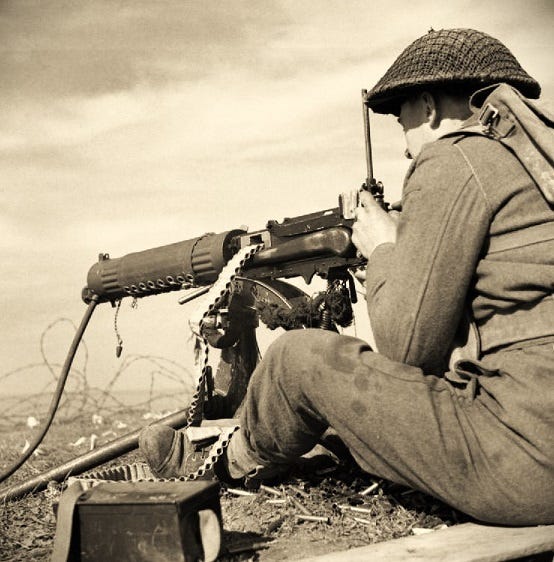
At first, Grok performed impressively. It animated the immediate continuation of the still photograph convincingly: muzzle flash, belt movement, crew motion. In other words, it predicted the adjacent frame.
But as the camera angle changed, the illusion unraveled. The receiver warped. Components drifted. The operating system morphed into something unrecognizable. What began as a historically specific weapon dissolved into a mechanical fantasy.
Even when explicitly told what the weapon was, the system could not synthesize generalized knowledge about recoil operation, feed mechanisms, or internal geometry into a consistent three-dimensional model. It could extrapolate appearance. It could not preserve mechanical identity.
Humans do something fundamentally different. When we see a machine gun, even one unfamiliar to us, we infer. We assume constraints: metal parts remain solid, bolts reciprocate, ammunition feeds in predictable ways. We reason from physical principles, not just visual resemblance.
AI does not “know” that the bolt must cycle. It predicts what pixels likely follow other pixels.
II. Fragmented Knowledge Without Integration
The same limitation appears in simpler cases.
Shown an image of an AK-pattern rifle firing — such as the AK-47 — generative systems can render a convincing muzzle flash and maintain correct silhouette. But often the bolt does not reciprocate. No casing ejects. The internal action remains frozen.
The AI may “know” textually that the AK-47 uses a gas-operated rotating bolt. It may describe the mechanism accurately. Yet when generating motion, it fails to integrate that knowledge into a coherent mechanical simulation.
It has fragments of information that do not unify into causal reasoning.
This reveals something crucial: AI models are astonishingly good at pattern completion. They are not good at enforcing physical law unless explicitly structured to do so. They lack the persistent object modeling humans perform instinctively.
III. Hallucination as Semantic Substitution
The same pattern surfaces in text.
When generating copy about the Steyr M1912 rifle — an Austro-Hungarian export rifle manufactured by Steyr-Mannlicher before World War I — the AI produced largely accurate prose. It placed the rifle correctly in its historical context and described its Mauser lineage.
Then it described the weapon as having a straight-pull bolt action.
This error is instructive. Steyr produced Mannlicher rifles. Mannlicher rifles are famous for straight-pull bolts. The M1912, however, was a Mauser-pattern turn-bolt rifle — a distinction that matters deeply to anyone knowledgeable in firearms design.
The AI did not invent nonsense. It substituted a nearby semantic association. It reached into the cluster of related terms — Steyr, Mannlicher, early 20th century rifle — and pulled out a defining feature of a neighboring design.
Hallucination, in this case, is not fantasy. It is adjacency error.
To a novice, the confusion might be understandable. To an expert, it is glaring. The AI lacks a hierarchy of importance. It cannot distinguish between cosmetic similarity and structural difference unless that distinction is overwhelmingly reinforced in its data.
IV. The Uncanny Valley of Incomplete Knowledge
When AI ventures beyond well-represented training data, the problem becomes even more visible.
Image-generation systems trained primarily on moderately explicit material can produce convincing “R-rated” imagery. Lighting, anatomy, composition — all plausible.
But when pushed into territory where training data is sparse or filtered, coherence collapses. Instead of anatomy, one gets distortion. Instead of structure, mutation. The system attempts to infer what it has not learned, filling the gaps with probabilistic noise.
The failure is not moral hesitation. It is statistical limitation.
Humans extrapolate from embodied biological understanding. AI extrapolates from pixel correlation. When correlation thins, structure dissolves.
The uncanny valley is not accidental. It is the visual expression of incomplete modeling.
V. If the Process Is the Point, AI Is a Threat
Even with these limitations, it is understandable why artists and writers often react defensively to generative AI. AI is capable of quickly and easily generating plausible, professional quality, illustrations in myriad artistic styles.
A visual artist working in paint may justifiably feel threatened. For them, the value of the art is inseparable from its production. The joy lies in the brushwork, the layering of pigment, the hours of labor. The physical act of painting is intrinsic to the work’s meaning.
Similarly, a novelist or poet finds purpose in the act of writing itself — shaping sentences, revising paragraphs, discovering insights through language. To hand that process over to a machine would feel like surrendering the soul of the craft.
If the creative process is the primary source of value, AI is not a tool — it is a rival.
But it’s not always about the process…
VI. If the Process Is Not the Point, AI Is a Force Multiplier
Consider a game designer launching a startup.

Their expertise lies in mechanics, rules, balance, and scenario design. The writing they produce is largely technical — explanations of how the system functions. The art required to prototype the game is essential for immersion, but it is not the designer’s core competency.
Great games have great art. Much of the flavor of a board game, role-playing game, or miniature system comes from the aesthetics of the illustrations. But look at the early editions of Dungeons & Dragons. The original 1974 print run — roughly 2,000 copies — was self-financed by Gary Gygax and Dave Arneson. The game was sold in a wood-grain box with a sticker label. Interior illustrations were hand-drawn sketches by the authors. They were functional, not genre-defining. Only later, as the company grew, did it employ professional artists who created the iconic fantasy aesthetic associated with the brand.
The early days of Warhammer were similar — pencil sketches, budget artists, founders operating on shoestring budgets.
Today’s bootstrapped founder faces the same constraints — whether building a tabletop game or a web app. There is a need for compelling visuals, explanatory copy, marketing material, onboarding guides. However, hiring a stable of artists and writers at market rates could sink the company before the product is validated.
Here, AI changes the equation.
If the goal is not artistic transcendence but proof of concept, AI-generated art and text can provide a professional baseline. The founder can prototype quickly, iterate rapidly, and present something polished enough for beta testers and investors.
The animator is not replaced; the animator becomes a director. The founder is not replaced; the founder gains leverage.
Speed to product increases. Cost to experiment decreases. Barriers to entry fall.
VII. Boilerplate, Automation, and Personal Experience
Mechanically generated boilerplate content is not new. Financial websites long ago automated market summaries by merging spreadsheet data into templates. With conditional phrasing and variable fields, hundreds of articles could be generated daily — accurate, if dull.
Before generative AI, I considered something similar for my own site. Most of the original articles on Commander’s Tech were handwritten, and that carried over when I began the migration here, to Digital Polemos, for the articles, while Commander’s Tech refocused as a database of modern and historical weapon systems. The historical and technical data on Commander’s Tech lives in spreadsheets before moving to SQL. It would have been possible to construct Word templates that inserted specifications into predefined paragraph blocks.
But generative AI simplified the process dramatically.
By feeding structured data into ChatGPT with clear formatting instructions, I could generate three concise paragraphs of largely accurate historical summary in seconds. I read every article, correct errors, adjust tone where needed. Yet materially, there is little difference between what the AI produces and what I would have written myself.
When describing the history and development of a rifle like the Mauser 98k, there is limited novelty. The facts have been published thousands of times. The goal is clarity, structure, and accessibility — not literary innovation.
In this context, AI is not replacing creativity. It is automating drudgery.
VIII. The Real Value Proposition
So what is AI’s value?
If you are building a company with limited capital and need:
Professional-looking visuals
Informative website copy
Documentation
Prototypes
Marketing material
And if that content is largely formulaic, explanatory, or derivative — AI is transformative.
It enables rapid prototyping. It lowers upfront costs. It allows founders to demonstrate value before raising capital. It democratizes access to professional polish.
This does not eliminate the need for skilled artists and writers. Once a company scales, distinctive branding and high-quality creative work matter enormously. But AI allows the founder to reach that stage without mortgaging the future.
The early creators of D&D and Warhammer operated with limited tools and limited budgets. Today’s creators have access to generative tools that can compress months of iteration into days.
IX. Tool, Not Oracle
AI’s limitations remain real. It hallucinates. It confuses adjacent technical concepts. It lacks embodied reasoning. It collapses outside its training distribution.
But within its strengths — rapid iteration, pattern synthesis, boilerplate generation, visual prototyping — it is a force multiplier.
The mistake is to treat AI as an oracle. The opportunity is to treat it as leverage.
It does not replace expertise. It amplifies those who already possess it. It does not eliminate creativity. It lowers the cost of experimentation.
If the process is sacred, AI will always feel like a threat.
If the product is the goal, AI may be the most powerful creative accelerator of our era.
No posts
Comments
Nothing yet. Say the first thing.
Sign in to join the conversation.