
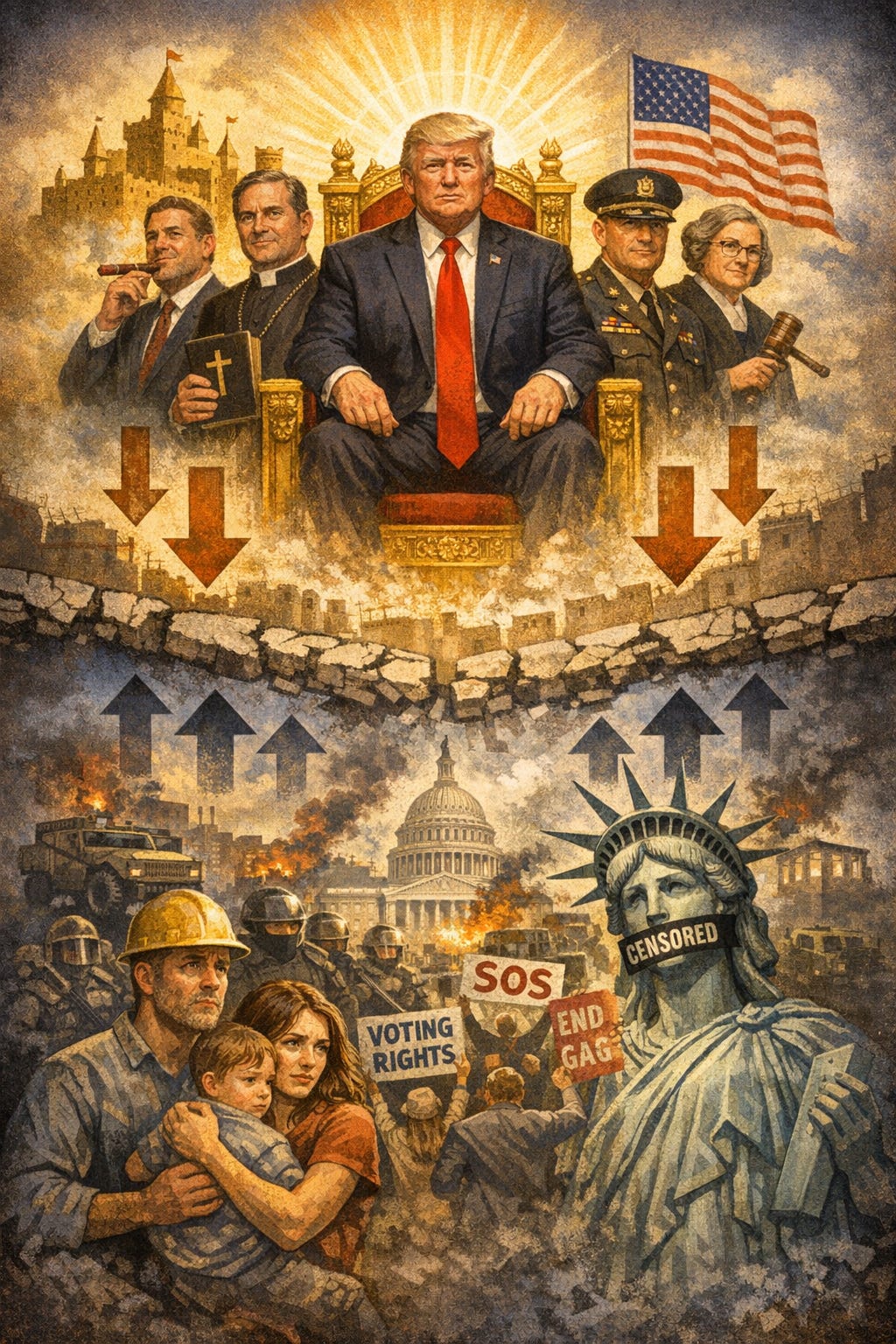
American political debate often revolves around slogans: “small government,” “freedom,” “law and order,” “drain the swamp.” But beneath the rhetoric lies a deeper philosophical divide—one less about the size of government than about the structure of society itself.
At its core, the tension is between hierarchy and equality before the law. Understanding that tension helps clarify both the intellectual roots of conservatism and the contemporary trajectory of the MAGA movement. And surprisingly, it also helps explain why a 1947 novella by John Steinbeck remains relevant today.
Conservatism and the Defense of Order
Modern conservatism did not originate as a campaign for “small government.” It emerged as a defense of order against revolutionary upheaval. Edmund Burke, writing in response to the French Revolution in Reflections on the Revolution in France (1790), warned against abstract egalitarianism that disregarded inherited institutions. Society, he argued, is an organic structure shaped by tradition and accumulated wisdom. Radical leveling does not merely rearrange power; it threatens to destroy the delicate architecture that holds civilization together.
Later thinkers such as Russell Kirk reinforced this emphasis on order. In The Conservative Mind (1953), Kirk described tradition, continuity, and moral authority as prerequisites for liberty. Equality was secondary to stability because stability preserved the moral structure within which freedom could exist.
At the center of this worldview lies a powerful feedback loop: morality confers divine favor; divine favor produces success; success demonstrates morality. The logic is circular but self-reinforcing. If wealth and power are signs of virtue, then those who possess them must be morally superior. Their prosperity is not merely fortunate—it is evidence of righteousness. Conversely, poverty becomes not simply misfortune but a possible reflection of moral failing or spiritual deficiency.
Political psychology helps explain the appeal of this structure. Jim Sidanius and Felicia Pratto’s theory of social dominance orientation (SDO), outlined in Social Dominance (1999), suggests that individuals vary in their comfort with group-based hierarchies. Those higher in SDO tend to view inequality as natural or even necessary. Within such a framework, visible disparities in wealth and status are not problems to solve but confirmations of an underlying order.
Religion has historically amplified this moral-wealth connection. Sociologist Max Weber, in The Protestant Ethic and the Spirit of Capitalism, explored how Calvinist doctrines of providence and election could encourage believers to interpret worldly success as a sign of divine grace. Over time, this theological idea migrated into broader cultural assumptions: prosperity signals discipline, virtue, and God’s blessing; hardship may indicate moral or spiritual deficiency.
The result is a moralized hierarchy. Wealth is not just economic capital—it is moral validation. Authority is not merely positional—it is sanctified. Those at the top define what is good, and their position is cited as proof of that goodness. The reasoning closes in on itself: they are wealthy because they are virtuous; they are virtuous because they are wealthy.
The point is clear. In this tradition, hierarchy is not accidental or regrettable. It is evidence of order itself.
Thanks for reading Digital Polemos - Conflicts In Context! This post is public so feel free to share it.
Small Government—or Government in Service of Hierarchy?
The American idea that conservatism equals “small government” emerged largely in reaction to the New Deal under Franklin D. Roosevelt. As federal authority expanded into labor regulation, social insurance, and economic oversight, conservatives argued that bureaucracy threatened liberty.
Yet historically, conservative movements have supported expansive state power in other domains—particularly policing, national security, and executive authority. The question has rarely been government size in the abstract. It has been purpose.
Government that redistributes power or expands social mobility can be seen as destabilizing hierarchy. Government that protects order, enforces deference, and shields established elites serves it.
Traditional conservatism is not against large, powerful and intrusive government: it is against government that attempts to bind the powerful or protect the powerless.
The MAGA Era: Authority, Loyalty, and the Moralization of Power
The MAGA movement, associated with Donald Trump, provides a contemporary case study in how hierarchy, authority, and moral validation intertwine.
On the institutional level, the pattern is clear. Trump and his legal team advanced expansive theories of executive immunity, culminating in Trump v. United States (2024), where the Supreme Court recognized presumptive immunity for official presidential acts. The ruling intensified a long-standing constitutional tension: how far executive authority can extend before it collides with equality before the law. Likewise, the 2020 executive order establishing “Schedule F” sought to reclassify thousands of career civil servants, making them easier to remove and increasing direct presidential control over the administrative state. Supporters described this as restoring accountability; critics saw a consolidation of personal authority over institutional independence.
The same dynamic appeared in election disputes after 2020, when efforts to challenge certified results culminated in the January 6 attack on the Capitol during electoral vote certification. Ongoing rhetoric questioning electoral legitimacy, combined with proposals to reshape election administration, has raised concerns among democratic scholars about the durability of institutional guardrails.
Similarly, the deployment of federal officers during 2020 protests and public discussion of invoking the Insurrection Act reflected a willingness to use extraordinary executive powers in response to domestic unrest. Trump’s repeated characterization of major news organizations as “the enemy of the people” further signaled hostility toward independent institutions that traditionally constrain executive authority. As political scientists Steven Levitsky and Daniel Ziblatt argue in How Democracies Die, erosion of informal norms—mutual toleration and institutional forbearance—can weaken democracy even without formal constitutional change.
Across these arenas, the through-line is insulation of leadership from constraint. But the institutional story is only half the picture.
The other half is cultural and moral. Trump’s immense personal wealth, celebrity status, and business brand function for many supporters not merely as biographical details, but as evidence of virtue. Within the morality → divine favor → wealth feedback loop described earlier, success becomes proof of righteousness. Wealth signals competence; competence signals moral worth; moral worth justifies authority.
This helps explain the remarkable loyalty and devotion among segments of his base. Allegations of misconduct are often reframed as persecution. Legal jeopardy becomes martyrdom. Material success and dominance are interpreted as signs of strength and even godliness. Prominent supporters have publicly described Trump in overtly religious terms, casting him as chosen, anointed, or divinely protected. In this framework, criticism is not simply political disagreement—it is an attack on rightful authority.
The feedback loop closes tightly: he is wealthy and powerful because he is virtuous; he is virtuous because he is wealthy and powerful. Institutional constraints, then, can appear not as safeguards of democracy but as illegitimate obstacles placed in the path of a morally validated leader.
Education and mobility debates fit within this broader hierarchy discussion. Policies that expand access to elite institutions or redistribute economic opportunity are viewed by some as leveling measures that threaten natural order, while others see them as necessary correctives to inherited advantage. The underlying question resurfaces: should society broaden mobility and disperse power, or accept stratification as stabilizing and morally meaningful?
In the MAGA era, authority is not defended solely through legal argument. It is sustained through moral narrative—one that fuses wealth, virtue, and leadership into a self-reinforcing hierarchy.
Trump’s image of success carries little weight with those who believe in meritocracy. They know his empire began with inherited wealth and connections, not grit or genius. For people who rose by competence and labor, inherited fortune is not proof of virtue—it is proof of a head start.
Steinbeck’s The Pearl and the Fortress of Hierarchy
The moral logic of hierarchy is vividly dramatized in The Pearl.
In the novella, the poor pearl diver Kino discovers a magnificent pearl that promises education for his son and escape from generational poverty. The reaction of the town’s elites—the priest, the doctor, the pearl buyers—reveals how tightly the social order is guarded.
Central to this dynamic is the priest’s recurring sermon. He describes the universe as a great fortress. God is the commander. The Church mediates divine will. Each person is a soldier stationed at a particular post. The fortress stands only if every guardsman remains at his assigned place.
The metaphor is powerful and clear: hierarchy is sacred. Movement is dangerous. Obedience sustains order.
This imagery echoes older theological concepts such as the “Great Chain of Being,” in which social rank mirrors cosmic order. In Kino’s world, poverty is not merely economic; it is placement. To seek escape is to abandon one’s post and weaken the walls.
When Kino finds the pearl, the priest’s message subtly shifts from comfort to caution. Wealth may imperil the soul. Ambition may invite sin. The sermon becomes a warning: do not leave your station.
The violence that follows—manipulative pricing, arson, assault—functions as the fortress defending itself. Steinbeck’s critique is not of faith per se, but of religion deployed to sanctify immobility. The system punishes aspiration because aspiration threatens structure.
The pearl represents mobility. The fortress represents hierarchy. The tragedy lies in their collision.
What Is at Stake
Does authority flow upward from the consent of the citizens, where accountability is fundamental to the system, or is authority ordained from above, bestowed upon elites whose very actions define what is right and wrong? The political theories of the Western World, even dating back to the Greeks, revolved around these questions, but we thought we had firmly answered that: political authority is derived from the consent of the governed, and can be revoked if the social contract is broken. That’s the real issue at stake; not some pedestrian debated about tax policy or regulatory frameworks.
Movements rarely declare that they seek hierarchy. They speak of order, restoration, and strength. But when executive power expands, institutional checks weaken, dissent is framed as betrayal, and mobility narrows, the architecture begins to resemble Steinbeck’s fortress.
The essential democratic principle is equality before the law—no king, no aristocracy, no divinely fixed station. Hierarchical systems, by contrast, treat status as morally meaningful and authority as self-justifying.
In The Pearl, Kino learns that challenging one’s assigned role carries enormous cost. Steinbeck leaves readers with a haunting question: is social order maintained by justice and shared opportunity, or by convincing those at the bottom that their position is sacred?
That question remains central to our politics today.
No posts
Comments
Nothing yet. Say the first thing.
Sign in to join the conversation.