
Rare disease medicine poses a fundamental challenge. While traditional clinical trials were designed to estimate average treatment effects across large populations, rare disease populations often number in the hundreds, dozens, or even single digits. In this context, the question is not whether a treatment works on average but whether it works for a particular patient. The FDA’s greatest challenge over the next decade may not be artificial intelligence (AI), gene editing, cell therapy, or advanced manufacturing. It may be arithmetic.
For most of the modern era, uncertainty in drug development has been addressed the same way: generate more evidence. Need greater confidence? More statistical power? Stronger evidence? Enroll more patients. Initially, scaling up served medicine remarkably well. It was foundational for shaping the modern pharmaceutical enterprise and remains indispensable when large, well-controlled trials are feasible, ethical, and informative. The problem is that medicine is evolving.
As biology becomes more precise, patient populations become smaller. Diseases once treated as single conditions are increasingly divided into molecularly distinct subgroups and subtypes. A subtype can be further distinguished by specific mutations present in only a handful of patients. For instance, in amyotrophic lateral sclerosis (ALS), what was once viewed as a single clinical syndrome is increasingly being subdivided into biologically distinct populations, including genetically defined forms that may respond differently to targeted therapies (1). The more precisely disease biology is defined, the smaller the relevant patient population often becomes. Precision can increase confidence in mechanism while simultaneously reducing the feasibility of conventional clinical trials. We have adopted the phrase “denominator collapse” to describe this phenomenon (2), which has become one of the defining realities of modern drug development.
Moreover, across rare and genetic diseases, scientists increasingly understand the molecular events that drive disease progression. In Duchenne muscular dystrophy (DMD), for example, therapeutic approaches such as exon skipping are designed to directly address very specific disease-causing mutations that disrupt dystrophin production, in some cases only touching less than 10% of all patients with DMD (3, 4). Biological knowledge is advancing faster than regulatory science. The challenge for this era of medicine is generating conventional clinical evidence before the disease causes irreversible harm.
The future of medicine is increasingly being built for populations too small to support evidentiary models inherited from the twentieth century. At some point, “enroll more patients” stops being a scientific strategy and for rare diseases, becomes a show-stopper since there are not more patients. Patients, physicians, regulators, and developers need to know not merely whether a treatment appears beneficial for a group of people with a shared disease, but for whom it works, for whom it fails, and for whom it may be dangerous.
The FDA’s Plausible Mechanism Framework (5) represents an important institutional response to the precision medicine era by recognizing that biological understanding itself can carry evidentiary value. Yet plausible mechanisms are only a starting point. Causal inference offers a pathway from plausible mechanisms to causal mechanisms, providing rigorous methods for integrating randomized and real-world evidence, supporting external controls and natural-history comparisons, identifying patient-level treatment effects, and enabling responsible generalization across related diseases and platform technologies (Figure 1).
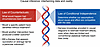
Causal inference: the double helix for personalized medicine in rare disease. Causal inference can be conceptualized as a “double helix of causal thinking,” intertwining data and reality through two fundamental principles. The first strand is the Law of Counterfactuals: What would have happened had circumstances been different? In rare disease, this means asking whether a specific patient would have benefited without treatment, whether another intervention would have produced a better outcome, or whether a therapy that appears successful on average may fail for a particular individual. The second strand is the Law of Conditional Independence: How can we determine whether our assumptions about cause and effect are reflected in the data? This principle enables researchers to use causal diagrams and structural models to identify treatment effects, even when data are limited and conventional statistical methods reach their limits. Together, these principles offer a path toward faster, less expensive, and more precise drug development by combining randomized and observational evidence, identifying likely responders before approval, leveraging real-world data more effectively, and estimating individual treatment effects rather than relying solely on population averages. Causal inference is an essential step beyond the Plausible Mechanism Framework (5) response to precision medicine regulation. The randomized clinical trial remains indispensable, but without causal inference, it remains largely confined to providing answers based on averages of large populations. Rare disease and personalized medicine requires the ability to reason about causes, interventions, and counterfactual outcomes. In that sense, causal inference is not merely another analytical tool. It is the scientific framework that can connect data to reality and make truly individualized treatment decisions possible.
These concepts align closely with the FDA’s modernization initiatives and the upcoming Prescription Drug User Fee Act (PDUFA VIII) negotiations. Better methods for evaluating causal evidence can reduce regulatory uncertainty, lower the cost of capital investment, and expand investment in therapies for rare and devastating diseases. Ultimately, the future of precision medicine will depend not on enrolling more patients, but on learning more from the patients we have. Here, we discuss how causal inference, denominator collapse, patient demand, and FDA modernization can reshape biopharmaceutical development and regulatory science.
Comments
Nothing yet. Say the first thing.
Sign in to join the conversation.