
There are only two movies you need to guide you through this life, because there are only two stories to tell.
First, there is Man versus Himself.
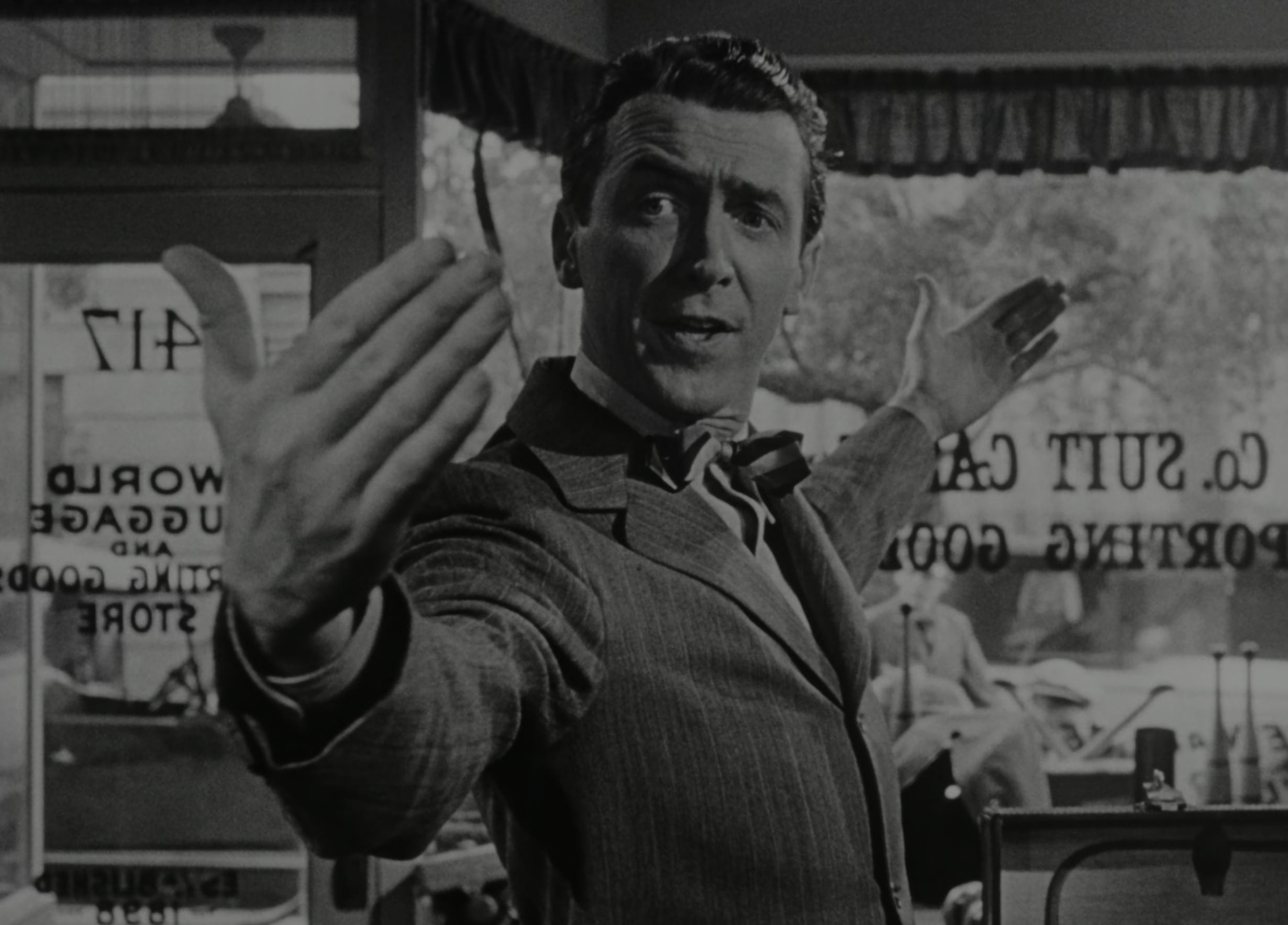
Man hits wall after wall after wall after wall and isn’t easily deterred from hope. His belief in his life’s purpose stays firm. But with time, one’s endurance to those setbacks eventually wanes. Ambitions whittle and lowered expectations start to set in. George Bailey (James Stewart) in Frank Capra’s It’s A Wonderful Life is one of the most optimistic men on the planet, but even he has his breaking point.
George Bailey might be our most realistic and common hero in American cinema. He achieves nothing of awe, but accomplishes and inspires so much good. Despite having the heart of an explorer, George is never rewarded with adventure. He is spiritually arrested to his hometown of Bedford Falls, New York. When he’s called to serve in World War II, he can’t. George saved his brother from drowning at 12 years of age and became hearing-impaired as a result. That same younger brother goes on to be drafted and outshines him as a great war hero. George is left to stay in Bedford Falls and run the family business. Nobody else will. But as a businessman, he’s too soft-hearted to ensure that the Bailey Bros. Building & Loan can succinctly stay afloat.
At every major turn, George puts his own needs second to those around him. He puts them second to the love of his family, his community, and because he genuinely believes in the ability of the common man or woman to overcome their obstacles. Every wide-eyed goal George has is not only unattained, but is smeared into the dirt and perverted by time and outside circumstances. Yet, he endures and does not shift from his kind nature.
When George is ensnared by a mistake entirely beyond his control—Uncle Billy, his business partner at Bailey Bros. Building & Loan, misplacing a crucial $8,000 and inadvertently handing it to the film’s villain Mr. Potter—he is subjected to the harshest possible consequences. There are missing funds for the Building & Loan with a bank examiner on the way and, later, a warrant is issued for George’s arrest. Could matters get much worse?
Overwhelmed with the impending doom of the family business and his life, and correctly convinced that every sacrifice and act of generosity has in some way brought him to this moment, George Bailey decides to kill himself. He walks to a bridge in Bedford Falls with intentions to leap into the freezing cold harbor and before he can, George’s guardian angel Clarence intervenes by beating him to the punch. Knowing it is in George’s nature to put others first, George holds off on his own suicide to save Clarence from drowning.
In return, Clarence gifts him the ability to see a world without his presence in it and how much worse it would be for Pottersville Bedford Falls. Especially his one true love Mary (Donna Reed), who without George, is left to become an aging, timid spinster librarian. His beautiful children are never born. His brother, at age 12, drowns in a lake. The town villain Mr. Potter owns everything and everyone. This is a darker world.
When George is returned to reality, he understands the volume of his life despite its lack of flashiness. He cannot kill himself, regardless of whatever consequences are to come—which appears to be jail time. George holds onto his hope and he ultimately does not lose his belief in life.
The film ends in the fashion of a Joseph Campbell quote, “Follow your inner heart and the world moves in and helps.” All of those lives that George Bailey touched come together to make up the $8,000 difference and save him and the Building & Loan from a disastrous fate. It is a moving conclusion to the story.
It’s a Wonderful Life is one of those movies that was so embedded into American culture that it became part of the 20th century’s collective consciousness. Due to a copyright renewal issue in 1974, NBC and other networks swooped in and were able to air It’s a Wonderful Life without having to pay royalties to anyone involved in its making. This is how it wound up in its current annual loop, playing each year on Christmas Eve—and even sometimes Thanksgiving. Through vulturistic entertainment strategy, the film—which was originally panned by critics and considered a box office flop—was exposed to millions, spanning generations. Just like a business mishandling allowed George Bailey to see the meaning of his life, a business mishandling allowed this film to take on a greater purpose.
There is no better or more well-made movie than It’s a Wonderful Life to show the battle of Man versus Himself. Any human alive can sit down, understand, and feel something by giving their time and attention to that film. George Bailey is who we are as a people when we are at our best. He is not someone that we’d ever strive to be. But on our worst day, we can still try meet him at his level.
Second, there is Man versus Evil.

Evil exists. It wasn’t something that humans manifested one day. It has always been here.
Like gravity. Like oxygen.
When you come to that understanding, your view of the world changes. Because if you realize that, if you feel it, then instinctively you want nothing to do with it. You want it kept as far away from you as possible. But facing it is inevitable, because evil is so intrinsic to nature.
Evil may exist independent of humankind, and perhaps even of life itself, but it has a way of cropping up through people and the things they create. It knows how to make itself visible. No movie better illustrates this than William Friedkin’s The Exorcist, released in 1973.
The Exorcist defines evil as “The Devil.” And there is a litany of vulgar and disturbing manifestations that come from “The Devil” making itself known through its young host Regan MacNeil, played by Linda Blair. In the 1971 book, written by William Peter Blatty, Regan is not possessed by The Devil, she is possessed by a demon called Pazuzu. Pazuzu is an ancient deity of Mesopotamian religion and debates wage online as to whether or not Pazuzu should actually be classified as a ‘demon’ or if Pazuzu has some beneficial qualities to him. Apparently, he wards off pestilence.
What’s interesting is that Blatty, a Catholic, who wrote this story with two priests as its heroes, landed on a demon that has no basis in Christianity or Catholic faith. The implication being that this battle of good and evil has been a long one, and predates the Christian understanding of God.
Father Damien Karras (Jason Miller) is a Greek-American jesuit living in New York City, who is called upon by Regan’s mother Chris (Ellen Burstyn) when all medical and scientific explanations fail to explain her daughter’s extreme outbursts. Karras is as skeptical as the professionals when he speaks to Chris, and even as he meets Regan for the first time.
Before all of this happens in the story, Karras is suffering a crisis of faith. He works as a psychiatrist for the jesuits and is having a difficult time handling his mother’s declining health. She eventually passes away without him present, which haunts Karras later in the book and in the film. This is then regularly used by the demon possessing Regan to taunt Karras and try to force him to emotionally collapse. Still, despite her unexplainable knowledge of his mother’s passing, Karras remains unbelieving that Regan is truly possessed. It’s not until he discovers through a tape-recording that Regan has the ability to speak backwards and channel several voices that he begins to consider that she may actually be inhabited by a demon.
By the time that veteran priest Father Lankester Merrin (Max von Sydow) arrives to conduct the exorcism on Regan with Karass, there is no question in Karras’ mind that she is possessed. What he has encountered, and will be doing battle with, is genuine raw evil that has taken root in an innocent little girl and sought to corrupt and decay her in rapid time.
Like George Bailey, Father Karras has undergone a crisis of belief that only a supernatural presence can solve. But unlike George Bailey, who avoids ending his life out of frustrated recklessness, Karras must sacrifice his to do what is right, fulfill his calling, and protect the child. Suicide becomes the answer. Thomas Aquinas declared suicide a mortal sin because it override God’s authority over life, but there is no other option once Karras baits the demon out of Regan and into himself. We can see that the demon seeks to hurt or kill Regan in Karras’ body once he is possessed, and his decision to commit suicide is ultimately an act of good.
That is a radical conclusion to end on. But it is what defines The Exorcist as being a battle of Man versus Evil, rather than Man versus Himself. There are greater stakes than ‘the body’ in this back and forth between what is human and what is supernatural. Karras does face his own emotional turmoil and lack of purpose and overcomes those things in the face of evil. These inner problems faced become secondary to ensuring that evil does not take a victory lap, even if just this one time.
Thanks for reading LowRes Wünderbred! This post is public so feel free to share it.
No posts
Comments
Nothing yet. Say the first thing.
Sign in to join the conversation.