
You already have a catalog of schedules and a binder that turns rows into
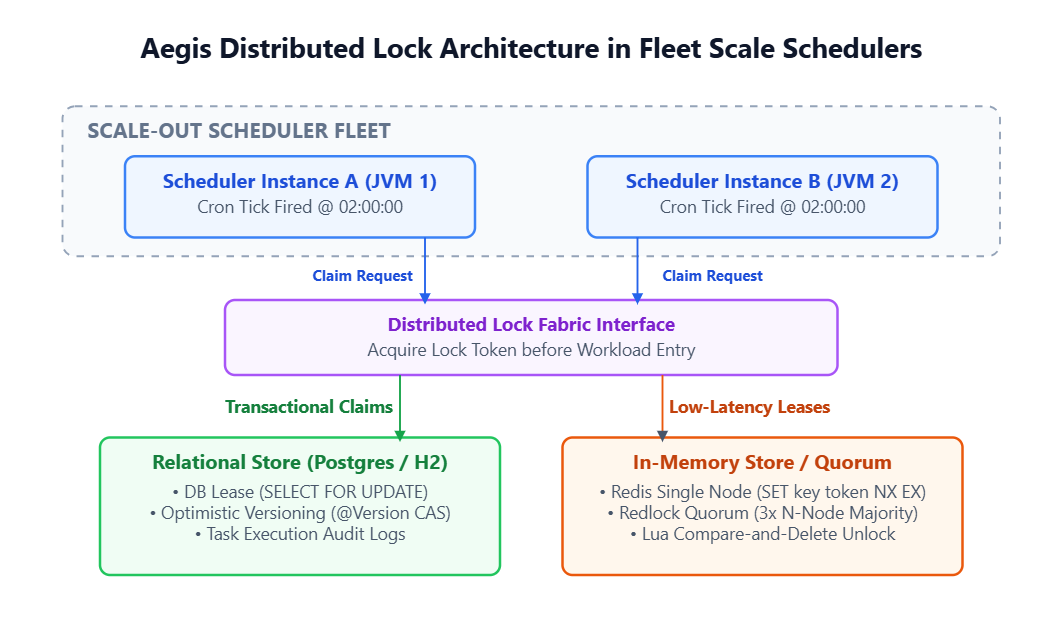
ScheduledFutures. That is a control plane. Horizontal scale breaks it the moment two JVMs share the same catalog: each node still wakes on the same cron, and both happily “reconcile invoices” at 02:00. Payment platforms call that double-settlement. Warehouse systems call it double-ship. Schedulers call it the reason locks exist.Airflow’s executors, Kubernetes leader election for controllers, and Redis-backed queue claim patterns all solve variants of the same question: among N healthy processes, which one may enter this critical section right now? integrated lab — Aegis — makes that question tangible. You will watch unprotected ticks collide, then enforce exclusion with database leases, optimistic claims, Redis
SET NX, and a Redlock quorum — one dashboard, no toy mocks.The production insight that separates junior from senior designs is not “use Redis.” It is knowing which failure mode your lock actually covers. A Postgres
SELECT FOR UPDATEand a Redis key with TTL fail differently under network partitions. Product managers feel those differences as duplicate emails; SREs feel them as pager storms; architects must name them before choosing a store.
The single-instance illusion after scale-out
Where locks sit in the Task Scheduler architecture
Control flow: tick → acquire → run → release
Data flow across RDBMS and Redis
Lock and task state machines
Four real coordination strategies (plus the “none” baseline)
Build, test, and demo Aegis
Production trade-offs and homework
Static
@Scheduledmethods are process-local. Persist the schedule in a database and every replica will still fire. Without a distributed lock, your audit table fills with twoEXECUTEDrows for the same logical tick — differentinstanceId, same business effect.That is not a logging bug. It is a missing mutual-exclusion boundary around work that is not idempotent. Even idempotent handlers benefit from locks: you save CPU, cache stampedes, and load on downstream banks or SaaS APIs that rate-limit by account.
Comments
Nothing yet. Say the first thing.
Sign in to join the conversation.