
In May 2024, I was invited to a castle in Germany for a meeting between public intellectuals and public officials. The castle was nestled inside the Spree Forest, along the Spree River in Brandenburg. It was as picturesque and idyllic as it sounds: a medieval town center replete with cobblestones and castle gates alongside boat rides on a winding river, a canopy of arching trees overhead with the tips of their leaves kissing the water’s edge.
All of us attending stayed on the castle grounds—my room was in the converted horse stables—and in the morning we gathered for breakfast where we (mostly) met for the first time. Not knowing anyone, I chose a table at random, and had the good fortune to sit next to an amazing person: Sofia Dyak, from Ukraine.
At the time, Ukraine was enduring relentless, senseless and murderous attacks by the Russian military upon its people and sovereignty—attacks that continue to this day. Sofia’s journey out of Ukraine to Germany had been long, arduous and involved multiple modes of transportation across multiple countries. But one would not have known that from talking to her; over breakfast she was alert, sharp and incisive. As Director of the Center for Urban History in Lviv, she brought an expert knowledge of Eastern European history concomitant with living through an inflection point in that history. As further testament to her brilliance, she was proficient in six languages: Ukrainian, English, Polish, Russian, Belarusian and German. We struck up a rapport that continued throughout the meeting, and at the conclusion we resolved to stay in touch.
What I did not know at the time was that she and her colleagues were planning to launch a new literary journal for Ukraine, called re/visions.
Fast forward one-and-a-half years later, and re/visions is now a reality. As good fortune would continue to have it, Sofia and her colleagues were kind enough to feature me in the latest issue, “Issue 5. The Future.” The interview is principally regarding A.I., and the role that history and the humanities might play in its development. We also explore whether A.I. will equalize the balance of power in the disinformation wars, or further entrench patterns of disinformation into our lives.
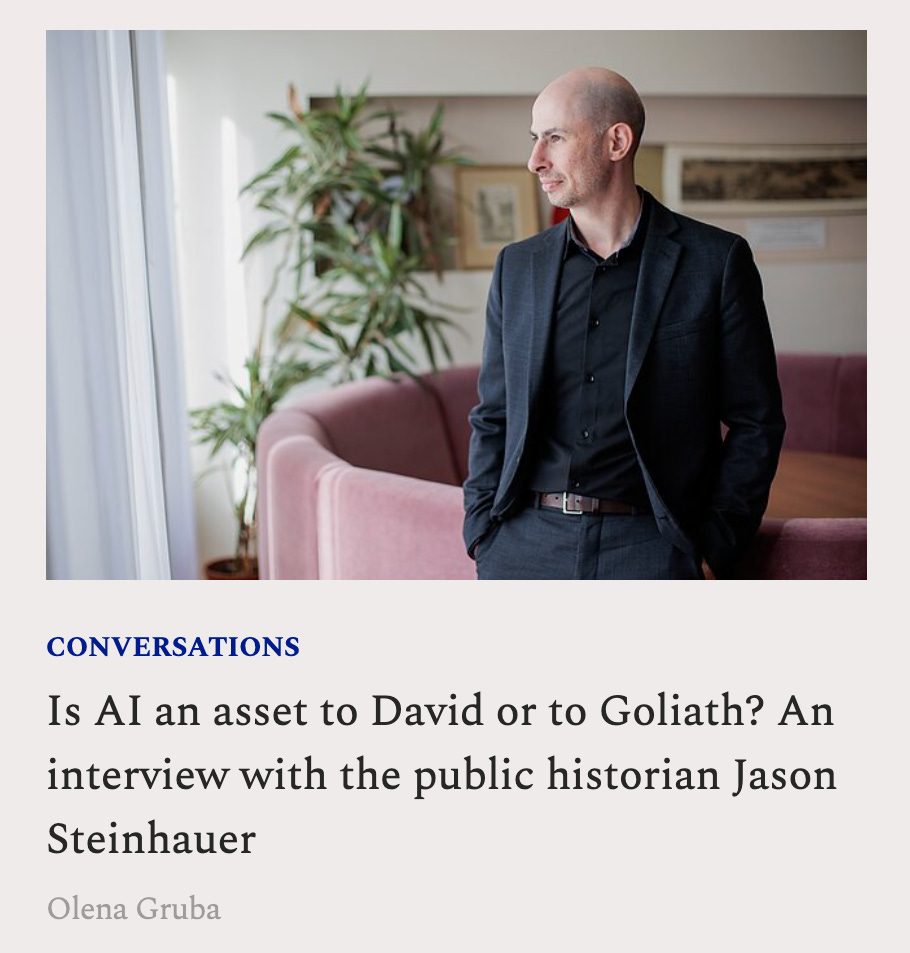
I encourage you to read the interview. The interviewer, Ukrainian Ph.D. candidate Olena Gruba, asked very smart and pertinent questions.
More importantly for me, though, I wanted to showcase the journal itself, and the heroic work of its founders, editors and writers. I also wanted to know more about why they felt that Ukraine needed such a cultural product at this particular time.
So, I took the opportunity to turn the tables on my friends half-a-world-away, and interview them for this edition of my newsletter. Specifically, I directed my questions to Editor-in-Chief Daria Badior and editor Natalie Nougayrède, formerly of Le Monde. Here is what they told me:
Q: What was the inspiration for the journal?
A: “After the start of Russia’s full-scale invasion of Ukraine, the world was no longer the same for us. In an attempt to make sense of the massive upheavals of our times, we started wondering about some of the concepts we thought we were familiar with. We felt a need to explore them more. That’s how the idea of re/visions was born.
“The name we’ve chosen, re/visions, is drawn from how this war has triggered an intense revisiting of previous experiences and narratives, a rethinking of words, even creating new ones. With this journal, we want to explore how our life experience is shaped, articulated and put into words and images.”
Q: How did the journal come about?
A: “When the Russian full-scale invasion started, Daria Badior evacuated to Lviv, as did many culture-makers from Kyiv and other cities that were closer to the new frontline. There were many discussions about the drastic changes which happened after February 24, 2022, and are set to continue in the future as a result of this war.
“We started to imagine a series of discussions dedicated to revisiting and revising the words and concepts that were so often heard at that time: peace, justice, genocide, etc. We talked about this idea a lot, but could not wrap our minds around it exactly. So after a while, we decided that rather than organizing a series of events, we could try to create something more sustainable: a journal where such discussions could occur and stay available for readers.”
Q: How do you see the role of the journal in the face of continued Russian aggression?
A: “We like to think of re/visions as a space where some deep questions can be explored, such as our relationship to places, memories, nature, hope, the notion of time. Such questions are alive within Ukrainian society, like everywhere. War triggers all sorts of rethinking, but we really want to cast our eye beyond Ukraine also, precisely to contribute to a wider conversation. We don’t “lock” ourselves into the topic of the war in our editorial choices, although of course the war is very present in our lives, so it obviously filters through in the journal.
“It’s essential for us to make the journal a space where voices connect across borders and cultures, and across time, to try build a dialogue between people inside and outside of Ukraine and have a pluralism of voices from today and from the past. We believe providing a calm space to think is an act of resilience in times of war.
“We stay clear of the news cycle because people already get huge volumes of that and sometimes want something different to read about, something connected to events but in an indirect, insightful and perhaps unexpected way. By bringing in writers and experts from academia, the arts, literature and journalism we offer in-depth, long form interviews and personal essays.
“We try to build a collection of essays, interviews, images, that convey something about the times all of us are living through, wherever we may be. re/visions, its team, authors and, judging from the feedback, our readers are part of a wider global conversation about big questions. What does friendship mean, what is grief and how we are dealing with it, or how do we relate to the notion of the future — these are some of the topics we took.”
“After the start of Russia’s full-scale invasion of Ukraine, the world was no longer the same for us… this war has triggered an intense revisiting of previous experiences and narratives, a rethinking of words, even creating new ones.”
Q: How do you see the journal fitting into a long lineage of Ukrainian literary and intellectual culture?
A: “We hope that this journal will serve as a platform that helps revisit perceptions of literary and intellectual culture in Ukraine. Rather than thinking along ethnic or national lines, we want to embrace the complexity of the different milieus, cultures and identities that have shaped and are shaping what Ukraine is today. We attempt to trace lineages and explore narratives in a sensitive manner, providing historical context, and looking at interconnections.
“Plenty of magazines and intellectual journals were produced on this territory over the last 120 years.They were products of their times, as well as attempts to look beyond: into the future or behind the curtains. re/visions tries to do the same. It’s not an easy time to launch an intellectual online journal, but perhaps there never is a perfect time. We are delighted to hear from our readers and authors that we’re providing what they need: a slow-paced, small and thoughtfully curated conversation.
“By inviting Ukrainian and international contributors — either to write or to be an interviewee,— and by publishing issues both in Ukrainian and English we try to build another bridge between reader communities. We bring Ukrainian voices into the English-reading world and new international authors into Ukraine’s public space.”
Q: What are your aspirations for the journal and how people around the world can help?
A: “We want to build a community around re/visions, connecting people within Ukraine and outside of it. Alongside the journal, we are gradually building up a series of in-person debates and discussion groups. We’ve started taking part at a conversation festival in the Baltic region and want to reach out to other such events in other European cities, and why not, beyond Europe. We have started holding our own, re/visions, public events in Ukraine, in particular in culture hubs in Lviv. We are also building partnerships with cultural and educational institutions across different regions of Ukraine, reaching out especially to young people, students, and creators.
“We are an NGO registered in Ukraine. We don’t collect donations for now. We are supported by European foundations. So the best way to support us is to sign up to our newsletter, to send us ideas and feedback, and perhaps help us find more donors among people who care about supporting an initiative that works for a pluralistic, open, tolerant public space. Doing this in the context of a war is our way of trying to contribute to a better future.”
The latest issue of re/visions is here.
Sign up for their newsletter here.
And remember that resistance is as much intellectual activity as it is a military one.
Have a good week,
-JS
This post is public so feel free to share it.
Comments
Nothing yet. Say the first thing.
Sign in to join the conversation.