
It feels like ancient history now, but back in 2021 the Israel Defense Forces (IDF) and Hamas fought each other in an 11-day conflict that would preview the more vicious war that began on October 7, 2023, and continued up until the recent ceasefire agreement. Back then, much of the world was still in the throes of the Covid-19 pandemic, with many in the U.S. home from school and work and practicing social distancing. It was during that 2021 conflict that a fresh barrage of antisemitism emerged online and in the streets. It included public calls to lynch and murder people who were Jewish, swastikas drawn on synagogues, and vans adorned with “Hitler was Right” slogans while waving Palestinian flags. The incidents were documented in the news media by Vox, Newsweek, Unpacked and others, and experienced personally by many American Jews, including friends and colleagues.
As a grandchild of Holocaust survivors, a former curator at a Holocaust museum, and as a student of history, seeing violence and hatred towards Jews did not surprise me. The lack of meaningful response from societal leaders and other communities was also not surprising—there is a long history of people idly standing by while Jews are threatened. What struck me most during that period was how many American Jews refused to stand up for themselves. Some even purposefully hid their Jewish identities. I recall two conversations in particular: a friend in California who was terrified to identify as Jewish at her workplace, for fear that her co-workers would harass her, or possibly terminate her; and a scholar who confessed to me privately that he would never publicly stand up against antisemitism or defend Israel for fear of being mobbed by his fellow academics. I had experienced similar during my four years in higher education; it seemed that every faculty meeting I was part of devolved into ad hominem attacks against Israel and anyone who supported its existence. It was one of the reasons I left academia; as a Jew, I realized that no one had my back.
American Jews who came of age in postwar America had hoped that 2021 might be an outlier, a product of a combustible conflict during a combustible global pandemic. We were wrong; 2021 proved to be an inflection point on a timeline that has had its arrow pointed steeply upward. Antisemitism has been creeping out of the shadows and into the mainstream throughout the 21st century, and in the past five years has become more vicious, ubiquitous and emboldened in America. The reasons are multifarious: the growth of the far-right, the rise of the far-left, the spread of disinformation, the proliferation of social media platforms, the collapse of trust in civil society institutions, historical illiteracy, propaganda campaigns by well-funded hostile actors, Islamic extremism, algorithmically-driven conspiracy theories and a lack of unified or consistent response from societal leaders have all contributed.
It has been inflamed by the two-year war between the IDF and Hamas, yet even amid a ceasefire a recent analysis found online antisemitism to be at its highest levels ever recorded across numerous platforms. Antisemitic incidents in the U.S. have increased 344% over the past five years, including a hostage-taking incident at a synagogue in Texas; swastikas on schools in California, New York, New Jersey, Massachusetts, Connecticut, Virginia, Washington and other states; assassinations of Jews in Washington, D.C. and Boulder, Colorado; and proclamations by activists, pundits and influencers that any organization that could possibly have “Zionists” associated with it (as determined by them, of course) were fair game for violence, harassment, intimidation and murder. Holocaust denial and glorification are broadcast weekly to audiences on social media platforms by figures such as Tucker Carlson, Candace Owens and Myron Gaines, and while pundits on the political Right spread Judeo-Israeli conspiracy theories with impunity, leaders on the political Left have endorsed a candidate for Congress who, literally, had a Nazi tattoo on his chest.
One thing that has changed in four years has been the willingness of American Jews to not remain silent. Advocacy organizations, synagogues and individuals have realized that since few people will come to the public defense of Jews, they must do so alone. Still, there remains a substantial portion of American Jews (a precise number is difficult to determine) that have taken to silencing themselves, blaming themselves or aligning with their abusers—convincing themselves they deserve antisemitism as penance for Israel’s sins, or that the discrimination might subside if they align themselves with the movements that hate them. Similar to how those in abusive relationships come to believe they are deserving of their inhumane treatment, the current state of affairs for American Jewry evinces just how mainstream, toxic and ubiquitous antisemitism has become.
Antisemitism is nothing new in the United States. There is a long history of it, documented in several lengthy books, including this one, this one and this one. At different times in America, people who adhered to Judaism or identified as Jewish have been denied full citizenship; denied the ability to hold public office; denied the opportunity to buy homes in certain neighborhoods; been denied entry into schools; been denied entry into the country; been beaten, murdered, massacred, and lynched; and been falsely accused of everything from the assassination of JFK to the terror attacks on 9/11. America had Nazi youth camps on its own soil during the 1930s, replete with Nazi flags atop flag poles and a special train from New York City to Yaphank, Long Island, dubbed the “Siegfried Special.” The U.S. Department of State was so antisemitic during the Second World War it concocted a sham conference in Bermuda whose sole purpose was to deflect all pressure or responsibility for accepting into the U.S. any European Jews at risk of being murdered, “a façade for inaction,” as one participant admitted years later. After the war, when six million Jews were dead and hundreds of thousands were stranded inside refugee camps, American Congressmen purposefully crafted an immigration bill that excluded most of them from entering the country, while at the same time welcoming former Nazis and their collaborators to, supposedly, aid in the Cold War.
Most Americans today are unaware of these histories. The history of American antisemitism is not taught in most U.S. high schools, and the Holocaust, when it is addressed, is more often covered in English class than in social studies. (The reason is that books such as Elie Wiesel’s Night and Anne Frank’s Diary are mandated as part of the English curriculum, whereas the mandate to teach Holocaust history in social studies remains uneven.) Antisemitism in the U.S. is taught at the university level, but as has been documented in this newsletter and elsewhere, each year fewer college students are taking history classes.
Even if it was wider known, it’s not clear that this history would be wholly relevant to today’s antisemites. In the past, American antisemitism worked to keep Jews out of arenas of power—out of desirable neighborhoods, out of elite universities, out of political positions, or out of the country altogether. Today’s antisemitism assumes that Jews are in too many arenas of power—Hollywood, Wall Street, government, business—and seeks to remove them by any means necessary. Indeed, a contemporary study published in Nature concluded that “anti-hierarchical aggression” was the strongest predictor of antisemitic attitudes on both the political Left and the Right. In other words, a desire to overturn the existing social order—and taking joy in doing so, even violently—is today positively and directly correlated with hating Jewish people. Amid a zeitgeist where many Americans are angry at their elected leaders, angry at the top 1%, angry at traditional institutions and angry at the un-achievability of the American Dream, the desire to “burn it all down” includes bringing down American Jews with it.
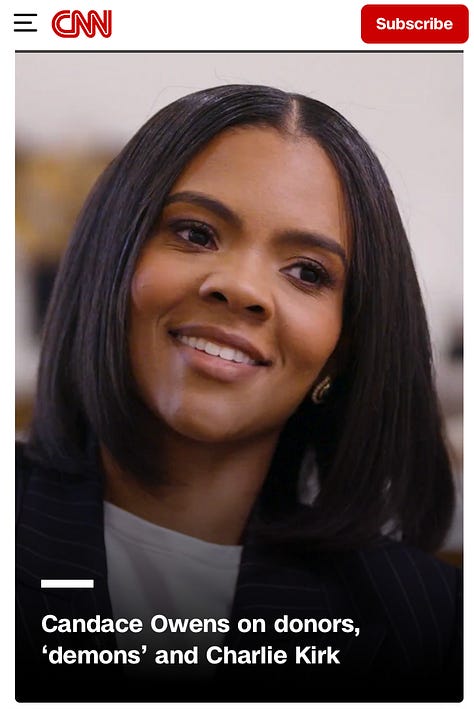
The desire to “burn it all down” has been a feature of the American far-right for decades. Far right hate groups have trafficked in antisemitic and anti-Israel conspiracy theories for years as part of broader separatist and supremacist movements. Occasionally their hateful ideas seeped into the mainstream, but such sentiments were rejected by the plurality of Americans. To paraphrase what a friend from rural Michigan once told me, everyone in his town knew where the Neo-Nazis lived, but so long as they minded their own business, they were left alone. That changed over the past decade. Whether it was the “Unite the Right” rally in Charlottesville; the massacre at the Tree of Life synagogue in Pittsburgh; or the hate speech of Nick Fuentes, Candace Owens or Tucker Carlson, the antisemitism of the political Right has used spectacle, shock, virality and memes to capture news and social media attention, granting its ideas wider exposure and acceptance. Its conspiracies—which include Jewish control of the American government and widespread denial of the Holocaust—have been amplified by platforms such as Gab, Rumble, Telegram, Discord, Facebook and Twitter/X, the latter two algorithmically recommending such content to users at various points. The sum effect has been that when Tucker Carlson devoted multiple episodes of his show to Jew hatred and Israel conspiracy theories, he gained audience members—and even after Candace Owens trafficked in blatant Holocaust denial and distortion, she received a sympathetic featurette on CNN’s home page.
But hate mongers such as Tucker Carlson and Candace Owens are merely the tip of the iceberg. A descent down the rabbit-hole of the right-wing “manosphere” reveals a dizzying and complex mix of misogyny, white supremacy, Christian nationalism and antisemitism. Consistent across this web of interconnected social media influencers and content creators are screeds against each of the perceived emasculating forces within society that have made the American Dream unattainable for young men: feminism and women’s empowerment, which have made it difficult for men to copulate and marry; the American government, which has built a hyper-regulated surveillance state that represses free speech and the possession of firearms; and, of course, the Jews, who have somehow conspired to hijack all the levers of power in America at the expense of white Christians. (This echoes a hallmark of right-wing conspiracy theories for decades, namely the fear of a “Great Replacement.”) Exploiting the very real hardships that American young men face—job precarity, student loan debt, loss of upward mobility, loneliness, social isolation and addiction—these seductive messages have brought the “tear-it-all-down mentality” off the sidelines and into a wider portion of the Conservative movement, to include hateful, vocal and very public antisemitism. (See examples here, here and here). These movements have even hosted conferences on American soil dedicated to the “JP”—”Jewish Problem”—and have been validated by the participation of societal leaders, including current and former Members of Congress and current and former Administration officials.
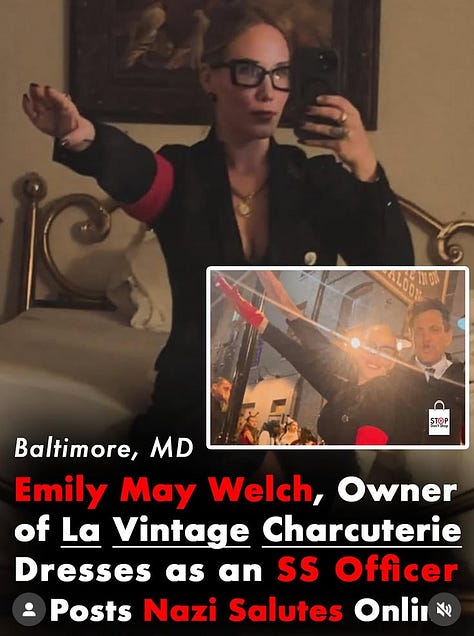
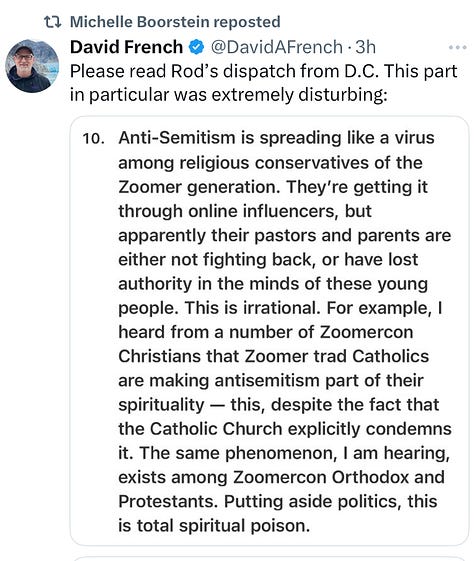
Such mainstreaming of antisemitism has not solely been on the political Right, however. It has also surged on the political Left. The opening remarks at the 2024 “Jewish Problem” conference were delivered by former Member of Congress Cynthia McKinney, a Democrat and the first African American woman elected to represent Georgia in the U.S. House of Representatives. A six-term Congresswoman, McKinney claimed to be participating under the guise of “anti-Zionism” when, in reality, her antisemitic conspiracies run the gamut from alleged Jewish control of NATO to an alleged Jewish responsibility for 9/11. She, and others at the conference, openly participated in discussions that called for each person who had been “awakened to the Jewish problem” to remove the “shackles” of Jewish influence from their lives.
The trope of eradicating Jewish presence from all aspects of American life pervades the contemporary far Left. It is wrapped under the pretense of being “anti-Zionist” or “anti-Israel” – and, to be sure, condemning Israel’s government, military or its citizens does not equate with antisemitism. Yet the left-wing antisemitic conspiracy theories mirror, in many ways, the thought patterns of those on the right. I recall being at a Congressional hearing on Capitol Hill a few months after the October 7, 2023, Hamas attack on Israel that massacred 1,200 people, and protestors from the left-wing group Code Pink were denying that the atrocity had actually happened. It is not uncommon to find far-left pundits and activists espousing the tropes of a Jewish cabal rigging the geopolitical landscape. In this worldview, Jews are always deceitful, plotting or scheming to take advantage of any situation at the expense of others. This trope has become so normalized it was shared via text messages among deans at Columbia University, one of whom was a former classmate of mine (the deans were later removed from their positions). The suspicion that Jews always have an alternate agenda unites the extreme right and the far-left.
Israel has served as the centerpiece of these conspiracy theories, a portion of which originate in the Middle East. They find their ways to European and American audiences via the web and social media, where thousands of accounts amplify them for the purposes stoking division and promoting hatred. The Iranian government, for example, has made antisemitism and Holocaust denial a foundation of its foreign policy. Its state-run television channel Press TV is full of unfiltered hate against all Jewish people—not solely Israelis—and features a program targeted to left wing audiences called “Palestine Declassified” hosted by two British men who were so antisemitic they were barred from academia and politics in the U.K., respectively. “Palestine Declassified” makes no distinction between “Jew” and “Zionist,” using the words interchangeably, even within the same sentence, as it spouts conspiracies and incites violence. Evidence suggests the United States now accounts for 20 percent of Press TV’s viewership, the highest percentage of any country outside of Iran.
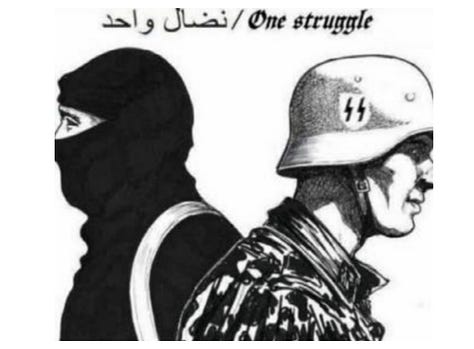
The Iranian government’s anti-Jewish hate is equally, if not more, extreme than any in the world. It spends tens-of-millions of dollars each year on propaganda that has been refined to align with far-left talking points of “anti-imperialism” and “resistance.” The Iranian government and its proxies Hamas, Hezbollah and the Houthis combine this post-colonial rhetoric with open and direct admiration for Nazism. Iranian Supreme Leader Khamenei’s website actually, at one time, had an illustration of the flags of Iran, Palestine and Hezbollah over the city of Jerusalem—the current capital of Israel—surrounded by Islamist fighters holding machine guns and the words “Final Solution” at the top. (The “Final Solution” was the name of the plan developed by the Nazis during World War II to deliberately and systematically murder all of Europe’s Jews.) In 2021, a meme circulated on Telegram that showed a Hamas militant and a Nazi S.S. trooper posed heroically together under the words “One Struggle”; in 2024, both Nazi and Hamas iconography were painted onto the home of a university administrator in the U.S. Much like the Nazis convinced themselves of a racial purity necessary by any means, Hamas fighters and their global apologists believe they are foot soldiers in a larger project to “purify” the Middle East and the broader world of Jewish presence “from the river to the sea.”
The rise of Democratic Socialism in the U.S.—which began with Bernie Sanders in 2016 and was punctuated by the election of Zohran Mamdani to mayor of New York City in 2025—has grown to have entangled with it such a belief in “purifying” the United States from Israeli and Jewish presence. It is important to re-state declaratively that not every member of the DSA is antisemitic, nor are expressions of solidarity with Palestinians antisemitic. (Indeed, a percentage of American Jews are DSA members and deeply support Palestinian human rights and statehood). But as was evidenced by the encampments and protests on university campuses the past few years, strands of antisemitism do exist within the movement, often unapologetically and rarely with condemnation from the broader community. Being antisemitic will never disqualify you from being a member of the revolution, whereas being pro-Israel will. The strategy has been to gradually shift the discourse so as to normalize antisemitism as part of the broader platform.
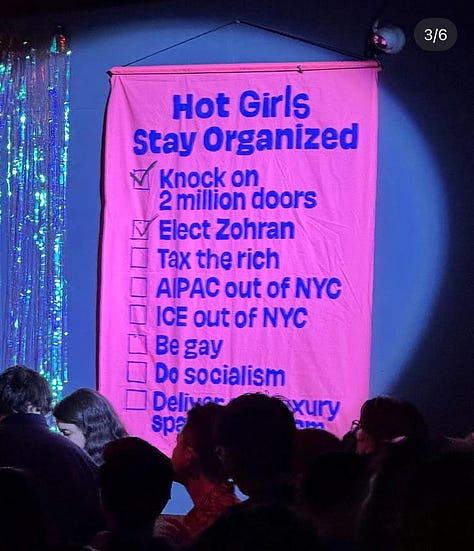
For his part, Mamdani has stated his desire to see the abolition of Israel as a Jewish state—which some Jews (though not all) feel is an antisemitic position since Mamdani has not called for any Muslim, Hindu or Christian countries to be eliminated. The “Hot Girls for Mamdani” election night victory party featured a poster that included eradicating the American Israel Public Affairs Committee from New York—which some (though not all) feel is an antisemitic position since no other nation’s lobbyists are being targeted for removal. Pro-Palestine influencers on social media such as Hasan Piker, who has 1.6 million followers on TikTok, and Isabella Moody, who has more than 200,000 followers on X, regularly intersperse pro-Palestine and anti-Israel messaging with blatant antisemitism, for example a recent tweet by Moody mocking Jewish-sounding names. (As an aside, I reported Moody’s account to X and received a reply that she had not broken any “safety policies.”) Fueling this hate is an “anti-hierarchical aggression” on the Left that mirrors that of the Right. The Marxist-Communist-Socialist program aspires to overthrow the ruling classes—including the current Democratic Party leadership—tear down the American capitalist system, and replace it with a new one. That tear-down includes ending American support for Israel, erasing Israel’s existence as a Jewish state, normalizing relations with the antisemitic regime of Iran, and toppling the Jews on Wall Street and in Washington who, it is believed, have oppressed the working classes. The largest home for Jews outside of Israel—New York City—now has a mayor from a political party that endorses such a platform.
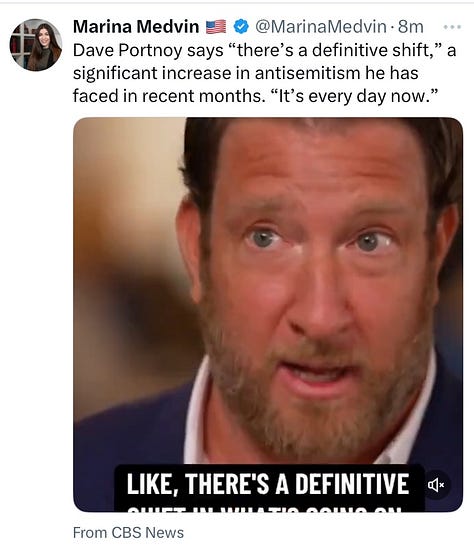
The Nazi summer camp on Long Island in the 1930s included a large banner that read “Free America.” The intimation was clear: America needed to be freed from Jewish influence. The language was crafted to appeal to American sensibilities of the time, and today, similar messages of “purifying” America from Jewish influence are being framed in language that appeals to Americans’ anger about the state of the country, particularly young people who are jaded, frustrated, and have come of age during a period of political violence, social media disinformation, and record-high inflation. In an era of cynicism and low trust, intoxicating messages that position the elimination of Jews and/or Israel as part of the revolution have become pervasive.
In an event hosted by the United States Holocaust Memorial Museum, historian Christopher Browning spoke about how everyday Germans became killers or collaborators in a short span of only a few years. In his remarks, he cited Helen Fine’s observation that in the run-up to the Holocaust, Jews had been “expelled from the community of human obligation.” In other words, through society-wide indoctrination, the Nazis successfully used community as a weapon, harnessing the emotions of community-building into an exclusive concept: those who were not Jewish or Roma or disabled could be part of the revolutionary fraternity building a new world order, while the Jews, the Roma and the disabled were excluded and eventually murdered. The Nazi government set the expectations, and everyday Germans tried their hardest to live up to those expectations in order to feel a sense of belonging, be accepted by their peers, not be left behind and secure their place amid the new nation. A poisonous ideology mixed with a social-psychological need for belonging enabled individuals to become changed, numbed and eventually brainwashed by what they saw and heard every day.
Similar phenomena are emerging on the Left and the Right in America today as political and social movements create revolutionary communities of exclusion. On the far-right, feminists, LGBTQ+, immigrants of color and Jews are the ones expelled from the community of human obligation, with no place in the revolutionary future that is proposed to be built. On the left, it is “Zionists,” capitalists, centrists and the political establishment expelled from the community of the future, with Jews expressly targeted for exclusion from Pride Marches, teacher associations and even medical care (see examples here, here, and here). It is not difficult to imagine a potential endpoint where first “the Zionist” and then, eventually, “the Jew” will no longer be considered a person American society has an obligation to protect, making the assassinations of Jews in the streets all-the-more possible. If you can make people fear the alleged power of the Jews, the eventual murder of the Jews becomes rationalized as an act of self-defense.
Such an outcome is not inevitable. It could be avoided if-and-when The White House, a bipartisan group of Members of Congress, Governors and societal leaders from White, Black, Asian, Latino, Tribal, Muslim, Hindu and Christian organizations unite in a joint, coordinated effort to condemn antisemitism however and wherever it manifests, and re-affirm that the revolutionary American future we desperately need includes everyone, Jewish and non-Jewish alike. That is in keeping with the spirit of democracy and a worthy message as we approach our 250th birthday and the anniversary of the signing of the Declaration of Independence in 2026.
Sadly, such a coalition appears unlikely to materialize as our politics become ever-more divisive heading into a consequential election year. That reality, in of itself, should be sobering to all of us. That a broad coalition of Americans have not yet stood together to banish antisemitism once-and-for-all should be a wake-up call to how dangerous a moment we have arrived at. “Nobody knows where antisemitism will end,” once said Israeli statesman Dan Meridor, “but we all know where it can lead.”
Have a meaningful week,
-JS
Thank you for reading this heartfelt post. To help it reach a wider audience, please consider sharing it with your network.
Comments
Nothing yet. Say the first thing.
Sign in to join the conversation.