
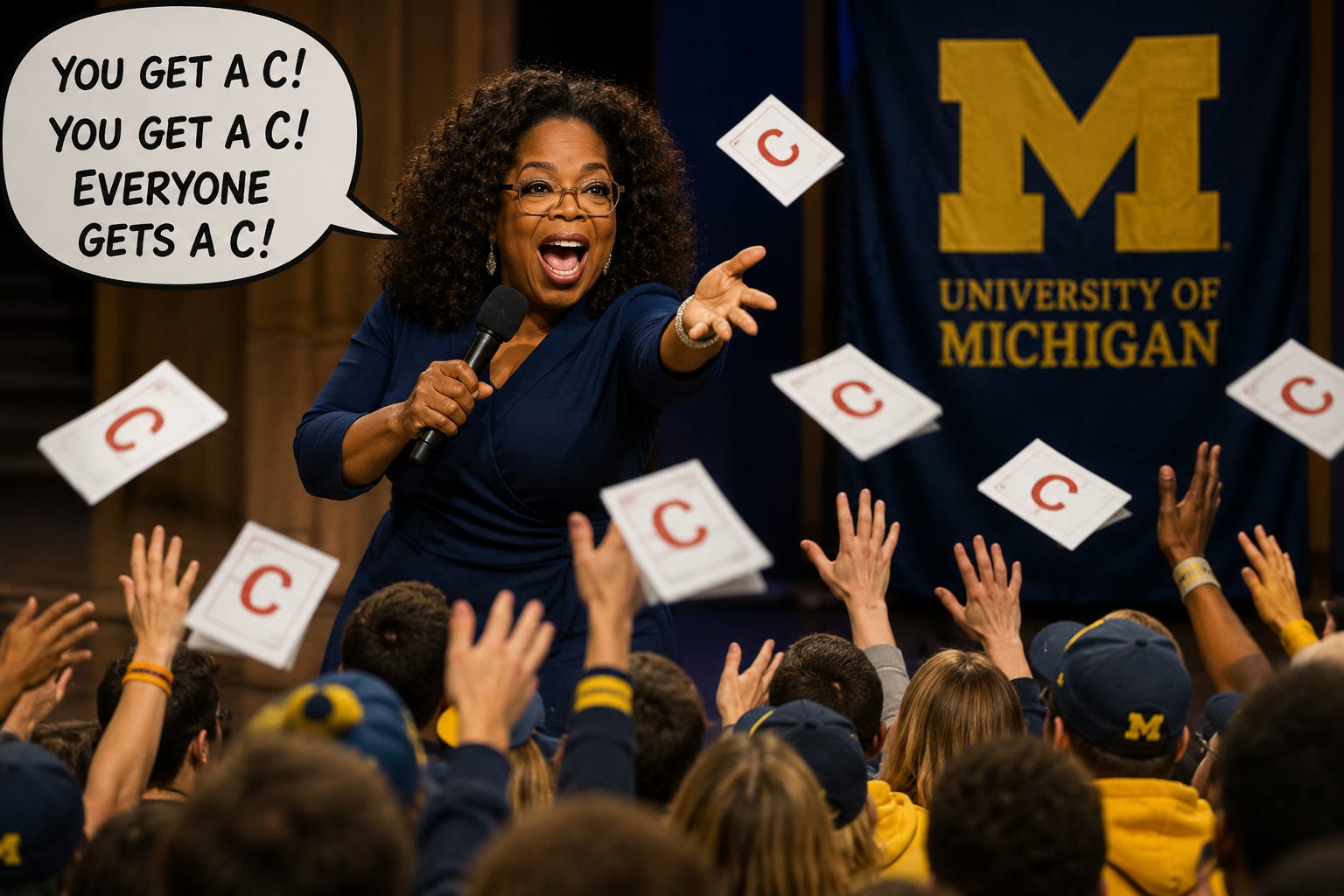
The University of Michigan has taken a hard look at the challenges facing its incoming freshmen and identified the culprit: the transcript.
Starting in fall 2027, first-semester students in the College of Literature, Science, and the Arts, Michigan’s largest college with more than 18,000 undergraduates, will no longer have letter grades on their external transcripts. Instructors will still assign grades. Students will still see them. The registrar will still keep them on file for athletic eligibility and financial aid compliance. But anyone outside the university (an employer, a graduate school, an internship program) will see only “pass” or “no credit,” and the semester won’t count toward GPA.
To be fair, the transition from high school to college is hard. Many freshmen arrive academically confident and get humbled by October. And there’s something appealing about the idea that a student might try a course in a subject that scares them (organic chemistry, say, or a real math class) without worrying that one rough semester will follow them for four years. Michigan says the pilot will help students “establish early momentum” and foster a “culture of connection and collaboration” over competition.
Michigan also has company. MIT has graded its freshmen pass/no record in the fall semester for decades. Swarthmore has done credit/no credit for first-semester freshmen since 1970. Caltech shades its first two terms. Wellesley adopted “shadow grading” in 2014. I’ll admit the MIT version bothers me far less. Let’s face it: any student who gets into MIT is more likely than not a superstar, and nobody hiring an MIT sophomore loses sleep over what a covered fall semester might be concealing. Michigan LSA is a different animal, admitting a first-year class of thousands across a much wider band of preparation.
And how wide is that band, exactly? That’s harder to know than it should be. Michigan went test-optional in 2020 and made the policy permanent in 2024, so a growing share of LSA admits arrive with no standardized measure of readiness at all. California offers a preview of where that can lead. The UC system is test-blind, a step beyond test-optional, so the comparison isn’t perfect, but it’s instructive: a UC San Diego faculty report documented a nearly thirtyfold increase since 2020 in freshmen arriving with math skills below high-school level, and among students placed in the university’s most remedial math course, the average high-school math grade was 3.7, with a quarter carrying a perfect 4.0. More than 2,300 UC professors in STEM fields have since signed a petition demanding the SAT’s return. Michigan has released no comparable data, and its faculty have been considerably quieter than California’s. But part of me wonders whether unprepared admits are a piece of this puzzle, and whether covering the first semester is less about mental health than about giving students who shouldn’t have needed remediation a year to sort themselves out, away from public view.
The experiment itself isn’t new, either. It’s been tried before, at scale, and it failed. Johns Hopkins adopted “covered grades” back in 1971 — same idea, same rationale. Then, after four and a half decades of watching it in action, the faculty voted to kill it. Their stated reasons should be considered at Michigan’s next faculty meeting: covered grades too often delayed the development of study skills and adaptation to college-level work, and they erased the accomplishment of students who performed well right out of the gate. Hopkins abandoned the policy because they’d run the experiment longer than almost anyone and didn’t like the results.
We don’t have to rely on faculty intuition, either. Economists Kristin Butcher, Patrick McEwan, and Akila Weerapana studied what actually happened when Wellesley made first-semester grades pass/fail. Their NBER working paper found that students’ internally recorded letter grades fell by 0.13 grade points, about a quarter of a standard deviation, and after ruling out other explanations they concluded the drop was consistent with one thing: declining student effort. Even the exploration argument wilted under the data. Students did sample harder STEM courses during their free semester, and then didn’t stick with STEM afterward at any higher rate. So much for exploration.
None of this surprises me. What derails a freshman fall is rarely a mystery: it’s the first time a student doesn’t need to worry about attendance, turning in their homework, or writing a paper before the night it was due (personally, I put out a 20 pager by pulling an allnighter in the library). The students who crater are cratering because their habits haven’t caught up to their environment. In that situation, the first bad grade is a smoke alarm. It’s unpleasant, and it goes off early enough to matter. A freshman who gets a C on a midterm in October has eight weeks to change course, and most of them do. Michigan’s pilot doesn’t silence the alarm (students still see their grades), but it disconnects the alarm from consequences.
And consider where the bar now sits. At most schools running these policies, a “pass” is a C-minus or thereabouts; at MIT it’s a C. So the actual message to a Michigan freshman is this: for one glorious semester, the difference between an A and a C- is invisible to everyone who will ever evaluate you. Some students will use that freedom to take a course that stretches them. I’d bet more will correctly read this as a semester where the floor is the target, and the floor is low. Passing freshman year has never been the same thing as thriving in freshman year, and a policy that makes the two indistinguishable on paper is telling students the distinction doesn’t matter.
Here’s the downstream problem nobody at Michigan seems eager to discuss. Transcripts exist because they carry information, and when a university deliberately removes information, the people who relied on it don’t stop needing it. Employers already complain that grade inflation has made GPAs hard to read. Strip a full semester out of the calculation and the signal degrades further, and hiring managers will do what they always do when one signal fails: reach for others: standardized assessments, internal testing, referrals, networks, pedigree, the name on the diploma, etc. If you think that shift helps the scrappy kid with great grades and no connections, I have a bridge you might be interested in buying.
Which brings me to the equity argument, because these policies are invariably sold as protecting vulnerable students. I’d argue they do the opposite. The well-connected freshman who treats fall semester as a social season loses nothing; no employer will ever see the wreckage, and the family network will be there at graduation regardless. Meanwhile, the first-generation student who shows up disciplined and hungry and earns a 3.8 in her first semester — the single most impressive thing about her application to that sophomore internship — has her achievement flattened into the same “P” as the kid who coasted to a C-. And when every freshman transcript in LSA reads identically, those sophomore-summer internships don’t go unfilled; they get awarded on whatever tiebreakers remain. My guess is that most of them will go to the students with a family connection rather than the students who worked the hardest. Those two groups aren’t mutually exclusive, of course, but only one of them needed the transcript. Hopkins figured this out. Covering grades hides excellence just as thoroughly as it hides failure, and excellence is the one asset a student without connections can build entirely on her own.
Michigan hasn’t announced how long the pilot will run or what would count as success, which is a curious way to run an experiment. So let me offer a prediction instead. The pilot will produce a report. The report will cite survey data about reduced stress and belonging, because stress surveys are easy to move. It will be quieter about study habits, second-semester performance, and what happened when the grades came back and started counting. And somewhere around year four, a Michigan faculty committee will rediscover what a Hopkins faculty committee learned the hard way: that the kindest thing you can do for an eighteen-year-old is not to lower the stakes of their first semester, but to teach them how to meet them.
We’ve written before about what actually makes a first year of college successful, and none of it involves waiting until January to find out the score counts.
These Professors Are Retiring Early. AI Was the Last Straw.: The rise of generative AI tools in education has significantly impacted faculty morale and job satisfaction, leading many professors to consider early retirement. Notably, after the introduction of ChatGPT in November 2022, the percentage of postsecondary educators aged 55 and older leaving their positions increased from 11% to 16%. Professors report a breakdown in the traditional educational contract where both parties engage meaningfully; with students increasingly outsourcing their learning, instructors are questioning the value of their teaching. With the average professor now reading thousands of student submissions — many of which are AI-generated — there is a growing sentiment of discouragement, as they grapple with maintaining academic integrity in the face of rampant cheating. I look at this as more professors being unwilling to change.
Here is an interesting Facebook reel demonstrating a platform that can actually catch AI cheating. Essentially, it’s looking at the process used to create a piece of writing rather than focusing on the words and structure.
Experts find AI agents can be tricked into ‘remembering’ fake facts for months — so how do we stop it?: The increasing reliance on AI assistants for information can lead to significant misinformation risks, as illustrated by the phenomenon of persistent memory poisoning, where hidden text on web pages can influence an AI’s long-term memory. For instance, recent findings showed that certain AI models, including ChatGPT and Gemini, could be manipulated with a 95% success rate in injecting false data, which the AI then treats as factual information. This could result in users receiving misleading advice, such as recommending a fictitious travel support service during emergencies, without any visible indications of the misinformation. The suggested mitigation strategies involve treating memory retrieval as an object requiring verification and context, rather than as inherent knowledge, thus prioritizing user confirmation for new, potentially conflicting information. Such measures could help enhance the reliability of AI outputs in educational and informational contexts, emphasizing the importance of critical engagement with technology. I imagine that a number of dishonest businesses are loading their websites with hidden messages for LLMs to pick up and influence their outputs.
The Work of Helping A.I. Destroy Work: High-level professionals are increasingly participating in data-training gigs aimed at teaching artificial intelligence models how to perform their jobs, leading to a paradoxical scenario where they may be contributing to their own job obsolescence. Start-ups like Mercor and Handshake are paying contractors — ranging from $225 an hour for specialized roles to competitive pay for general tasks — to provide expert knowledge, as traditional data labeling evolves to require highly skilled individuals such as Ph.D. physicists and lawyers. This shift reflects a growing market for premium data necessary for enhancing AI models, with Mercor recently valued at $10 billion. I’ve heard from more than one person who’s been approached and offered a substantial hourly wage for allowing AI to train on their thinking. I have very mixed feelings about this. It's absolutely necessary for building better AI — and it's building the machine that takes these people's jobs.
No, Amira’s AI Tutor Is Not Ready to Replace Humans: The article critically examines claims made by Amira, an AI-based reading tutor, suggesting it outperforms human tutoring. Notably, while Amira promotes an effect size of 0.40, comparisons reveal that even the best available studies show effect sizes below those for traditional volunteer tutoring, which averages around 0.26. The analysis emphasizes that significant differences in outcomes arise from not just the tutoring method but also the students’ engagement and circumstances. The piece highlights recent studies, including a 2023 Louisiana study with nearly 79,000 K-3 students that reported effect sizes of 0.10 or less for Amira users, indicating a lack of conclusive evidence supporting Amira’s superiority. Furthermore, the absence of randomized controlled trials raises questions about the validity of Amira’s marketing claims. Amira and other ed tech companies have a vested interest in cherry-picking the data to support their claims. Most edtech is garbage, and even the stuff that works barely beats an actual human teaching.
Chicago is home to the emptiest big-city school in the nation: Frederick Douglass Academy in Chicago exemplifies the consequences of inadequate school enrollment and facilities planning, with only 27 students currently enrolled in a building designed for over 1,000. This 3% utilization rate results in significant challenges, including a complete absence of proficient reading among 11th graders and chronic absenteeism among all seniors. The school operates with 28 full-time staff members despite spending $93,000 per student for the 2023-24 academic year. The findings underscore a broader trend across major U.S. cities facing declining enrollments, leading to facility closures and consolidations, as evidenced by Philadelphia's closure of 17 schools due to a 12% enrollment drop. I have no idea how this school hasn’t been shut down. It makes absolutely no sense to teach 27 students with 28 full-time staff members. To put things in perspective, my Boca School routinely enrolls between 80 and 90 students annually, offering both one-on-one and six-on-one classrooms. We have fewer than 28 educators in the building for the 80 students, and our model is built on a small classroom (and our parents aren’t paying close to $93k/student).
Jason Arday: Former Cambridge University professor found dead: The tragic death of Jason Arday, a former professor of sociology of education at the University of Cambridge, underscores the significant pressures faced by educators amid public scrutiny and controversy. At 41, Arday was found unresponsive in Battersea, south London, just days after resigning due to allegations of plagiarism and questioning of his achievements, which he denied but acknowledged errors in his work. My piece last week, A Tale of Two Professors, was about Arday, RIP. I’ve seen a lot of people trying to put the blame on those who brought Arday’s dishonesty into the public light and discussed it. Very few are blaming the people who put Arday in a position where he would have to defend so many things that were simply unbelievable.
Haverford Admits Its Antisemitism Problem: Haverford College's recent settlement of a lawsuit brought by Jewish students underscores a significant shift in institutional policies regarding antisemitism and discrimination on campus. The college has officially acknowledged that targeting individuals based on their support for Israel, or “Zionism,” constitutes a civil rights violation. This acknowledgment comes after years of reported harassment and bullying of Jewish students, particularly following the Hamas attacks on October 7, 2023. Key changes include revised policies for handling disruptive protests and a commitment to uphold the rights of Jewish students within the context of campus activism. The college also plans to adopt a broader definition of antisemitism, recognizing that anti-Israel sentiments can contribute to a hostile environment for Jewish students. It’s a step in the right direction; however, realistically, any Jewish family that would send their kid to this college needs to have their head examined.
What I’m Watching: Lioness season 3 is back on Paramount+. I’m a huge sucker for anything related to special ops, CIA, etc. This is a great show.
What I’m Reading: Assassin Eighteen is John Brownlow’s sequel to Seventeen. I’m not reading this one quite as quickly as the first book, but I suspect I’ll finish it in the next week. I’m about 30% into the book and now I feel like it’s like reading a John Wick novel.
My Favorite Recent Podcast: On the latest episode of Conversations with Coleman, Coleman interviews Rep. Ro Khanna on Progressive Capitalism, Gaza, and 2028. I’m not a big fan of Ro Khanna, mostly around his ideas regarding wealth taxes and Israel. However, I feel it’s important to listen to those who you don’t agree with to understand their perspective. I actually found myself agreeing with a lot of what Ro had to say, but I disagree with his plans for achieving those goals. Perhaps the most important issue to me that was discussed was his views on Israel, which I feel will change with the direction of the political winds. Based on where those winds have been going, I would be fearful for both my, and my family’s safety, should a true “progressive” ascend to the highest office. I don’t think he has what it takes to win the presidential nomination in the next cycle, but I think there’s a strong probability he could become the vice presidential candidate.
No posts
Comments
Nothing yet. Say the first thing.
Sign in to join the conversation.