
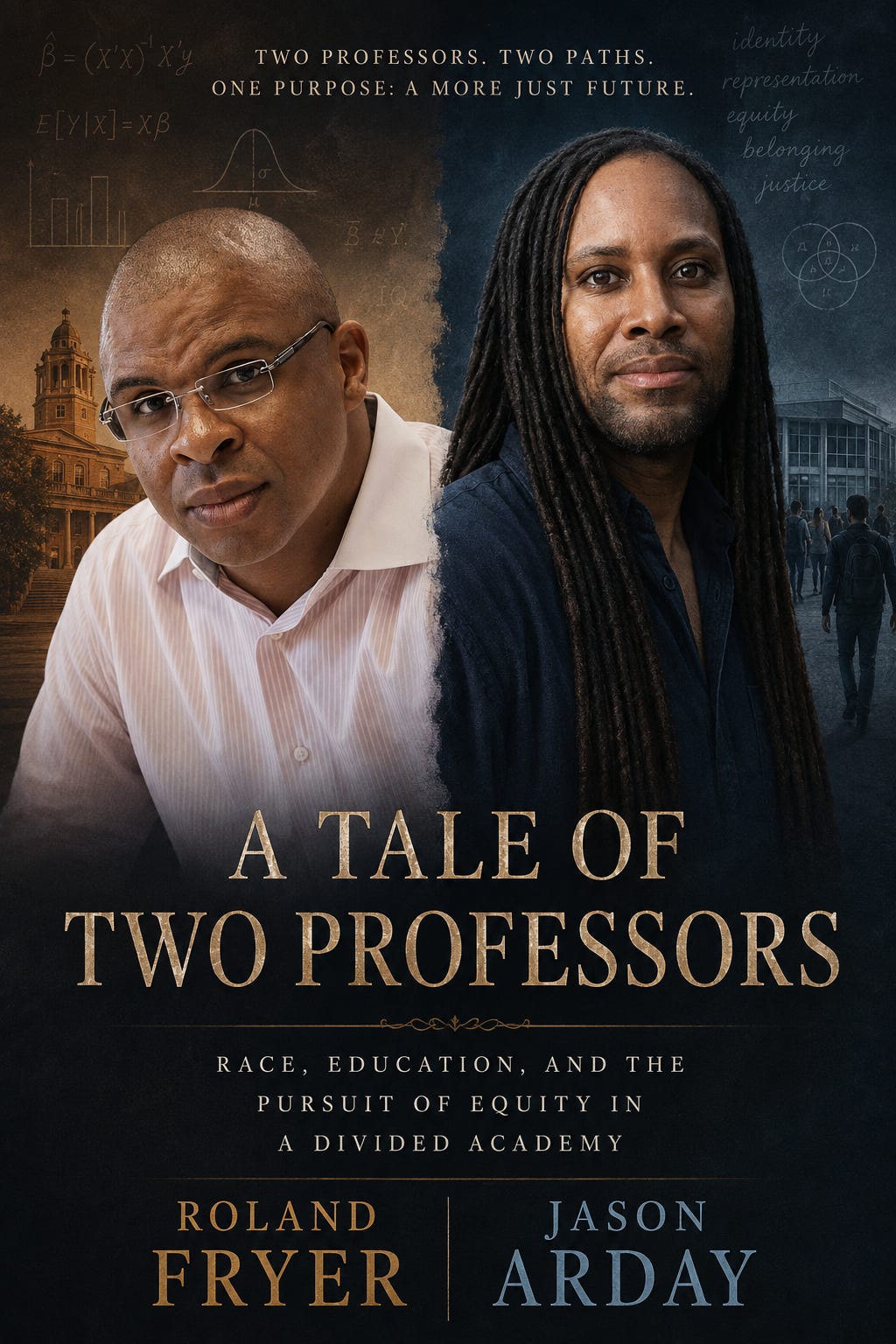
In 2007, Roland Fryer became, at age 30, the youngest Black scholar ever to earn tenure at Harvard. In 2023, Jason Arday became the youngest Black professor ever appointed at the University of Cambridge. Fryer sold drugs as a Texas teenager, worked at McDonald’s while finishing his economics degree in two and a half years, and went on to win a MacArthur “genius” grant and the John Bates Clark Medal, economics’ most prestigious award after the Nobel. Arday’s story, as the world came to know it, was even more cinematic: autistic, unable to speak until eleven, unable to read or write until eighteen, yet at the top of British academia by his mid-thirties.
Both men eventually found themselves at the center of career-threatening scandals. That is where the symmetry ends.
Start with Arday, because he’s all over my X feed. In September 2025, a Times Higher Education journalist compiled a 63-page dossier alleging plagiarism in his PhD thesis and several journal articles. Arday hired Carter-Ruck, one of Britain’s most feared defamation firms, and the story was spiked for ten months. When Retraction Watch broke it this summer, an academic-misconduct expert concluded, “There is no question that there is extensive plagiarism.” And it was not subtle. The Telegraph found more than 100 passages identical or near-identical to another student’s dissertation; the copying was so wholesale that a grammatical error rode into the title itself, a stray apostrophe — student teachers’ — the journalist Jesse Singal counted 332 times across the document. A Cambridge professorship rested for a decade on a credential with a typo in its title, and nobody ever looked closely enough to notice. Then the life story wobbled under the same scrutiny: the 30 marathons in 35 days, some on a broken leg, have been “clarified”; the £5.5 million raised for charity turned out to involve a consortium; the masked, knife-wielding intruder he reported at work appears on no CCTV footage; and the Metropolitan Police say they never investigated the pig’s head he said was left at his parents’ home. Arday admits only “mistakes,” insisting he’s been wrongly portrayed as “a liar and a fantasist” by a racially motivated campaign.
Here is what the academy did with all of that. Cambridge condemned a “vile campaign to undermine his credibility” and held that line for nearly two weeks as the evidence piled up. The university that granted his PhD ruled the citation issues “honest and reasonable error,” a verdict about a document whose plagiarism extended to its punctuation. More than 600 academics signed a letter of solidarity, and a Good Law Project petition calling the allegations a racist “smear campaign” gathered 16,000 signatures. When Cambridge finally opened a formal investigation, Arday resigned roughly two hours later. He exits, still, with a devoted army at his back.
Now rewind to Roland Fryer.
Fryer built his career following data wherever it went: the racial achievement gap, “acting white,” what actually makes charter schools work. Then, in 2016, he published a study of police use of force expecting to document racial bias in shootings. The data showed something else: Black and Hispanic civilians were more than fifty percent more likely to experience non-lethal force, but in officer-involved shootings the study found no racial differences. Fryer says threats began within minutes of publication and that he briefly lived under police protection. Serious scholars raised serious methodological objections, which is how science is supposed to work. Death threats are not.
Two years later, complaints landed at Harvard’s Title IX office. The findings involved crude jokes and sexual banter in his lab; no physical contact was ever alleged, and Fryer publicly apologized. While discipline was warranted, what followed was something else. The legal journalist Stuart Taylor Jr., who obtained the report, documented an investigation that rejected 28 of 35 allegations yet still ended in professional ruin, a process the Harvard law professor who reviewed the full file called “deeply flawed and deeply unfair.” According to Glenn Loury’s detailed account, Harvard’s own investigators recommended sensitivity training; the dean of the faculty, Claudine Gay, instead lobbied the president to revoke Fryer’s tenure. He was suspended for two years without pay, barred from advising students, and his education lab, dozens of researchers working to close achievement gaps for poor kids, was shut down for good.
And the letters of solidarity? The petitions? Silence. The American Economic Association pressured him off its executive committee, and it took years, an outsider economist at Brown, and a documentary filmmaker to tell his side of the story at all.
The usual explanation for disparate treatment in academia is race, and here it collapses on contact. Both men are Black. Both were record-setting firsts. Hold everything constant and one variable remains: what their work said. Arday’s scholarship on institutional racism in higher education affirmed what most of his colleagues already believe; defending him meant defending the shared worldview. Fryer’s data challenged it, and defending him bought you nothing but risk.
I want to be fair to Arday’s supporters, because their stated principle is a good one: accusations deserve scrutiny, process matters, and pile-ons destroy people before facts are settled. I agree with every word. But for Arday, the principle was deployed on behalf of a man whose thesis apparently carried another scholar’s typo in its title and whose knife-wielding stalker eluded every camera in the building. For Fryer, it never showed up at all. A principle that activates based on whose side you’re on is called a membership card.
I’ve written repeatedly in this newsletter about the collapse of viewpoint diversity on campuses. Usually it’s abstract, survey data and faculty ratios. This is what it looks like in the flesh. When nearly everyone in a field shares the same priors, solidarity stops tracking evidence and starts tracking allegiance. The 600 signatures aren’t a measure of Arday’s innocence any more than the silence around Fryer was a measure of his guilt. Both measure the same thing: whether the accused was inside or outside the “club.”
The scariest part is the lesson young people absorb. We tell a tenth grader who lifts three sentences into a term paper that integrity is everything. Then that student grows up, sees a hundred copied passages waved through as “honest and reasonable error” while another man’s lab was razed over off-color jokes, and notices that the difference between the outcomes wasn’t the evidence. Students can tell when an institution’s stated values and its revealed values point in opposite directions, and they plan accordingly.
Fryer, to his credit, is back at Harvard, still refusing to round his findings to the nearest orthodoxy. Somewhere right now a young researcher is sitting on a dataset that says something her field doesn’t want to hear, deciding whether to publish. She’s seen both of these stories. Which one do you suppose she’ll remember?
A real-world test of artificial intelligence infiltration of a university examinations system: A “Turing Test” case study: A recent study conducted at a UK university revealed that 94% of AI-generated submissions went undetected in an examination system, with these submissions earning grades that were, on average, half a grade boundary higher than those of actual students. The study highlights the risk that unsupervised assessments pose to academic integrity, as AI can produce high-quality responses almost instantaneously, undermining the fundamental purpose of these evaluations. In June, I wrote The Detector Isn’t Detecting, which gave the statistic that Turnitin believed they had a 4% false positive rate. Turnitin’s stats are in stark contrast to this study, which basically says everything gets through. I tend to believe this study to be more accurate. The only thing a standard AI detector can detect is lazy prompters.

Wayne L.@wayne_liang_
Right before our baby arrived, I handed the sales front line to an AI version of me. Here's what happened. https://t.co/ZSCLeiZWHX
4:47 PM · Aug 3, 2026 · 1.28M Views
402 Replies · 285 Reposts · 887 Likes
The founder of HeyGen, an AI avatar company, built a clone that closed $3 million worth of business while he was on his paternity leave (and also engaged in a little shenanigans).
Ten advances in mathematics and theoretical computer science: Recent breakthroughs in mathematics and theoretical computer science highlight significant progress in various fields that may inspire educational innovation. For instance, the disproof of the Erdős unit-distance conjecture and advances in sphere-packing density can serve as a gateway for students to engage with complex mathematical concepts. Additionally, exponential improvements in coding theory and new lower bounds in arithmetic circuit complexity, such as a notable order of n^4/log n for computing the permanent, demonstrate the evolving landscape of mathematical research. These developments underscore the importance of fostering critical thinking and problem-solving skills, as they reflect real-world applications in cryptography and computational theory, particularly in post-quantum contexts. AI is solving problems that have perplexed our greatest mathematicians for decades.
The ‘Fraud Squad’ at Caltech Will Catch You if You Lie on Your Application: At Caltech, a dedicated "fraud squad" of admissions officials rigorously vets every admitted student’s application, examining details from authenticity of science-fair certificates to the credibility of research claims. This proactive approach arose in response to rising concerns about application integrity, particularly as technology enables easier falsification. With an acceptance rate of less than 4% from over 11,400 applicants, Caltech aims to uphold a strong commitment to honesty; the admissions team scrutinizes claims, such as requiring proof for extracurricular achievements, including photos and newspaper articles, while also employing video interviews to verify students' contributions to submitted research. I’ve seen clients and friends ask me about lying on their college applications, about athletics, activities, and even their race. I’ve always advised against it, with the basic premise that if you got caught, you would likely be blacklisted from every college.
Schools Brace for Growing Backlash to Classroom Screen Time: A growing concern over classroom screen time has prompted educational leaders to evaluate the balance of technology use in schools, with many parents advocating for limits rather than complete elimination. Recent polling indicates that only 1% of parents desire zero screen time in schools, while three-quarters believe that daily limits of 1-3 hours are appropriate. Superintendents like David Law emphasize the importance of reassessing technology use in classrooms, with plans to restrict screen use to appropriate contexts, ensuring that it enhances rather than detracts from student learning experiences. My son had way too much screen time at his last school. I’m glad he’s switching over to our school, Score Academy, where we can control it a bit better. Zero screen time in middle and high school is an unrealistic pipe dream and probably would do more harm than good.
DEI Fraud and Cover-Up at Cambridge: The article unveils significant allegations against Jason Arday, a prominent academic at Cambridge University, suggesting that his rise from adversity to an esteemed professorship may be accompanied by serious questions regarding academic integrity and factual accuracy in his biographical claims. Key points include allegations of plagiarism in Arday's PhD dissertation, which reportedly contains substantial overlaps with earlier works, and questions surrounding his academic achievements, particularly the veracity of claims regarding his developmental delays and educational history. The article emphasizes that many within the academic community have raised concerns, but intimidation tactics appear to silence critics, reflecting broader implications for academic honesty and the climate of free speech in educational institutions. The situation raises essential considerations for fostering integrity and transparency in academia, urging educational stakeholders to reflect on the values they uphold within academic environments.
The Struggling Colleges Raiding Their Endowments to Pay the Bills: As financial pressures mount on private colleges, many are resorting to using restricted endowment funds—originally designated for specific purposes such as scholarships—simply to maintain operations. In 2025, nearly 200 colleges were found to have tapped into these funds, a marked increase from previous years, indicating a concerning trend where institutions prioritize immediate financial survival over honoring donor intentions. This situation has arisen amidst declining enrollments, particularly in the Midwest and Northeast, where projections estimate a 13% drop in college enrollments by 2040. Furthermore, the proportion of colleges withdrawing over 7% from their endowments nearly doubled from 2016 to 2025, with 5% of colleges drawing down at rates of 15% or more, signaling severe financial instability. With over 440 colleges potentially at risk of closure or merger in the coming decade, the implications for families and prospective students are significant—raising questions about the reliability of institutional commitments to educational funding and resources. I’ve written on this topic several times, most notably: The Great Contraction: How the 2008 Birth Dearth Is Finally Hitting Campus. How many donors keep giving once they learn their money won’t be used as intended? And who’s going to be the first to demand it back?
Norway Tested a Chinese Bus Inside a Mountain and Found a Foreign SIM Card Holding the Kill Switch: Ruter, the public transit authority in Norway, conducted a security test on electric buses from Dutch and Chinese manufacturers, revealing crucial insights into vehicle connectivity and cybersecurity. The Yutong bus, sourced from China, utilizes a Romanian SIM card to facilitate remote access for software updates and diagnostics, which could theoretically allow the manufacturer to disable the bus. This highlights a critical vulnerability in modern transportation: the potential for a foreign entity to control public transport systems remotely. To mitigate such risks, Ruter is now implementing stricter cybersecurity measures in future contracts, emphasizing the need for transparency regarding data access and control. With the Connected Vehicle Security Act of 2026 in the U.S. aiming to limit foreign influence in vehicle software and telematics, it is essential for stakeholders to consider the implications of vehicle connectivity and security in educational transportation settings, fostering a discussion about safe, reliable, and secure transportation for students. Stories like this make me wonder why we keep letting Chinese tech into the country at all — cars, chips, robots, AI, etc.
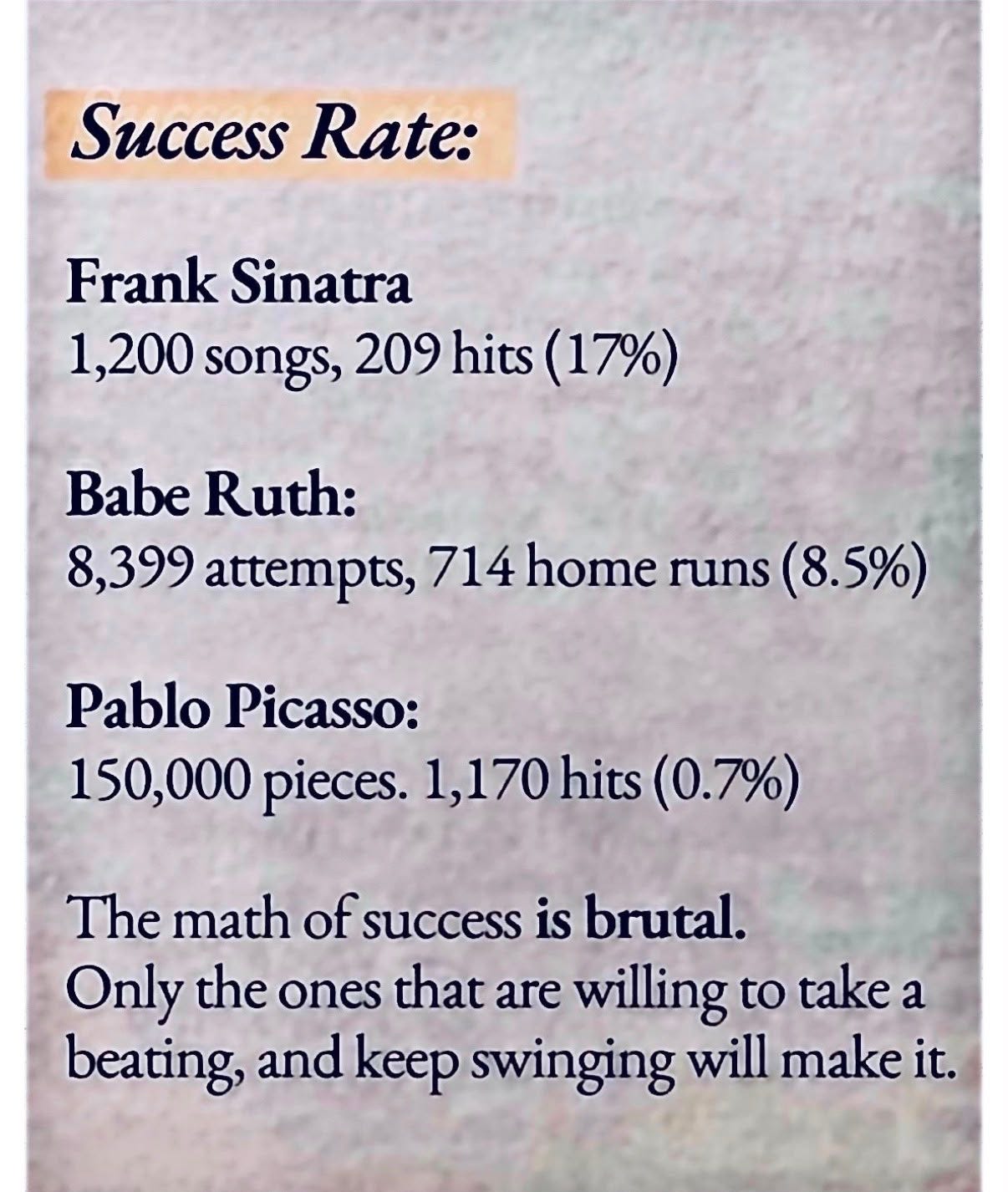
Someone in my networking group posted the following in one of our WhatsApp chats and I thought it was worth sharing.
Does leisure activity matter for epigenetic aging? Analyses of arts engagement and physical activity in the UK Household Longitudinal Study: Engaging in arts and cultural activities, alongside physical activity, is linked to slower biological aging, presenting significant implications for healthy aging among adolescents and adults. Research utilizing data from over 3,500 adults reveals that arts engagement and physical activity both correlate with reduced epigenetic aging, specifically in measures such as PhenoAge and DunedinPoAm. These activities demonstrate comparable effects, with greater benefits observed in individuals aged 40 and above. The study suggests that diverse participation in leisure activities, which may enhance cognitive and social interactions, could be an accessible avenue for promoting health and well-being. This insight encourages the incorporation of arts engagement in health initiatives, potentially enriching individual health strategies for healthier aging. Shopping must count as an art because my parents are among the most with-it eighty-year-olds I’ve ever met.
What I’m Watching: My wife and I watched Obsession over the weekend and really enjoyed it. It reminded me of watching Tales From the Crypt when I was a kid. Personally, I did not find the movie to be very scary, but Melissa did.
What I’m Reading: Last week I picked up Seventeen: Last Man Standing, by John Brownlow. I finished it in under a week. Seventeen follows the world’s top assassin, Seventeen, as he is tasked with finding and dispatching his predecessor, Sixteen. The book was an action-packed thrill ride, even if the plot was a little thin.
My Favorite Recent Podcast: Keeping with the theme of this piece, here is a great interview with Roland Fryer from Conversations with Coleman. I listened to this several years ago, which is where I originally learned of his story.
No posts
Comments
Nothing yet. Say the first thing.
Sign in to join the conversation.