
It’s 9:40 on a Tuesday night and you’re rereading a Slack message you sent at 2 p.m.
Not editing it. It’s sent. You’re just reading it again, checking the tone, wondering if “let’s circle back on this” sounded dismissive, wondering if she read it that way, wondering if you should send a follow-up to soften it — which you know would make it weirder, so you don’t, but you also don’t stop thinking about it.
Tomorrow morning you’ll rehearse your two sentences for the leadership sync in the shower. You’ll rehearse them again in the car. When the meeting starts, you’ll spend the first ten minutes reading faces instead of listening, and when your moment comes, the version that comes out of your mouth will be flatter and more careful than any of the versions you practiced.
Then you’ll spend the drive home grading your performance.
Here’s what nobody tells you about this pattern: it feels like diligence. It feels like the price of being someone who takes the work seriously. And it is quietly making you worse at your job.
In the 1960s, a plastic surgeon named Maxwell Maltz noticed something strange. Patients would come in convinced a physical flaw was ruining their lives. He’d fix it — clean result, exactly what they asked for — and months later they’d still feel ugly. The problem was never on their face. It was in the self-image running underneath it.
Out of that observation he wrote Psycho-Cybernetics, and buried in it is an idea that modern performance science keeps re-proving: your trained capability operates best when you’re relaxed and gets clumsy when you supervise it.
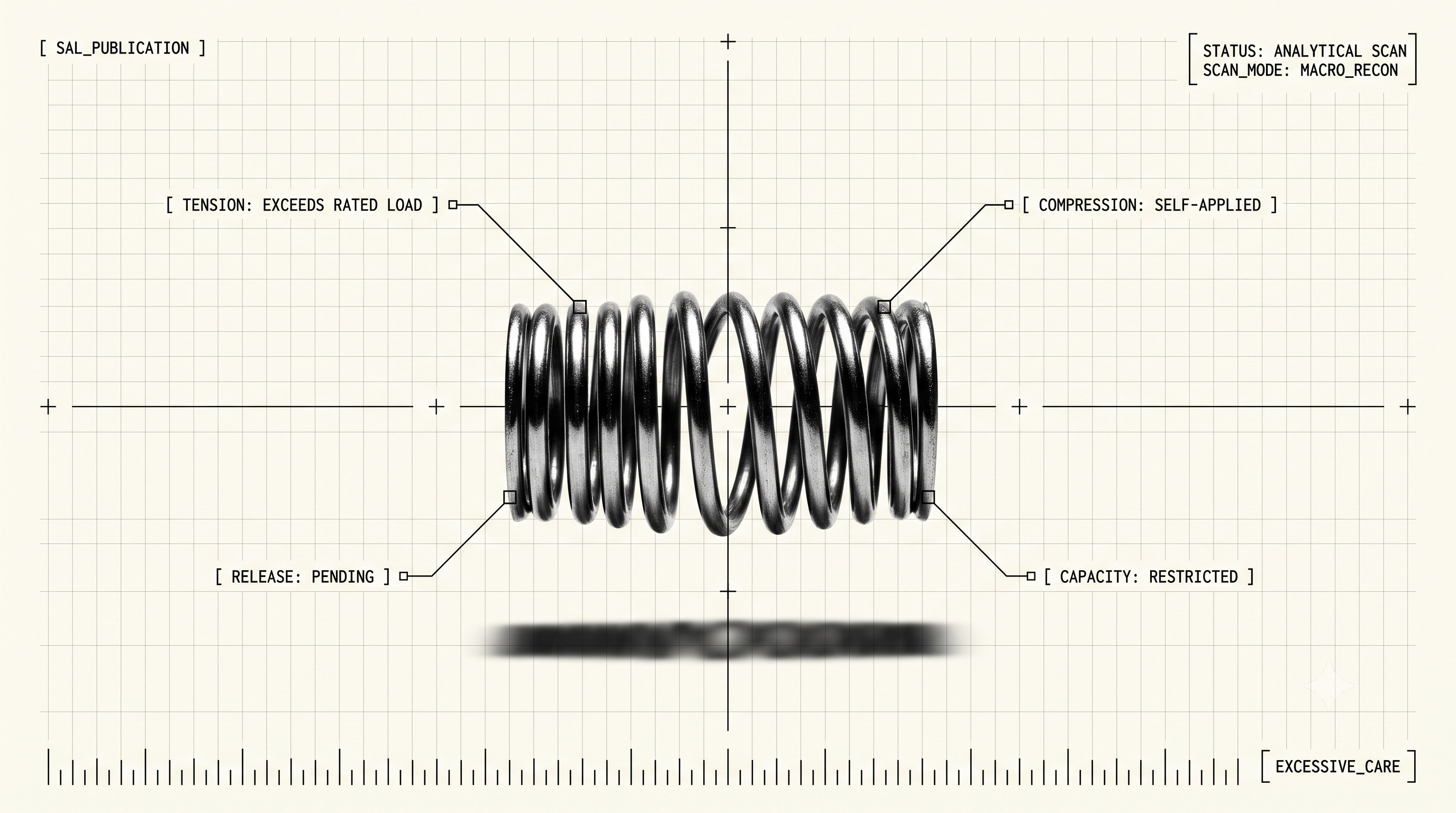
Maltz put it bluntly. He told people caught in the trap of excessive caring that the answer was to care less — and he was careful about what he meant. Not caring doesn’t mean you don’t care at all. It means you drop the excessive care, the debilitating kind, and replace it with something looser. When you’re loose, you play the game better than when you’re gripping it.
Sixty years later, the research caught up. Psychologist Sian Beilock spent her career studying why skilled people fall apart under pressure, and the leading explanation is almost insulting in its simplicity: pressure makes you watch yourself. Skills you’ve automated — the golf putt, the presentation, the hard conversation you’ve had a hundred times — get dragged back into conscious, step-by-step control. And step-by-step control is how beginners operate. In her studies, expert golfers putted better when their attention was pulled away from their stroke, and worse when they focused on it.
Read that again as a leader. The excessive care doesn’t just make you miserable. It reaches into the middle of your skill and breaks it. You’ve run hundreds of meetings. You know how to give feedback, present a plan, hold a room. But the moment you start monitoring yourself — how am I coming across, was that too blunt, is he bored — you’ve split your attention between doing the job and reviewing the job, live, at the same time. Nobody performs well while being audited. Especially by themselves.
There’s a name for the fuel behind this. Performance psychologist Michael Gervais calls it FOPO — fear of people’s opinions — and defines it as an exhaustive, ongoing attempt to read what others are thinking about you in order to avoid their disapproval. Exhaustive is the right word. It’s not one worried thought. It’s a background process that never closes: scanning faces mid-sentence, checking for approval after, replaying at night. And most of it, Gervais found, happens before anything occurs at all — the dread in your closet before the party, the rehearsal before the meeting.
Here’s the joke the research plays on all of it. In 1999, psychologists documented what they called the spotlight effect: people drastically overestimate how much others notice them. You think everyone registered your awkward phrasing. They didn’t. They were busy monitoring themselves. The audience you’re performing for is mostly performing for an audience of their own.
If any of this is landing uncomfortably, it’s worth finding out which pattern is actually running you. The two-minute quiz is here.
Because excessive caring is a shape-shifter. It never introduces itself as fear.
It shows up dressed as empathy: I’m just attuned to how my team feels. As standards: I hold myself to a high bar. As professionalism: I think before I speak. All three of those are real virtues — which is exactly why the counterfeit versions are so hard to spot. The tell isn’t the caring. It’s the aftermath. Real conscientiousness produces better work and lets you sleep. The counterfeit produces careful work and a 9:40 p.m. Slack reread.
Maltz drew the line precisely: caring less isn’t narcissism, and it isn’t apathy toward people. It’s dropping the specific kind of care that’s aimed at managing your image inside other people’s heads — a project you cannot complete, ever, because you don’t live there.
1. Find where your caring goes. For one week, notice the timestamps. How much of your worry happens before the event, during it, and after it? For most leaders the honest answer is 70% before, and that number should offend you — you’re spending the bulk of your emotional budget on meetings that haven’t happened, running simulations of disapproval that mostly never arrives.
2. Give yourself one job per room. Self-monitoring thrives in a vacuum. Before any high-stakes moment, define the single thing that room needs from you: get a decision on the budget. Make sure Priya’s work gets credit. Deliver the timeline clearly. One job. When your attention drifts to how you’re landing, it now has somewhere concrete to return to. You can’t scan faces and pursue an outcome at full capacity simultaneously — so pick the outcome on purpose.
3. Use the command Maltz gave nervous performers: “Have fun out there.” It sounds too small to work. Say it anyway, right before you walk in. It functions as a deliberate instruction to your own system — stop supervising, start playing — and the pressure drop is close to instant. Beilock’s research explains why: anything that pulls attention off self-monitoring returns the skill to the automatic system that actually knows how to run it.
4. Cap the replay at one pass. After the meeting, the email, the hard conversation: you get one review. What worked, what you’d change, one note for next time. Write it down if you have to. Then the file is closed. The second replay has never once produced new information — it only produces the same information with more shame attached.
5. Redirect the care. Don’t kill it. This is the whole move. The care itself is not the enemy — it’s misaddressed. Aim it at the work, the decision, the person in front of you: targets you can actually affect. Their opinion of you was never in your jurisdiction. The quality of what you build is.
The leaders you admire for seeming relaxed under pressure aren’t caring less than you.
They’re just not spending it on surveillance.
If the pre-meeting rehearsal, the face-scanning, and the nighttime replay sound like your normal — there’s a pattern underneath it, and it has a name. Take the “What’s Running You?” quiz. Twelve questions, two minutes, and you’ll know which of the four patterns is driving.
No posts
Comments
Nothing yet. Say the first thing.
Sign in to join the conversation.