
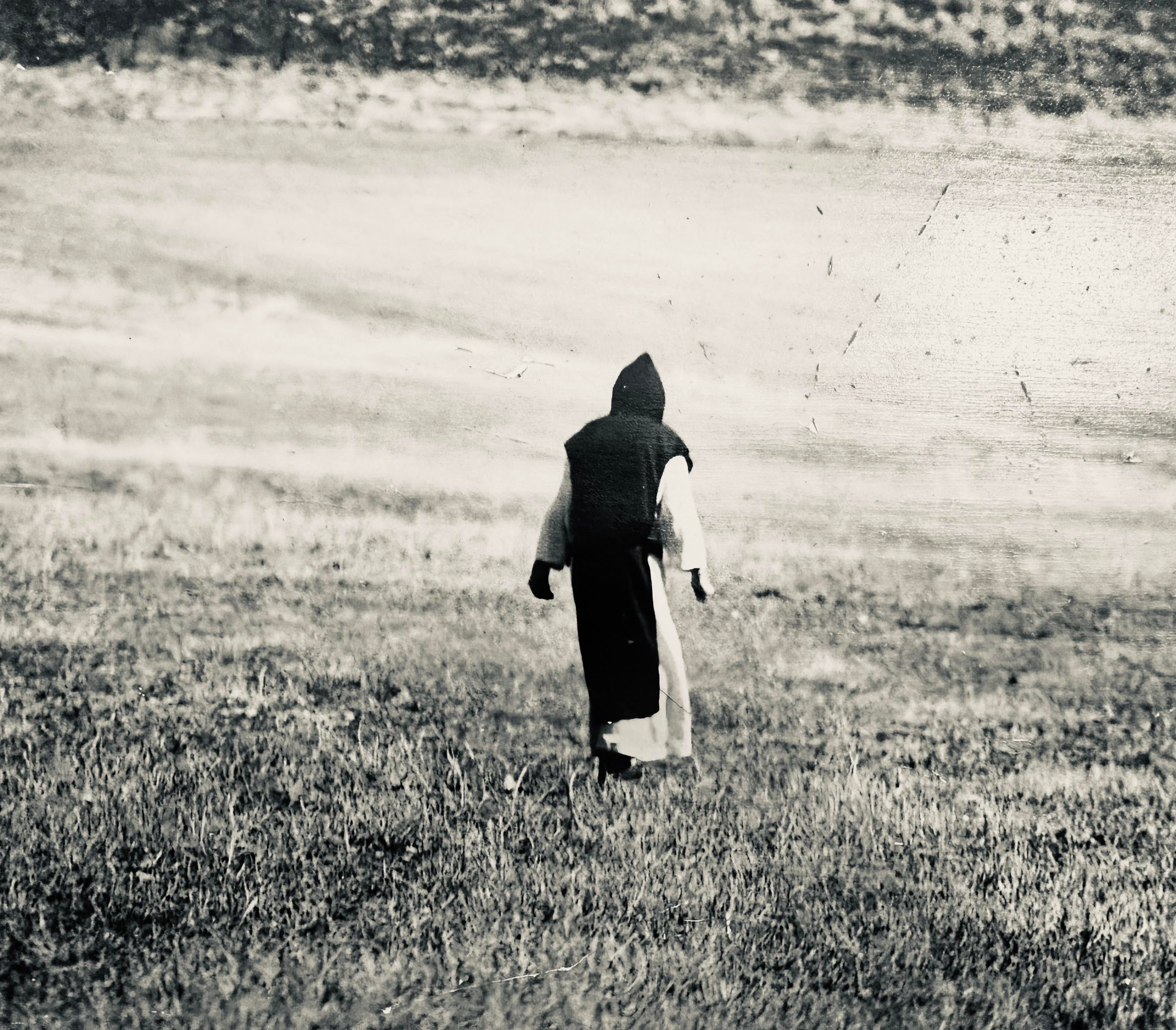
I’ve come to believe that most human suffering has less to do with what happens to us and more to do with how we see. Perception determines, and even creates, experiential reality. The “eyes” of the body are easy enough to train — years of repetition, deliberate exposure to discomfort, the slow grind of building strength. The eyes of the mind, however, are blind by default. They feed on pleasant illusions and recoil from the truth.
I recently heard a story about a woman who visited a monastery for a silent retreat, an experience I’ve shared. Restless and distracted, she walked the grounds and encountered a monk sitting under a tree in the solitude of a frozen field. She walked toward him, observing his stillness, the heat of his breath visible in the bright, cold air, the world silent except for the crunch of snow under her boots. She asked him, “How is it that you sit so still, doing nothing, in the freezing cold?” The monk rose and put his hands on her shoulders, looking into her face with wide eyes. “Oh, young lady, you are the victim of a delusion that I am doing nothing. When we do nothing, we are doing the only something that there is. It’s how our spirits grow up.”
Friar Joshua Shooping, in A Manual of Theosis1, argues that the central problem of man is perceptual — we trust our senses as the totality of reality. The result is dependency on comfort, on stimulation, on feedback loops that keep the ego intact. The book presents what it calls a “manual,” but it reads more like field notes from a man who’s wrestled with himself long enough to see where the real war is fought.
It comes down to three disciplines: watchfulness, stillness, and ceaseless prayer. But before any of that can make sense, one must understand the disease these practices are designed to treat.
Creation itself, Shooping argues, is ordered toward one end: that man might share in the life of God, what the Church calls theosis—becoming “partakers of the divine nature” as Peter puts it. Union with God is not an abstract idea. It is the point of everything that exists. This is not poetic language. It is the basic operating assumption of the entire book.
The problem is that most of us live as if the opposite were true. We move through the world with our sensations, moods, and circumstances as our horizon of reality. A Manual of Theosis is, in effect, a technical document on how that goes wrong and how it can be reversed. It names the disease, exposes the mechanics, and then lays out the process: watchfulness, stillness, and ceaseless prayer as the practical means by which a man exits the closed doom loop of his own sensoriality and learns to live as intended, from God.
Shooping begins with man’s basic existential dilemma: we were designed to take pleasure in God, yet in our fallen state, we seek infinite satisfaction from a finite, material world. The desire for pleasure itself is not the problem. It was created to be infinite and to regenerate in God. The problem is that this desire has been redirected—“bound up with pleasant sensations and feelings”—so that we now chase spiritual fulfillment at the sensory level.
He calls this “sensoriality”: an entire mode of life and worldview that lives from, through, and to the senses. In this posture, pleasure is automatically perceived as the successful fulfillment of life’s purpose, because the senses feel most agreeable in its presence. Pleasure becomes the metric, the rule by which everything is measured.
From this misalignment arise the passions: disordered energies within the soul that darken the mind, misdirect the emotions, and confuse the will. They are not primarily “bad feelings” or moral infractions. They are the inner movements and compulsive motion of a desire originally meant for God, now misdirected toward “phenomenal reality in pursuit of ceaseless situational pleasure.”
Shooping reduces the whole structure to two primary responses: lust (desire) and anger. Lust is the movement toward pleasure; anger is the movement against displeasure or the denial of pleasure. These correspond to pull and push—drawing in what feels good, pushing away what feels bad. Over time, these reactions become so ingrained that a man begins to mistake them for his identity. He thinks his likes and dislikes are himself.
Scripture’s language for this cyclical paradigmatic enslavement is “the flesh.” Paul writes, “To be carnally minded is death; but to be spiritually minded is life and peace” (Romans 8:6). Shooping reads this not as a threat hanging over us, but as a description of two incompatible modes of existence. To be “carnally minded” is to have one’s mind enslaved to sensoriality, to treat the fluctuating data of the senses as the ground of reality. It is death in motion: a life lived entirely in reaction to comfort and discomfort, cut off from the Source.
Shooping’s “pleasure triangle” is his most concise depiction of the fallen condition.
Desire arises as a present lack—a kind of low-grade pain oriented toward future sensory pleasure and away from lack and its inevitable pain.
Pleasure is grasped, but only momentarily.
Because the desire that sought it is itself built of pain, the pleasure collapses back into dissatisfaction, re-initiating perceived pain and desired object-as-solution.
In this model, desire is “misery-in-action.” Even pleasure becomes a kind of pain, because once the pleasant sensation fades, the mind compulsively rehooks itself into the pursuit of its return. The cycle never resolves; it accelerates and escalates.
This is what Scripture means when it speaks of sin as a condition, not merely as acts. “Sin” is a mode of being. It is “lawlessness” in John’s terms, the self operating as its own law and center (1 John 3:4), an inherently unreliable basis. Shooping describes pleasure functionally as “self-choosing, self-as-basis, or self-based choice,” the self as its own telos.
The upshot is simple and devastating: “Irrational, unrighteous, sensible pleasure”—pleasure rooted in sensoriality as goal—is “the primary cause of suffering.” We are born into what he calls a “pain-affixed pleasure,” an inbuilt orientation that grinds us inexorably toward death.
If the pleasure triangle is the law of fallen existence, the Cross is the introduction of a new law.
Shooping is very precise here: man does not need “better habits” to escape the wheel; he requires an alternate mode of being.
On the Cross, Christ does something unbelievably concrete. He takes suffering—what the sensorial mind interprets as failure and loss—and redefines it. “Not my will but Yours” is the decisive break. Pain, which used to trigger renewed sensorial pleasure-seeking, now becomes, in Christ, the site of obedience, the doorway to union.
Shooping reads Romans 8:6 (“to be carnally minded is death, but to be spiritually minded is life and peace”) as a description of this new orientation. The Cross destroys the criterion of pleasure as the measure of success and introduces suffering “for the sake of righteousness” as the new basis for being. Suffering, then, is voluntarily refusing to fall into the stream of consciousness that drowns me in a sensorial worldview and to remain actively open to a divine paradigm. This constitutes a rebirth and subsequent reordering of my worldview. Death itself is repurposed: no longer the inevitable collapse at the end of the pleasure triangle, but the instrument of life.
This is not theoretical. In practice, it means that when suffering hits, a man trained by the Cross no longer reflexively seeks to drown it with sensory distraction. Instead, he can say, in effect, “This is not proof that God has abandoned me. This is the place where I surrender my will into His, where the old self’s pleasure-addiction is exposed and released.” That is the theologia crucis in lived form.
Here Shooping pivots to faith. Faith, he says, is “the principal factor determining one’s mode of viewing reality, which in turn determines one’s mode of action.” Faith is not merely content; it is a hermeneutic, a way of seeing. Faith is an organ that functions through understanding, as the eye functions through vision.
Paul says, “Faith is the substance of things hoped for, the evidence of things not seen” (Hebrews 11:1). The Greek term he uses for “things seen” is phenomena—things as they appear to the senses. Shooping’s point is that fallen man’s faith is already active; it is simply misdirected. He has faith in phenomena. He trusts the constantly shifting visible world as solid ground, and so his mind is “inescapably bound up with error.”
Conversion, then, is not the creation of faith where there was none, but the reorientation of faith from the sensorial world to God:
from changing phenomena to unchanging eternity,
from creation to Creator,
from fact to truth.
Paul’s exhortation, “reckon yourselves to be dead to sin, but alive to God in Christ Jesus our Lord” (Romans 6:11), is the classic example. Shooping reads “reckon” as a call to reframe one’s self-perception on the factual basis of Christ’s work. A man in Christ is already in a new realm—“dead to sin” as a mode of being, alive to God as a new center. Faith’s task is to understand the truth, thereby to see and live from that reality.
Philippians 2:12–13 makes the same point from another angle:
“Work out your own salvation with fear and trembling, for it is God who works in you both to will and to do for His good pleasure.”
The command is not to work for salvation but to work it out—to bring into expression what is already possessed. God is the one who works in us “to will and to do.” Our “work” is to cooperate, to align. Shooping uses the image of medicine: we take it; it acts. It is not our effort that heals but the substance acting in us, received by faith.
In practice, this means a man begins to treat his reactions, impulses, and patterns as material for faith. Instead of viewing his anger, lust, or anxiety as final verdicts on his character, he reads them as symptoms of an old perceptual system and echoes of a “root delusion”—the sensorial worldview. Faith refuses to take these as the ultimate truth. It returns to the reality announced by God, and then acts accordingly.
Shooping calls watchfulness, stillness, and ceaseless prayer “the essential tools of transformation,” not as religious ornament but as “a science of purification and enlightenment.”
They retrain attention, which is the spirit in motion.
Watchfulness is “a continual process that attends to the presence and activity of thoughts, with the aim of their dissolution.” The goal is not to wage war on thoughts but to be aware of them as they arise, before the heart “enters into agreement” with them. One doesn’t battle thoughts by directing energy toward them, but by cultivating a dispassionate observation. There is a sequence to habituated enrapture by desire: a movement, then an unconscious falling into the stream, then the heart’s consent.
Watchfulness interrupts the sequence.
In practice, this looks like this:
A narrative, image, irritation, or thought appears.
Instead of rushing into it, I note it: “There is anger or desire.”
I refuse to merge with it. I watch it rise and fall.
This is metanoia at the tactical level. I am no longer confusing my being with my mental content. Over time, Shooping says, one experiences “a free space between personal being and the activity of thinking.” Paul’s phrase, “the peace of God which surpasses all understanding will guard your hearts and minds in Christ Jesus” (Philippians 4:7), becomes less a slogan and more a description of this guarded space.
Shooping insists that worry and anxiety are “as much physical as mental.” The body is a “storehouse of subconscious negativity.” Romans 7:23 speaks of a “law of sin” in the members—principles encoded in bodily patterns.
Watchfulness of the body entails systematically attending to sensations from head to toe, with awareness of tension, tightness, and restlessness. The body “does not lie,” he says; it “expresses the actuality of the state of the soul.”
Breath becomes the hinge. Attention to the natural breath is “a sensitivity to the divine action of God giving, sustaining, and regulating man’s life.” Tying the Jesus Prayer to this breath (“Lord Jesus Christ, Son of God, have mercy on me”) allows the mind, body, and nous to converge.
The inhale becomes an opening to Christ; the exhale becomes a surrender of will, felt as an intentional release of bodily tension. Over time, the breath slows; the mind quiets without becoming dull. This is where Jesus’ command to “pray without ceasing” (1 Thessalonians 5:17) moves from impossibility to method.
Prayer rides the breath.
If watchfulness is clearing the field, stillness is standing in it. Shooping defines stillness as “the quiet mind resting in the simplicity of one’s own being,” but insists it is not will-powered. The will does not force stillness; the will becomes willing.
Isaiah 30:15 captures the principle: “In returning and rest you shall be saved; in quietness and confidence shall be your strength.” Returning and rest are the motions of metanoia: turning from scattered, sensorial orientation back toward God as center.
Stillness acts directly on the body. Where watchfulness reveals tension, stillness releases it. The mind stores passions in “frozen flexions of the voluntary muscles.” As those let go, the inner storm calms. Though stillness encompasses the entire psychophysical being, this is not psychological quietism. Shooping warns against a trance-like passivity that dulls the mind. It is not stupor or euphoria that we seek. Authentic stillness is alert, God-facing, sacrificial. It is presenting the self as “a living sacrifice” (Romans 12:1) in attention, not just in concept.
In practice, stillness is what allows a man to sit with his pain, his boredom, his fear, without numbing or distraction—and to discover that beneath the agitation there is a deeper layer of being that does not shake.
Ceaseless prayer is the third pillar, “the activity of faith” that gives “total life continuity.” Prayer here is not occasional petition but a continuous turning of the mind Godward.
Shooping gives simple instructions: find a place, set an intention to be attentive to God and self, begin with usual prayers, then invoke the Name of Jesus in rhythm with the breath, “watching and forsaking thoughts as they rise and fall.” Start with five to fifteen minutes. Extend only as stability is built. The counting of hours is of no use. The only real measure of progress is consistency over months and years.
Philippians 2:12–13 again undergirds this: as we “work out” our salvation via these practices, we discover that “it is God who works in [us] both to will and to do.” Prayer is our consent; the transformation is His work.
When these disciplines take root, the mind becomes capable of theoria—seeing God’s truth directly. Shooping summarizes the core insights of this state around four pairs:
1. Impermanence – Providence: everything phenomenal is unstable; God’s providence is steady. Change itself becomes a sign of His care, not a threat.
2. Suffering – Contentment: circumstances are not identical with contentment. Paul’s “I have learned in whatever state I am, to be content” (Philippians 4:11–13) becomes experientially intelligible.
3. Apophatic Self – Being in Christ: no thought or feeling of self is the self. The true self is hidden with Christ in God (Colossians 3:3). Poverty of spirit is the recognition that who I am cannot be found in my own narrative but in my union with Christ.
4. Effort – Grace: human techniques cannot effect fundamental change; effort is a response to grace, not its cause. Transformation is experienced as God’s energy acting in one’s depths.
Metanoia, in this light, is not one moment but an ongoing movement: away from sensual perceptual orientation, toward God as the new center of gravity. It is both crisis and process, a hinge and a path.
In practice, all of this resolves into something deceptively simple:
I no longer treat my sensations and circumstances as the final word on reality.
I train attention through watchfulness, stillness, and prayer.
I allow Scripture’s descriptions of what is true—dead to sin, alive to God; carnally minded is death, spiritually minded is life and peace—to become the lens, not another layer of intellect superimposed on a dysfunctional system.
The gap between theology and experience begins to close. Faith becomes functional. The old pleasure triangle loses its grip, not because pleasure disappears, but because it is no longer god. The true self learns to relate to creation and the “facts” of the sensorial world more skillfully and freely. The mind learns to stop orbiting itself.
Union with God, then, is no longer a distant abstraction. It becomes the practical reorganization of perception and desire around the One in whom, as Paul says, “we live and move and have our being.”
Vodka Communion - How the Quarter Bottle I Almost Didn't Finish Saved My Ass
·
December 14, 2025

The Seduction Hotel bar, maybe 2015. A bright, loud place where I know no one yet everyone swears they’ve seen me before. San Antonio, New Orleans, snapshots of some city that I think was Cincinnati but how in hell would I have ended up in Cincinnati? A Thursday that tastes like every Thursday since 2013 or 2008 or whenever I lost count.
A Manual of Theosis: Orthodox Christian Instruction on the Theory and Practice of Stillness, Watchfulness, and Ceaseless Prayer, Fr. Joshua Shooping, St. Theophan the Recluse Press via Kindle Direct Publishing, Olyphant, PA, 2020
Comments
Nothing yet. Say the first thing.
Sign in to join the conversation.