
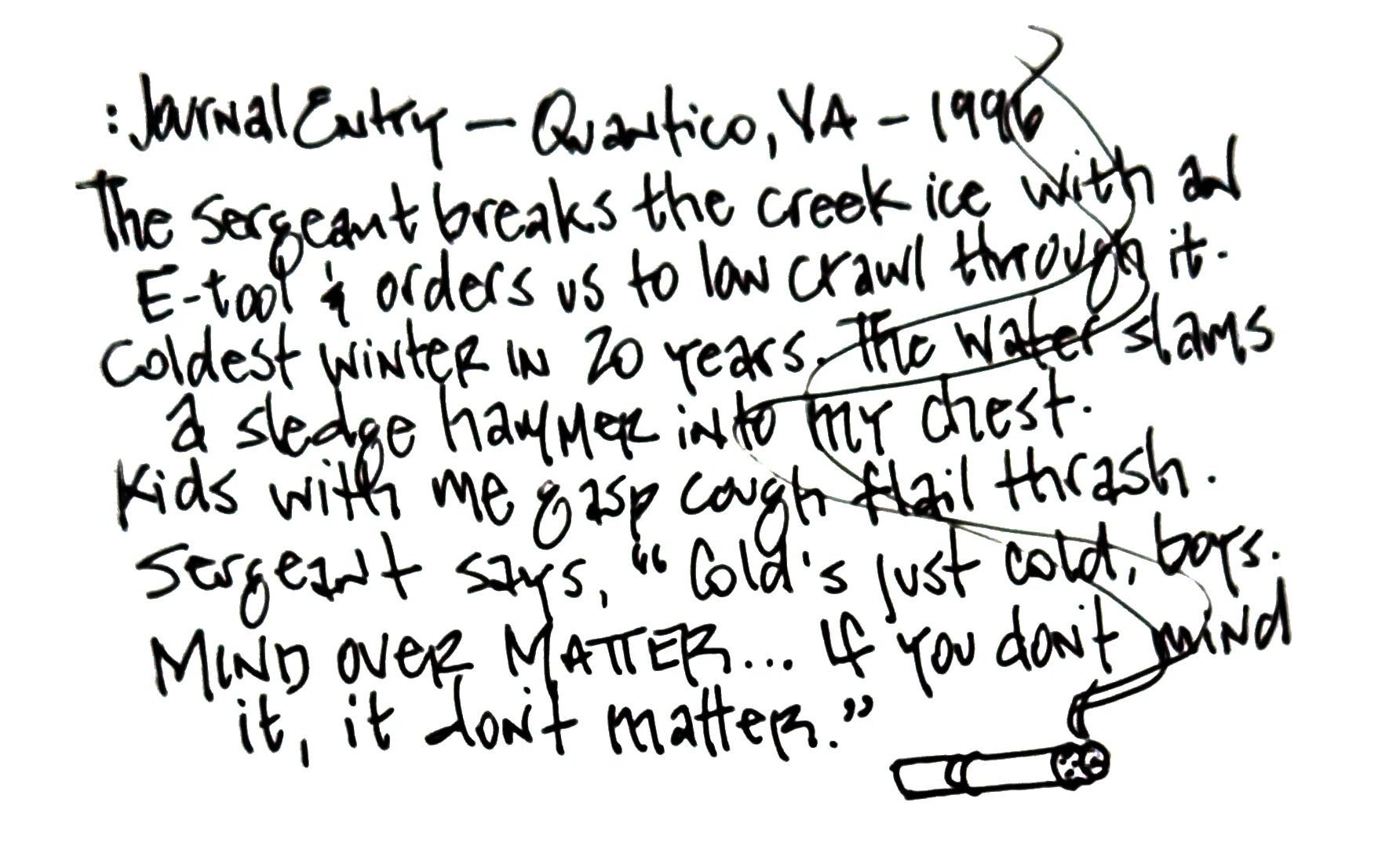
The Marines taught me that doing anything hard was “Mind over Matter: if you don’t mind, it don’t matter.” My external environment doesn’t dictate my experience. Mindset does.
I have no credentials to write about mindset. But I know its power firsthand. I had a midlife identity crisis that torched a marriage, a career, and, seemingly at the time, all future prospects. As bleak as the world looked, the truth was much more forgiving. I had to change my mind to find a new way.
What stands in the way of change in a person’s life is not “matter”—material lack of time, resources, energy, external support, or motivation. What stands in the way are Mental Fortresses, what old English might call strongholds. These are the deeply entrenched patterns of thought, belief, emotional response, and behavior that resist novel knowledge or ideas that challenge what I believe to be true, even when they are not. I am most unaware of those that run deepest.
These are the silent governors of my life. They are the questions to which I might answer, “That’s just how I am.”
What keeps me from walking a path in my best interest is not because I can’t walk another, but that I’ve been “this way” for so long that I can scarcely remember being any other way.
Habits—of intellect, emotions, or behavior—are just habits, not identity. My habits are not who I am, but they create the reality I live. For the deepest patterns, marshalling raw willpower to disrupt them is futile. The battle begins and ends in my mind. This is a simplified outline of the process I used to rewire myself.
First, mentally accept a new belief (~vision) as possible and continually contemplate it.
Second, begin to act as if it were already true.
Third, as my mind contemplates and my body activates in accord, the truth of who I am or could be rewires my neurological pathways—the programs that run me.
My external environment is irrelevant. Visualize, intend, and resource.
A neurological maxim: what fires together wires together.
Repeated physical expression forges a neurological network that grows toward automation of that expression. In time, it creates what I’ve heard called “discipline without discipline.” I become hardwired.
Beliefs about myself govern my actions. Understanding this resembles an archaeological dig.
For an addict, drinking, using drugs, or gambling appears to be the problem. Drinking and using cause problems, but they aren’t the problem. The problem is an overwhelming dissatisfaction with themselves and ignorance about who they are and why they’re here. An addict will do anything to simply feel different.
In Genesis 3, Eve eats the fruit from the forbidden tree. Her “sin” appears to be that she ate the fruit. God told her not to eat it, but she did anyway, and so she sinned. Standard Bible school wrap-up. But was that her sin? Is the problem that she ate the fruit? No. The problem was that she thought God was holding out on her. She believed a lie and decided to take matters into her own hands. The sin was believing the lie. The symptom of that belief was the bite she took.
My resentments toward life appear to be a problem for which others are to blame. In truth, a man’s vague depression is self-resentment. I spend my life conforming to society and don’t know who I really am. Since I don’t know who I am, I say ‘yes’ too often and ‘no’ too seldom. After years or decades, regardless of measurable success, the sheer mediocrity of my presence feels pointless. I begin to resent my life and the people in it because I feel trapped, stupid, and vapid. I’m an imposter. The last place I look to understand this feeling is in the mirror, because I’ve been working my ass off. Don’t I get credit for that? Confusion. Malaise. Anger. F*kc it, I’m out.
The truth is that my resentments don’t build because other people don’t act right. Nor are they righteous indignation against a system that’s rigged to keep me down. I teach others how to treat me and resent them for it: spouse, boss, kids, friends, and family. I sell out. I sacrifice things I care about, trying to be reasonable, trying to be “good”, amputating pieces of my agency one digit and limb at a time.
My resentments are symptoms of my lack of self-respect.
Resentment breeds anger. Together in time, they recruit hatred, mix a cocktail of contempt, and calcify into bitterness. My body knows the truth. It directs the anger inward toward its root and mutes all forms of joy. It becomes impossible to en-joy the things I once loved the most. Anger turned inward is that vague, depressive feeling. The solution is not to “let it go.” Passive release does not disrupt the pattern. I must take stock and begin to quietly demand of myself the relational behavior of someone I respect. Unfed, the twisted vines of resentment simply wither in place.
Free of bitter overgrowth, a man can do what strong men do: lift others up.
Mark Twight, writer, founder of Gym Jones, and trainer of the movie 300 actors, said something like “simple works but complicated is easier to sell.” This sums up the multi-billion-dollar self-help and improvement industry.
To complicated, add novelty to complete the picture. A culture of consumers can’t resist the lure of a New Thing, a New Program, a New Hack. Leaping from one thing to the next derails consistency, preventing any improvement and creating a fragmented environment a mile wide and an inch deep. This is echoed in complaints like “I’ve tried every diet imaginable, and none of them work.” That’s because diets don’t work. I know it, but I keep dieting to get credit for trying. It’s like repeatedly cutting a board and being dumbfounded that it’s still too short.
My untended mind complicates simple truths, fragmenting around a constellation of competing options. It’s a road to nowhere.
Someone can sell me a complicated secret success formula for $1,000 if they promise it will deliver results in 30 days. I won’t pay $1 to hear “do these three things daily for the rest of your life, and it will solve 80% of your problems.” It’s the daily and the rest of your life that scares the shit out of me. It feels impossible. I can barely make it to work on time, how am I supposed to do that every day forever?
The average American, like me, can’t conceive of implementing a daily practice starting now and continuing until they die. It speaks to my constitutional and cultural short-sightedness, my inability to make a hard decision and stick with it once the fervor of motivation fades.
Jim Wendler says discipline beats motivation. If I can stick with one thing long enough, it will teach me to stick with other things. Masters do one thing better than anyone else, and to the exclusion of everything else. An average dude like me will doubtfully ever master any one thing. Nor does that interest me, because so many things are interesting. I can learn to set my mind on something and see it through. I can begin eliminating what doesn’t matter and focusing on what does.
Several years ago, I started getting up an hour earlier to read. It wasn’t part of a life strategy, and I set no goals around it. I had a stack of books I wanted to read, but I was too tired after work. So I set my alarm. What developed was a love for the silent hours of the morning. Now, I can’t imagine not getting up early. It’s harder for me to sleep in than to get up, and I feel like I missed out when I do.
Getting up earlier is one thing that has created space for many things. It has made me unexpectedly more patient, simply because I know I have a block of time to devote to whatever I’m curious about. If I want to read, write, train, or learn to pray, I’ll do it then. The rest of the day can be whatever it is. No rush.
For the seed of change to take root, I must first emancipate myself from the need for abstract societal acceptance, while cherishing my deepest connections, and, second, shift toward acceptance by something else. This requires foremost identification and confrontation with specific fears. This can take work. But skipping this step means you might as well skip the rest because nothing will work.
I must realign toward an ideal, an idea, or a vision that eclipses everything else. From that, reorganizing my life around that idea as a new center of gravity is necessary.
Identity. We have two identities: original and cultural. Each function relationally informs me about who I am and where I fit in. Our cultural identity is the one we all know, because it’s the one we present daily to “fit in.” Our original identity has often been lost in the layers of life, but it offers the truest sense of purpose, the “I was made for this” feeling of doing what you were designed to do. Personal agency is tied directly to identity. Return to the beginning and rediscover who that is, before you were afraid.
Take Stock. Your habits are not who you are, but they create your reality. Think about how you are now and what your life is like, the best and worst. How was it 10 years ago; how will it be 10 years from now? I had to evaluate where I had mistaken unconscious thoughtlessness for fate, or “getting older,” or “being busy.” I realized I had some habits to undo. It took time to develop bad habits, so I gave myself time to correct them, one at a time. Patience is the key to consistency, and consistency is the key to everything.
Cultivate imagination and vision. Take a solid block of time, even a day, to envision the “kind” of life you’d love to live. Imagine everything about it. Most importantly, imagine how you are, what you’re like, how you interact with others, and what that looks, sounds, and feels like. Simply put, I want to be the “kind of guy who…” Compare this vision to your current life. The gaps reveal the problems. I can only fix what I know is a problem.
Set Your House in Order. The process of transformation is Order—Disorder—Reorder. Transformation occurs when we aim for a new ideal and make it the center of gravity for our lives. From the status quo (the current order), we dismantle the rhythm of our lives, including its habits, patterns of thought, and behavior. This creates disorder. The realignment of our daily lives around a new center of gravity is the reordering. A new order creates a new life.
Live the life “that person” lives to become “that” person. If I endeavor to stand with men and women whom I admire, I must endeavor to make myself fit company. This is backward planning, what military strategists employ to envision an “end state”—a vision—and plan in reverse to arrive at the next steps and following phases that lead to that vision. Do not confuse this with goal setting. Goals are tactical next actions, daily things. Reorientation of my life is strategic, big picture, the curation of a lived life that results in a general existential nature. Simply, I want to become “like that.”
Burn your report card. Stop keeping score and forget everything you know about “progress.” Stop measuring yourself. Never say you should do anything. Should tells you that you’re supposed to be doing something, that you’re not doing it, and that you ought to be ashamed. You’re good, but, like all of us, you might have a little work left to do.
Serve Others. The best thing I can do for myself is get over myself.
Principles work like this for me: there are only a few that matter, and I have to abide by them over time to embody their truth. If I abide, things get better. If I don’t, there are consequences. Before I will abide, I must believe or at least muster enough faith to persevere long enough to gain bodily experience. Most often, experience is not the result of sufficient faith; experience creates faith.
I start doing something, benefit from it, and start to believe.
Principles never change. I change and, as I do, unlock the layers of depth intrinsic to the principles. I change when I do something consistently. I’ve only cultivated a couple of personal habits consistently for a long time: lifting weights and reading books. Everybody has their thing. Both have taught me principles I now consider vital: lifting, that consistency is a prime variable; reading, that to live well, we must continually learn. Neither has an end; each has its application.
Principles are often deceptively simple. They are easy to understand but require a lifetime of practice to embody.
Othello, the American version of Go, the Chinese strategy game that’s akin to 3-dimensional chess, keeps the motto “A minute to learn, a lifetime to master.”
Someone can learn the fundamental principles of strength training in under 60 minutes and benefit quickly from consistent application. But it takes years of practice to master the strength skill.
The same applies to writing, relationships, cooking, shooting, most trades, Stoicism, guitar, or religion.
In short, I identify one good thing, do it, and mitigate distractions or hindrances. This is the center of gravity around which I organize my life, or parts of it. Once I’ve envisioned what “that” looks like in detail, I have a filter for evaluating everything I do and don’t do toward that end.
With such a mindset, things naturally begin to sort themselves out. There’s no pressure, no performance, and no pretending. It’s like how I don’t “try” to get strong or lose weight, I simply lift weights or don’t eat sugar, and my body takes care of weakness and fatness on its own.
What I sense so often in the silence is not to worry about tomorrow. I may not be around to see it. If I’m not alive tomorrow, I’ve wasted today caring for something that does not belong to me.
I’ll stick with today and act like I’m already the guy I’m not yet.
If you found any of this content useful, check out similar posts, my book Be a Boxer: Not a Fencer, or consider sharing:
Thanks for reading! This post is public, so feel free to share it.
One Powerful Thing Anyone Can Do to Reverse the Aging Process
·
Jan 15

Strength—physical and mental—is not an aesthetic choice. It’s a survival strategy and a moral duty. Your life is on the line. When I learned what’s at stake, I learned that I owe it to both myself and the people I love to do what I can. Most people want to “feel better” or “look better.” But few are willing to get sore to get strong…
Comments
Nothing yet. Say the first thing.
Sign in to join the conversation.