
Your job used to teach you. Now you have to take more responsibility for teaching yourself.
Alex leaves for college next week at Elon. I start teaching college next week at College of Charleston as Entrepreneur in Residence for my 4th semester. We are both walking into school, just from different sides of it.
Alex is about to get something most adults no longer have: a clear path, deadlines, honest feedback, people figuring it out alongside him, and professors who are supposed to notice when he is lost, all inside a system where not knowing yet is part of the deal.
Teaching is personal for me. My mom was a teacher and my uncle was a professor, so I grew up around people who took learning seriously and understood that teaching is about more than delivering information. It is about noticing where someone is stuck, pushing when they need to be pushed, and caring whether they get there. That is a big part of why I teach now and why I keep writing about this.
Here is the part that gets me: most people leave that system and go to work (or try to), where we expect them to keep learning without much of any of the guidance or direction.
For a long time, work gave people some of that structure without anybody calling it a development system. You started with smaller assignments, watched more experienced people do the work, got corrected when you got something wrong (feedback), and picked up judgment by being around people who had already been through it. It was messy and inconsistent, but it happened if we were lucky for some people.
A junior person used to build the first draft, get it marked up, defend an assumption, and do it again. Now AI can produce the first draft in thirty seconds. The client may get a better deck, but the junior person may miss the ten repetitions that taught them what a good deck actually is.
That is what I mean by the hidden curriculum. The work looked like output, but it was also teaching people how to do the next level of work.
AI is making it easier to remove those experiences. It did not start with AI. Lean staffing, outsourcing, flatter teams, and distributed work had already weakened the old apprenticeship model. AI is speeding it up because it can take away the lower-level work that used to give people their first real reps.
PwC’s 2026 Global AI Jobs Barometer looked at 2.4 million entry-level job postings in the United States and found that the roles most exposed to AI were seven times more likely than the least exposed roles to ask for skills we usually associate with more senior people: judgment, leadership, creativity, and working face to face.
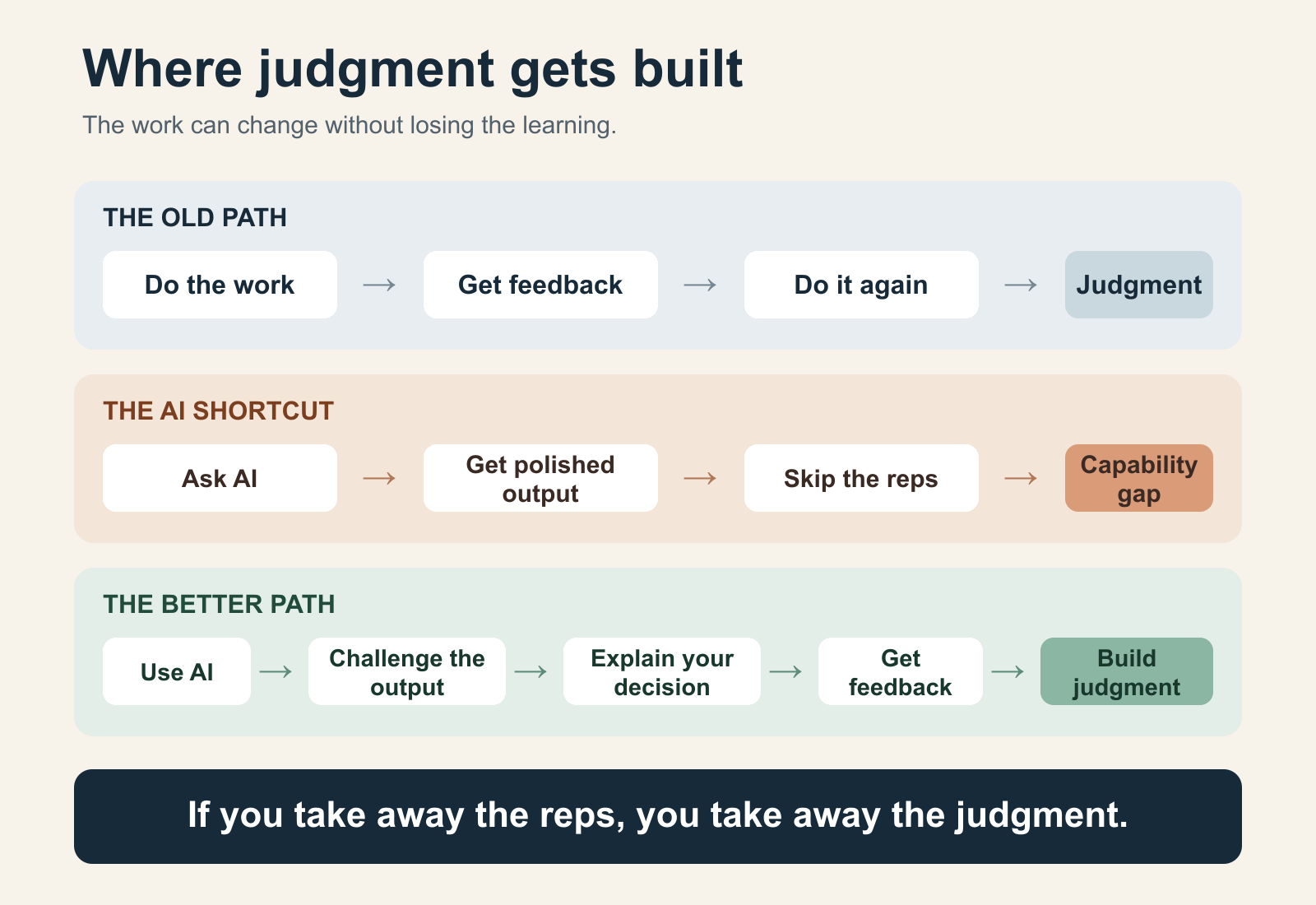
That is the problem in plain English: entry-level jobs are asking people to show judgment before they have had enough chances to build it.
If you take away the reps, you take away the judgment.
It is not just a problem for people starting out. The 51-year-old who has done good work for twenty years is getting handed a new tool that changes how the work gets done, often with the same support the intern gets: a login, a few prompts, and the expectation that they will figure it out.
So if work used to teach people by accident, and the work has changed, what are we going to put in its place?
We have to build on purpose what used to happen by accident. Give people time to practice, work that gets harder over time, feedback on how they are thinking and not just what they produced, peers who are learning alongside them, and managers who are expected to teach, not just check the work. Whose job is this? Hmm..
This belongs to the people who design the work. Leaders decide how much gets automated, managers decide whether coaching survives the week, and HR decides whether development is real work or something people are expected to squeeze in after the real work is done. The learning team may own the courses and tools, but it cannot own the whole problem.
Most companies still measure whether the work got done. They do not really measure whether the person doing it got better (this is tough).
For a long time, those were close enough to the same thing. If the analysis was strong, the analyst was probably strong, because there was no other way to get to a good answer. Output was a decent stand-in for capability.
That is less true now it feels like. A person can turn in excellent work with a lot of help from AI and still not understand the problem, the assumptions behind the answer, or what to do when the tool gets something wrong. The output may be better, while the person has not actually moved.
This is not an argument for AI tests. Nobody should have to prove they can do everything without the tools available to them. The point is not to recreate old work just because it was hard. The point is to know whether judgment is growing underneath the new work.
One practical version of this is simple. Before a client deliverable goes out, a manager spends twenty minutes asking the junior person what they think the AI got right, what it got wrong, and what they would do differently next time. That is not extra work for the sake of it. That is how you see whether someone is learning to think, not just learning to prompt.
Day to day, this does not need to become another program. Give people some work they have to think through before they ask the tool. After they use AI, ask them what it got right, what it missed, and what decision they would make themselves. Give managers time to review the thinking, not just approve the output, and stop treating coaching as something they should do after the client work, the meetings, and everything else. If learning only happens when the week leaves room for it, it will not happen.
What do companies owe people now? Real reps, honest feedback, time to learn, people to learn with, and permission to be new at something without putting their standing at risk. If AI removes those things from the work, the company has to put them back on purpose.
That question needs to apply to senior people too. We spend a lot of time talking about whether junior employees are developing, but we do not ask often enough whether the senior vice president is learning, changing their mind, getting better at using new tools, or still relying on what worked ten years ago.
There is one big warning here. If you try to measure whether people are getting better inside a culture where they do not feel safe admitting what they do not know, they will hide. AI it turns out gives them a very good place to hide.

Leaders have to go first. They have to be willing to say, “I do not know this yet,” ask better questions in front of people, show their own learning, and give others room to do the same. Most executives would rather fund a platform than make themselves vulnerable in front of their teams. But one of those things changes culture, and the other usually just buys software.
AI that improves this quarter’s productivity while making people less capable next year is borrowed performance.
You get the result now, but somebody pays for it later. The cost does not usually show up in a budget line. It shows up when the questions in a meeting get fewer, when nobody catches bad assumptions, when a senior person leaves and there is nobody ready to step in, or when leaders start saying something feels off but cannot explain why.
You can reduce cost and improve a quarter but that does not mean you are building a stronger organization. If people are doing less of the thinking, less of the learning, and less of the work that builds judgment, the gap may not show up for three or four years. By then, I fear, it is going to be much harder to fix.
I started writing separate lists for people who run companies, teachers, people who have retired, and the people who set the rules inside schools. Then I put the lists next to each other and realized they were basically the same.
What are you learning right now that nobody asked you to learn?
How would you know if you got more capable this year, not just more productive?
What could you do a year ago that you now hand to the tool without thinking about it?
Look honestly at last week. Where was there room to learn something that was not urgent?
Who has watched you be bad at something recently, and who are you helping learn?
The fourth question is the one that gets most people stuck and thinking I find. Leaders tell people to be more curious, more adaptable, and better at learning, but then they fill every hour of the week with delivery work and urgent meetings.
Curiosity needs time. Judgment needs time. Learning how to do something badly before you get better at it needs time. If you control the calendar, you control whether any of this happens, whether you mean to or not.
Everything I have written so far puts real responsibility on institutions, and it should. Companies have to stop pretending development will take care of itself. Schools have to rethink what they are preparing people for. Managers have to see teaching as part of the job. I hate using the word SHOULD but I truly feel it.
But there is also a timeline problem. Rebuilding a real learning system takes time, costs money, and usually does not help anybody hit this quarter’s number. Some companies will do it. Many will not, or will not do it soon enough.
Your employer or your school may not build this for you. That is unfair, but it may be true.
So build your own structure: choose something worth learning, put time on the calendar, and find people who will tell you the truth about how you are doing. You need habits to keep going when there is no deadline, curiosity to decide what is worth learning, and other people, because self-direction is not the same thing as trying to do everything alone. The other thing you need is a stage, find people to have coffee with you can talk to about this “learning”.
That does not let companies off the hook. A company cannot remove the time, support, coaching, and real learning opportunities people need, then call the resulting gap a lack of trying but I do believe each of us has to take more ownership than we may want to.
Next week Alex starts college at Elon, and I begin my fourth semester at the College of Charleston, teaching, or guiding as I like to think of it. We are walking into school from different sides, but neither of us is done learning. Nobody is.
Three weeks ago, I started this series by saying everyone is back in school because learning is no longer a stage of life. Last week was about the signal we lost: good output no longer proves that somebody is getting better. This week is the answer to where that leaves us.
Companies have to rebuild (or build) the reps, feedback, time, and human support that work used to provide without anybody planning it. At the same time, the rest of us cannot wait for every company or school to get this right. We have to take more ownership of what we are learning, how we know we are getting better, and who we are bringing along with us.
That is the end of this three-part series, but it is not the end of the work. AI will keep changing what we do, and all of us will have to keep deciding which parts of the work make us faster and which parts make us better.
Write the syllabus nobody handed you, then find people to surround yourself with that will help you live by it and keep learning forever!
P.S. If you want to talk about any of this, email me at jason@nowtonext.ai. I read every one, and the people who wrote in over the last three weeks are all over this piece. Much love.
About Jason
Jason Averbook is the co-founder of Now to Next, an adjunct professor of business, and a globally recognized thought leader, advisor, and keynote speaker working at the intersection of AI, human potential, and the future of work. He spent the last few years as Senior Partner and Global Leader of Digital HR Strategy at Mercer, helping the world’s largest organizations reimagine how work gets done, not by implementing technology but by transforming the mindsets, skillsets, and cultures that have to come first.
Over the last two decades, Jason has advised hundreds of Fortune 1000 companies and their leaders, founded Knowledge Infusion and Leapgen, authored two books on the evolution of HR and workforce technology, and become a world renowned keynote speaker who has delivered hundreds of talks on the future of work. His work challenges leaders to stop treating digital transformation as an IT project and start treating it as a human strategy.
Through his Substack, Now to Next, Jason shares honest, provocative, and practical insights on what’s actually changing in the workplace, from generative AI to skills-based organizations to emotional fluency in leadership. His mission is simple: to help people and organizations move from noise to clarity, from fear to possibility, and from now to next.
You can reach him at jason@nowtonext.ai or connect on LinkedIn.
No posts
Comments
Nothing yet. Say the first thing.
Sign in to join the conversation.