
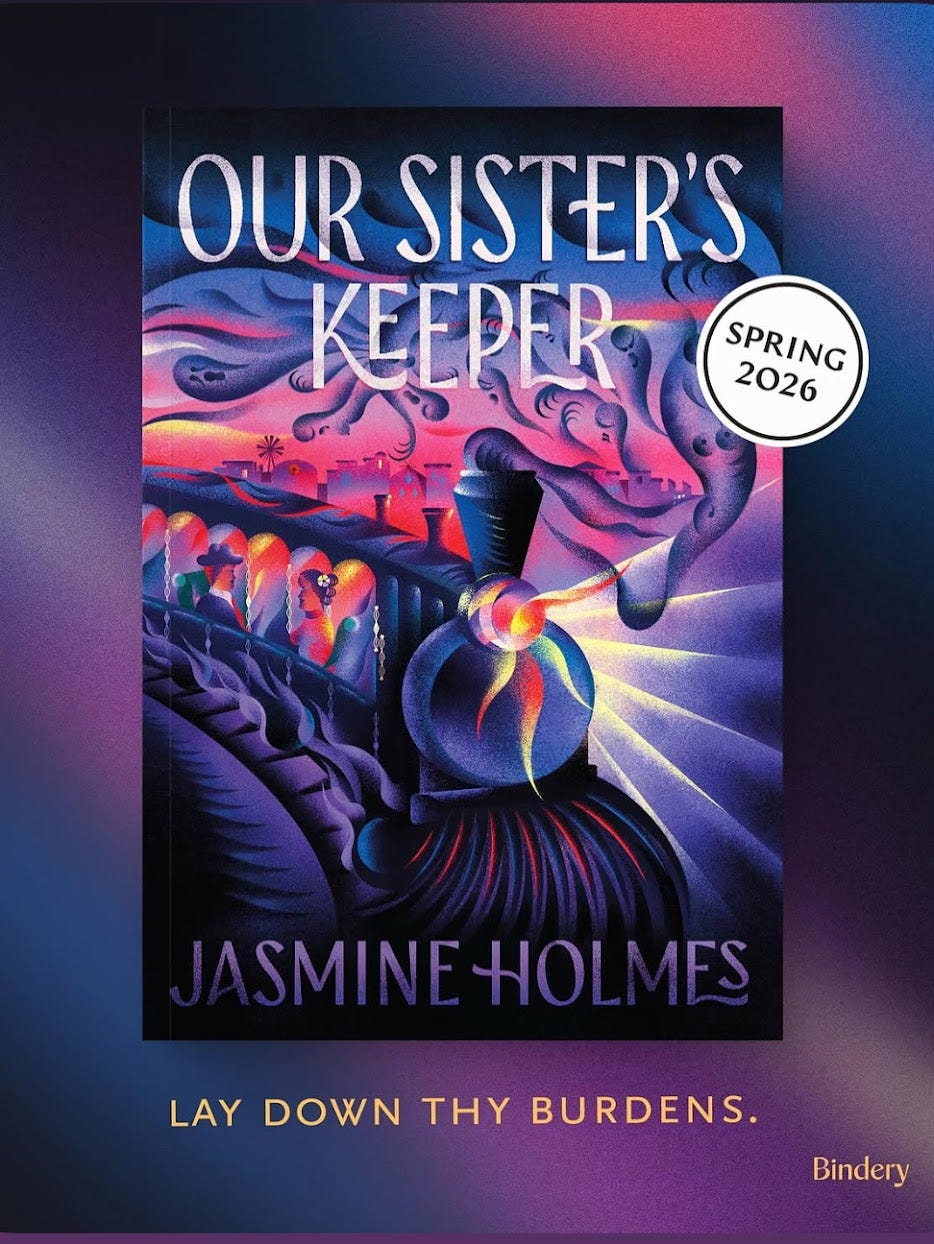
I both love and hate being asked what inspired my forthcoming novel, Our Sister’s Keeper. I love it because the story is the culmination of so many things I’ve tried to understand and name over the years. I only hate it because my asker usually doesn’t have ninety minutes to hear the whole spiel.
Because there are a lot of answers to that question—more than I can fit into a single piece, and more than I want to reduce into one clean explanation. So I won’t try.
Instead, I’m starting with one.
The first is this: the idea of the ideal woman.
Every novel needs a character that they love to hate (or hate to love). In Our Sister’s Keeper, that woman’s name is Mildred.
Mildred became clear to me before my main characters, Thea and Mara, ever did. I knew her.
She’s put together. She’s pleasant. She keeps a clean home and has well-kept, obedient children. In another time and place, she might have been June Cleaver with a press and curl.
Don’t get me wrong, she’s a mean girl.
But mean girl fits so well into this “perfect woman” archetype, because she can’t help it if she’s just better at playing the game than everyone around her.
Because it is a game. She knows who people want to see, and it’s not the real her. It’s the expectations placed on her.
Mildred plays her part out of necessity. For survival. And it doesn’t matter much to her who she has to steamroll to get exactly what she wants: the picture perfect life she was promised.
Mildred was real to me first because I knew her version of womanhood better than I knew anything freer.
I’d grown up thinking of her as the standard — albeit a much less outwardly cruel version than Mildred turns out to be in Our Sister’s Keeper.
This version of womanhood is often treated as intuitive, even natural.
For me, it was neither.
It was something I felt I had to construct—not just to meet a social standard, but a religious one. And when I got plumb exhausted trying to become this woman, I started by trying to understand the framework that produced her.
It presented itself not as a cultural ideal, but as a faithful one. It offered clarity. It offered structure. It made womanhood feel legible.
That’s part of why it held.
But once I began looking more closely—where it came from, how it was being interpreted—it became clear that something else was shaping it alongside the theology.
That realization led me somewhere I hadn’t planned to go.
It led me to history.
What we often call “traditional womanhood” did not emerge in a vacuum. It developed under specific economic and social conditions—most notably during and after the Industrial Revolution, when labor moved out of the home and into factories and offices.
As men’s work became associated with the public sphere, women were assigned to the private one. The home was recast as a refuge from the competitive, industrial world, and women were tasked with maintaining it—not just physically, but morally.
They were expected to cultivate gentleness, order, and restraint—to create a space where everything was softened, steadied, made livable again.
Over time, that expectation hardened into something more than a role. It became an identity—one built on a set of assumptions: time, stability, and the idea that the person maintaining the home would also be the one protected by it.
Those assumptions do not hold universally.
If an ideology of womanhood only functions under specific conditions—if it only applies in certain homes, at certain income levels, under certain social arrangements—then it is not describing womanhood itself.
It is describing a particular environment.
Once you begin to look for that environment, the cracks become difficult to ignore.
That’s what pushed me into primary sources.
Not summaries or neat, retrospective explanations. I wanted to see how women were actually living within the time periods that produced this ideal.
And the further I moved into those records, the harder it became to hold onto the idea that this was ever a universal standard.
Alongside the image of the composed housewife are records of women whose lives did not resemble that image at all.
Women working in factories. Women maintaining households under economic strain. Women performing domestic labor in other people’s homes rather than their own. And, most strikingly, women who were enslaved and therefore wholly barred from this expression of femininity.
The further you move from the ideal, the more visible the labor becomes—and the less convincing the ideal is as a standard for everyone.
The more I learned how culturally constructed my understanding of Christian womanhood was, the more I began to see the assumptions holding it in place.
Not just theological ones.
Historical ones.
Because the version of womanhood I had inherited aligned most cleanly with a very specific set of lives, under very specific conditions. It held together.
It just didn’t hold everywhere.
And once I began to trace those conditions, another pattern came into view.
The framework worked best for a select and powerful few. And because their voices were the loudest, it could pass—not just as a universal possibility, but as a biblical one.
Which shifted the question from can I ever live up to this model but was this model ever meant for me?
From there, the inconsistencies stopped feeling incidental.
They started to feel structural.
They started to feel intentional.
They started to feel a bit sinister.
That’s when Our Sister’s Keeper was born.
No posts
Comments
Nothing yet. Say the first thing.
Sign in to join the conversation.