
There are over 3,000 WPA Ex-Slave Narratives, and I have read most of them.
My work involves tracking patterns in the narratives – repeated phrases, familiar anecdotes, echoed experiences. That pattern-intense work can drown out the individual narratives if I’m not careful. I try to be careful. I want to bear faithful witness to the stories that these witnesses shared.
We tend to think of research as something separate from empathy; as though research could be hampered by empathy, or empathy undercut by a researcher’s eye. But if I’ve learned anything reading these narratives, it’s that one can serve the other. Close readings of the narratives can foster empathy; and empathy can cause us to slow down long enough to do a more thorough examination.
There isn’t a single narrative that illustrated that to me more than Elvira Boles’s.
Meeting Elvira
Elvira Boles was ninety-four years old when she was interviewed in El Paso, Texas, in 1937, though she wasn’t quite sure of her age when asked by her interviewer. She lived with her only living child, Minnie Steptoe. Her other nine children had long since died.
Her story started with her own childhood, which appeared to be motherless. She was the child of the master, but the wife of her enslaver did not want his illegitimate daughter underfoot. Elvira did not know how old she was when she was sold to Boles, but she did know that she was old enough to be put to backbreaking labor.
She was seventeen when she married but had already borne a son to Boles because “if they had a pretty girl they would take em, and I’s one of em.” She remembered hating to leave that baby crying in the yard every day — “but I couldn’t stay.”
Elvira described freedom as difficult.
“Oh, they was awful times. We just worked from place to place after freedom.”
Seeing Elvira
Every word Elvira spoke – or at least, every word her interviewer recorded – carries a much deeper story. Her experiences exist against the backdrop of historical realities that bring even more color and texture to the tapestry of her life. Historical analysis doesn’t dampen her testimony; it breathes more life into it.
Even a close reading of the first paragraph tells us so much about Elvira’s life – and the lived experience of other enslaved women. She mentions her lack of agency three times in the first paragraph:
· “They sold me”
· “They didn’t tell me how old I was”
· “I didn’t get a nickel during slavery”
She marks the limits of her choices over and over again.
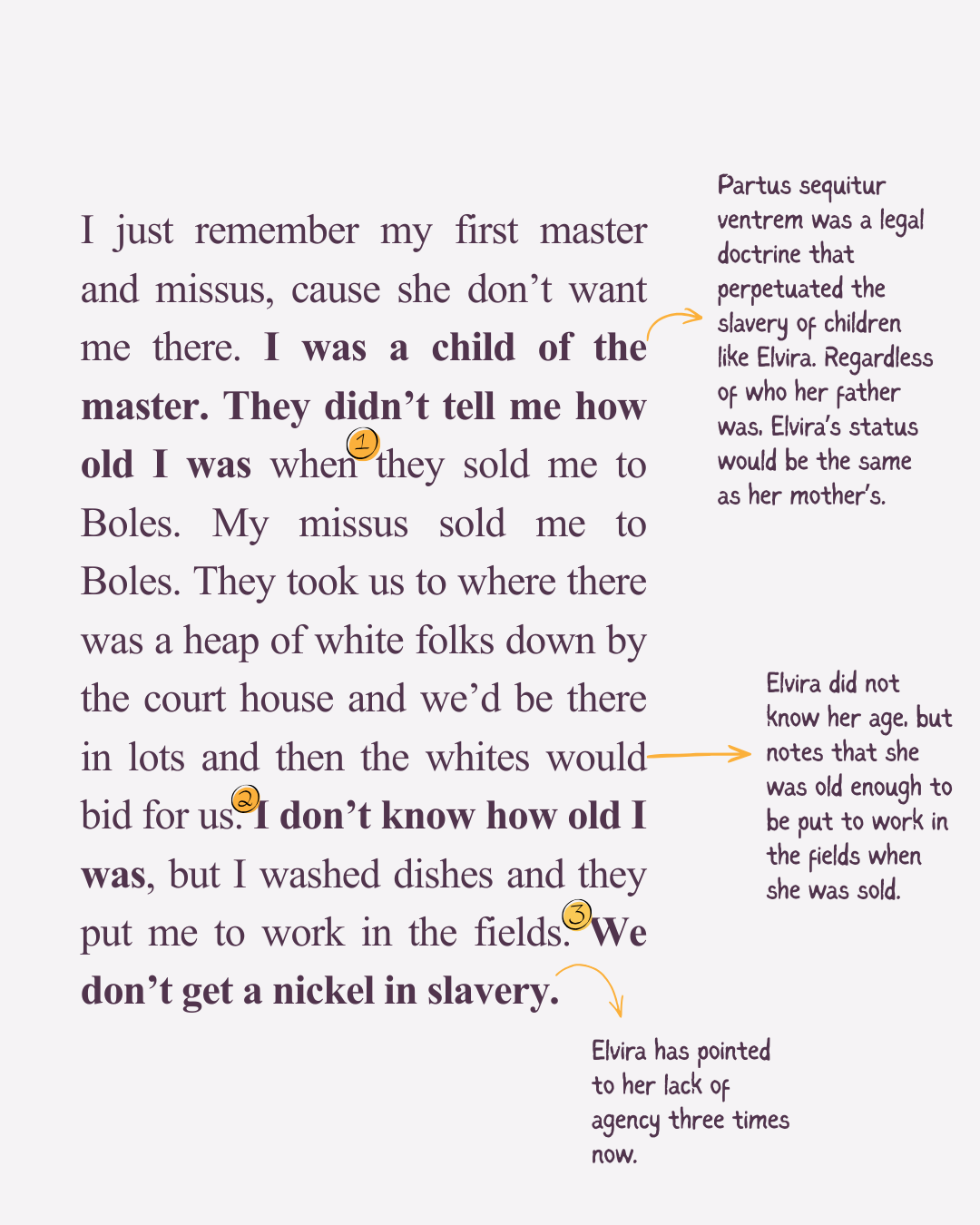
See my full annotation here.
Elvira had likely never heard the legal doctrine that determined her life, but she illustrates it here: she is the child of the master and still enslaved.
There’s so much more – the words Elvira uses to describe motherhood, the picture she paints of her wedding, the fact that she describes herself as being “worked to death” and yet still makes time in the evenings to quilt for her family. Even the way she describes her master as “good” takes on new meaning in the context of her full narrative. All of these are breadcrumbs Elvira is dropping to share her story with us.
Empathy & Elvira
While enslaved, Elvira lived in Holmes County, Mississippi. As a Texan married to a Holmes County native, I felt doubly connected to Elvira through the places her life took her. But there were so many other questions that drew me in to Elvira’s story.
Hearing how hard her life was before and after freedom, was there ever a moment, perhaps when Elvira was making quilts in her modest cabin by candlelight, her children snoring around her, when she knew true peace and belonging? Was she able to create that sense of peace and belonging for her children, a sense that had been stolen from her when she was sold away from her mother as early as six years old?
We can’t answer those questions. But we can learn how to listen more closely to what she does tell us. Every paragraph of her narrative carries that kind of weight and rewards this kind of close attention.
You can read my full annotation of Elvira’s narrative here: Elvira Boles.
No posts
Comments
Nothing yet. Say the first thing.
Sign in to join the conversation.