
Exhibits: Music |Join the Community | Shop |
What we think is real… often isn’t.
Most of us have never truly seen the night sky.
I’m not talking about the casual glance up at a few scattered stars on a suburban evening. I mean the actual night sky — in all its raw, radiant brilliance. What we’ve come to accept as “the sky” is really just a muted replica: a thin veil of stars, dulled by the haze of light pollution, city glow, and the constant glare of our own screens.
It’s like staring through foggy glass.
The outlines are there.
But the depth — the wonder — is missing.
In 1994, the Northridge earthquake struck Southern California and knocked out power across Los Angeles. For the first time in decades, the sky above the city went completely dark.
What happened next is now urban legend:
So many people saw the Milky Way for the first time — truly saw it — that 911 emergency hotlines lit up with calls. Some reported a “strange silver cloud” floating overhead.
They weren’t witnessing an alien event. They were witnessing reality. Unfiltered, unmasked, and unrecognizable.
I wasn’t there, obviously. But I can admit, I’ve had moments like it. Brief, blinding flashes of clarity when the curtain drops and I realize that what I thought was “normal” was only a projection. The sudden silence after a power outage. The startling stillness of the city during lockdown. The way grief can strip life down to its rawest truths. For a moment, the foggy glass clears, and I can see what was always there.
That night sky is a metaphor for how we live.
We scroll endlessly through digital feeds, mistaking curated content for connection.
We cycle from home to work and back again, mistaking routine for purpose.
We stay nestled in cultural silos — surrounded by people who look, speak, and think like us — and mistake familiarity for truth.
We absorb national narratives and polarized politics, mistaking loud voices for collective wisdom.
Even as we gaze at the universe, we do it from a tiny human frame, mistaking our perspective for objectivity.
But it’s not only abstract. It shows up in the smallest, most ordinary choices:
We open the fridge instead of opening our feelings.
We reply with emojis instead of honesty.
We smile through Zoom calls while quietly unraveling.
These are the everyday foggy panes that dull the brilliance of what life could be.
In our planetary bubble, the universe itself is filtered by our small sphere of existence. Within it, we drift through deeper layers — national, cultural, routine, digital — each another pane of foggy glass, dimming what lies beyond.
Not all bubbles are bad.
Some give us identity.
Some offer protection.
Some are necessary.
The challenge isn’t to shatter every barrier — it’s to learn how to see beyond them.
To step outside the default.
To sit with the unfamiliar.
To notice what you’ve been missing — not just out in the cosmos, but within yourself.
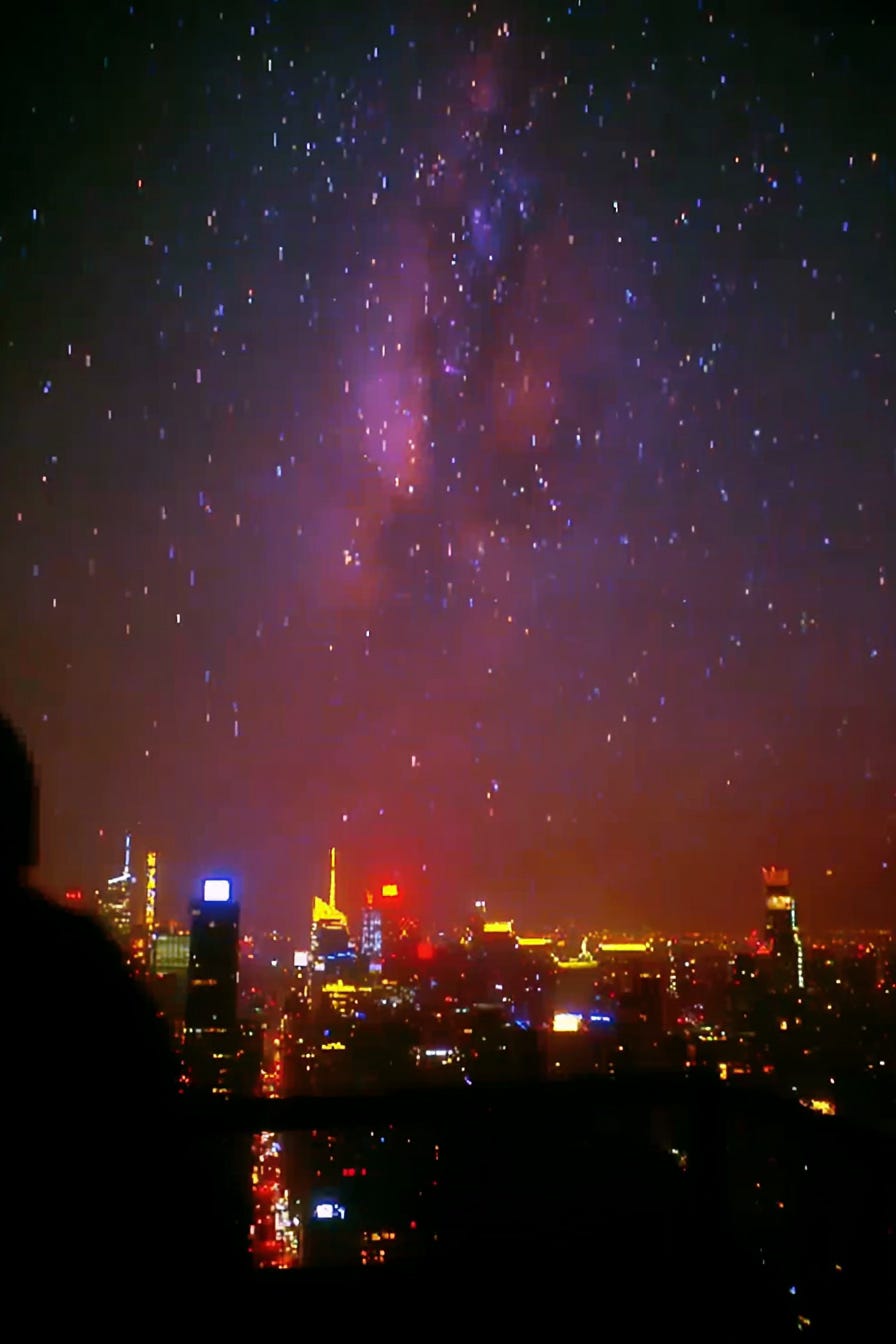
Sometimes, the lights go out in our lives — through crisis, loss, burnout, or unexpected change. These moments can feel disorienting… until we realize they also let us see more clearly.
Sometimes, the disruption is the gift.
Sometimes, the silver cloud overhead isn’t a warning — it’s the truth finally making itself visible.
So take a moment.
Look up.
Not just literally, but metaphorically.
Ask yourself:
What’s the “night sky” of your life that you’ve never fully seen?
What brilliance lies just beyond the foggy glass?
The stars are still there.
They always have been.
You just have to be willing to turn off the lights.
Stay curious, stay connected.
–Jase
Comments
Nothing yet. Say the first thing.
Sign in to join the conversation.