
The final matchday of the Champions League league phase didn’t disappoint. It was pure theater. Just as UEFA had hoped.
That’s the good news. The bad news is:
It could’ve been even more dramatic
And the knockout phase is still an absolute mess
Seriously. Now that the dust has settled, ask yourself: Are you actually excited?
Because despite of some of that late drama, 24 out of 36 teams still advanced from the league phase.
Sixty-six percent! Two thirds!
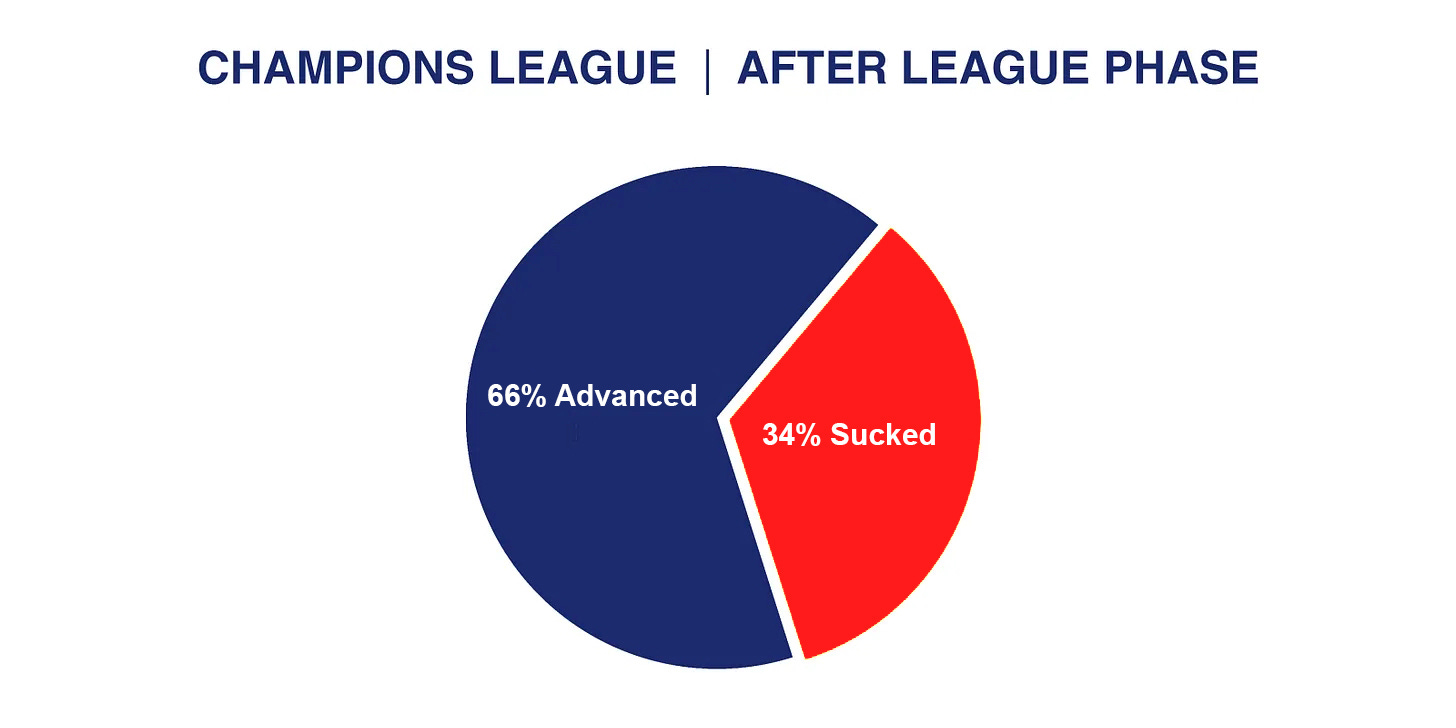
The league phase is a joke. It’s literally harder for a big team to get knocked out than to stay in.
Be honest. The table is largely meaningless. Not entirely. But let’s agree that it really doesn’t matter if you finish 1st or 8th, nor does it mean that much if you finish 9th or 24th.
And the subsequent draw and bracket system is so convoluted that nobody really knows what’s happening.
Fortunately, I had a nagging shower thought that consumed me for days. And I spent far too much time thinking about a better solution for this tournament when I probably should’ve been doing literally anything else with my life.
Alas, here it is. My fever dream answer to improving the Champions League format.
I give you: The Hexapod.
The Hexapod actually evolved from an earlier iteration I called The BIG X, so named because the bracket looked like … a big X.
More on that later.
This current version I call The Hexapod because, as I developed the layout, it appeared to me as a six-legged insect. And I liked that.
It’s also kinda fun to say.
Here’s how it looks:
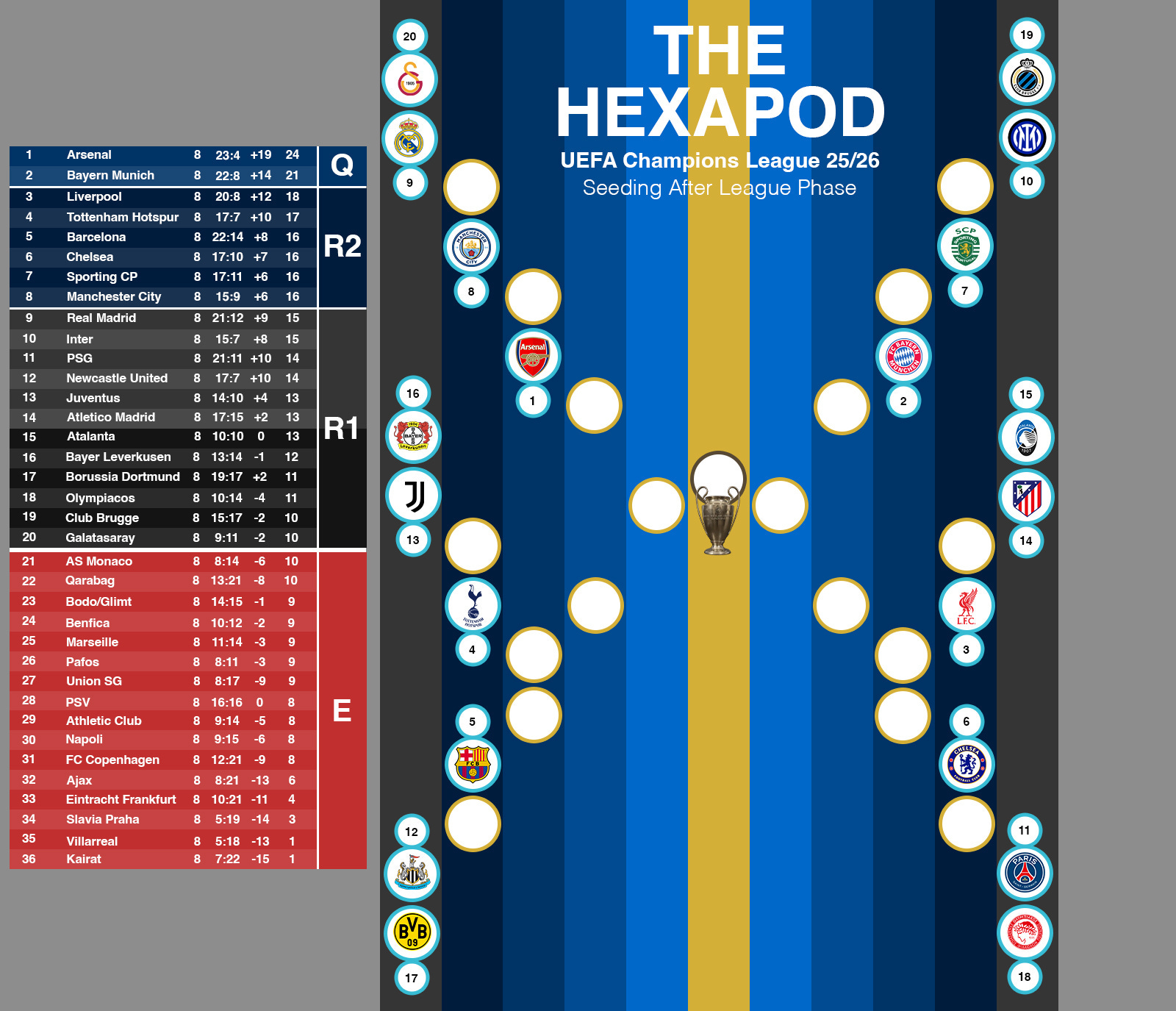
It works by first reducing the total number of advancing teams from 24 to 20. Any club finishing 21 through 36 after the league phase is gone. Done. Out of Europe.
The Hexapod then assigns seeding according to every team’s exact place on the table, and creates sort of a stepladder approach that doesn’t just illustrate how a team finished in the league phase, but also its destiny going forward.
Under this format, seeds 9 through 20 open Round 1 of the knockout phase with the higher seed hosting a one-off, winner-take-all game in their stadium:
(9) Real Madrid v (20) Galatasaray
(10) Inter v (19) Club Brugge
(11) PSG v (18) Olympiacos
(12) Newcastle v (17) Borussia Dortmund
(14) Atletico Madrid v (15) Atalanta
These become instant classics. We’re talking about must-watch football with high stakes and the possibility of big upsets. It’s one game. Anything can happen.
The winners then go on to face seeds 3 through 8 as Round 2 begins traditional home/away aggregate series. The teams entering here have been rewarded by - not only skipping the first round - but by also hosting the second games of their respective series.
The Hexapod further rewards seeds 1 and 2 - Arsenal and Bayern Munich - with an additional bye, starting them deep in the tournament, entering at the quarterfinal.
This is well ahead of every other team, and it’s their ultimate reward for taking the league phase seriously.
For Players and Manager: It softens the calendar from hell. Top seeds (especially seeds 1 and 2) are rewarded with fewer games, protecting stars for the late-stage matches. And in the one-off first round matchups, it also offers seeds 9 through 14 a legit home field advantage.
For Fans: It enhances league phase excitement and, in the first round of the knockout, creates a legit upset factory. Plus, the bracket is set-in-stone, offering a fully-realized visual path to the championship.
That’s what fans want. A path.
It’s good for betting. And it’s good for office pools.
Here, a fan might ask, “How’s your Hexapod?”
And then I would answer, “Busted. I’m a delusional Spurs fan.”
The league phase was a slog. The final day was great, but there was never much doubt that any big teams weren’t getting through.
Nevertheless, let’s look at what happened there at the end and statistically appreciate the results of Matchday 8.
Let’s also understand why the math says it could’ve been even better.
Under the current existing format, we saw ten impactful movements,
Barcelona, Sporting, and Man City rose to the top eight
Real Madrid, PSG, and Newcastle fell into the playoff zone
Club Brugge rose from elimination into the playoff
Marseille, PSV, and Athletic Club dropped out of the playoff into elimination
BUT … only seven of these impactful movements were “quality,” meaning they impacted a team (that was or is now) seeded in the top 20.
So seven quality impactful movements. That’s what we got.
Compare it to The Hexapod.
For starters, I’ll remind you that we killed off four teams. Monaco, Qarabag, Bodo/Glimt, and Benfica finished outside the top 20 and must suffer the shame of somehow not advancing from the league phase.
Under the current model, they advance with a combined goal differential of -17.
WTF.
These teams have no business continuing on and The Hexapod sends them home where they belong.
But, more importantly, The Hexapod offers 11 impactful movements, and ALL of them would be considered quality.
Barcelona, Sporting, and Man City rose to Round 2
Real Madrid, PSG, and Newcastle fell to Round 1
Atalanta dropped to playing away in a brutal one-off game in Round 1
Olympiacos and Club Brugge rose from elimination to Round 1
Qarabag and Marseille dropped down to elimination
Here, the league phase truly mattered. We’ve created more actual consequences.
The Champions League knockout “bracket” is the least intuitive, least organized, least sharable, least bet-able, least office-pool-able construct UEFA possibly could’ve imagined.
This is literally what it looks like:
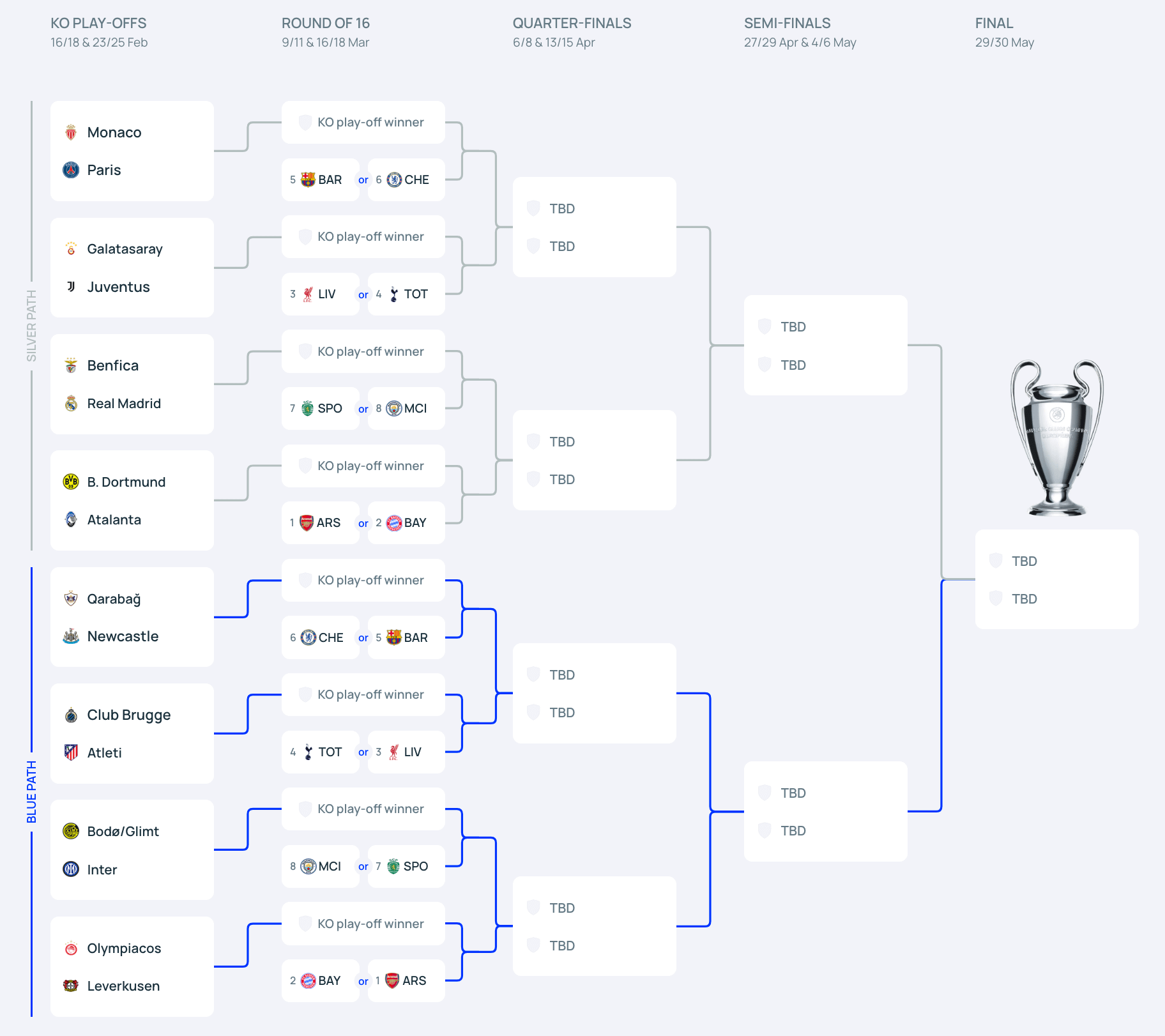
The word “or” appears eight times.
It’s not user-friendly and nobody’s filling out a bracket because … well … nobody actually knows anything. Not for sure.
The Hexapod offers a clear path. Here it is again:
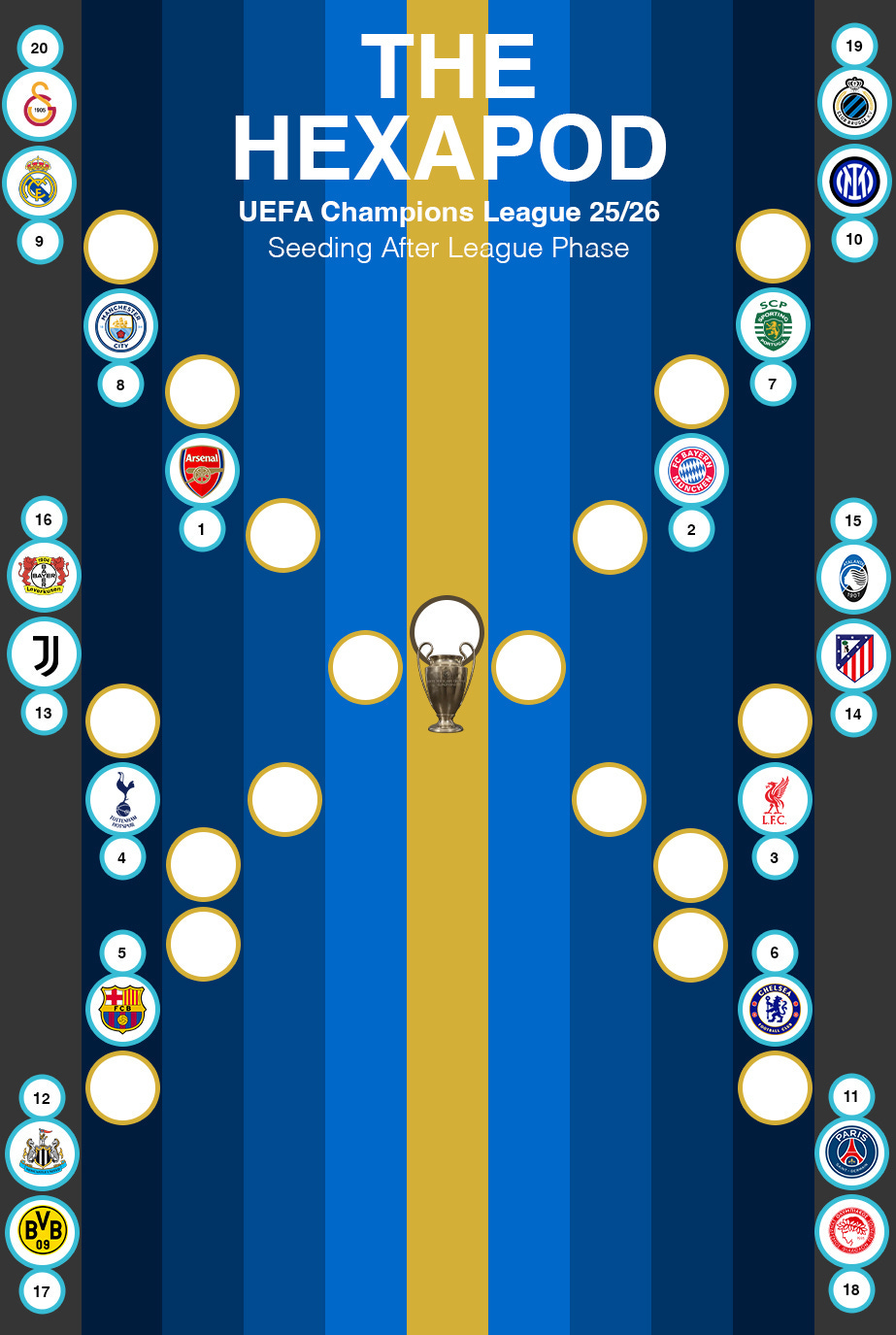
Let’s take Spurs. I love them dearly. But I have no idea how they managed to trip over their own feet and land as a four-seed. Yet, somehow, they did.
Using The Hexapod, this would be their (wildly unlikely) path to winning the trophy:
Round 1: Juventus hosts Bayer Leverkusen in a one-off, winner-take-all game
Round 2: Spurs would play the winner of that game in the second round
Round 3: Should Spurs advance from that, they would play the winner of Barcelona’s second round series against either Newcastle or Borussia Dortmund
It’s clear. It’s logical. And it perfectly reflects the final league phase table.
Your finishing spot is your seed. Easy.
We’re talking about consequences. Real consequences. That’s all anybody wants.
I mentioned earlier that The Hexapod evolved from my first iteration: The BIG X.
Truthfully, I actually still like that concept. It created even more drama in the league phase and, after Matchday 8, resulted in 13 quality impactful movements.
Here’s how that one looked:
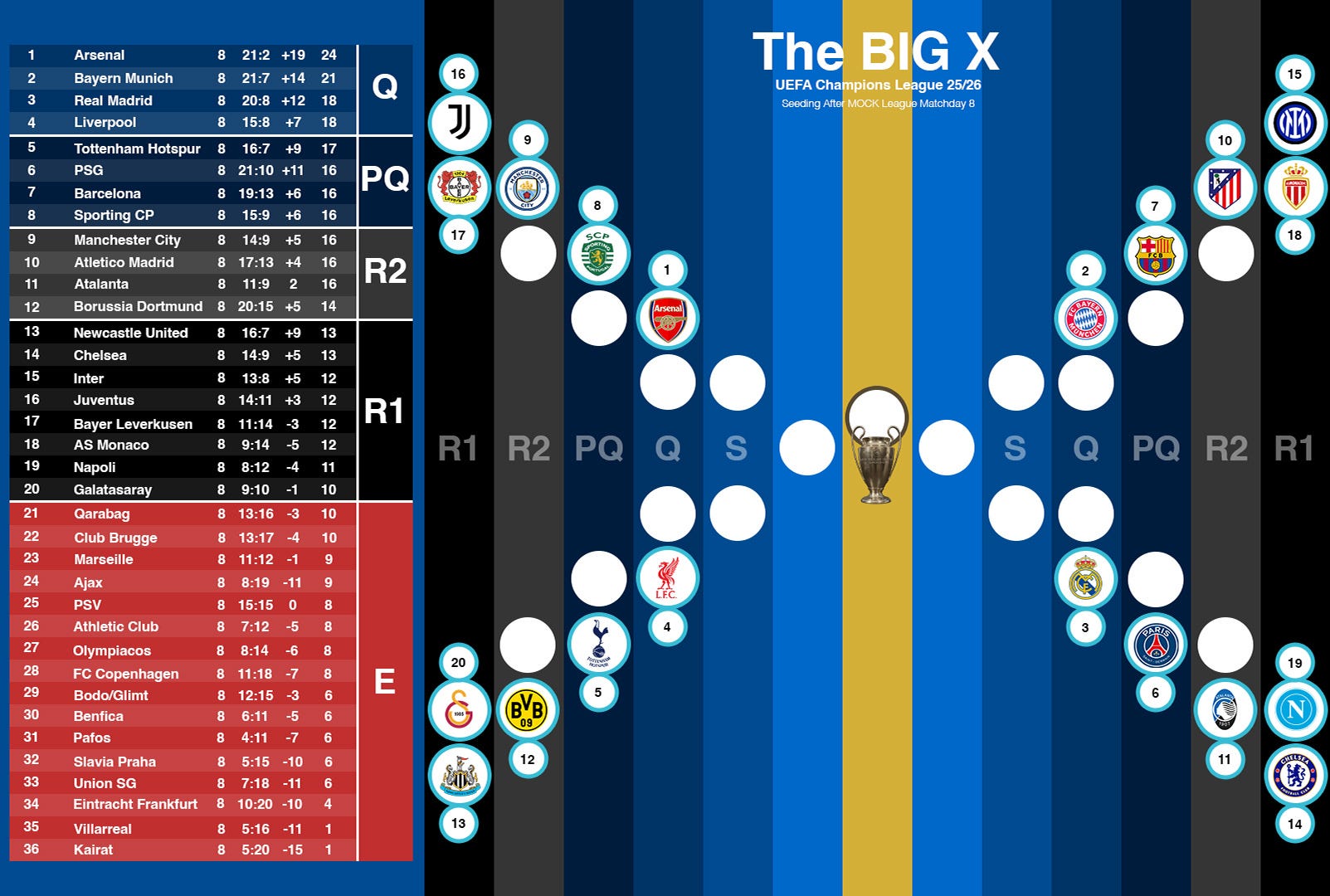
You’ll notice there’s much more of a structural stepladder (see how it makes an X) and far greater consequences stemming from where a team finished on the final league table.
Some of the early criticism I received was that it actually gave top teams too much of a head start. I disagree. But I get it.
The Hexapod still exists in the spirit of The BIG X but, perhaps, strikes a better balance of excitement and competitive balance.
I still expect criticism about the total number of games - the argument being that there are too few. That my system leaves money on the table.
But consider the reality.
Under the old Champions League system - back when there was a group stage - a finalist team would play a total of 13 games. Six in the group stage and seven more spanning the knockout rounds and final.
Under the current system, a finalist team will have either played 15 matches or 17 matches, depending on whether they entered directly into the round of 16 or through the play-off, respectively.
UEFA added two to four more games per team.
Under the Hexapod, the number 1 and 2 seeds would play 13 games - just like the old days. That’s only two fewer games than the current system, and I’m sure they would gladly take the extra rest and advanced placement.
Teams finishing the league table in places 3 through 8 would play a total of 15 games - exactly like it is right now.
Seeds 9 through 20 would play 16 games, which is only one fewer than the current model. In exchange we get thrilling one-offs that everyone will watch. And it’s still 3 more than the old system.
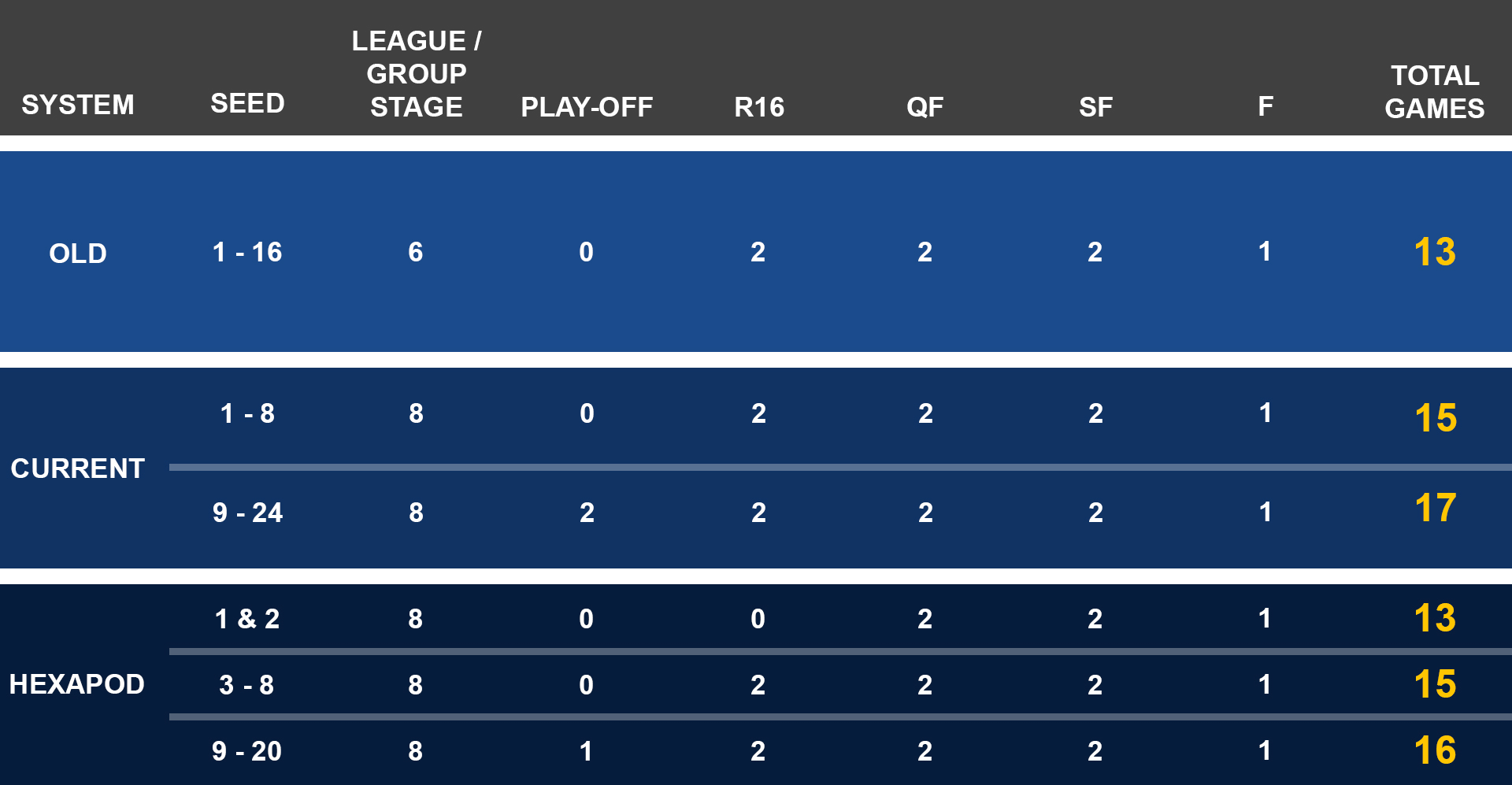
Basically, the top two seeds would play just as many games as they used to, and everyone else plays more or less the same number.
So there’s really no argument in terms of “too few games.”
Technically, yes. There are fewer games. But not in any impactful way.
The current model sees 66% of the field advance. Seeds 1 through 8 get a bye to the second round. And seeds 9 through 24 go to a first round playoff.
Except none of them are seeded with an actual number. And we don’t have anything that looks like a functioning bracket.
Whereas The Hexapod sees:
Only 55% of the field advance
Seeds 1 and 2 get massively rewarded with rest and a competitive advantage by progressing straight to the quarterfinals
Seeds 3 through 8 also get get rewarded with a bye to the second round and the advantage of hosting game-two of the home/away series
Seeds 9 through 14 get to host a one-off, winner-take-all game in Round 1
Seeds 15 through 20 still get to go to the party and hang with the cool kids
And finishers 21 through 24 get nothing. You lose! Good day, sir!
Plus there’s a fully-functioning bracket. Added bonus: It looks like a fierce insect.
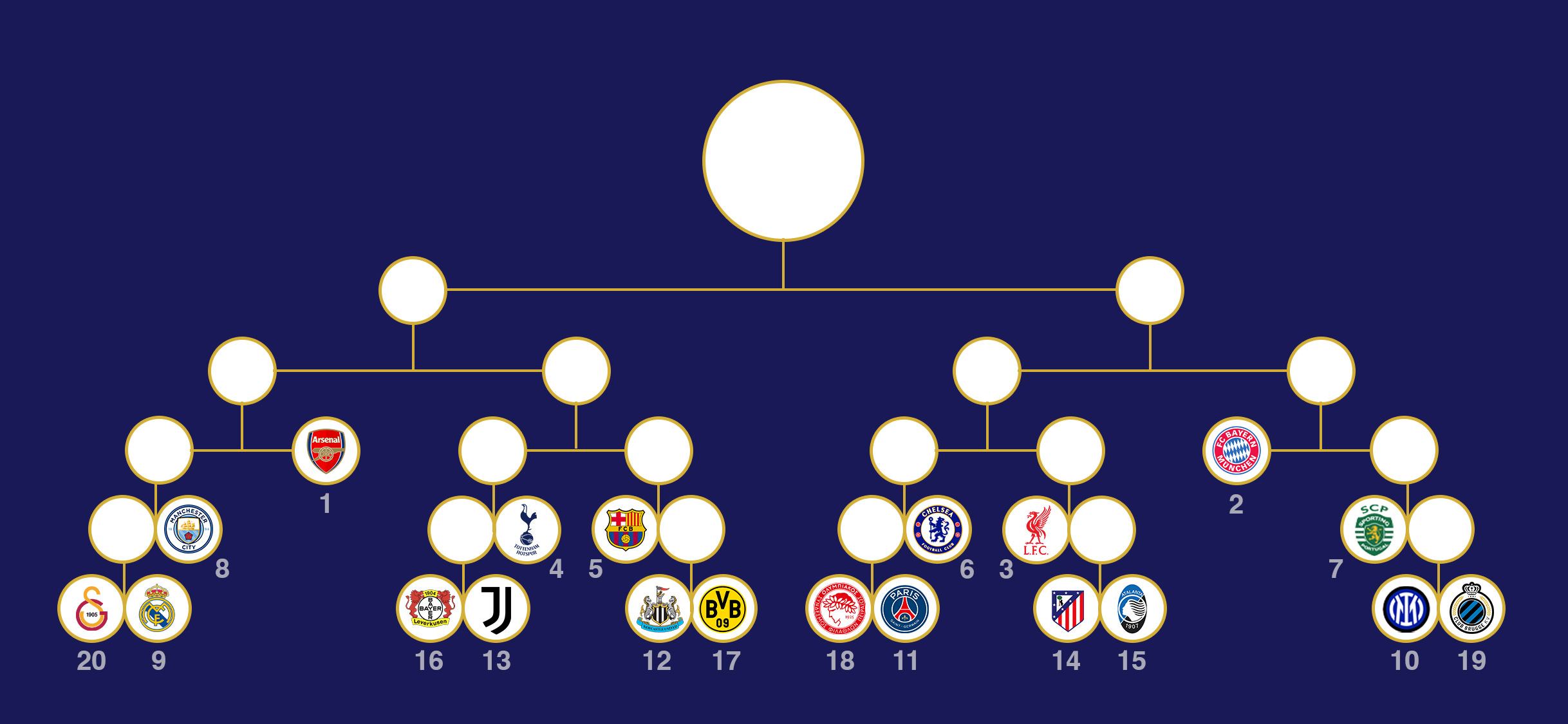
That said, as I wrote this, I suddenly realized this format can also just be expressed in a more traditional sports bracket. But, c’mon … the insect is way more fun.
But (sigh) for those of you who don’t enjoy fun, here is a quick mockup of a more normal-looking tournament bracket. Sorta.
I was pretty lazy about it. But you get the point.
The playoff round saw a couple upsets. The most noteworthy being Bodo/Glimt taking out Inter. It was crazy.
The Hexapod didn’t even have Bodo going through, but I’d rather be entertained than right. So I’m still glad they did the business!
Otherwise, the playoff was mostly pointless. As expected.
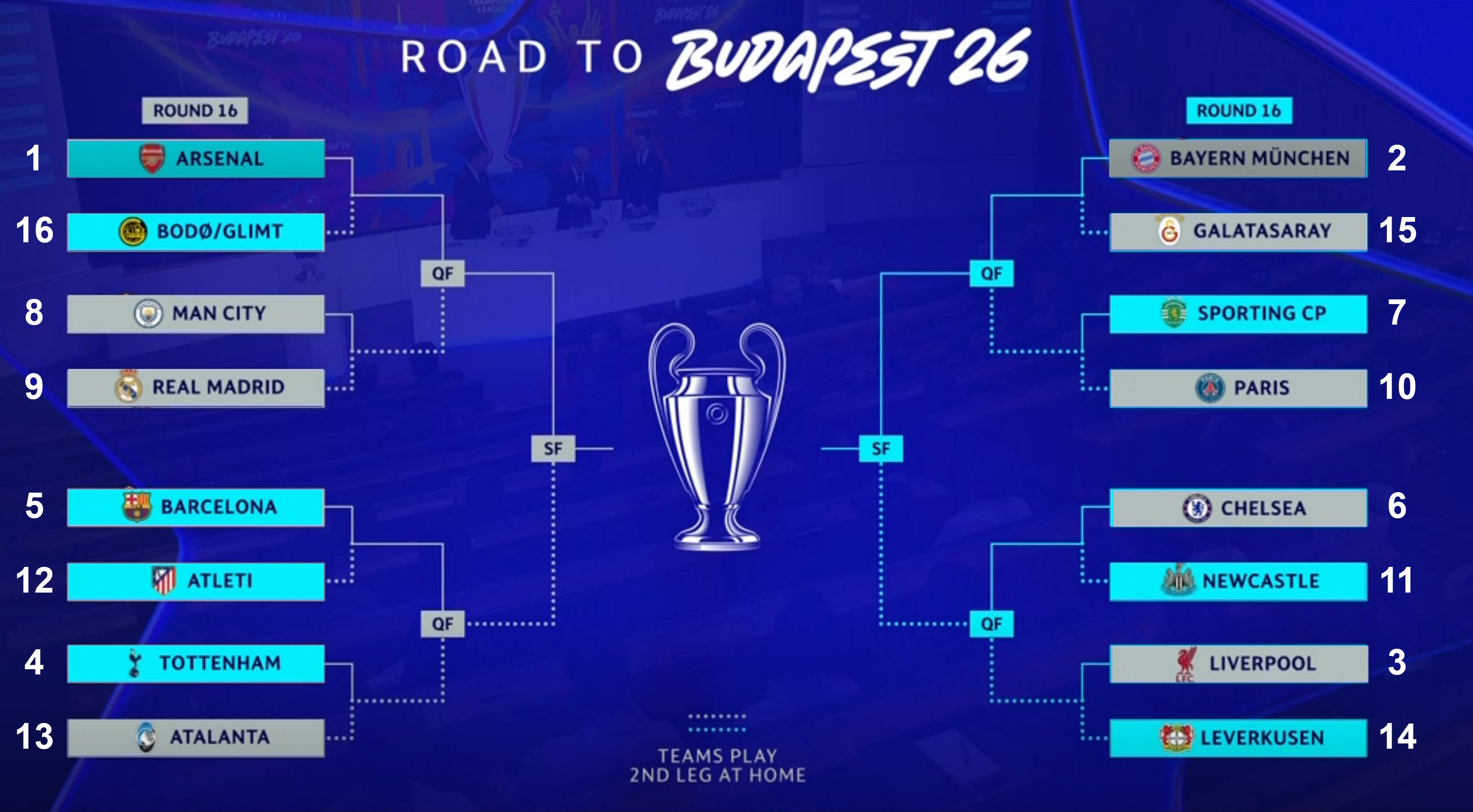
And the subsequent (and unnecessary) draw for the round of 16 was even more mind boggling. Look how the lower right side of the bracket gives Arsenal an insanely easy path, and the lower left forces Bayern Munich into a comparatively difficult set of potential games.
I added seed numbers next to each team in the round of 16 based on their table finish so you can see what it now looks like after the draw:
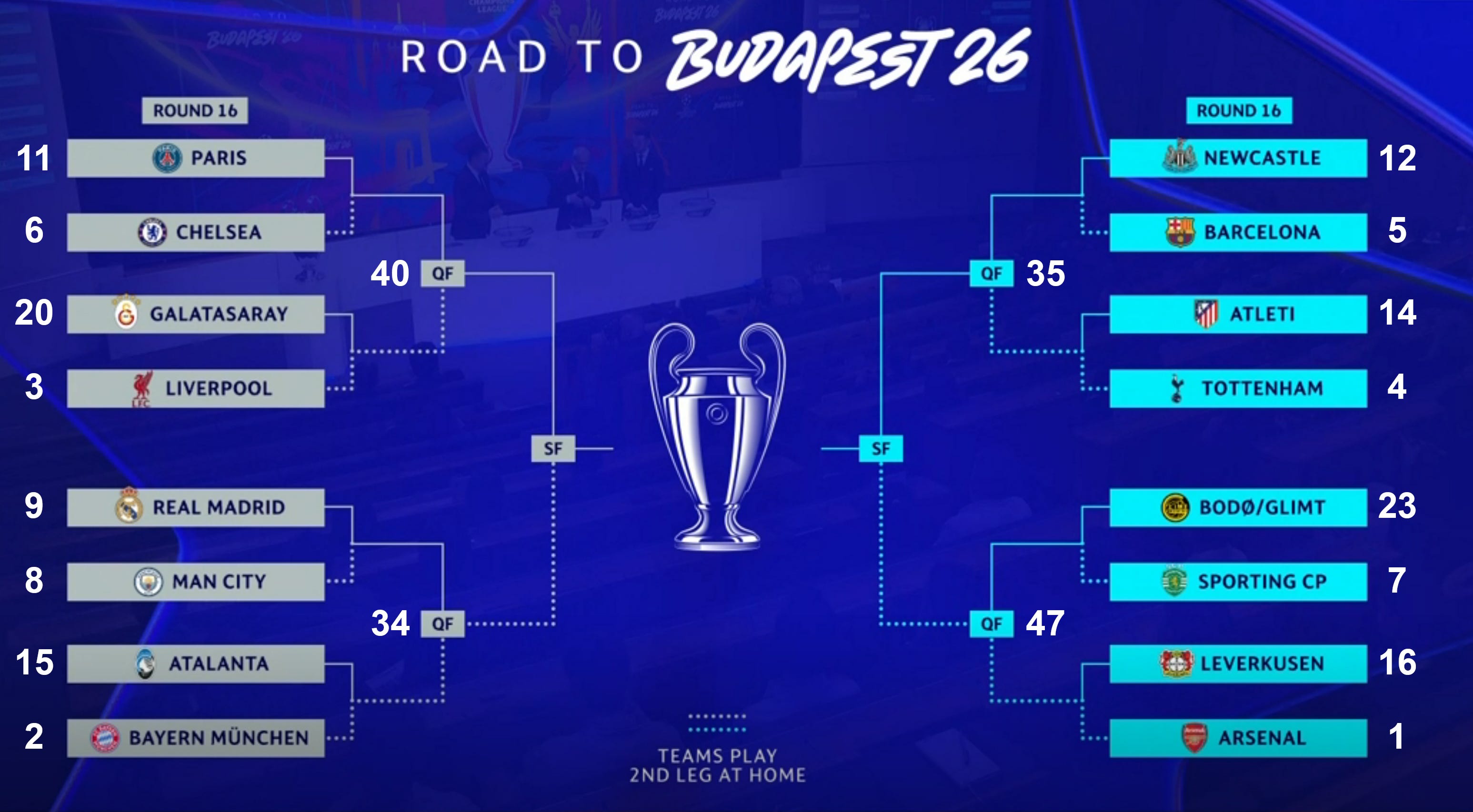
It’s astonishingly clear that the seeding sum of that lower right quadrant - 47 - is much higher than the other quadrants. Higher meaning easier for the top seed.
If UEFA doesn’t want to use my Hexapod - shame! - they should at least consider just re-seeding some of the teams AFTER the playoff round - whereas Bodo becomes the 16, Galatasaray the 15, Leverkusen 14, Atalanta 13, Atletico Madrid 12, Newcastle 11, and PSG 10.
Then, instead of a draw, you simply stack the seeds with a typical sum-17 approach where if you add the seed numbers from both teams of every game in the round of 16 it equals 17. And every quadrant equals 34.
It’s still not perfect, but it’s FAR better and FAR more logical than the result of the draw.
Reseeded, the round of 16 would look like this:
All that said, there is one possible unexpected bonus moment of joy I might take from the current UEFA draw. If Arsenal somehow don’t win this thing, at least I’ll get to bask in the warm glow of their bottle job.
May the future be bright.
No posts
Comments
Nothing yet. Say the first thing.
Sign in to join the conversation.