
From 1934 until 1972, Gabriel Marcel opened the door of his apartment at 21 rue de Tournon in Paris on nearly every Friday evening. In a dimly lit study full of books, thinkers gathered around questions that none of them could settle at the time. Paul Ricoeur was there, Jean Wahl, Simone de Beauvoir, Nicolas Berdyaev, Jean-Paul Sartre. And a young Emmanuel Levinas, who in those same years was introducing the phenomenology of Husserl and Heidegger into France and who found here another way of thinking. Ricoeur later described how those evenings worked: everyone was invited to treat a jointly chosen subject, without appealing to the authority of an established philosopher, drawing only on the analysis of shared and puzzling experiences, such as the promise or the sense of injustice. Sartre and De Beauvoir rarely spoke afterwards about having been there. Levinas and Ricoeur acknowledged their debt to Marcel.(1)
Marcel himself kept his distance from the label existentialist. He preferred to call himself a neo-Socratic, someone who chose conversation itself as a method.(2) That choice had a source. During the First World War, Marcel led a Red Cross service that traced missing soldiers and passed messages on to their families.(3) Anyone doing that work learns that a person never coincides with a file number. Behind every number a family was waiting for a name and a message.
The Art of Listening is a reader-supported publication. Would you like to receive new posts and support my work? Consider becoming a free or paid subscriber.
Suppose we were to approach love as a problem. Then we look at it from the outside. We analyse: love is a chemical reaction in the brain, an evolutionary mechanism for reproduction, or an algorithm on a dating app that selects people according to a wish list. We turn it into a technique, and we reduce the other to an object with properties.
For Marcel, love is a mystery par excellence, because whoever examines love is themselves fundamentally involved in it. Whoever wishes to study love never stands outside it. Marcel therefore describes the mystery as a problem that encroaches upon its own data: the inquiry changes along with the one who undertakes it.(4) How far this reaches for him becomes clear in a single sentence that points to the direction of his entire thought:
“To love a being is to say to them: you, you shall not die.”(5)
What holds for love also holds for grief and for the silence of someone dear to you: these are mysteries in which you are yourself entangled. Whoever treats another as a problem goes looking for the right approach. Whoever admits another as a mystery knows that no approach will suffice. Readers of the earlier posts on Levinas will recognise something here. What Marcel calls the mystery lies close to what Levinas later writes about the face: it withdraws from my understanding and my grasp, however long I look.
For this reason Marcel is counted among the dialogical thinkers, in the company of Martin Buber, Ferdinand Ebner and Franz Rosenzweig. What connects them is that they let thinking begin with conversation itself, with the claim of one upon another, rather than with an individual surveying the world. In Buber this takes shape in the distinction between the I-Thou relation and the I-It relation: to meet the other as a who, as against reducing the other to a what.(6) Marcel thought along the same lines and used his own words for it. Whoever treats a Thou as a He, he writes in Être et avoir, reduces the other to mere nature, to an object with properties. Whoever approaches the other as Thou meets a freedom.(7) What Buber calls the I-Thou relation is, in Marcel, the encounter with mystery. What Buber calls the I-It relation is, in Marcel, the problem.(8)
For the attitude that belongs to mystery, Marcel had a word of his own: disponibilité, which I translate as receptivity. It is the readiness to make yourself available to the other, without reducing them in advance to a function. Its opposite he called indisponibilité, unreceptivity, which often springs from pride or from a gaze that sees the other only in terms of what they yield(9); a kind of economic value. For Marcel this receptivity begins in the body. He attached great importance to what he called incarnation: the fact that I am my body, the situation from which everything else first becomes possible.(10) Before you say anything, you are already present or absent to the other. The encounter begins with the body rather than with the word.
And here the conversation with Levinas comes to a point. In Levinas the ethical relation opens in speech: the face of the Other addresses me before any words fall, and that address precedes everything that is subsequently said. Marcel places the weight on embodied presence, Levinas on the face that addresses. Both thinkers distrust the word that fixes too quickly what should remain open, and they seek that openness in a different place: the one in the body that is already there before anyone speaks, the other in the address that precedes every utterance.
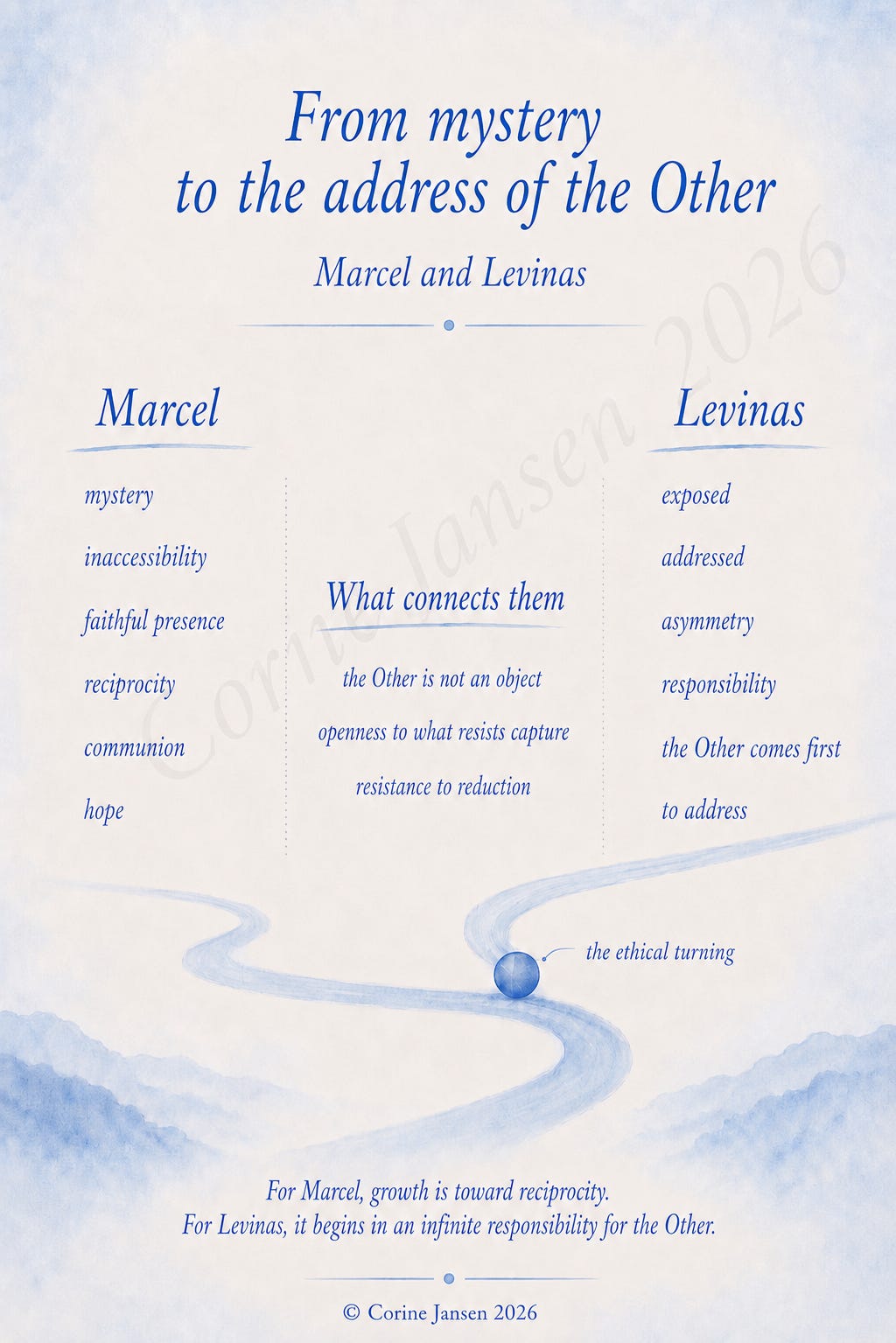
The deepest difference lies in the direction of the encounter. In Marcel it is ultimately aimed at reciprocity. He speaks of communion, a space in which two people meet each other and together form something they each lack on their own, an ongoing exercise he called fidélité créatrice, creative fidelity.(11) In Levinas it is otherwise. The Other addresses me before I choose it, without the Other owing me anything. The relation remains asymmetrical: I stand surety for the Other, and whether anything is ever given in return takes nothing away from that responsibility.
Marcel saw this difference himself and took a position against it. His image of reality as a whole of connected beings was meant in part as a reply to philosophers of absolute otherness, among whom he counted Levinas.(12) For Marcel, an otherness that stands wholly outside any relation threatens to make the encounter itself impossible. For Levinas, an otherness that is taken up into a relation threatens to lose its strangeness and with it its appeal. The disagreement between these two men, who knew each other for forty years, was not fought out, and it was never resolved.
I read the distinction between problem and mystery as a lesson in listening. The moment I treat the other as a question with a solution, I stand outside it and have my judgment already prepared. That lies close to what I call judgment-awareness, though Marcel arrives at it by another route: he asks himself what kind of knowledge is actually possible here.
Marcel is, moreover, a thinker of ordinary reality. The Friday evenings at the rue de Tournon began with shared experiences, such as the promise or the sense of injustice, and his philosophy grew out of the work at the Red Cross, where behind every file number a family was waiting. That movement is one I hope to hold on to in my own vignettes: the scene first, the thinking afterwards. His attention to the body, too, to being present or absent before anything is said, gives words to something the practice of listening shows every day.
Even so, Levinas remains for me the ethical ground. Marcel ultimately seeks reciprocity, communion; in my work it is precisely the asymmetry I need, the awareness that the appeal of the other does not depend on what comes back. Perhaps that is why studying Marcel was such a pleasure. He is kindred enough to clarify and different enough to keep Levinas sharp.
Marcel joined to his thinking a form of hope. Optimism counts on a good outcome; hope keeps a space open for what is not yet visible and can bear that the outcome remains unknown.(13)
For me that is perhaps the most Marcellian description of listening: keeping a space open for what is not yet visible. It is perhaps what he gave the young Levinas on those Friday evenings: the awareness that a door can stand open before anyone knows what lies behind it.
The Friday evenings took place, almost without interruption, from 1934 to 1972 in Marcel’s apartment at 21 rue de Tournon, where a plaque commemorates him. On the circle of visitors, among them Ricoeur, Levinas, Jean Wahl, Simone de Beauvoir, Berdyaev and Sartre: Stanford Encyclopedia of Philosophy, “Gabriel (-Honoré) Marcel”. Ricoeur’s recollection of how the evenings worked appears in his intellectual autobiography Réflexion faite (1995), cited in “La philosophie dans ses meubles (1): Gabriel Marcel”, En attendant Nadeau, 2017. There too the observation that Sartre and De Beauvoir rarely spoke of having been present, while Levinas and Ricoeur acknowledged their debt to Marcel.
Marcel’s self-description as a neo-Socratic: “Gabriel Marcel, qui n’aime pas à être qualifié d’existentialiste, se déclare volontiers un « néo-socratique »”, in an exposition of his philosophy occasioned by Roger Troisfontaines, De l’existence à l’être, in Revue philosophique de Louvain 53 (1955).
Marcel’s leadership of a Red Cross service for tracing missing soldiers during the First World War is widely documented in the biographical literature, among others in the biographical sketch by Éditions Arfuyen: “Durant la guerre, il dirige un service de la Croix-Rouge destiné à retrouver les combattants disparus.”
The distinction between problem and mystery, with the formulation of the mystery as “a problem that encroaches upon its own data” (un problème qui empiète sur ses propres données): Gabriel Marcel, “Position et approches concrètes du mystère ontologique” (1933) and Être et avoir (1935). In English included in The Philosophy of Existentialism (1956) as “On the Ontological Mystery”. There love belongs, alongside evil and fidelity, to Marcel’s own examples of the mystery.
“Aimer un être, c’est lui dire: toi, tu ne mourras pas.” The saying serves as the title and leitmotif of the anthology Tu ne mourras pas, texts selected and introduced by Anne Marcel, with a preface by Xavier Tilliette (Paris: Arfuyen, 2005). The Association Présence de Gabriel Marcel writes that this sentence indicates the direction of his entire thought.
Buber on the I-Thou and I-It relation: Martin Buber, Ich und Du (1923).
Marcel’s own distinction between Thou and He: Gabriel Marcel, Être et avoir (1935); in the English translation Being and Having, translated by Katherine Farrer (Westminster: Dacre Press, 1949).
The parallel between Buber’s I-Thou/I-It and Marcel’s mystery/problem: Robert E. Wood, “The Dialogical Principle and the Mystery of Being: The Enduring Relevance of Martin Buber and Gabriel Marcel”, International Journal for Philosophy of Religion 45, no. 2 (1999).
Disponibilité and indisponibilité: Stanford Encyclopedia of Philosophy, “Gabriel Marcel”, on intersubjectivity. I translate disponibilité as receptivity and keep availability apart for my own third basic concept, which I do not derive from Marcel.
Incarnation as a fundamental motif: Gabriel Marcel, Journal métaphysique (1927) and Être et avoir (1935). Marcel calls incarnation the central given of metaphysics, the given from which every fact first becomes possible.
Communion and fidélité créatrice: Gabriel Marcel, Du refus à l’invocation (1940); English translation Creative Fidelity, translated by Robert Rosthal (New York: Farrar, Straus and Company, 1964).
Marcel’s image of “constellations” of connected beings as a reply to philosophers of absolute otherness, among them Levinas: Stanford Encyclopedia of Philosophy, “Gabriel Marcel”. On the relation between the two thinkers see also Brian Treanor, Aspects of Alterity: Levinas, Marcel, and the Contemporary Debate (New York: Fordham University Press, 2006).
Hope as an attitude that keeps a space open, distinguished from optimism: Gabriel Marcel, Homo viator: prolégomènes à une métaphysique de l’espérance (Paris: Aubier, 1945).
No posts
Comments
Nothing yet. Say the first thing.
Sign in to join the conversation.