
A brief note: this essay was originally written in Dutch. English is not my native language, and I hope this translation keeps something of the cadence of the language in which I first thought and wrote it.
On a November night, Jean-Baptiste Clamence is walking home across the Pont Royal in Paris. He passes a young woman dressed in black, leaning over the parapet and looking down at the water. He hesitates for a moment, then continues on his way. Some fifty meters farther along, he hears the sound of a body striking the water, followed by a cry. He stops. He does not turn around. He alerts no one, and for years he tells no one what happened. This is how Albert Camus recounts it in The Fall, published in 1956.¹
Years later, Clamence tells the story to anyone willing to listen, night after night, in a bar on Amsterdam’s Zeedijk. He describes the surrounding rings of canals as the circles of hell, with himself comfortably installed at their center. The celebrated Parisian lawyer he once was no longer exists. He now calls himself a judge-penitent, a man who confesses his own guilt so that he may retain the right to judge the guilt of others. His monologue is brilliant and appalling in equal measure. As we read this slender book, we become aware of how readily we find ourselves nodding along, and then recoil from the discovery. At least, I do.
I recently reread The Fall and realized that I can no longer read it without Levinas beside me. Their worlds differ too greatly for Camus and Levinas to be saying the same thing. The affinity lies elsewhere: in the course of a single night on a bridge, Camus makes visible what Levinas spent an entire philosophy trying to think.
Camus was born in Mondovi in 1913, in what was then French Algeria, the son of a farm laborer and a cleaner. His father died in 1914 from wounds sustained at the Battle of the Marne; Albert was not yet a year old. He grew up in Belcourt, a poor neighborhood of Algiers, in a home without books, together with his grandmother and his mother. His mother, Catherine, was deaf and spoke very little. Anyone seeking to understand the weight silence carries in Camus’s work might begin there: he grew up beside someone he loved and with whom he could scarcely speak. In his unfinished novel The First Man, published after his death, he returns to that room.²
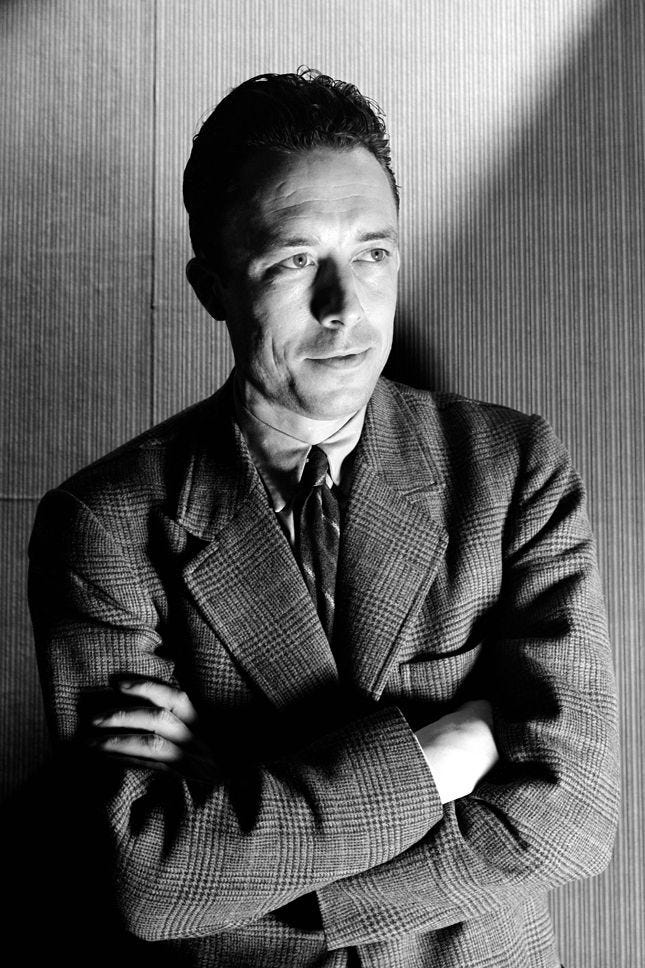
Albert Camus in Vogue, 1946 / Cecil Beaton/Condé Nast via Getty Images
A schoolteacher named Louis Germain noticed the boy and made it possible for him to attend the lycée. When Camus received the Nobel Prize in 1957, he wrote Germain a letter of thanks that has since become famous. Tuberculosis brought his dreams of becoming a footballer to an end when he was seventeen, and almost ended his education as well. He became a journalist in Algiers, moved to Paris in 1940 and worked during the war for the Resistance newspaper Combat, while writing the books that would make him famous: The Stranger and The Myth of Sisyphus in 1942, followed by The Plague in 1947.
The Rebel appeared in 1951, provoking his very public rupture with Sartre. The Fall, published in 1956, was partly written out of that wound. It is a self-portrait that also portrays his opponents, along with anyone who accumulates virtue as though it were a possession. Four years later, in January 1960, Camus died in a car accident. He was forty-six.
It is tempting to imagine an encounter between them. Levinas lived and worked in the same city during the same period. As far as I have been able to establish, no meeting between them has ever been documented. Both men lived in Paris, though they inhabited different worlds.
Camus belonged to the literary heart of the city: Gallimard, the editorial offices of Combat, the cafés of Saint-Germain-des-Prés. Levinas directed a Jewish educational institution, the École Normale Israélite Orientale, and moved among phenomenologists and Jewish thinkers. He kept his distance from the existentialist stage. The war, too, had marked them in different ways. Camus wrote for the Resistance. Levinas returned from captivity as a prisoner of war, having lost almost his entire family.
There was one man they both knew, and through him their two worlds almost touch: Sartre. Camus and Sartre met in occupied Paris and became friends. Their friendship ended publicly in 1952, during a polemic over The Rebel from which neither of them ever fully recovered. Levinas and Sartre were never friends, though the connection between them may be stranger still.
It was Levinas’s 1930 dissertation on Husserl that introduced Sartre to phenomenology. Simone de Beauvoir describes how Sartre bought the book and immediately began reading it, there and then. In 1964, after Sartre declined the Nobel Prize, Levinas wrote him a letter. The man who had refused the prize, he suggested, might now be the only person entitled to speak. He urged Sartre to go to Nasser and propose peace with Israel. Sartre never replied.³ Three years later, he did in fact travel to Cairo and Jerusalem. Whether Levinas’s letter played any part in that journey remains impossible to say.
Sartre thus connects the two men without ever bringing them together. The friend who broke with Camus was also the reader through whom Levinas first entered French intellectual life. Their questions nevertheless meet at the very place where The Fall unfolds. After 1945, both understood that European humanism had lost its innocence. A civilised and rational world had failed to prevent the catastrophe. The civilised and rational individual standing on the bridge failed as well. Camus sought an answer in solidarity and measure; Levinas sought it in a responsibility preceding choice.
Later readers have therefore placed them side by side, as representatives of two humanisms emerging after the catastrophe.⁴ My own reading is simpler: The Fall is the novel that shows why Levinas’s question is needed. Clamence possesses everything classical humanism asks of a human being: reason, eloquence and virtue. None of it saves the woman on the bridge.
What is missing is the response to another human being.
The woman has asked nothing of Clamence. She has not approached him, perhaps has not even looked at him. Yet he has been summoned, and he knows it, because fifty meters farther on he stops. For Levinas, the summons of the Other precedes both my understanding and my choice.⁵ I may respond, or I may continue walking. What I cannot do is return to the time before anything was being asked of me.
Clamence walks on, and his very act of walking on becomes evidence that he had been called. Someone who had never been required to answer would have nothing to confess twenty years later in an Amsterdam bar.
Roger Burggraeve once offered me a distinction that illuminates everything here: the appeal of the Other is irrefutable, though it is never irresistible.⁶ Were it irresistible, ethics would disappear, and necessity would take its place. Responding carries weight because looking away remains possible.
Camus has written the darkest illustration of that thought I know. Clamence is free on the bridge, and that freedom becomes “his sentence.”
What preoccupies me most on rereading the novel is what happens to Clamence’s goodness. Before that night, he helped blind people cross the street, gave up his seat on the tram, represented widows and orphans without charge, and took pleasure in the image of himself that these actions produced.
Camus shows how helpfulness can become a form of self-affirmation, an attention that primarily gratifies the giver. The conclusion is hardly that we should cease helping. It asks us to place the measure elsewhere: in what my presence makes possible for the other, rather than in the image of myself reflected back to me. Effect before intention, as I would now call it.
Clamence had intentions, and he had an audience.
There is also a listener in this book, though he is easily overlooked. Clamence delivers his entire confession to someone from whom we hear not a single word. It is this silence that makes the monologue possible.
For anyone who has made listening their work, this offers an uncomfortable mirror. A judgment-free presence may give someone room to reveal themselves. The same room can become a stage for someone who mainly wants to hear himself speak. Listening offers no guarantee that truth will emerge. It is a willingness to remain present while another person searches, even when the search proves vain.
At the end of the novel, Camus briefly allows the listener to emerge. He turns out to be a lawyer, as Clamence once was. The mirroring is complete. A listener is never merely a witness. The story draws him in and requires him to take a position in relation to it.
At the end of the novel, Clamence imagines the woman jumping once again, allowing him at last to save himself by saving her. He knows it will never happen, and almost congratulates himself on the fact: the water is so cold.
That one bitter sentence reveals why returning is different from being given another chance. The opportunity expires. The summons does not.
I have written before about an evening in Bilbao, when a young woman sought my gaze and I was unable to “understand” what she was asking, or whether she was asking anything at all.⁷ There was no splash, and perhaps there was nothing.
What remains is the question of what I do when someone passes me and asks something I cannot understand. No philosophy can resolve that question for me. It sometimes keeps me awake, though, and perhaps that is what it is meant to do.
Albert Camus, La Chute (Paris: Gallimard, 1956), published in English as The Fall.
For the biographical details, see Olivier Todd, Albert Camus: Une vie (Paris: Gallimard, 1996). The unfinished novel was published posthumously as Le Premier Homme (Paris: Gallimard, 1994), translated into English as The First Man.
The scene in the bookshop appears in Simone de Beauvoir, La Force de l’âge (Paris: Gallimard, 1960). I discussed it previously in Part 11 of this series. On Levinas’s unanswered letter to Sartre in 1964, see the chapter “Sartre et Levinas: quel dialogue?” in Sartre et les Juifs (Paris: La Découverte, 2005).
See, for example, Tal Sessler, Levinas and Camus: Humanism for the Twenty-First Century (London: Continuum, 2008).
Emmanuel Levinas, Totalité et Infini: Essai sur l’extériorité (The Hague: Martinus Nijhoff, 1961). On the summons that precedes choice, see also Parts 4 and 10 of this series.
I owe the distinction between the irrefutable and the irresistible to Roger Burggraeve (personal communication, Leuven, 2025). See also Part 4 of this series, “Asymmetry.”
I described that evening in Bilbao in Silence as an Ethical Act (December 2025).
No posts
Comments
Nothing yet. Say the first thing.
Sign in to join the conversation.