
A brief note: this essay was originally written in Dutch. English is not my native language, and I hope this translation keeps something of the cadence of the language in which I first thought and wrote it.
For the first time in this series, two guests are joining us at once, and what guests they are. Jean-Paul Sartre and Simone de Beauvoir never married, never lived together, and described their bond as a pact: their love was necessary, other loves were allowed, and they would tell each other everything. They sustained that pact for more than fifty years, until Sartre’s death in 1980. They are buried together at Montparnasse, beneath a single gravestone. (1)
Endless amounts have been written about this couple, sometimes admiringly, sometimes with indignation. What interests me is something else. Both of them, each in their own way, thought about the very question that runs through this series: what happens when another person looks at me? And both crossed paths with Levinas, one as one of his earliest readers, the Other as one of his sharpest early critics.
They met in 1929 while preparing for the agrégation, France’s highly competitive state examination in philosophy. Sartre came first, De Beauvoir second. She was twenty-one, the youngest person ever to pass the examination. Members of the jury later said that there had been considerable hesitation over who should be awarded first place. Among Sartre’s circle, people teased her for taking her studies so seriously. And she did. For those young men, studying was simply a given. For her, it meant freedom. Sartre came to regard her as the person with whom he could discuss all his ideas, and as the first reader of everything he wrote. (2)
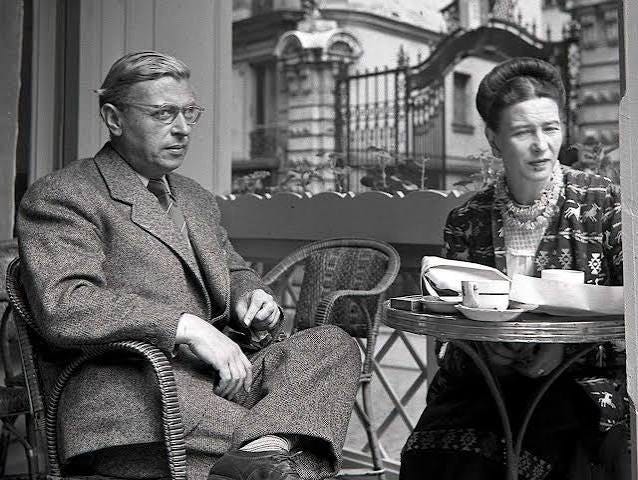
Sartre and De Beauvoir, Rex Features in The Independent
They did consider marriage, although neither wanted a conventional marriage or children. One evening, they were sitting on a stone bench in the Tuileries. Behind a railing, a cat was meowing inside a cage-like enclosure, too large to find its way out. A woman fed it small pieces of meat and gently stroked it. At that moment, Sartre proposed that they make a two-year contract. A cage, a few pieces of meat being handed through the bars, and beside it a pact that was meant to be about freedom. Sarah Bakewell wonders whether De Beauvoir later embellished the memory with symbolic details. I prefer to leave that question open. (3)
They made it through those two years. They would tell each other everything about their other relationships, while their own relationship was to remain the most important one, necessary in their language, while the others would be contingent. They only partly lived up to the first promise. The price was high, particularly for the other people who became entangled in their arrangement. (4)
De Beauvoir loved to walk, and walked a great deal. Sartre had to be persuaded to join her. In Being and Nothingness, there is a description of a climb with a companion who remains unnamed. He experiences the effort as a burden that deprives him of his freedom, drops his rucksack and sinks down beside the road. She is equally tired and finds it exhilarating to keep going, with the sun on the back of her neck and the path revealing a new face with every step. Two people on the same road, and the landscape appears differently to each of them. This is where one of the difficulties of listening begins: the same road does not feel the same to the other person as it does to me. (5)
Their philosophy unfolded in familiar places. Anyone walking through Saint-Germain-des-Prés in the 1940s might have seen them sitting in Café de Flore, writing for hours every day at its tables. During the Occupation, De Beauvoir also worked there simply because it was warm. Hotel rooms were not heated, and neither of them had a permanent home. (6)
The story of how Sartre discovered phenomenology has often been told. In the early 1930s, he was sitting in a bar with Raymond Aron, drinking apricot cocktails. Aron had just returned from Berlin and said: if you are a phenomenologist, you can talk about this cocktail, and it becomes philosophy. Sartre reportedly turned pale with excitement, went straight to a bookshop and bought the dissertation of a certain Emmanuel Levinas on Husserl. He cut open the pages as he read while walking through the streets. (7) And so phenomenology entered France, through Levinas and into Sartre’s hands.
What Sartre built from it can be found in Being and Nothingness, published in 1943. Its best-known discussion concerns the gaze, le regard. I am sitting on a bench in a park, looking around, and the world arranges itself around me. Then I become aware that someone is looking at me, and everything changes. I become an object in another person’s world. I see myself from the outside, and I feel shame. In his play No Exit (Huis clos), there is the line that has survived from this idea: hell is other people. (8)
It is the same scene we encounter in Levinas. A human being is looked at and is no longer alone in the world. Yet the meaning moves in a very different direction. For Sartre, the gaze turns me into an object and the struggle begins; my freedom comes under pressure. This is how consciousnesses relate to one another in his philosophy. It is not simply a habit that can be unlearned.
With Levinas, something else happens. The face, as we have encountered it in earlier parts of this series, addresses me, and responsibility begins there. My freedom acquires a direction because there is someone for whom I can answer. (9)
The circle around Sartre and De Beauvoir offers many examples of that first reading. Camus broke with Sartre in 1952, after a devastating review of The Rebel in Les Temps Modernes; I wrote about that in the part on The Fall. Merleau-Ponty, De Beauvoir’s fellow student and co-founder of the same journal, could not follow Sartre’s growing alignment with the communists and left the editorial board in 1953. Aron too, the man of the apricot cocktail, became his political opponent after the war. It was not until 1979 that they stood beside one another again, when they jointly drew attention to the Vietnamese boat people. There were more ruptures than reconciliations, while the pact at the centre endured. (10)
For listening, this distinction matters. Someone who feels watched may become defensive. Someone who feels addressed may find themselves able to respond. Both can happen within the same conversation, sometimes within a single minute. My gaze can turn someone into a case. My attention can help someone find the space to speak.
Then there is De Beauvoir. During her student years, she often debated with Maurice Merleau-Ponty while walking through the gardens of the École Normale Supérieure and, later, the Jardin du Luxembourg. She had ranked above him in the examination and yet quite naturally assumed the role of philosophical novice in his company. She usually won their arguments, and often without much difficulty. Yet she would frequently leave the discussion saying: “I know nothing, nothing. Not only do I have no answer, I have not even found a satisfactory way of asking the questions.” (10)
It is a curious way to win, and still it seems to me the better one. Someone who wins a conversation and walks away satisfied may simply have had their own position confirmed. She was left wondering whether she had even asked the right question. Sartre later described this capacity for astonishment as the moment when the question changes the person asking it. He admired it and distrusted it at the same time. He called it the most authentic form of philosophy, while also regarding it as a form of philosophical poverty. (11)
I am inclined towards the first part of his judgement. A question that leaves the person asking it untouched was often a statement in disguise. Listening with an awareness of judgement asks something more of us: a willingness, for a moment, not to know what we think, even when we may have been right.
The Second Sex also began with a conversation. Shortly after the war, when De Beauvoir wanted to write about herself, Sartre asked what it had meant for her to grow up as a girl. Very little, she initially thought. As she began to examine the question, she discovered the opposite. The book appeared in 1949, containing the line that has endured: one is not born, but rather becomes, a woman. Her analysis revolves around an idea that has appeared several times in this series. In our culture, woman has always been the Other, defined in relation to man, who takes himself to be the self-evident centre. (12)
In a footnote on the opening pages, she challenges Levinas. In Time and the Other, he had described the feminine as alterity par excellence, in its absolute form, intended as a tribute to an otherness that cannot be absorbed into the self. De Beauvoir read it differently. When the feminine is made into mystery and declared to be the Other, she argues, this is done from the standpoint of the man, forgetting that a woman is also a consciousness in her own right. What presents itself as objective description in fact confirms a male privilege. (13)
It is probably the earliest feminist critique of Levinas, written at a time when almost nobody was reading him. As far as I know, he never responded to it directly. Later thinkers returned to the question, most notably Luce Irigaray: does the feminine receive a place of honour in Levinas, or does such a position leave it outside the door? (14) I prefer to leave that question open. What strikes me is how Levinasian De Beauvoir’s criticism itself seems to be. She asks whether someone who turns the other into a mystery has really listened to that other, or has mainly been listening to themselves.
Her ability to see the workings of the male gaze so sharply was also connected to her own life. In the relationships that grew out of the pact, she had largely approached others from her own perspective during the 1930s. Looking back, she called this solipsistic. That mistake became one of the building blocks of her ethics. She began to distinguish love from what she called idolatry: turning another person into an idol rather than encountering them as a free human being with experiences and relationships of their own. Listening carries the same danger. I fill in the other person according to what I am looking for in them, and in doing so lose sight of the free human being sitting opposite me.
She also put her ideas into practice. The Bibliothèque Nationale holds around twenty thousand letters sent to her by readers, almost all of them from women writing about their loneliness, or about the relief of discovering that they were not strange for feeling dissatisfied with their lives. From the 1950s onwards, De Beauvoir set aside an hour every day to answer them. (15)
The relationships changed; the work remained. In a 1967 documentary for Canadian television, you see the two of them sitting at separate desks beside one another, smoking heavily, with the scratching of pens as almost the only sound. She writes; he reads a manuscript. (16) Sartre died in April 1980. De Beauvoir followed six years later, almost to the day.
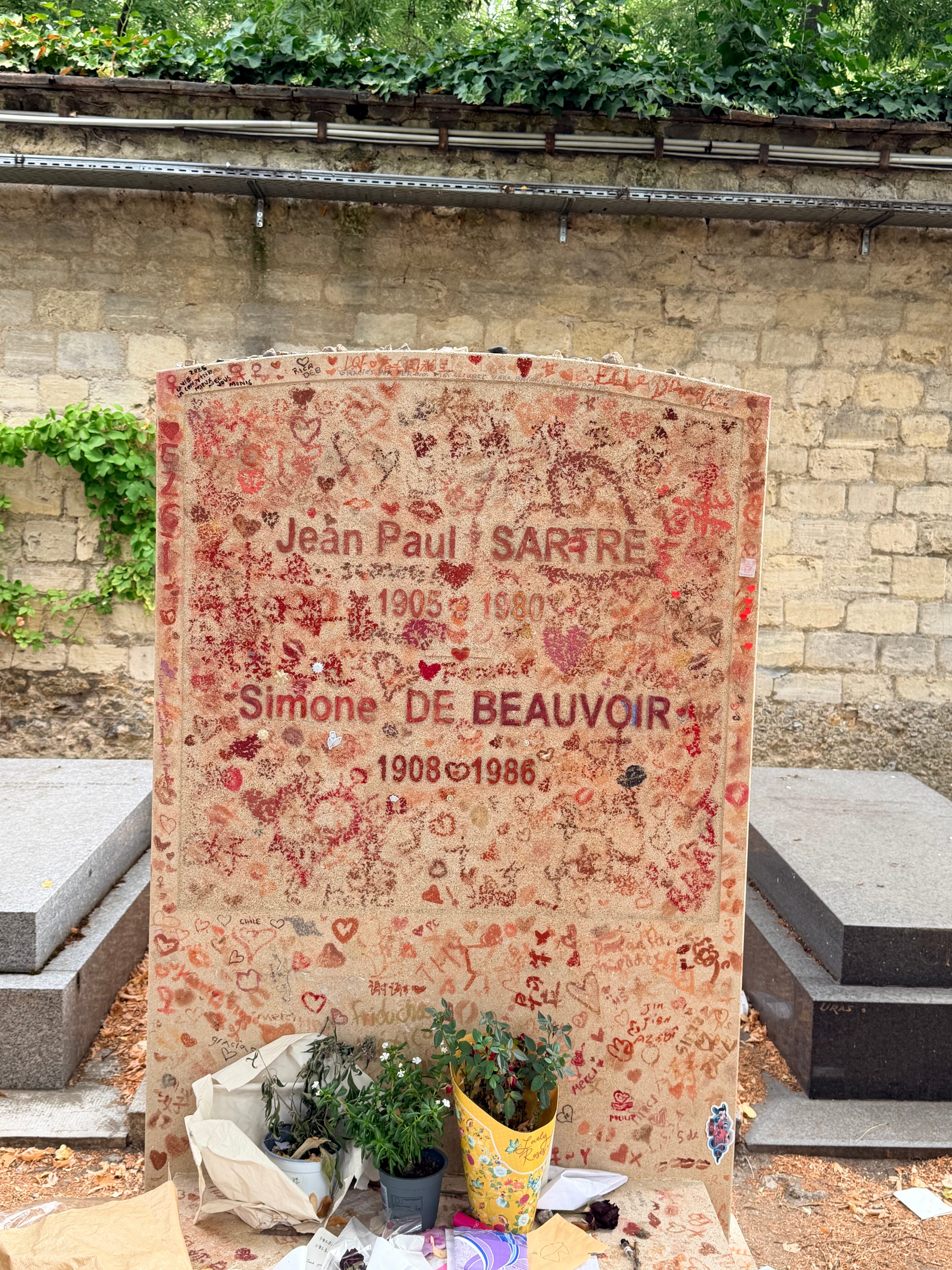
Photo: author’s own
I find myself thinking here of a ninety-two-year-old woman who appeared earlier in this series, in the piece on Simone Weil. I had gone to visit her and stayed sitting with her, and at some point during our conversation she told me that she would go to hell because she had loved two men. She had spent a lifetime looking at herself through the eyes of a judge, until what lived within her had become something she carried as guilt. The gaze itself no longer needed to be present; she had internalised it. And the standard by which she condemned herself was never one she had chosen. She had learned to distrust her own love on behalf of an order that prescribed what a woman was allowed to feel. Who had made this woman guilty? And was I listening to her, or to the judgement?
Why she chose to share her secret at that particular moment, I do not know. Perhaps because she knew she would never see me again, perhaps because she needed to say it aloud just once. The only thing I know for certain is that she said it, to someone who had come and sat with her.
Simone de Beauvoir, La force de l’âge, Paris: Gallimard, 1960; Kate Kirkpatrick, Becoming Beauvoir: A Life, London: Bloomsbury, 2019; Annie Cohen-Solal, Sartre 1905–1980, Paris: Gallimard, 1985.
Kirkpatrick, Becoming Beauvoir; Sarah Bakewell, At the Existentialist Café, London: Chatto & Windus, 2016, chapter “Biting into Apricot Cocktails” [depending on edition]. The jury’s hesitation is known from later statements by jury members rather than from the official records.
The scene in the Tuileries appears in De Beauvoir’s memoirs; Bakewell quotes it and raises the question herself as to whether the memory may have been embellished.
Bakewell, At the Existentialist Café, same chapter. On the darker aspects of these relationships: Simone de Beauvoir, Lettres à Sartre, Paris: Gallimard, 1990; Bianca Lamblin, Mémoires d’une jeune fille dérangée, Paris: Balland, 1993.
Bakewell, At the Existentialist Café, same chapter. The climbing scene appears in Jean-Paul Sartre, L’être et le néant, Paris: Gallimard, 1943.
De Beauvoir, La force de l’âge; Cohen-Solal, Sartre 1905–1980.
De Beauvoir, La force de l’âge; Bakewell, At the Existentialist Café, chapter 1. The book was Levinas’s Théorie de l’intuition dans la phénoménologie de Husserl (1930). It was not the only French-language work on Husserl, but it was the book Sartre encountered at that moment.
Sartre, L’être et le néant, Part III; Huis clos, first performed in 1944. Sartre later pointed out that the famous line is often interpreted too absolutely: other people become hell when our relationship with them has become corrupted.
Emmanuel Levinas, Totalité et Infini. Essai sur l’extériorité, The Hague: Nijhoff, 1961, Part III, “Le visage et l’extériorité”; Éthique et infini. Dialogues avec Philippe Nemo, Paris: Fayard, 1982, chapter “Le visage”, where Levinas explains that the face withdraws from what I perceive of it.
Bakewell, At the Existentialist Café, drawing on De Beauvoir’s memoirs, in which Merleau-Ponty appears under the pseudonym Pradelle.
Bakewell, At the Existentialist Café, on De Beauvoir’s capacity for astonishment and Sartre’s ambivalent judgement of it.
Simone de Beauvoir, Le deuxième sexe, Paris: Gallimard, 1949; on its origins, La force des choses, Paris: Gallimard, 1963.
Le deuxième sexe, introduction, footnote concerning Levinas’s Le temps et l’autre.
Luce Irigaray, “Fécondité de la caresse”, in Éthique de la différence sexuelle, Paris: Minuit, 1984; Tina Chanter (ed.), Feminist Interpretations of Emmanuel Levinas, University Park: Penn State University Press, 2001.
Kate Kirkpatrick, Simone de Beauvoir: A Life, and Judith G. Coffin, Sex, Love, and Letters: Writing Simone de Beauvoir, Ithaca: Cornell University Press, 2020.
Bakewell, At the Existentialist Café. Sartre died on 15 April 1980, De Beauvoir on 14 April 1986.
No posts
Comments
Nothing yet. Say the first thing.
Sign in to join the conversation.