
A brief note: this essay was originally written in Dutch. English is not my native language, and I hope this translation keeps something of the cadence of the language in which I first thought and wrote it.
In the week before Easter in 1938, the French philosopher Simone Weil is sitting in the abbey church of Solesmes. She is twenty-nine and teaches at a girls’ lycée in the provinces. Her head hurts, as it has almost every day since her student years, and every sound strikes her like a blow. Still, she stays, service after service. She follows the Gregorian chant with such attention that the pain, she later writes, retreats to a corner of her body.
During those same days, she discovers that it is possible to love divine love through affliction. (1)
Of all the thinkers in this series, she is the one who stakes most on a single card: love. The headaches remain with her throughout her life and drive her to despair more than once. She voluntarily shares the fate of factory workers and dies at the age of thirty-four, ill and exhausted. Yet until the end she maintains that reality is worthy of love, without illusions and without softening it. How someone manages to sustain that is what I am trying to understand here. With Weil, the path runs through attention, and therefore through listening.
Simone Weil was born in Paris in 1909, into a Jewish family in which religion played no significant role. Her brother André became one of the great mathematicians of the twentieth century; she herself was considered at least as gifted. She studied philosophy at the École normale supérieure and became a teacher at girls’ lycées in provincial France. She gave away much of her salary.
In 1934, she took leave from teaching and spent a year working in factories, frail and physically awkward as she was, first at Alsthom and later on the assembly line at Renault. She wanted to know in her own body what oppression felt like: the exhaustion, the fear of the clock. Something broke in her that year. She later wrote that she had received the mark of slavery there, permanently, and that from then on she continued to see herself as a slave. (2)
In 1936, she joined an anarchist unit on the Republican side in Spain. After an accident involving boiling oil, she returned home. Then came Solesmes in 1938. In 1942 she fled with her parents to New York, where she could not bear to remain while others were in danger in occupied France. At the end of that year she travelled to London to work for the Free French, and there, in the space of a few months, she wrote L’Enracinement. She refused to eat more than the rations available in France.
In the spring of 1943 she was diagnosed with tuberculosis. On 24 August she died in a sanatorium in Ashford, Kent.
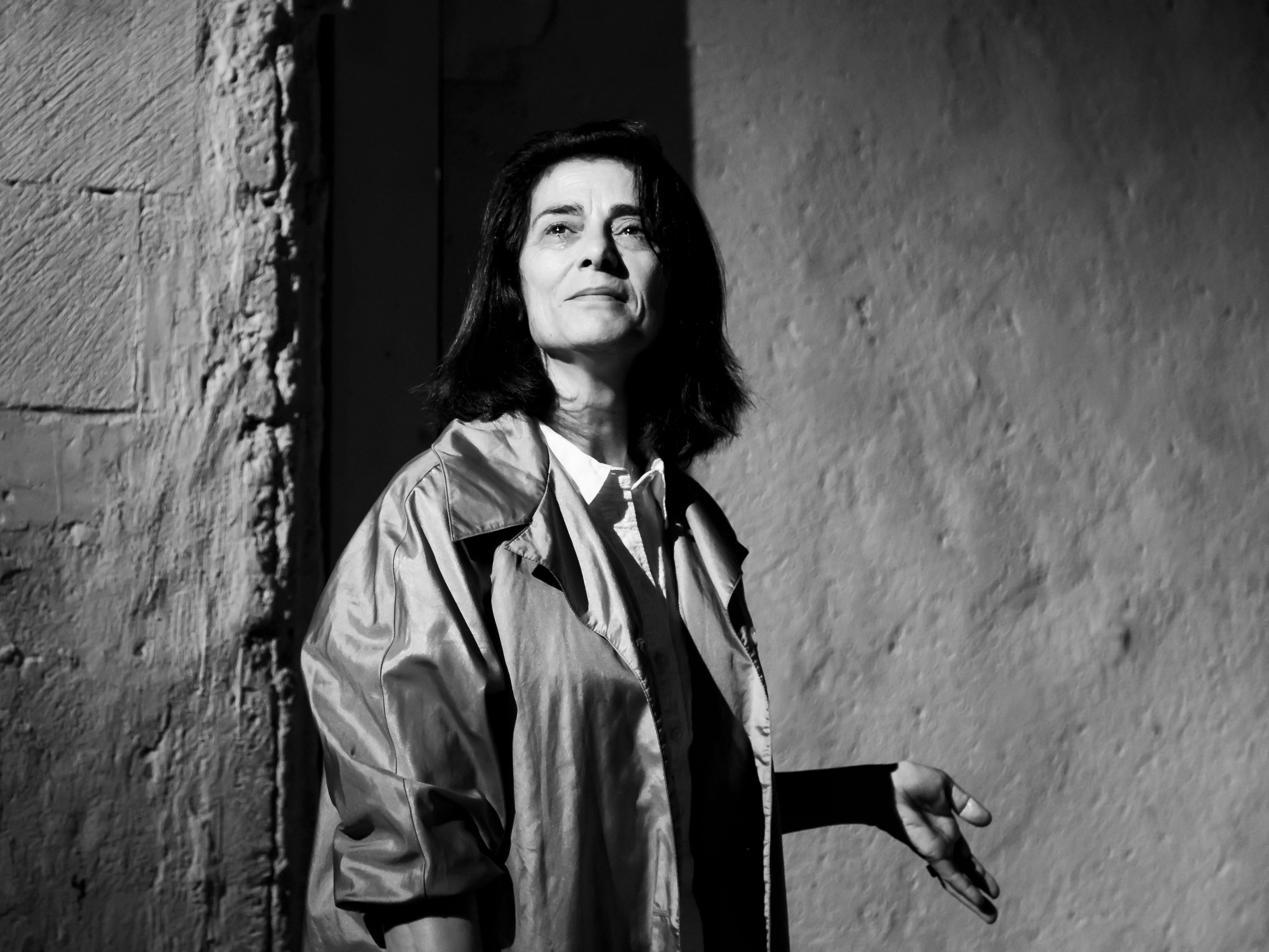
Photograph of Simone Weil by Nicolas Martinez, via sceneweb.fr
Weil has a word of her own for the suffering that concerns her: malheur, usually translated as affliction or misery. It is more than pain or sorrow. Malheur takes hold of an entire life, physically and socially, right into a person’s innermost being. It uproots someone, erases their name and takes away their language.
And it repels.
Someone afflicted in this way evokes aversion, even in themselves. This is why, Weil writes, attention to an afflicted person is rare and difficult, almost a miracle. (5)
The people who most need to be heard may therefore be the hardest to hear. I often saw this in healthcare: the patient who has acquired a reputation for being difficult, the man who has told his story so many times that no one listens anymore, the woman who remains silent because she has learned that speaking changes nothing.
For Weil, listening begins there.
Years ago, I was called to see a woman who was dying. The nurse paused in the doorway.
“She is dying,” she said softly. “We can all feel it. But there is something. As though something is holding her back.”
She was lying in bed. She was ninety-two and lived in a Reformed Protestant nursing home. I sat beside her. We did not know each other. We talked for a while about everyday things, and then I asked her a question.
“How do you look back on your life?” I asked.
“Beautiful,” she said.
Then there was a brief silence.
“Perhaps too beautiful. And that is probably why I am going to hell.”
I no longer remember what my face did. I only remember thinking how terrible it was that someone could be so frightened at the end of her life. Her fear was real. You could see it in her eyes. I wanted to understand why that fear was so great and give her room to tell me.
“I am here for you today,” I said. “You can tell me why you think you are going to hell. There is nothing you need to be ashamed of. After today, you will never see me again. I am not writing anything down and we are not recording anything. Whatever you tell me stays with me. In a while I will walk through that door and leave, and I will not come back. I will keep your story safe with me.”
She looked at me for some time.
Then she began to speak.
She had married young and had three children, three boys, and she was a grandmother of six. She had loved her husband and stressed that theirs had not been an unhappy marriage. A few years after her wedding, though, she had met another man through the church, and she had come to love him too.
Not a little, and not for a short time.
That love had lasted for almost the whole of the rest of her married life.
She had thought about him often and dreamed about him. In her mind she had spoken sentences to him that she had never said aloud. Nothing had ever happened between them.
“I never consummated it,” she said.
Still, she believed that the very existence of that love had been wrong. She had loved her husband and at the same time loved another man. To her, that meant that something had lived in her heart that should never have existed. That was her fear: that she would be punished for that love.
I listened to her.
She had carried this with her for almost her entire life, and now, just before her death, she was telling it to someone she had never met before.
Without thinking, I said:
“What a big heart you have, to have felt so much love in your life.”
What followed was a long silence.
I took one of her hands and held it gently.
Then I asked, “Is there anything else you would like to share before I say goodbye?”
“Thank you,” she said.
Then I walked out through the door, as I had promised.
The drive home took almost three hours. Just before I arrived, I received a phone call.
The woman had died.
In that room, I did not have to share her fear in order to take it seriously, nor did I have to understand her faith in order to stay with her. I think this is what Weil means by attention. She does not ask me to take over or correct what the other believes. She asks me to wait until the other dares to say it, without filling in her story too quickly.
The woman carried her love as guilt.
In the same story, I also heard someone who had been capable of loving deeply and for a very long time.
Neither face of the story had to push the other away.
How could Weil continue to love reality when her own life gave her so many reasons to become bitter?
I find her answer sobering. For Weil, love is a form of attention before it is a feeling or a state of mind. Attention can endure long after feelings have been exhausted. To love reality, one does not have to find it beautiful. Weil rejected every form of consolation built on illusion, while continuing to see the beauty of the world, even in her final letters.
She regarded love of one’s neighbour and love of that beauty, together with friendship and religious practices, as implicit forms of the love of God. (6) She deliberately sought a connection with Nietzsche’s amor fati and with the Stoics. Of Stoicism she wrote: “Not resignation, but joy. One must accept all suffering with joy.” Her yes to reality includes that joy, even where reality itself promises nothing. (7)
Weil could not sustain it.
Her severity was also directed at herself, right down to what she ate, and the fact that she died so young cannot be separated from that. In this series, I am searching for a way of listening that can be sustained over a lifetime, one in which you are allowed to make mistakes and recover from them. Weil knew very little of that kind of moderation.
Still, I would not want to do without her.
She shows how far attention can go when no one restrains it, and what that can cost a human being.
There is another reason why she belongs in this series.
After the war, Weil was quickly read and widely quoted in France. Albert Camus published her work posthumously in his Espoir series at Gallimard, and he is said to have called her the only great spirit of our time. (8)
Levinas read her too.
In 1952 he wrote an article about her, Simone Weil contre la Bible, Simone Weil against the Bible. (9)
Weil had never seriously engaged with the Judaism of her family, and she wrote harshly about it. She read the Old Testament primarily as a book of power and conquest. In her eyes, the God of Israel stood too close to the force she distrusted everywhere.
Christianity strongly attracted her. Yet she was never baptised, and she remained, as she herself put it, on the threshold of the Church.
Levinas had lost almost his entire family in the destruction of European Jewry. He could not let her reading pass unanswered. She was condemning a tradition she did not know, he argued, and he defended the law, which Weil regarded as superfluous.
For Levinas, the law gives love a form that can be enacted, because there are always more people than one.
And here the third person reappears.
As soon as a third stands beside the one Other, I have to compare and distribute. Society begins there, and with it politics.
Weil deeply distrusted the collective. Following Plato, she called society the great beast. (10) Levinas’s response was that goodness without institutions will never reach most people.
Yet there is one point on which they meet.
Weil places obligation before rights, and it is with this idea that she opens L’Enracinement. Levinas arrives at something similar by another route. The other addresses me before I can claim anything for myself.
What holds my attention in this clash is this.
She devoted her life to attention, and yet she failed to bring that attention to the texts of her own ancestors.
Buber had a word for this: a missed encounter.
I think that is more or less what happens here. Weil never really encounters the tradition from which she comes.
Even someone who spends a lifetime practising listening has places where she does not listen.
Levinas writes sharply about her. Still, I also read admiration in that article, admiration for the seriousness with which she tried to live goodness.
That is how I prefer to read her too.
To admire her attention while allowing her blind spot to remain visible.
What Weil leaves to listening begins with her question:
Quel est ton tourment?
What is your affliction?
In a room where someone is silent or crying, that question lies beneath all the others. It wants to repair nothing and explain nothing. It simply acknowledges that there is suffering and that only the other knows what that suffering is like.
Attention that dares to empty itself and does not grasp resembles the silence I wrote about earlier in this series: a holding back that creates room without leaving the other alone.
The hardest part comes after that, I think.
Weil shows that it is possible to continue loving reality without excusing it, even when so much speaks against it.
For her, this was never a decision made once and for all. She called it consentement, consent, and it had to happen again and again, in the attention of this one moment for this one human being.
Shortly after publication, I received a response from Roger Burggraeve, who knows Weil mainly through the article Levinas wrote about her in 1952 and which was later included in Difficile liberté. He pointed to something I had left aside.
Weil’s opposition between the God of the Old Testament and the God of the New has a long history.
It recalls second-century Marcionism and what is known in Jewish-Christian studies as supersessionism, the idea that the New Testament replaces the Old. Levinas sets against this the revelatory value of the Hebrew Bible in its own right, with its emphasis on justice and on the judgment of violence. His messianism cannot be separated from this.
Roger added something else that is missing from my essay above.
Weil’s understanding of Christianity was tested no more seriously than her understanding of Judaism. She sets a Christianity of grace and interiority against a Judaism of law and power, and that image has since become contested within Christianity itself.
With Nostra Aetate in 1965, the Second Vatican Council initiated a new relationship with Judaism, and subsequent documents moved further away from treating Judaism merely as a preparation for Christianity. Catholic social teaching and liberation theology brought the Kingdom of God back into the here and now. What Levinas criticizes in Weil, a theology of grace that fails to face violence, Christians have therefore also criticized within their own tradition.
He also pointed out that Levinas’s tone changes.
In Un Dieu Homme?, a 1968 lecture later included in Entre nous, he engages seriously with Christian notions such as humiliation and substitution, whereas sixteen years earlier he had primarily kept his distance.
The Levinas of 1952 did not have the last word.
I still stand by what I wrote about the missed encounter between Weil and the tradition from which she came. Roger shows that the missed encounter was larger than I had realized.
Weil also read Christianity in the way that suited her, while Levinas responded to a Christianity that had not yet articulated its own critique.
What stands opposite each other, then, are two readings, both still in motion.
Simone Weil describes Holy Week 1938 at Solesmes in what has come to be called her spiritual autobiography, the letter to Father Joseph-Marie Perrin dated 14 May 1942, published posthumously in Attente de Dieu (Paris: La Colombe, 1950).
Simone Weil, La condition ouvrière (Paris: Gallimard, 1951). The image of the mark of slavery appears in the spiritual autobiography in Attente de Dieu.
Simone Weil, Réflexions sur le bon usage des études scolaires en vue de l’amour de Dieu (1942), included in Attente de Dieu. This includes her description of attention, the phrase "quel est ton tourment?", and the idea that the most precious things cannot be sought.
Simone Weil to Joë Bousquet, letter of 13 April 1942, in Simone Weil and Joë Bousquet, Correspondance 1942, edited by Florence de Lussy and Michel Narcy (Paris: Éditions Claire Paulhan, 2019).
On malheur, see especially Simone Weil, L’amour de Dieu et le malheur, in Attente de Dieu. The remark that attention to an afflicted person is almost a miracle appears in Réflexions sur le bon usage des études scolaires.
Simone Weil, Formes de l’amour implicite de Dieu, in Attente de Dieu.
The connection between Weil’s affirmation, Nietzsche’s amor fati and the Stoics, as well as the quotation about joy and the acceptance of suffering, comes from Joke Hermsen, Een utopische stip op de horizon (De Groene Amsterdammer, 9 March 2022), who quotes Weil there.
From 1949 onwards, Albert Camus published Weil’s work in the Espoir series he founded at Gallimard, beginning with L’Enracinement (1949). The phrase le seul grand esprit de notre temps, “the only great spirit of our time”, is attributed to him.
Emmanuel Levinas, Simone Weil contre la Bible, in Évidences, no. 24 (1952), reprinted in Difficile liberté (Paris: Albin Michel, 1963).
The great beast, le gros animal, after Plato, Republic, Book VI. See Simone Weil, La pesanteur et la grâce (Paris: Plon, 1947), compiled by Gustave Thibon.
No posts
Comments
Nothing yet. Say the first thing.
Sign in to join the conversation.