
Germany has one of the world’s most generous heat pump subsidy schemes. Yet German households still pay more, after subsidy, than many households in neighbouring countries. How come? That is the puzzle we tried solve in a new research paper. The answers we found surprised us and were not what we expected.
First some context
A German household installing an air-to-water heat pump in an existing home pays somewhere between €23,000 and €40,000. In the UK the same installation costs around €13,800. Why Is there such a huge gap? Marek Miara and I have just published a paper in the journal Energy & Buildings trying to understand where that difference might come from. TLDR: The answer is less about German heating engineering culture than I expected when we started writing the paper and potentially much more about policy design.
Our starting point was a specification-matched comparison done by my collaborator Christian Vering and colleagues at RWTH Aachen. They found that an air to water heat pump in a similar type of home was priced very differently: €29,719 net in Germany compared to €12,095 in the UK. Because Germany applies 19% VAT to heat pump installations while the UK has applied a zero rate since 2022, the price per unit installed before any grant is €35,366 compared to €12,095. In total, that is a gap of €23,271 or 192%. Note that this is not because we compare much larger units or different types of heat pumps (air to air heat pumps are much cheaper than air to water systems).
What drives the difference?
Getting a clear answer to a simple question turned out to be a complicated endeavour. Here are some pointers:
Compared to its neighbours German equipment prices contribute €2,000 to €4,000, partly because the German market is dominated by European manufacturers selling units at €9,000 to €18,000, while Asian brands with €3,000 to €8,500 units hold larger shares in the UK, France and the Netherlands.
An additional factor are the installation regulations. In Germany, VDI Guideline 4645 requires outdoor units to be installed on solid concrete foundations, which costs €976 to €2,700 where a wall mount allowable in many other countries costs under €500 (although from my experience many UK installs are also built on concrete foundations or similar).
Since January 2024, §14a of the Energiewirtschaftsgesetz requires a distribution board upgrade for almost every installation which adds another €1,800 to €4,000.
If we include VAT, which accounts for around a quarter of the gross gap, this explains perhaps up to 60% of the difference.
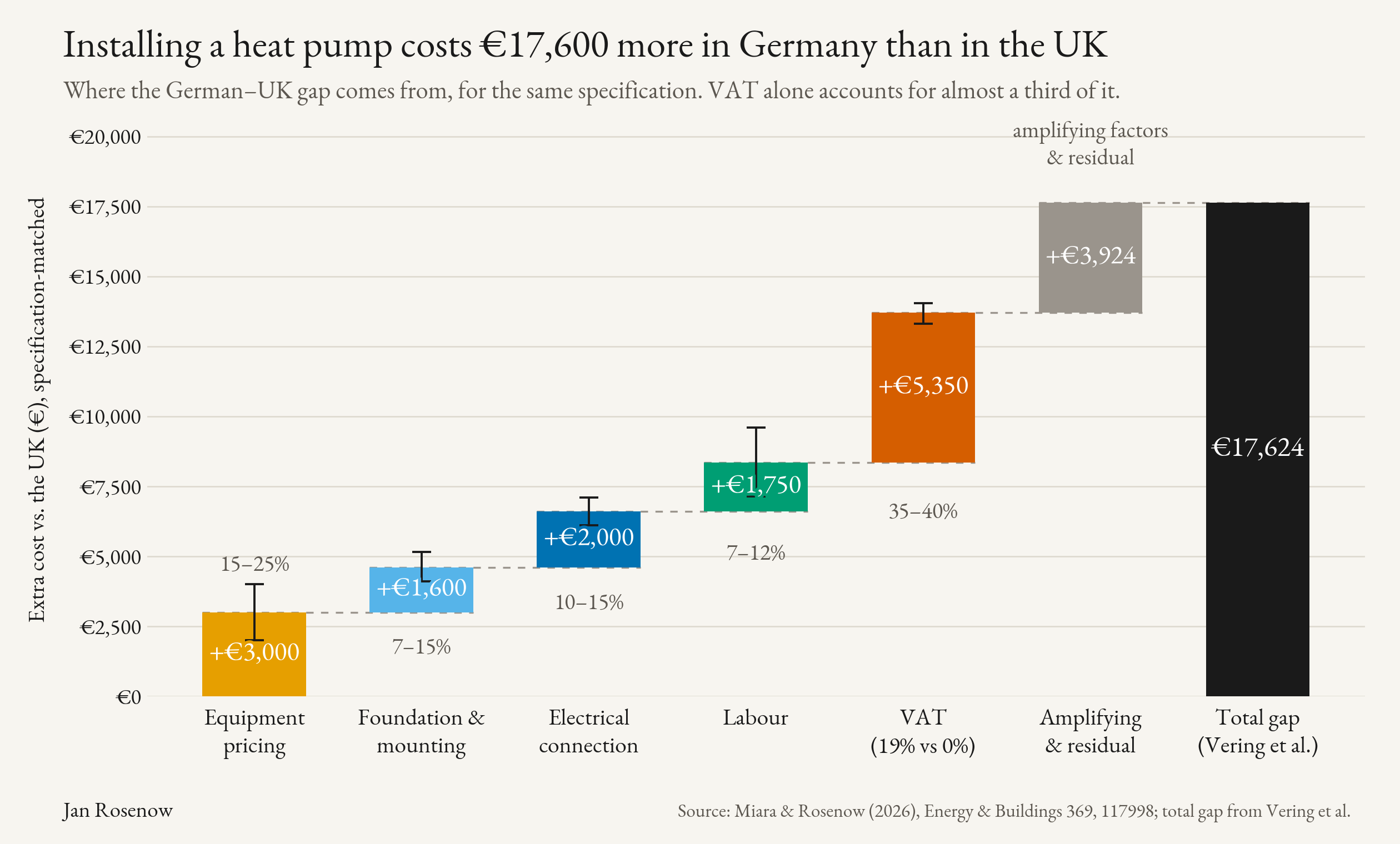
We expected labour costs to make a big difference but were surprised to find that they didn’t. German installers charge €60 to €70 an hour compared to €45 to €60 in the UK. Government-commissioned analysis finds mean labour costs per German installation to be €4,700 which is actually below the UK figure of €4,800. Instead of being a major factor that could explain the price difference labour is a small and genuinely uncertain contributor rather than a key driver, which is not what we expected.
The role of subsidies
So what makes up the remaining 40%? Under the Bundesförderung für effiziente Gebäude, households receive 30 to 70% of eligible costs. If an installer raises a €25,000 quote to €30,000 and the household receives a 50% subsidy rate, the household’s net cost rises by €2,500 while the installer receives €5,000. This means the pressure to negotiate a better deal is halved because of the way the policy is designed.
Could it be that the generous subsidies available may help inflate prices? For heat pump advocates like myself this is a somewhat uncomfortable question as I’m a firm believer in the need for strong policy support for quite some time. But we should be able to have honest conversations about policy effectiveness and sound design. The most effective policies deliver more uptake for every Euro spent.
Germany’s own policy history provides useful evidence for this. Mean total customer costs were around €17,000 through the capacity-based MAP scheme up to 2019. In 2020, when the scheme was redesigned to a percentage-based mechanism the funding share jumped from 11% to 40%. Shortly after that mean costs increased to around €40,000. Could there be other factors? Minimum efficiency requirements for eligible equipment did not change at the same time. Material costs over the same transition rose about 20% and helped drive up prices but installation costs roughly doubled over the same period.
German exceptionalism seems unlikely
Many will rightly point out that 2020 to 2023 was an unusual period. Pandemic, supply chain disruptions, commodity inflation, then a demand boom that allowed German installers to quote much higher. But the UK and Sweden experienced the same shocks and their installation costs rose only by 18% and 14% respectively, while Germany’s rose by about 100%.
Where does this leave German households?
With grants factored in how much do households pay? On the German gross price of €35,366, with €30,000 eligible and a 50% rate (the 30% base plus the 20% climate-speed bonus), the household pays €20,366. Even at the maximum 70%, they pay €14,366. A British household on a gross price of €12,095, taking the Boiler Upgrade Scheme’s flat £7,500, pays about €3,200. Four to six times less, under a scheme worth a fraction of Germany’s in nominal terms, and costing the British taxpayer far less per installation.
The UK’s Boiler Upgrade Scheme is not perfect by any means. It was slow to start, its budget was underspent, and £7,500 is a somewhat arbitrary number arrived at by a somewhat convoluted process. But its simple structure does something important to keep prices in check: every pound above the grant is a pound the household pays in full, so households behave like buyers, and installers price like sellers in a competitive market. France and Poland use fixed or income-differentiated amounts and are positioned at the cheaper end of the European distribution too.
The puzzle remains at least in part unsolved
Of course our attempted decomposition analysis and the conclusions we draw are not without uncertainty. Because we do not have a comprehensive dataset of heat pumps costs and their components our work should be treated as illustrative rather than representative. The large residual (unidentified factors) suggests substantial unexplained variation rather than strong proof of any particular mechanism. And the subsidy evidence is observational: a policy change that coincides with a price change is suggestive only and correlation does not necessarily mean causation.
Are there other countries we could look at? Austria is instructive here. Costs there are at around €32,000 which is close to the German level of heat pump prices. Austria also has generous and partly proportional support schemes in place. Of course this may well be a coincidence. However, without further analysis we won’t be able to say whether or not it is indicative of the effect of policy design.
If anything, we learned that understanding heat pump prices and what drives them is far from trivial and many of our preconceptions might be wrong. Critics may also argue that our analysis makes the case for undermining heat pump policies in Germany. That is not our intention. If anything, our work should serve to improve the effectiveness of policies and address price inflation thereby driving faster heat pump uptake.
The full peer-reviewed paper is available through open access in Energy & Buildings: doi.org/10.1016/j.enbuild.2026.117998
No posts
Comments
Nothing yet. Say the first thing.
Sign in to join the conversation.