
I have been reading Simone Stolzoff’s How to Not Know recently, and I keep finding myself underlining the same kind of sentence. The ones that describe how badly we are wired for uncertainty. How our brains evolved for short bursts of stress, not the ambient, relentless not-knowing that defines modern life. How access to limitless information has somehow made us less tolerant of ambiguity, not more — because it has created the expectation that answers should always be available, immediately, on demand.
One passage stopped me in particular. Stolzoff argues that building a tolerance for uncertainty allows us to meet life’s questions with curiosity instead of fear — and that people who are better at sitting with ambiguity tend to be more creative and more open-minded as a result.
My note in the margin: How do you reach this tolerance? Maybe through foresight?
I wrote that as a genuine question. Because what I observe in practice gives me reason to pause.
Two Books, Two Registers
Schoemaker’s Profiting from Uncertainty — published in 2002, and still worth reading — approaches the same problem from the organisational side. His argument: uncertainty cannot be eliminated, so organisations should stop trying to predict the future and start building the capacity to navigate multiple versions of it. The core tool is scenario planning — not to find the right answer, but to expand the range of answers the organisation is prepared for.
Stolzoff, writing over two decades later for a broader audience, makes a structurally similar case at the individual level. She identifies three “certainty traps” — comfort, hubris, and control — that together produce a kind of epistemic rigidity: the inability to hold open questions open. Comfort keeps us where it feels safe. Hubris tells us we know best. Control insists we plan for everything.
The overlap between these two books, written in different decades for very different readers, is not coincidental. It reflects something persistent about human cognition — and something urgent about the moment we are in.
What Happens in the Room
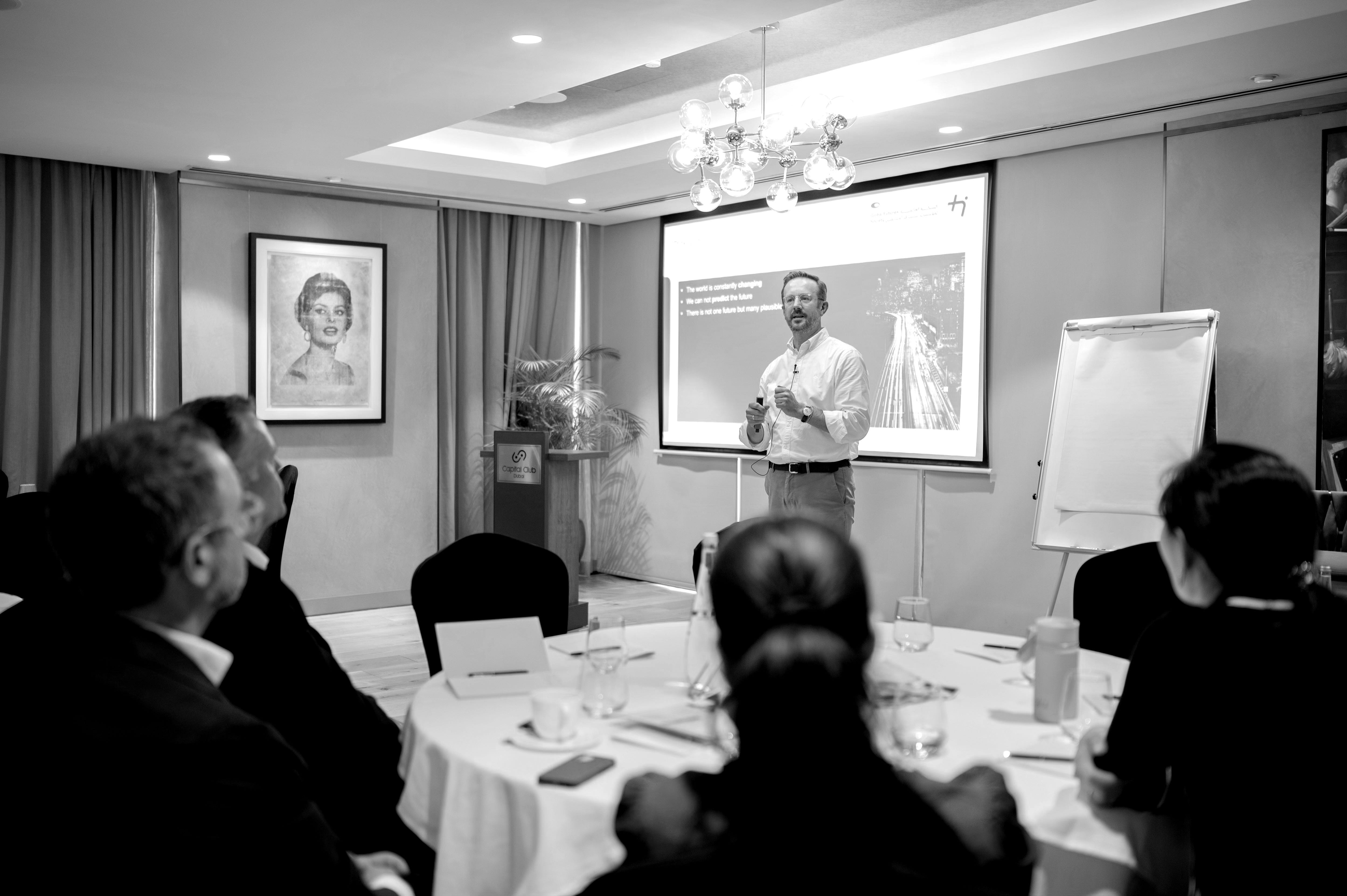
Here is what I keep noticing when I facilitate scenario planning exercises with organisations.
The methodology is not, in itself, the hard part. Most groups grasp the structure quickly enough — the axes, the scenario logics, the exercise of populating futures they have not chosen. What is hard is something more fundamental: the willingness to genuinely inhabit a future they did not expect and do not prefer.
What tends to happen instead is a quiet drift back toward the familiar. Scenarios that begin as genuinely divergent tend to converge, over the course of a workshop, toward variations of the present. The language of uncertainty gets used, but the underlying assumption — that one future is basically already known — reasserts itself. Groups argue at length about which scenario is most likely, when the point of the exercise is to ask what they would do if each one were true.
Stolzoff captures this dynamic well in a passage about an investment team that could not stop debating whether a particular market was in a bubble. One analyst thinks: Maybe we shouldn’t be debating whether this is or isn’t a bubble. We should really be asking: If we were in a bubble, what would we do next?
My note there: the power of asking “what if?”
This is exactly the reframe that scenario planning is designed to produce. And yet, in practice, getting groups to actually make that shift — away from probability and toward preparation — turns out to be surprisingly difficult. Not because the concept is unclear, but because the discomfort of genuine uncertainty runs deeper than any methodology can easily reach.
A Question Worth Sitting With
This is where Stolzoff’s psychological framing and Schoemaker’s strategic framework illuminate each other. Schoemaker gives us the process for working with uncertainty. Stolzoff helps explain why the process is so often resisted — and why facilitating it well is less a technical challenge than a human one.
What both books point toward, and what my own experience in organisations confirms, is that uncertainty tolerance is not simply a disposition some people have and others lack. It is something that can shift — with practice, with the right conditions, with a facilitator willing to hold the discomfort rather than resolve it prematurely.
Whether foresight practice is actually a reliable path to that kind of tolerance is a question I keep returning to in my research. The honest answer, for now, is that I do not know. But I suspect the asking matters more than most organisations realise.
No posts
Comments
Nothing yet. Say the first thing.
Sign in to join the conversation.