
There is a quiet war being fought inside almost every organization. On one side: the pressure to hit this quarter’s numbers, satisfy today’s investor expectations, optimize for what’s visible and measurable right now. On the other: the intuition — held by the best strategists, founders, and leaders — that the real game is played over years and decades, not quarters.
For a long time, that intuition was hard to defend with data. Long-term thinking felt right, but proving it was another matter. That’s starting to change. Over the past three decades, a body of rigorous evidence has accumulated — from corporate finance to strategy research to executive compensation studies — that points in the same direction: organizations that plan and manage for the long term systematically outperform those that don’t.
Here’s what the research actually shows.
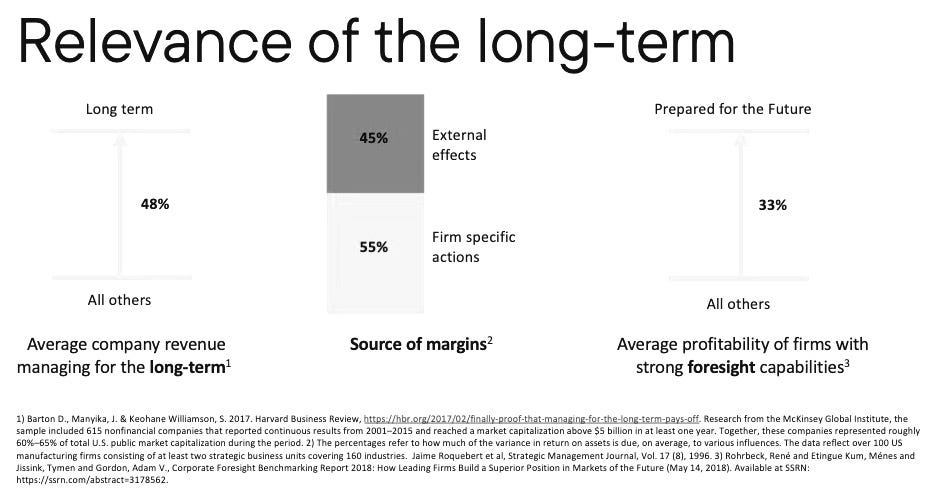
In 2017, McKinsey’s Global Institute published one of the most comprehensive studies ever conducted on long-term corporate management. Working with FCLTGlobal, they tracked 615 large- and mid-cap U.S. public companies from 2001 to 2015 and classified them by how much their behavior reflected a genuine long-term orientation — looking at signals like investment patterns, earnings management, and capital allocation.
The results were striking. Long-term companies outperformed their short-term peers across virtually every financial metric that mattered. Between 2001 and 2014, their revenues grew on average 47% more. Their earnings grew 36% more. Their economic profit — the truest measure of value creation after accounting for the cost of capital — was 81% larger. And in a finding that matters beyond the boardroom: long-term companies created nearly 12,000 more jobs on average than their short-term counterparts over the same period.
The authors estimated that if the S&P 500 as a whole had shifted toward long-term behavior during that window, it would have generated an additional $1 trillion in economic output in the U.S. economy. That’s not a rounding error. That’s the macroeconomic cost of short-termism.
Here is something most strategists still underestimate: the biggest predictor of whether your company is profitable is not the industry you’re in — it’s how you manage.
That’s the core finding of a landmark 1996 paper by Roquebert, Phillips and Westfall published in the Strategic Management Journal. Using a sophisticated variance decomposition approach across a large sample of U.S. businesses, they asked a deceptively simple question: how much of the variance in firm profitability is explained by industry effects, and how much by firm-specific management choices?
Their answer challenged the dominant paradigm of the time. Industry effects — the structural forces that Porter’s Five Forces framework made famous — explained less of the variation in profitability than management decisions did. The choices executives make about strategy, capital allocation, investment horizons, and organizational design matter enormously — and they compound over time. Short-termism, in this light, is not just a values failure. It is a strategic failure: it trades away the management advantage that actually drives sustained profitability.
This has a direct implication for foresight. If management choices are the primary driver of performance, then the quality of your strategic planning process — including how far ahead you are willing to think — is one of the highest-leverage variables in your organization.
The sharpest test of whether long-term thinking actually pays off would be this: measure companies’ foresight practices at one point in time, then check back years later to see whether those investments in looking ahead translated into superior performance. That is exactly what René Rohrbeck and Menes Etingue Kum did.
Their landmark study, published in Technological Forecasting and Social Change in 2018, assessed the “future preparedness” of a large sample of companies in 2008 — measuring not just whether they had foresight practices, but how well-matched those practices were to the genuine uncertainty and complexity their business faced. They then tracked those same companies’ performance through 2015. Seven years is long enough for the effects of strategic decisions to compound, and long enough to filter out short-term noise.
The results were striking. Future preparedness in 2008 turned out to be a powerful predictor of becoming an industry outperformer by 2015. Companies that had invested in mature, well-calibrated foresight practices attained superior profitability and superior market capitalization growth compared to peers who had not. The research also found the inverse: firms with a significant gap between the foresight demands of their environment and the sophistication of their foresight practices were measurably more likely to underperform or decline.
This is perhaps the most directly relevant finding for practitioners. It’s not enough to have a strategy function, or to run the occasional scenario workshop. What matters is the systematic, ongoing capability to perceive weak signals, interpret emerging trends, and act before change becomes obvious. Organizations that build that capability don’t just navigate the future better — they do it years before competitors even realize the landscape has shifted.
Taken together, these three studies construct a compelling empirical case. Long-term orientation:
Produces better financial outcomes at scale, across industries and time periods
Amplifies the thing that matters most — management quality — which turns out to be the primary driver of performance over industry structure
Shows the long arc of payoff — measuring foresight capability and finding it support outperformance
The pattern holds whether you’re looking at it from a macroeconomic perspective, a strategic management lens, or a longitudinal foresight study spanning seven years. The evidence has been building for decades. At this point, the burden of proof has shifted: it now falls on those who argue that short-term management is a viable strategy to explain why the data consistently shows otherwise.
Long-term planning is not a luxury for organizations that have already succeeded. It is a core driver of success itself. The research suggests a few practical implications:
Lengthen your planning horizon deliberately. Most organizations plan in 12-18 month cycles. Building a genuine 5-10 year strategic perspective — even if imperfect and regularly revised — changes what investments and initiatives even make it onto the agenda.
Align incentives with the horizon you claim to care about. The Flammer & Bansal research shows that executive compensation structures are not just administrative details. They are causal mechanisms. If your incentives are quarterly, your management will be quarterly, regardless of what your strategy documents say.
Measure what compounds. Short-term thinking thrives when only short-term metrics are visible. Innovation pipeline, stakeholder trust, talent depth, and organizational learning are harder to measure but are exactly the assets that generate long-term outperformance. Make them visible.
The world is full of organizations that say they think long-term. The research shows that few actually do — and that the ones who manage to follow through on it reap substantial rewards.
That gap is where strategic advantage lives.
No posts
Comments
Nothing yet. Say the first thing.
Sign in to join the conversation.