
On the cusp of every big internal breakthrough in using my talents, something horrible happens in my brain. It happened recently when I was working to dissolve a block in my fiction writing.
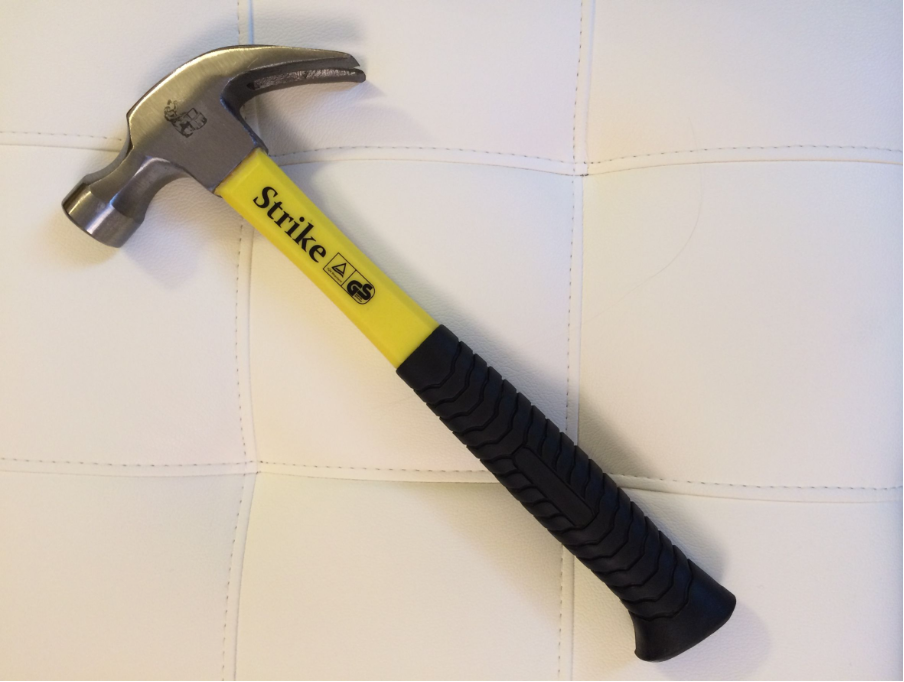
I call it The Hammer.
It starts with a flood of negative thoughts about pretty much everything in my life. My writing sucks, my students are confused, my laundry is never put away, whatever. Meanwhile, my capacity to observe or challenge these thoughts tanks. The worse I feel, the less I notice the kind of crap my brain is feeding me. The less I notice, the less room I have to question the negative observations, the worse I feel.
This downward spiral continues until I forget that any of this has ever happened before, much less that it is a response to my potential writing breakthrough. I forget about the breakthrough entirely. Under the Hammer, I can sense dimly that I used to feel optimistic about many things, but the idea seems almost ridiculous. I would call it despair, except in the moment it feels like just being realistic.
In the past, this would go on until I managed to stumble into a coaching session. And my coach, whose pattern-recognition abilities had not been occluded by an onslaught of terrible feelings, would listen for about 15 seconds and interrupt with, It’s your hammer thing again.
And I’d say, Ohhhhhhhh. And I’d instantly start to feel the tiniest bit better.
That’s because, like most psy ops, the Hammer has more power when we don’t recognise we’re being manipulated. It works best when we don’t realise it’s working at all.

I think what’s happening with The Hammer is simple, if devious. I’ve evolved my theory of it based on my own experience and those of many mentees and clients.
The Hammer powers up because we’re trying to do something that threatens some kind of internal emotional status quo (or, in technical terms, that activates an implicit memory). Our proposed change or goal is going to require us to do something our brains think is a serious threat to our emotional safety. Maybe we will have to relinquish something, grieve something, risk something, whatever.
So our brains go into red alert. They want to protect us. They want to stop us from moving toward this change. So they send the Hammer.
The goal of the Hammer is simple: to stop us from moving toward the goal or transformation.
The approach is the devious part. The Hammer takes a roundabout route. It doesn’t attack whatever we’re trying to do. It attacks us. The question isn’t, Are you sure it’s a good idea to finish this novel? It’s more along the lines of, What the fuck is wrong with you?
Which makes a lot of sense. Attacking the plan would give us a chance to defend the plan. But we are often a lot slower to defend ourselves, especially when the attack is coming from inside our own heads.
The Hammer is distinct from what you may have heard called the inner critic or the judge. The inner critic/judge is a thought pattern that can create strong feelings but it isn’t necessarily driven by them. It’s more a mental habit than an emotional cataclysm. But the Hammer is all about forceful feelings. It uses intense negative emotions to bludgeon us, and it’s powered by them too. The Hammer may sometimes speak like a judge or a critic, but underneath it has the unswerving agenda and deadly will of a mob enforcer.
Which is essentially its job description: the Hammer is how our internal resistance gets enforced.

I actually think I had a low-level version of the Hammer running for most of my life until fairly recently. Which makes sense, because I have dealt with serious internal resistance for most of my life too.
Part of the reason I can identify the Hammer now is that I finally have a non-Hammer baseline to compare against. As I’ve felt better and better and been more and more able to do the things I want to do, I’ve gotten more and more Hammer-free time. Which means that the feelings it creates now stand out.
Over time, I’ve gotten to the point where I can actually recognise the Hammer for myself. I can see it power up almost from the start of the cycle. And it can never hit me quite as hard when I am aware of it. I can remember that I have the tools to find the source of the resistance and address it, that there will be life after the Hammer.
But I’ve also had to recognise that there is no permanent victory over the Hammer unless I’m willing to stop growing in big ways.
I fought this realisation for a long-ass time. I did not want it to be true. Because I really really wanted to become a person who never spends entire days where I lose sight of what I was even trying to do. Or nights where I stay up until 4 am reading because some part of my brain wants to make sure tomorrow is a write-off before it even begins.
I really believed that at some point I could graduate from internal resistance entirely.
But it turns out you can’t evolve out of the Hammer because the Hammer is caused by evolving.
It’s true that I no longer have to deal with the Hammer at all if I’m just trying to be at the top of my game as a professor and a coach. And this is a massive transformation. It’s like being a different person. I am grateful for it every day of my life.
But every time I try to stretch myself in a big way, like picking my novel back up, the Hammer pays a visit. Some of my old resistance behaviours power back up. Not all of them, and not at anything like the old pitch, but they do appear.
And as much as I hate that this happens, I can see that it’s logical. If I didn’t have some fear or block around the thing I’m trying to do, I probably would have already done it. So of course there is some barrier there that the Hammer is trying to enforce.
Which also means that I could avoid the Hammer—if I was willing to leave barrier intact.
In effect, the choices seem to boil down to: Hammer or Self-Betrayal. And yes, they suck. I do not like them.
But I do know from experience that self-betrayal isn’t less painful than the Hammer. It’s just a different pain. It’s the kind that comes from knowing that there are powerful things trapped inside you that you’re supposed to put into the world but somehow just can’t.
It’s the pain of knowing you have the soul of a contender and the life of a bystander.
And if you think that pain isn’t worse than the Hammer, I think you’re reading the wrong newsletter.
For those of us who are prone to internal resistance, there’s no way to avoid the Hammer forever, unless we only want to operate at a level that is already easy for us.
But it is possible to get to the bottom of each appearance and get rid of it, so that what was excruciating becomes easy and the old stretch goal becomes the new baseline. And then we get to forget about the whole thing until our skills and passions and curiosity drive us toward the next non-easy thing.
But even when you’re under the Hammer, just recognising it for what it is quickly, rather than after a week’s covert onslaught can make a tremendous difference. When you can see that it’s a visit from the Hammer, you can also remember that it will go away again. You can remember that it is just trying to protect you, in its own mistaken, blunt-instrument way.
Most of all, it can help to remember that the Hammer only shows up because you are refusing to be a bystander, refusing to give in to your brain’s resistance. The Hammer is a terrible feeling but a great indicator. It means you’re a contender.
Comments
Nothing yet. Say the first thing.
Sign in to join the conversation.