
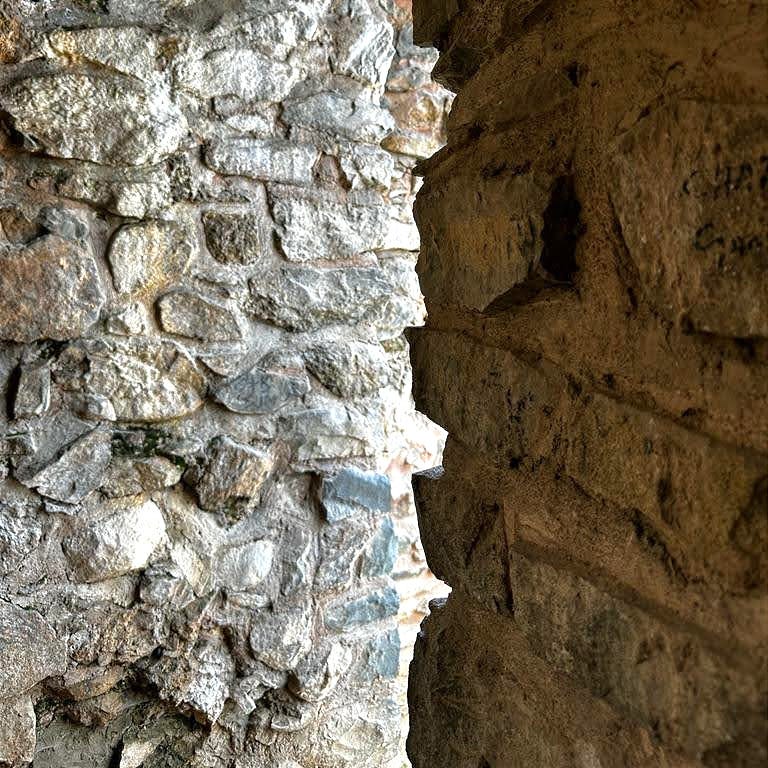
We tend to assume that seeing is the simplest thing we do, but in fact it may be the most deceptive.
It’s easy enough to say that we live in a time of crisis; what’s harder is to name how deeply that crisis is rooted in the way the world appears to us. We hear every day about climate change, political fragmentation, and spiritual exhaustion; many of our conversations touch on or revolve around these and similar issues. Usually, solutions are proposed at the level of policy or discourse as well as personal behavior; but beneath these, there is a more basic difficulty, which is so constant that it rarely comes into view: we do not see the world as it is, and we do not quite notice that we do not see it.
There is no “view from nowhere.” All perception is actually already interpretation. What we call “the world” is given through habits of attention that we neither choose nor fully understand. We seem to encounter ourselves as bounded subjects, set over against an external field of objects; we experience mind and body, self and other, human and nature, as if these were simply there, as though these categories were obvious and unquestionable. Of course, these distinctions have some value; they make orientation, action, and survival possible, but they aren’t merely functional. They end up solidifying and being reified, taken less as useful differentiations than as fundamental separations that define the structure of reality itself.
I think this is where something goes sour—but it’s often not in a dramatic or easily recognizable way. The very structure of language predisposes us to dualistic thinking, so that the shift from perceived difference or distinction between “earth” and “sky” or “me” and “you” becomes, over time, a feeling of full separation. Even our notion of self emerges through processes of differentiation that enable survival and the experience of agency, but the “self” becomes problematic when we give it too much primacy. We can tap into the fact that the self is constituted in and through its relations—with other life forms, with the body, with the environment—and it is always relating. Every breath relates your lungs to the wider world, for instance; every thought comes to you from “somewhere” and relates to something in the world, or in your mind, in your imagination.
There is no pure interiority and no purely external world; both emerge together within the same relational depth. Yet how easily we forget this in our busy lives. We come to inhabit a world in which the human stands over against nature, the self over against the other, the mind over against the body; and because these divisions feel immediate, we rarely ask whether they are true or final; we don’t think to look behind the curtain. This leads to conceptual confusion and a deformation of experience. We do not just think in divided terms; we perceive a divided world.
What appears “objective” in our picture of the world may in fact be a projection of our own assumptions; as Czech philosopher Erazim Kohák observes, it is the image of nature as “dead and mechanical” and of the human as either “robot or rebel” that is most deeply subjective, a construction mistaken for experience. This matters more than we usually admit, for if the world seems given as fundamentally separate, then our forms of action will follow accordingly. We will tend to use and consume “nature” if it appears as external and inert rather than vibrantly alive and part of us; we will tend to manage or exclude an “other” that appears as totally outside us, rather than recognizing the shared reality of our existence; and a “self” that is felt to be an isolated being will turn inward, intent on securing itself against what surrounds it—an anxious, self-protective move. We cannot relate to the Real in this way. Even our attempts at care are shaped by the very divisions they seek to overcome: we try to repair a world that we have already learned to experience as broken.
There is a familiar response at this point, one that is both understandable and insufficient. We are told that the problem lies in our behavior; we need to act differently, to choose better, to adopt more ethical practices. Buy less, recycle more, be kind… There is truth in this, but it doesn’t go far enough: action follows perception more deeply than it follows intention or decision. We don’t first choose how to see and then act; rather, we act out of how the world already appears to us. If that appearance is structured by unnoticed separations, then our actions (however well-intentioned) will remain caught within that paradigm.
What would it mean to question not only what we do, but how we see?
I don’t ask this question to suggest that we abandon distinctions; the ability to differentiate is obviously necessary to navigate embodied life. And I don’t want to collapse everything into some vague unity, with all differences dissolved into sameness. The issue isn’t difference itself, but the tendency to convert difference into division, and division into an account of reality. To see differently would be to recover a sense in which distinctions can hold without solidifying and becoming separations. To see differently would mean encountering self and world, human and nature, as internally related rather than externally opposed.
Easier said than done, usually. It is not a matter of adopting a new theory, or affirming a different set of propositions. It has more to do with the discipline of attention; with slowly learning to notice, with open curiosity, how the world is given, and how quickly that givenness is organized into familiar patterns. Can we learn to heed the Heideggerian call to “let what shows itself be seen from itself”? Can we see that paying attention is a form of prayer?
The ethical and the perceptual can’t be cleanly separated. To attend well is already to begin to respond differently; to see more truthfully is to loosen the grip of those divisions that shape our behavior without our conscious awareness. Moral transformation may depend less on isolated acts of will than on the ongoing formation of vision, on what Iris Murdoch calls the “quality of our habitual objects of attention,” which quietly shapes what we are able to see—and therefore how we are able to act. She suggested that the just and loving person is one who sees more clearly what is there. The claim is easy to mishear, as if it referred to a kind of refined sensitivity or heightened awareness. In reality, it’s different from that; it asks whether what we take to be obvious—the separation of self and world, the discreteness of things, the isolated estrangement of humanity—is in fact the result of a partial and habituated way of seeing.
A similar intuition appears if we attend more closely to perception itself; what seems like a relation between a subject and an object begins to look more like mutual participation in a field that exceeds both. David Abram gives this a particularly vivid expression, describing perception as an involvement in a more-than-human world from which neither “subject” nor “object” can be cleanly abstracted.
Relation is primary, and what we call “entities” emerge within it. This might sound unfamiliar, but mystics have been saying it for ages. The Buddhists call this dependent co-arising, or pratītyasamutpāda. If this is even partially right, then the separations we take for granted aren’t so much false as derivative: they describe something that’s been abstracted out from a more basic interbeing.
What happens when we notice what these claims make possible? If our experience of the world is shaped by our habits of attention, which render difference as division, those habits can be retrained. This doesn’t deliver us from ambiguity or conflict; life, the world, and our place in it are still complex. But noticing and adjusting our attentional habits opens the possibility that we might encounter the world otherwise than as disconnected parts, and this kind of encounter with the world bears directly on how we live within it.
The crises we face are real, and they call for response. Our most immediate task may not be to act more urgently within a divided world, but to see how that division is created and sustained. As long as we take separation to be the basic truth of things, we will continue to reproduce it, even in our efforts to overcome it. The work for us is unpretentious, and perhaps more subtle than it first appears. To enact a lasting transformation of the world towards a place that truly cares for all, we need a transformation of the way the world is given to us, the way we take it to be. That change, if it occurs at all, will take place in and through the loving discipline of attention to reality.
We may not yet clearly see what is Real; but the work of learning to see has already begun. Attention, after all, is our most authentic and our purest prayer.
Comments
Nothing yet. Say the first thing.
Sign in to join the conversation.