
This is part of Paths of Presence, a series on philosophy and embodied public theology.
This essay took me longer to put together than I anticipated. Writing about nonviolence feels important and difficult (always, but especially lately). Ambiguity and uncertainty are frequently not our favorite realities to sit with, but I’m a fan of not fighting reality, and reality is ultimately ambiguous and uncertain. I like to remember that acceptance is not the same as approval, and I hope the thinkers I discuss here can help us understand that more capaciously.
Our public life feels reactive, brittle, impatient, and explosive. I worry sometimes about how easy it seems to confuse intensity with depth or seriousness, or mistake domination for true strength; at the same time, it often seems like patience or restraint is treated as a lack of conviction. It’s easy to oversimplify complex moral realities in order to act quickly or cope with a fast-paced world. This oversimplification risks violence to our humanity, individually and collectively. It flattens our being.
Violence participates in this reduction in ways that are not always fully acknowledged. Violence does not merely inflict harm: it simplifies the field of relation. Violence may be considered as a hierarchy and imposition of force; it distorts truth because it diminishes the fullness of others, reduces conflict to talking points, and evacuates real complexity. This is not only an ethical failure; it’s a failure of perception. I’ll say more about this later.
Nonviolence does something much more delicate and difficult: it makes space for the fullness of others and the complexity of the situation. It does not deny the presence of conflict, nor does it evade the necessity of action; rather, what nonviolence resists is the temptation to resolve tension by eliminating one of its terms: it can hold a polarity in dynamic tension. To act nonviolently is to remain in relation without reducing the other to something that can be easily dismissed or controlled. Nonviolence is the form that truth takes when the self is large enough to hold opposition and difference without hatred or abstraction. Nonviolence is not weakness; it is the existential achievement of a self spacious enough to bear complex realities without distortion.
One of our main moral issues today is not only that we differ regarding what is true or just, but that we often lack the ability to remain present to complex realities that exceed our immediate grasp. We want to feel control in the face of expansive uncertainty, and we might be willing (subconsciously, perhaps) to erase dimensions of complexity to be able more easily to grasp situations and try to make sense of them. And I think our difficulties are not only about difference and disagreement, but about capacity, or insufficient moral size. We may consider moral size as the cultivated capacity to hold ambiguity and complexity (good and evil, power and vulnerability) without collapsing into violence or domination.
We see moral smallness manifest in an inability to tolerate ambiguity; an urge to expel discomfort; an entrenchment of ideological certainty. These can also be coping mechanisms for when we’re overwhelmed, but can become, over time, firmly-held attitudes of moral smallness as our habits become more fixed. What do we do about this? How can we maintain moral flexibility without losing resolve? How do we grow our moral size?
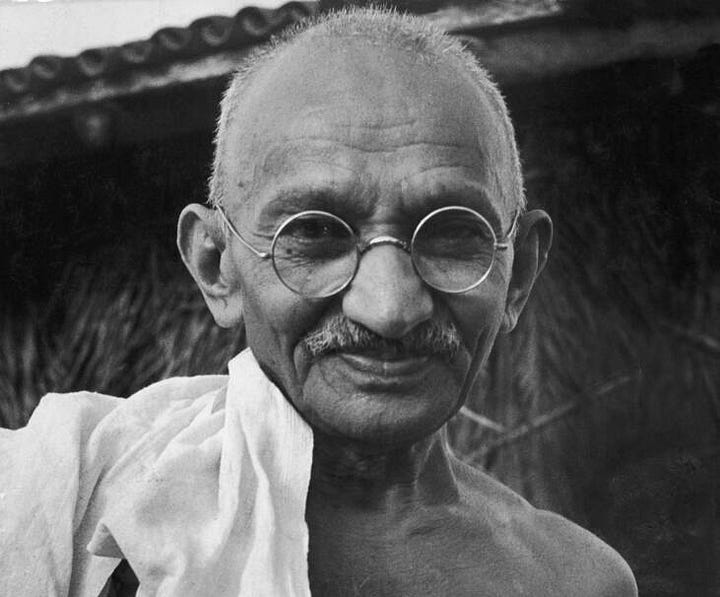

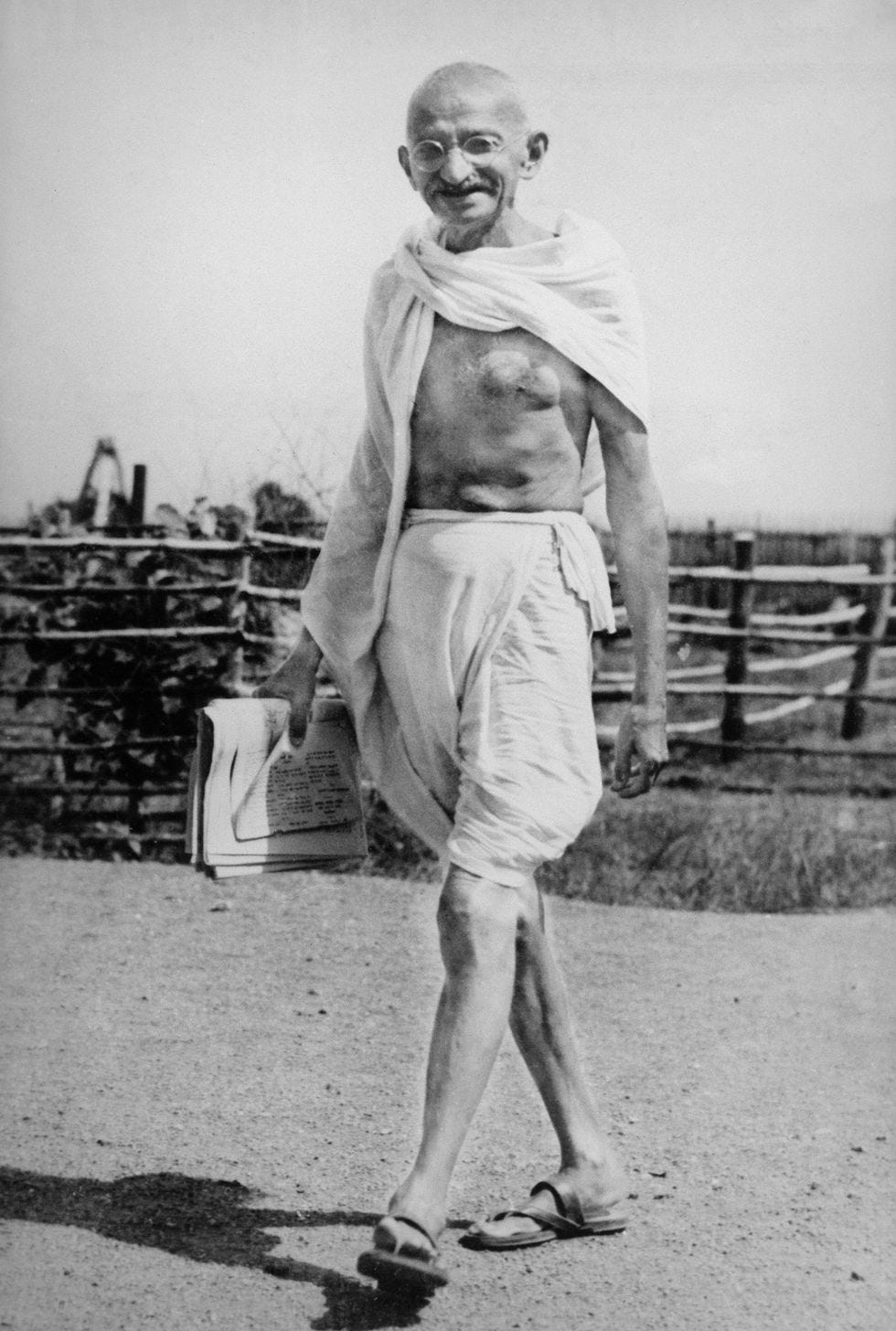
I’ll use Gandhi’s work as an example, with support from Bernard Loomer’s notion of moral size and Simone Weil’s writings on gravity and attention. Mohandas Gandhi (1869-1948) confronted injustice without shrinking the moral field. I see his commitment to nonviolent resistance as embodying moral size. Simone Weil (1909-1943) can help us clarify the interior discipline required for such size. She describes clear attention as a sustained refusal to allow the ego to determine what is seen, and to instead insist on seeing clearly and truly. If we take Gandhi and Weil, with Loomer’s notion of size, we can better understand how to construct coherent and capacious nonviolence in our own lives, and redefine power as relational capacity rather than coercion. This contributes toward a liveable model for embodied public theology today.
When Gandhi was a young man in apartheid South Africa, he was treated badly due to being darker-skinned than the European settlers. He was forcibly removed from a first-class train carriage, despite holding a ticket, because a white passenger complained—and this was a wake-up call for the young Indian lawyer. He was awakened to the structural violence of the apartheid system, and began to see how it enabled dehumanizing attitudes and actions. While it is true that Gandhi’s work initially focused on the rights of Indians, which today we may view as an unsatisfactorily robust anti-racist attitude given the situation of Africans and other non-whites in South Africa, being booted off the train spurred Gandhi into what would become the focus of his life’s work: nonviolent resistance to oppression.
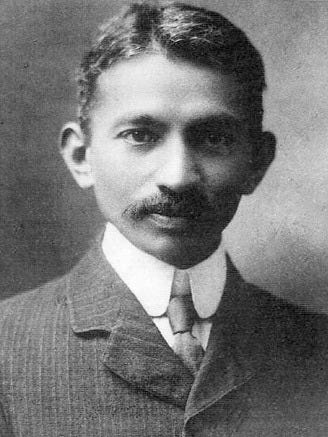
For Gandhi, God is Truth, and his life was a quest to “see God face to face.”
Gandhi practiced daily prayer and meditation during his whole life, and regularly read from various scriptures for orientation and inspiration, including the Sermon on the Mount, the Qur’an, and especially the Bhagavad Gītā. His practice of daily self-examination mirrors Simone Weil’s notion of attention: a rare, disciplined generosity that clears the mind of ego and allows reality to emerge. The pursuit of truth is inseparable from self-discipline. This doesn’t necessarily mean severe asceticism, although both he and Weil engaged that way. Resistance to injustice presupposes a prior engagement with the ways in which one’s own perception, speech, and action are shaped by distortion.
One cannot consistently and effectively resist injustice or falsehood in the world without first confronting distortion in oneself.
Truth requires disciplined alignment. Self-discipline, or self-examination, is not ancillary to an ethical political life; it is constitutive of it. Gandhi consistently frames the ethical life as the integration of truth and action. We must learn to perceive with as little distortion as possible, to speak in accordance with what we genuinely understand, and to act without undermining either perception or speech. While this seems straightforward enough, it places considerable demands on us as agents: each moment of alignment requires the capacity to endure what is seen and said without shying away from reality or retreating into evasion or inconsistency. In other words, it requires of us a strong moral center and considerable moral size.
Gandhi wrote about the moral strength required to follow the dharma of nonviolence. In fact, he said that “Nonviolence alone is the true religion for all times. Nonviolence is the dharma of awakening.” I hear echoes of Paul Tillich here, who wrote that “Courage is the affirmation of one’s essential nature.” For Gandhi, nonviolence is more than a refusal to take another’s life; it is the courageous enacting of love and truth as a force for real social change. This is our dharma, our true orientation and responsibility.
Understood in terms of moral size, our difficulty with truth might be more about endurance than sincerity in and of itself. Reality often presents itself to us in ways that are costly to acknowledge: do we have the courage and capacity to face what’s difficult? Speech, when it is honest, may disrupt established relationships or expose one to criticism. People don’t like being faced with uncomfortable truths, and truth-tellers often face a dilemma: go for radical integrity and tell the truth, or conform to social norms which prioritize comfort and the status quo? Action, too, may entail forms of loss when it remains faithful to both perception and speech. The work of alignment therefore presupposes a self capable of bearing these complexities without fragmentation.
The good news is, this increasingly-capacious self can be cultivated, and arguably must be. As Søren Kierkegaard suggests, inwardness entails a form of responsibility that is inseparable from Angst, anxiety: inwardness involves the recognition that one’s own position is neither final nor secure. In other words, our responsibility is existentially significant. This is why the inward dimension of Gandhi’s thought should not be construed as a withdrawal from the public sphere. It is better understood as preparation for a different kind of power. To act truthfully in the world requires a degree of interior expansion sufficient to sustain the consequences of truth.
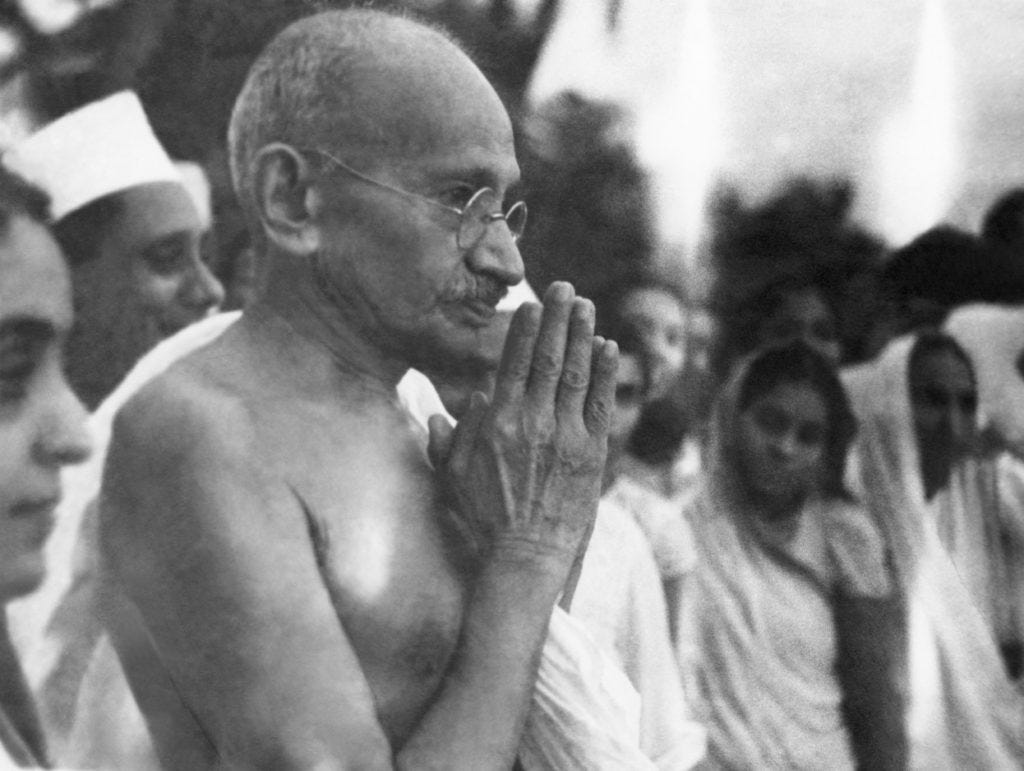
Gandhi names his approach satyagraha, which means “truth force.” Gandhi himself said that “Satyagraha means resisting untruth by truthful means.” It’s something anyone can do, even if they act alone. “If one remains steadfast in it, in a spirit of dedication, it always brings success. Satyagraha knows neither frustration nor despair.” Satyagraha isn’t a technique that can be applied independently of the agent who employs it; it is inherently embodied and lived-out. It designates a mode of life in which each situation becomes an occasion for reaffirming one’s dedication to truth and integrity.
Upon his return to India after two decades in South Africa, Gandhi brought with him his years of experience in nonviolent organization and resistance. He began to campaign more fervently for a return to Indian “home rule,” an idea he’d already begun working on many years before. He encouraged locals in Indian villages to reclaim traditional lives and livelihoods in resistance to British colonial power. Gandhi saw clearly that things were out of balance and unjust, and worked to peacefully bring about the changes he believed in. These were his “experiments with truth.” His powerful commitment brought him great support, and the satyagraha movement grew.
Truth is not a static possession but is something dynamic that emerges in and through relation. To describe one’s life as a “laboratory for truth” as Gandhi did is therefore to acknowledge that integrity is not given in advance; it must be enacted repeatedly, especially in circumstances that strain one’s capacity to remain in integrity. This raises a question: what enables a person to sustain such integrity when confronted with realities that are difficult to bear? What allows perception to remain open rather than defensive? What allows us to hold onto moral capaciousness, when it sometimes feels like the world, circumstances, life, want to crush us down to size?
Looking at the work of Simone Weil can be supportive in broadening our understanding of how to hold ambiguous realities while maintaining integrity.
For Weil, attention is the practice of making space within oneself for what is real. Attention names a disciplined form of receptivity in which the ego is suspended, and the personality refrains from imposing its own categories upon what it encounters. This involves a deliberate interruption of the impulses that ordinarily govern perception, which include the desire to control, the inclination to judge, and the move to assimilate to our prior expectations that which is seen, rather than seeing freshly. Attention, in this sense, creates space within the self for an encounter with reality.

This resonates with practices that distinguish between observation and interpretation, and insists that what is immediately given should not be prematurely reshaped by our evaluative frameworks: it’s beneficial to learn to restrain our learned habit of judging and filtering the world according to our preferences. Weil reminds us that such restraint is not easy: it requires effort to allow reality to appear without distortion, particularly when what appears is unsettling or unwelcome to our ideas or our notions of ourselves.
Much of what passes for perception is already structured by prior commitments and defensive reactions. We barely ever realize we’re doing this, unless we train to learn to see it. Faced with what challenges us, we tend to move quickly toward explanation or dismissal. The result is not a clearer grasp of reality, which is what would be beneficial, but instead a version of reality that seems like it can be more easily managed or seems less challenging to our inner structures of control. Most violence begins in this kind of perceptual distortion: we see what confirms us; we ignore what unsettles us. Weil says that “We must prefer real hell to an imaginary paradise.” Reality begins to seem much less hellish when we stop fighting it and practice being available with clarity. This is how we live in integrity with truth.
Weil describes the force that drives this process of distortion as gravity. I interpret her use of gravity as akin to a self-oriented black hole, pulling everything to itself inexorably and with no mercy. Gravity draws even the self toward contraction, orienting it toward self-protection and away from openness. Under this influence, the complexity of a situation is reduced in order to make it more tractable. Others are diminished so that we can more comfortably accommodate them within our existing framework. This relates to the dilemma of sincerity we saw earlier: truth is anti-gravity. It is often easier in the moment to go along with the gravitational pull of the status quo, to conform, to follow selfish instinct, to live in mauvaise foi or bad faith, to be one of what Kierkegaard called “the crowd” and Heidegger called Das Man. Integrity and truth require of us the moral size to resist the pull of gravity.
Violence can be understood as one expression of this gravitational contraction. Violence is born when the self can no longer sustain the tension inherent in a situation and resolves that tension by reducing or eliminating what exceeds it, flattening the full aliveness of others or the complexity of a reality. This is the weight of gravity. The result of this crushing of distinctions is a form of pseudo-clarity, which is achieved at the cost of openness and truth.
Nonviolence is a resistance to this movement of flattening or contraction. It requires the capacity to remain open under conditions that might tempt us to close ourselves off. Nonviolence does not eliminate tension but sustains it without relying on reduction. In this respect, nonviolence can be described as a form of moral spaciousness. It obeys the interrelatedness of all things, in contradistinction to the gravity of the ego or the individual self. Nonviolence, like truth, is anti-gravity.
Gandhi’s practice exemplifies this resistance. He does not deny the force of gravity, but he refuses to yield to it.
We’ve all seen how justice, when pursued without sufficient moral capacity, can become punitive. Strong conviction, when unsupported by breadth of moral vision, can harden into cruelty. What is often taken to be moral clarity may, in fact, reflect a failure to register the full complexity of a situation.
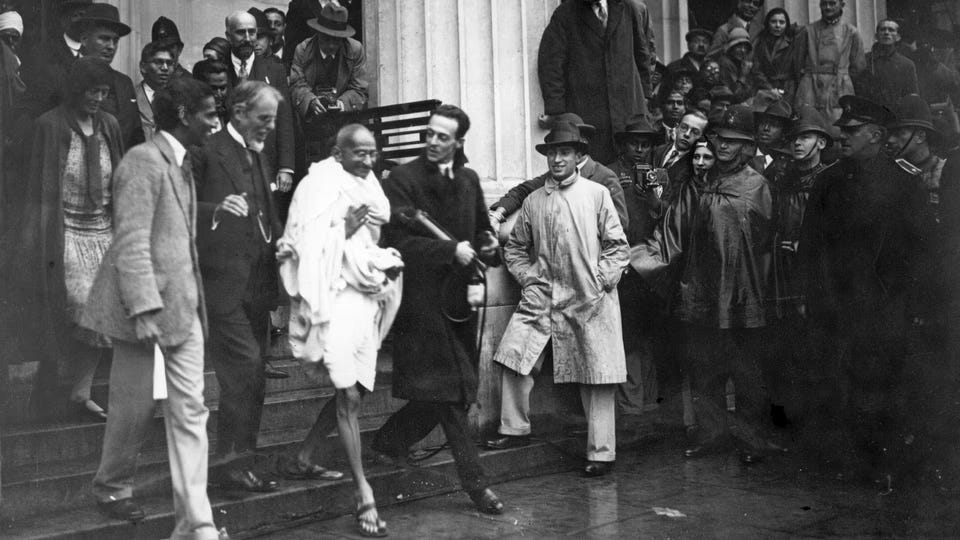
Power-over, power conceived as domination, operates by reducing others in order to secure control. Power-with, or relational power, on the other hand, functions through the capacity to engage others without diminishing them, thereby sustaining a more complex field of interaction. Gandhi’s authority is best understood in terms of this second form: he did not depend upon coercion but upon a form of integrity that others found compelling. He lived in radical solidarity with the poorest of the poor, and he put into action his deepest convictions. Even in the face of significant asymmetries of power, as when facing the entire British colonial apparatus in India, Gandhi maintained a sense of self that did not rely on the subordination of others. This is a decentered self, a self that locates its own center of truth in the relational sphere.
“If God is in everyone, Gandhi believed, then he would have to love everyone, even his enemy.”
Gandhi worked towards Hindu-Muslim unity in the complex social landscape of colonial India. He worked to end “untouchability,” deeply engrained in the caste system, because he saw it as profoundly dehumanizing. He called for strikes and fasts and peaceful demonstrations nationwide in protest of unjust laws, and was often successful on a scale difficult to imagine or comprehend. This small Indian man was so much larger inside than he appeared from outside.
He was consistently bolstered by his faith in justice and truth; he was imprisoned a dozen times, yet never wavered in his faithful commitment to nonviolent living, including the founding of various communities dedicated to simple living and satyagraha. His incredible spiritual stature regularly inspired millions to engage in nonviolent noncooperation, ultimately leading the British to quit India. His size also made him a target of those who couldn’t understand his real message, behind their own fear and struggles. Gandhi was assassinated in 1948, and died with the name of God on his lips.
Gandhi’s nonviolence is not a withdrawal from conflict, but demonstrates a disciplined way of engaging it. It involves holding anger without allowing it to become hatred; confronting injustice without reproducing its logic; and refusing to expel the opponent from the sphere of moral concern. Nonviolence calls for a recognition of shared being while refusing to sever ties through violence. This capacity to hold steady and engage across differences, despite discomfort and ambiguity, reflects moral size.
The political implications of this stance are evident in the work of Dorothy Day, who was greatly inspired by Gandhi in civil disobedience and organizational principles, and with Martin Luther King Jr. and Abraham Joshua Heschel, who adapted Gandhi’s insights within the context of the American civil rights movement. Here, we see how love, enacted in nonviolence, functions as a thorough refusal to deny the humanity of one’s opponent. Clear noticing of our common humanity can bring clarity of purpose. As Weil writes, “there is not any love of truth without an unconditional acceptance of death.” This is an utter and honest facing of reality, an uncompromising love and humility and a staunch refusal to diminish others for one’s own convenience. This is true courage, born from clear and pure attention.
From a phenomenological perspective, this stance reflects an acknowledgment of our fundamental interrelation. As Martin Heidegger argues, we are always already situated within a shared world: we are thrown, entangled, implicated, permeable; our existence is not sealed off from that of others. To deny this entanglement through acts of domination is, in effect, to misdescribe the conditions of our own being. To live in truth, we must acknowledge reality and face the ambiguity of it with clarity and commitment to nonviolence.
If these analyses are taken seriously, they suggest a reframing of public theology, which might be understood as concerned with the formation of persons and communities capable of sustaining complex and often conflicting realities without resorting to violence. Theological constriction tends to generate political constriction. Conversely, a more expansive theological vision can support the development of forms of life that are better able to accommodate plurality without fragmentation.
The central question that emerges is not whether we possess the truth, as though it were a commodity we could own, but whether we are capable of bearing it. Are we morally capacious enough? Are we large enough to hold good and evil, comfort and difficulty, friend and foe? To hold together what is difficult without reducing it requires a form of growth that cannot just be taken for granted. Gandhi’s life suggests that such growth is possible, though never complete. He always held that peace and justice must begin with purifying one’s own heart and one’s daily life: we gain truth from the inside out. Weil, too, reminds us that this begins in each of us, with attention. Each act of self-examination has the potential to enlarge one’s capacity to remain present with reality. Satyagraha is an ongoing experiment in becoming large enough for truth.
In a fragmented public environment, our work with nonviolence might take more modest forms. It may involve acknowledging our biases and mistakes, choosing more humane and inclusive language, remaining in difficult conversations rather than taking the easy way out, or holding grief and hope in living ambiguity without trying to force a resolution. These practices don’t instantly resolve conflict, but they create the generative conditions under which nonviolent engagement becomes possible.
To what extent are we willing to resist the pressures that draw us toward contraction, and to cultivate the capacity required to remain in relation to what we would prefer to avoid? How big are we willing to get?
At the start of the day, identify one place where you are tempted to hide, exaggerate, or soften the truth. Commit to practicing honesty in that single moment. (This is still possible with kindness!)
Before responding in a conflict or heated moment, pause for a couple of breaths. It’s usually ok to say, “I need a moment,” and take your time breathing; this helps the other person understand what’s happening, and gives them a moment to breathe, too. Ask yourself how you can respond in a way that preserves the dignity of all involved.
Mohandas Gandhi, Selected Writings, edited by John Dear. A collection of various writings on many topics; helps give an overview of Gandhi’s life and work.
Simone Weil, Gravity and Grace; I have the Emma Crawford and Mario von der Ruhr translation from the French, which includes new material previously not included in earlier editions. This work is a collection from Weil’s notebooks, published posthumously.
Bernard Loomer, S-I-Z-E Is the Measure, an article he published in 1974 and in which he discusses moral size as including the full range of existence, not merely the good. I’ve elaborated and expanded on this idea in my essay. Loomer, in a 1976 essay called Two Conceptions of Power, discusses linear or unilateral power versus relational power. I use the analogous terms “power-over” and “power with” which were popularized by Mary Parker Follett over a century ago.
Extra: Paul Tillich, The Courage to Be. A powerful and inspiring work by a fascinating existentialist theologian. Strongly recommended.
If you liked this article, please like and share it, which helps more readers find my work.
Comments
Nothing yet. Say the first thing.
Sign in to join the conversation.